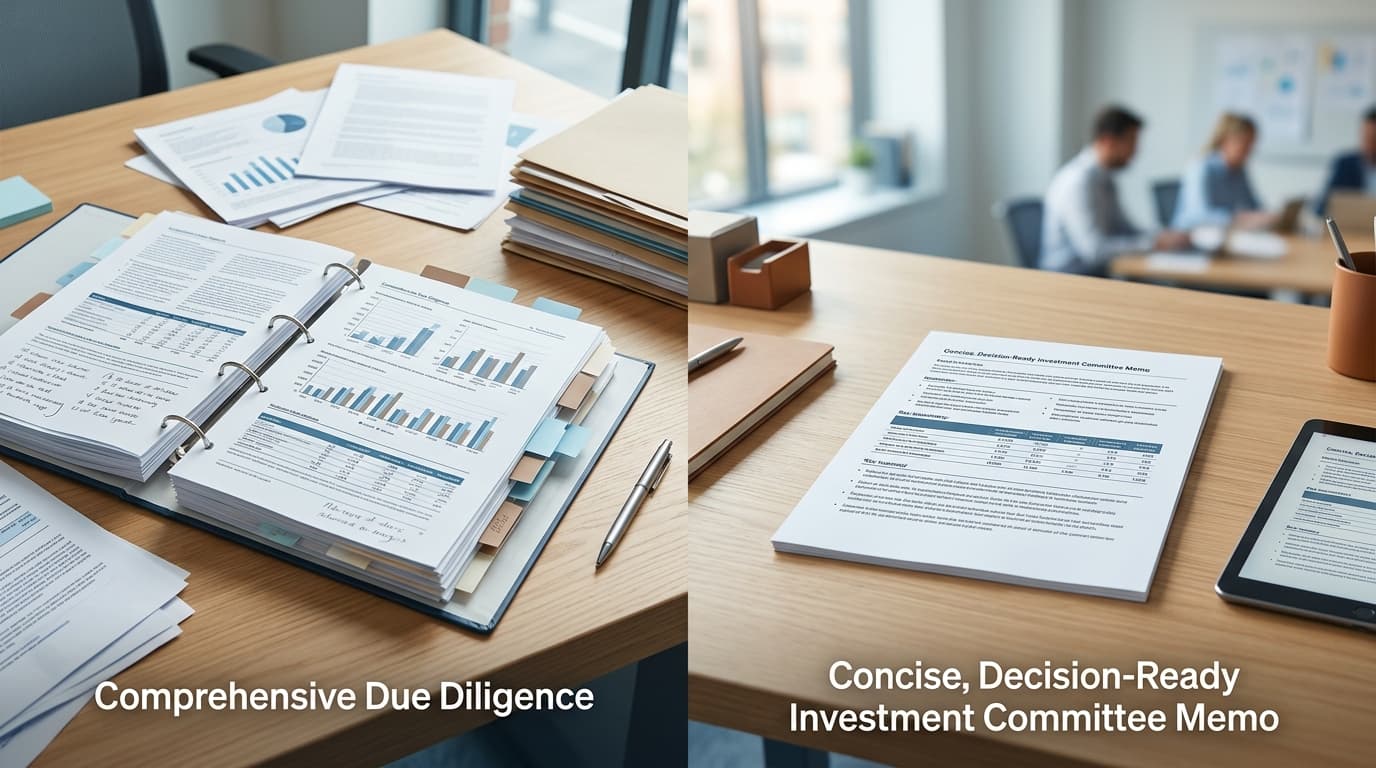
Why This Matters Now: The Gap Between Diligence and the IC Memo
IC memo reframe due diligence is the disciplined practice of translating raw, multi-workstream diligence findings into synthesized decision logic that an investment committee can immediately evaluate. While traditional diligence decks catalogue technical audits, operational reviews, and historical accounting data, an investment committee memo requires an explicit investment thesis, quantified downside risks, valuation adjustments, and actionable post-close mitigants. Reframing bridges the gap between passive fact collection and active capital underwriting, ensuring that partners evaluate clear trade-offs rather than wading through descriptive slide presentations.
For private equity and venture capital deal teams, preparing an investment committee memo from disparate diligence streams represents one of the most time-consuming phases of transaction execution. A thorough document review and memo drafting process typically consumes 13 to 18 hours of senior associate time per deal. When deal teams simply aggregate raw advisor reports and confidential information memorandum data into standard presentation decks, committee members are forced to spend valuable meeting time extracting the core thesis instead of debating conviction.
The structural disconnect between a commercial diligence deck and an investment committee memo is fundamental. Diligence decks are organized by advisor workstreams, presenting siloed findings that often obscure interdependencies. In contrast, modern IC memo automation and reframing frameworks restructure these findings around specific decision gates: whether to approve, approve with conditions, or pass on the asset.
- Descriptive reporting versus decision logic: Diligence decks catalogue operational facts, whereas IC memos evaluate how those facts impact underwriting return hurdles.
- Sunk-cost bias versus objective evaluation: Deal teams often unintentionally defend hours invested, while the committee requires neutral downside stress-testing.
- Workstream fragmentation versus integrated risk analysis: Technical, legal, and financial streams must converge into a unified risk-adjusted valuation rather than standalone appendices.
The Main Practical Framework for IC Reframing
Reframing due diligence outputs into an effective investment decision document requires a repeatable methodology that translates technical observations into capital allocation logic. The primary objective of the IC memo is to state a clear recommendation, support decision-making, and create an investment record of the assumptions, risks, and expectations that existed when the deal was approved. It also feeds the 100-day plan, the post-acquisition operational blueprint that sits alongside the IC memo among the standard outputs of a buy-side diligence process. Implementing structured AI diligence workflows enables teams to maintain this discipline across every transaction.
Separating Facts, Findings, and Judgments
The core architectural requirement of IC reframing is enforcing a strict three-tier taxonomy across all diligence materials. Conflating verifiable source data with subjective interpretations is the most common reason deal teams encounter friction during committee reviews:
- Facts: Objective, primary data points verified directly in the data room, such as historical cohort churn percentages, contracted revenue schedules, or filed patent registrations.
- Findings: Analytical conclusions derived by cross-referencing multiple facts, such as identifying that a material share of recurring revenue sits with a handful of customer agreements containing change-of-control termination rights.
- Judgments: Strategic underwriting conclusions and valuation implications, such as requiring a purchase price reduction, an earnout mechanism, or a dedicated escrow holdback to mitigate renewal exposure.
Once facts, findings, and judgments are separated, deal teams organize their narrative into four sequential steps: workstream synthesis, risk-to-return mapping, mitigation architecture, and condition-based decision recommendations.
What Investment Committees Are Actually Testing
Investment committees do not evaluate transactions to verify whether an analyst reviewed every document in the virtual data room. Instead, committee members first identify the transaction, then decide what must be true for the business to produce an outlier outcome, and they look for a sponsoring investor who has built a conviction argument rather than a defensive document that lists risks and hedges the writer's position. Memos that simply list defensive caveats fail because they describe an asset without establishing why the risk-reward profile warrants capital commitment.
During committee deliberations, partners interrogate the team's understanding of management depth, operational fragility, and competitive defensibility. Evaluating leadership capabilities through structured C-level due diligence ensures that executive track records align with the proposed value creation levers rather than resting on subjective interview impressions.
- Return asymmetry: Which specific operational lever or market dislocation creates substantial upside relative to the downside floor?
- Plausibility of failure modes: If this transaction underperforms its base-case model, what is the primary structural or commercial failure mechanism?
- Evidence integrity: Are growth projections supported by independent customer references and reconciled historical ledgers or management forecasts?
- Management capability: Can the incumbent executive team execute the value creation plan, or does the underwriting require immediate post-close executive hiring?
For institutions deploying capital across private markets, utilizing standardized evaluation criteria across PE and VC funds ensures that investment theses are evaluated against uniform return benchmarks.
Red-Flag Table: Navigating Critical Risks
A strong IC memo does not conceal vulnerabilities; it isolates them, quantifies their financial exposure, and pairs them with specific structural solutions. One practical method, used before purchase agreement negotiation, is an issue-to-clause matrix that lists, for each finding, the due diligence source, the legal risk, the financial exposure and the proposed solution, with most findings resolving into one of five routes: a pre-closing fix or condition precedent, a specific indemnity, a specific warranty, a price adjustment (including escrow or holdback), or an accepted disclosed risk. Risk register automation lets teams categorise those issues by severity as each workstream reports.
| Risk Category | Diligence Red Flag | IC Decision Impact | Actionable Mitigation / Deal Mechanic |
|---|---|---|---|
| Quality of Earnings | Aggressive pro-forma add-backs and recurring expenses labeled as one-time items. | Overstated base EBITDA and inflated entry multiples. | Normalize working capital peg and deduct non-recurring expenses from enterprise value. |
| Customer Retention | High aggregate growth masking underlying cohort churn in mid-market accounts. | Revenue fragility and vulnerable terminal value assumptions. | Structure milestone-based earnouts tied to gross revenue retention thresholds. |
| Key-Person Exposure | Founder holds exclusive customer relationships and uncodified operational knowledge. | Substantial operational disruption upon founder departure. | Implement equity rollover terms, mandatory retention escrows, and transition milestones. |
| Legal & IP Title | Unassigned contractor IP assignments and open-source software license exposure. | Ownership encumbrances and unexpected third-party liability. | Mandate special indemnities, comprehensive RWI coverage, and pre-close remediation. |
Presenting risks within a structured format demonstrates analytical transparency, building trust with committee members by addressing critical vulnerabilities before formal deliberations begin.
The Data Room Evidence Checklist
An investment committee memo is only as resilient as the primary evidence supporting its thesis. Its financial analysis has to rebuild the earnings base on the buyer's own terms: management's proposed add-backs are tested against the records, some are reduced or rejected, omitted recurring costs are added, and only adjustments the evidence supports survive into the figure used for valuation and internal approval. That is only possible when every figure traces back to a source document. Integrating comprehensive commercial due diligence with verified financial audits ensures that all strategic assertions stand up to rigorous cross-examination.
- Financial Evidence: Reconciled 36-month general ledgers, audited financial statements, tax compliance histories, and independent Quality of Earnings adjustments.
- Commercial Evidence: Granular customer cohort retention curves, net retention schedules, pipeline conversion data, and blind voice-of-customer interview transcripts.
- Legal & Corporate Evidence: Capitalization tables verified against historical share issuances, material customer contracts with change-of-control terms, and executed IP assignment agreements.
- Operational & Technical Evidence: Maintenance versus growth CapEx schedules, software architecture audits, cybersecurity assessment reports, and organizational charts highlighting single-point dependencies.
Establishing this evidential baseline transforms raw virtual data rooms into structured, auditable inputs, supporting the creation of a deal-ready report that links every claim directly to primary source files.
How Plausity supports the workflow
The platform helps private equity, venture capital, and M&A advisory teams reframe complex due diligence data into structured, committee-ready intelligence. By automating data ingestion and synthesis, it allows investment professionals to spend less time formatting documents and more time evaluating underwriting risks.
- Data Room Ingestion: Connects directly to electronic data rooms to parse, index, and organize thousands of PDFs, spreadsheets, contracts, and regulatory filings within minutes.
- AI-Analysis Engine: Scans and cross-references multi-workstream documentation to extract material facts, quantify financial variances, and highlight contractual risks.
- Risk Radar: Automatically scores findings by materiality, surfacing legal exposures, customer concentration issues, and quality-of-earnings discrepancies.
- Report Builder: Drafts structured, professional due diligence outputs and IC-ready deliverables with complete source traceability supported by Findings & Risk Intelligence.
By maintaining automated source tracing between data room files and draft reports, this approach gives investment teams full auditability while ensuring human judgment remains central to final investment decisions.
How to use this in your next diligence workflow
Transitioning to an IC-reframing model requires restructuring how deal teams capture and process data room information from day one of a transaction cycle. Rather than accumulating unstructured notes for a last-minute drafting rush, teams should build structured risk matrices as each workstream progresses.
- Define Underwriting Gates Early: Establish the core operational levers and market assumptions that must be proven before commencing deep due diligence.
- Maintain Strict Fact-Finding-Judgment Boundaries: Require analysts to link every memo assertion directly to primary data room documents.
- Translate Identified Risks into Transaction Mechanics: Map every material finding directly to a purchase price adjustment, indemnity escrow, or 100-day operational action item.
- Execute Pre-Committee Pressure Tests: Review base, upside, and downside return sensitivities prior to the formal investment committee session.
For advisory firms and investment professionals seeking to accelerate transaction execution while improving memo quality, integrating structured deal team workflows ensures reliable decision-making across competitive deal cycles.