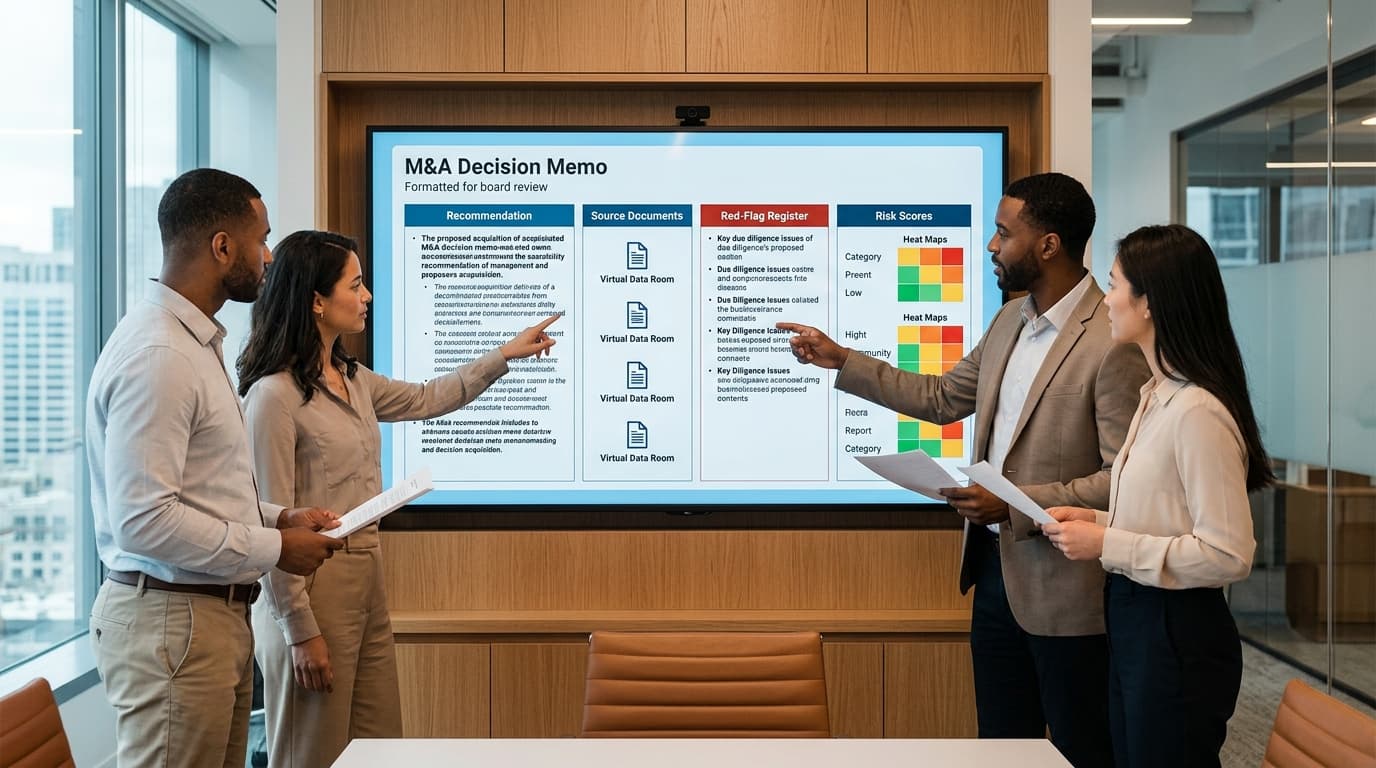
The Paradigm Shift: Why PE Firms Demand Artefacts Over Narratives
Pitch decks and executive interviews no longer satisfy institutional investors during management due diligence. Private equity buyers have shifted from listening to management stories to auditing granular operational and financial records. Because operational improvements are an increasingly significant driver of private equity value creation, deal teams focus PE due diligence questions for C-level teams on verifiable evidence rather than strategic slide decks. Investors demand direct access to underlying ERP exports, transaction ledgers, customer contracts, and source code to evaluate risk and growth potential accurately.
Moving from Narrative Testing to Artefact Verification
- Legacy narrative testing: Evaluated leadership through high-level presentations and verbal Q&A, creating blind spots in customer retention, technical debt, and revenue quality.
- Artefact-driven audit: Verifies raw virtual data room data, cohort retention schedules, and architecture documentation to validate executive claims.
- Systemic verification: Uses automated risk analysis to surface operational bottlenecks before completing C-level due diligence preparation.
To evaluate hundreds of deal files rapidly, PE firms rely on automated features like Data Room Ingestion to build repeatable diligence systems. This rigorous approach requires executives to prepare their private equity data room checklist items with fully traceable documentation before opening the deal room.
Revenue Quality Diligence: Proving Customer Retention and Cohort Health
In modern private equity dealmaking, investment committees no longer accept aggregated revenue figures at face value. Buyers quickly unbundle top-line figures to test revenue quality, separating durable cash flows from temporary booking spikes. Rather than relying on management pitch decks, deal teams perform granular churn analysis directly from raw virtual data room extracts. C-level teams must prove that revenue growth stems from sticky core accounts rather than unsustainable customer acquisition tactics.
The Three Key Revenue Quality Artefacts PE Buyers Demand
- Disaggregated Cohort Schedules: Monthly ARR or revenue sliced by signup quarter, customer tier, and industry segment to identify retention curves and logo churn patterns.
- Net Revenue Retention (NRR) Drivers: Clear evidence separating gross revenue churn from expansion upsells, showing whether existing accounts generate organic growth.
- Backlog and Pipeline Convertibility: Historical conversion ratios and contract renewal logs that validate forward-looking booking projections.
Evaluating Net Revenue Retention and gross churn side-by-side reveals whether top-line expansion is masking customer attrition. When revenue expansion relies heavily on a handful of account expansions, deal teams apply valuation haircuts to account for concentration risk. Management teams that maintain clean transaction logs, clear contract terms, and automated pipeline audit trails dramatically reduce diligence friction and defend premium valuation multiples.
Financial Durability: Testing Margin Resilience and Concentration Exposure
Moving beyond static income statements, private equity deal teams assess financial durability by stress-testing underlying transactional records rather than accepting executive narrative decks. CFO due diligence focuses on whether profit margins survive input cost volatility and whether revenue relies heavily on a concentrated client base.
Auditing Concentration Exposure and Contractual Terms
Deal teams inspect customer concentration ratios directly within ledger data. Acquirers flag substantial exposure when a single account represents more than 10 to 15 percent of total revenue, or when the top five accounts generate over 50 percent of annual sales. Conducting rigorous cohort analysis reveals whether major accounts carry structural churn risk or hold outsized leverage over pricing and renewal terms.
- Top 5 and Top 10 concentration: Auditing account distribution to ensure revenue stability does not rely on a single relationship.
- Discounting trends: Ingesting raw ERP invoice data to surface off-book concessions and margin erosion across sales channels.
- Contract renewal safeguards: Reviewing auto-renewal terms, lock-in windows, and notice periods across key customer contracts.
Finally, investors evaluate cost structure elasticity by testing how operating margins absorb inflationary pressures. Buyers inspect historical vendor invoices, wage growth trends, and price realization rates to confirm that gross margins reflect genuine pricing power rather than temporary tailwinds.
Operational Scalability: Assessing Processes, Capacity, and Execution Risk
Private equity deal teams are no longer satisfied with high-level summaries of workflow efficiency; they conduct rigorous operational alpha due diligence to verify how a target business actually executes at scale. Operational improvements are an increasingly significant driver of private equity value creation, pushing buyers to inspect concrete operational artefacts rather than accepting executive pitch decks. When interviewing Chief Operating Officers and operations leads, deal teams analyze raw data rooms, procure-to-pay tracking logs, and historical fulfillment metrics to verify whether current delivery systems can handle aggressive post-acquisition expansion without degrading service quality or eroding profit margins.
Three Core Vectors of COO Operational Due Diligence
- Supply Chain and Service Delivery Friction: Investors inspect order-to-cash throughput times, supplier concentration schedules, and SLA penalty records to surface capacity bottlenecks before closing.
- SOP Maturity and Key Person Dependency: Diligence auditors evaluate written standard operating procedures, cross-training matrices, and organizational chart redundancies to measure reliance on single star performers.
- Unit Operational Cost Trajectory: Analysts run cost-to-serve breakdowns across customer segments to prove whether marginal operating costs decrease as transaction volumes scale.
To test capacity limits, PE firms look for structural friction points across procurement, inventory management, and customer onboarding. If service delivery relies heavily on heroic individual efforts or undocumented institutional memory rather than standardized workflows, key person exit risk becomes a primary valuation risk. Software tools such as Data Room Ingestion enable investment teams to quickly extract and synthesize these operational records across thousands of pages.
Ultimately, proving operational scalability requires demonstrating that unit operating costs decrease as revenue expands. If scaling output causes customer support or fulfillment costs to grow linearly, the operating model lacks leverage. Providing verifiable operational logs during diligence gives buyers confidence that post-close value creation targets are achievable.
Technology Stack Diligence: Quantifying Tech Debt and System Security
Private equity deal teams have shifted from accepting high-level CTO presentations to conducting direct code audits and automated static analysis. Rather than trusting verbal estimates of engineering health, buy-side technical due diligence relies on evaluating actual repositories, test coverage ratios, and build automation pipelines. Investors quantify technical debt by identifying refactoring bottlenecks, obsolete frameworks, and undocumented custom code that could slow post-acquisition product expansion.
Mapping Dependencies and Cybersecurity Evidence
Beyond the core codebase, audit teams inspect external software libraries, hosting architecture, and third-party API lock-in. Investors evaluate whether key product features depend on proprietary external microservices or unmaintained open-source packages that introduce security vulnerabilities or cost volatility. Evaluating cloud infrastructure risks enables sponsors to model long-term hosting expenses and verify whether vendor licenses permit scaling.
- Codebase Health: Static code analysis reports, unit test coverage percentages, and active contributor logs across core repositories.
- Architecture & API Risk: Dependency mapping documentation, third-party API rate limit SLAs, and cloud hosting cost breakdowns.
- Cybersecurity & Compliance: SOC 2 Type II reports, recent penetration test findings, and automated vulnerability scanning exports.
By requesting verified system logs and compliance evidence during technical due diligence, sponsors transform subjective engineering claims into quantifiable post-deal integration plans.
AI & Data Readiness: Evaluating Proprietary Assets and Compliance Risks
Private equity deal teams have shifted from evaluating pitch deck promises about AI to auditing underlying technical assets and regulatory exposures. During management due diligence, investors inspect code repositories, training datasets, and API architectures to separate defensible machine learning IP from thin wrapper applications. When evaluating targets with heavy technical reliance, buyers perform an AI infrastructure exposure assessment to identify compute vendor lock-in, unhedged API pricing risks, and reliance on third-party foundational models.
Auditing Proprietary Moats vs. Generic API Wrappers
To verify genuine value creation, PE sponsors require engineering teams to demonstrate proprietary data loops and fine-tuning pipelines. Diligence teams review data rights contracts to ensure customer agreements explicitly permit model training on aggregated tenant data. Furthermore, legal and technical audits focus on compliance under frameworks such as GDPR and the EU AI Act, where non-compliance can trigger substantial regulatory penalties. Unclear data provenance or non-compliant model lineage can severely impair portfolio company valuations.
| Diligence Focus | Surface Pitch Narrative | Artefact Audit Requirement |
|---|---|---|
| Proprietary IP | Custom fine-tuned domain models | Git history, model weights, and training data logs |
| Data Rights | Full ownership of user dataset | Enterprise TOS clauses explicitly granting consent |
| Regulatory Compliance | Self-declared compliance with standards | Data protection impact assessments and model audits |
Sponsors look beyond marketing narrative by inspecting structural risk factors and operational dependencies across software and data workflows.
C-Level Diligence Preparation: Building an Audit-Ready Data Room
Transitioning from narrative presentation to evidence-backed diligence requires executive teams to transform their data rooms before buyers enter. Mid-market private equity transactions typically involve a 45-to-60-day due diligence window, leaving little buffer to reconcile conflicting reports or gather missing contract addenda. Corporate M&A project leads can reduce transaction friction by shifting from passive document hosting to active pre-diligence preparation.
Preparing an audit-ready virtual workspace means ensuring that every statement in the executive summary is directly traceable to verified primary files. Prior to opening the data room to external deal teams, executive leadership should use tools like Data Room Ingestion to structure files and establish a clean knowledge baseline.
- Run internal pre-diligence scans: Leverage Risk Radar to evaluate financial records, regulatory disclosures, and customer contracts for material exposure, liabilities, or operational anomalies.
- Map executive narratives to primary sources: Link every metric in the pitch deck directly to underlying general ledger extracts, cohort retention schedules, or executed contracts.
- Accelerate cross-functional verification: Utilize AI-Analysis Engine to parse complex legal addenda and technical documentation across deal teams, confirming data consistency prior to buyer access.
By establishing rigorous pre-diligence workflows, leadership converts potential deal blockers into verifiable proof points. Moving smoothly from an organized data room to a deal-ready report ensures that PE sponsors focus on growth opportunities rather than audit discrepancies.
Practical Implications for Management Teams and PE Investors
Findings from this diligence process should inform deal structuring and the post-close value creation plan, not just a go/no-go decision. Management teams preparing for C-level diligence preparation typically use the gaps identified above to close documentation issues before a process starts, while M&A advisors coordinating M&A advisory workflows use them to structure the data room and sequence management presentations around the evidence buyers will actually test. Corporate development teams should treat undocumented value creation assumptions as a basis for pre-diligence preparation, since a credible, evidenced plan is closely related to value creation diligence more broadly.
How Plausity Supports This Workflow
Assembling and cross-checking financial, operational, and technology evidence across a management team's data room is a document-intensive exercise. Plausity is an AI-native due diligence and deal intelligence platform that helps deal teams analyze company information, structure findings, surface red flags, and compare documents, including for workstreams such as a financial due diligence checklist, a commercial due diligence checklist, and software technology due diligence. Its findings and risk intelligence capabilities help surface inconsistencies across revenue, customer, and operational records. For management teams, Plausity helps structure diligence evidence into clearer, evidence-backed materials ahead of buyer review. This supports evidence review and does not replace legal, financial, tax, commercial, or technical judgement, and does not guarantee funding, acquisition, valuation, or investment outcomes.