The Cost of Manual Due Diligence: Why Spreadsheet-Based Risk Registers Fail in Modern M&A
In high-stakes mergers and acquisitions, the risk register acts as the central repository for transaction liabilities, compliance anomalies, and commercial exposures. Historically, transaction teams have relied on manual spreadsheet tracking to aggregate these findings. However, static spreadsheets introduce substantial operational vulnerabilities into the transaction lifecycle. Research indicates that approximately 88 percent of corporate spreadsheets contain formula errors or calculation defects. For M&A Advisory Firm Partners & Analysts, managing a deal's risk profile through an error-prone matrix is no longer a viable methodology, especially when navigating compressed transaction timelines.
Formula Fragility and the Limitations of Static Excel Tracking
The fragility of traditional spreadsheets poses an immediate threat to financial due diligence and risk valuation. When teams manually input findings from a variety of target disclosures, cell references easily break, and formula logic often fails silently. These defects propagate hidden errors throughout the model, leading to distorted valuation metrics and skewed purchase price adjustments. This risk is amplified because manual entries lack an audit trail. A line item indicating a high-severity legal risk cannot be easily verified without hunting back through thousands of data room pages. Without modern risk register automation, analysts spend valuable hours cross-checking formulas and cell inputs rather than evaluating the strategic implications of the transaction.
Multi-Workstream Friction and Siloed Insights
During a typical transaction, legal, tax, environmental, and financial teams operate in parallel. When conducting legal due diligence, legal advisors perform extensive contract risk analysis, while financial advisors concurrently review balance sheet exposures, often missing the cross-workstream synthesis that an integrated AI-Analysis Engine provides. Synchronizing these multi-workstream outputs into a single master document in real time is an operational bottleneck. Workstream leads must coordinate constant manual updates across multiple siloed teams. This manual synchronization delay creates a highly fragmented view of the transaction risk profile, where critical risks are easily lost in translation.
- Information Asymmetry: Individual workstreams remain unaware of overlapping risks, such as a material change of control clause identified in legal contract risk analysis that directly impacts the financial team's debt covenant calculations.
- Version Control Clashes: Multiple advisors editing disconnected copies of a spreadsheet leads to overwritten rows, missing updates, and outdated risk assessments during critical deal negotiations.
- Inefficient Resource Allocation: Expensive advisory partners and analysts spend up to forty percent of their billable hours manually compiling and formatting spreadsheet rows instead of performing high-value strategic analysis.
- Delayed Red Flag Escalation: Critical deal-breakers remain buried in individual workstream spreadsheets for days, postponing necessary renegotiations or restructuring of transaction terms.
These compounded structural inefficiencies highlight why traditional spreadsheet tracking fails to meet the demands of modern dealmaking. Manual data room document analysis is simply too slow and error-prone to keep pace with contemporary deal velocity. To eliminate these blind spots, leading transaction teams are moving away from manual tracking toward advanced tools like red flag reporting software. By transitioning from static documents to an AI-native due diligence platform, advisors can leverage Data Room Ingestion to establish seamless AI data room review processes. This modern approach delivers absolute source traceability due diligence, ensuring that every identified risk is linked directly back to its original source document within the virtual data room.
Enter Risk Register Automation: How AI Transforms Data Room Document Analysis
According to research from McKinsey, 40 percent of dealmakers utilizing generative AI report that it shortens transaction timelines by 30 to 50 percent. In the high-stakes realm of M&A advisory, managing transaction risk has historically depended on highly manual spreadsheet-based tracking. Traditional approaches rely on analysts scanning isolated documents and manually entering findings into a static risk spreadsheet, a process that is highly vulnerable to omissions. By integrating advanced machine learning, risk register automation transforms how deal teams process massive transaction datasets, moving from slow, sample-based manual checks to a continuous, comprehensive AI data room review.
Eliminating Information Silos through Unified Ingestion
Siloed information is the primary enemy of transaction velocity and accuracy. During a deal, financial analysts, legal counsel, and operational leads frequently work in separate workstreams, resulting in fragmented checklists. By deploying Plausity's Data Room Ingestion, deal teams can seamlessly connect directly to virtual data rooms, processing thousands of complex PDFs, contracts, and financial spreadsheets within minutes. This automated data room document analysis eliminates manual triaging, instantly indexing and structuring the entire transaction dataset to expose hidden liabilities.
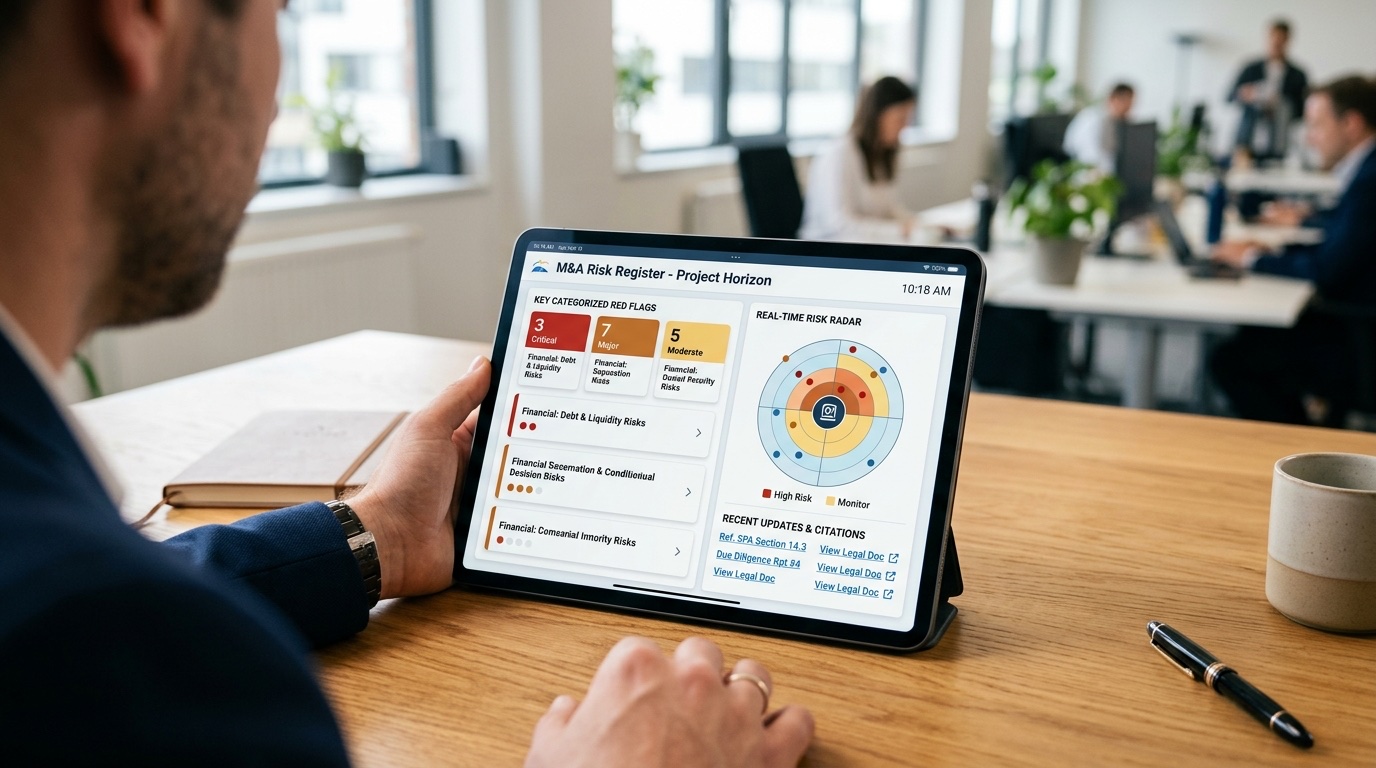
Once the data is ingested, the AI-Analysis Engine performs multi-document reasoning to categorize findings into an automated risk taxonomy. Rather than relying on simple keyword searches, this engine conducts sophisticated contract risk analysis, identifying cross-document contradictions and regulatory issues that a human analyst might miss. Through the platform's Risk Radar, risks are automatically evaluated and classified based on commercial materiality, legal exposure, and overall transaction relevance.
| Capability | Traditional Manual Tracking | Automated AI-Native Workflow |
|---|---|---|
| Analysis Breadth | Sample-based reviews that frequently miss outlying liabilities. | Full-scale continuous evaluation of every contract and document. |
| Traceability | Manual copy-pasting of folder paths and file names. | Direct source-level citations linking back to precise contract clauses. |
| Operational Velocity | Weeks of manual spreadsheet updates prone to version conflicts. | Real-time risk register updates generated in minutes via Data Room Ingestion. |
Continuous Red Flag Identification with Exact Citations
The true value of modern red flag reporting software lies in its ability to prove its conclusions. Generative AI tools that provide raw summaries without verification are highly risky for diligence professionals who must defend their findings to partners and clients. Plausity addresses this by building source traceability due diligence directly into its analytical core. Every flagged anomaly, undisclosed change-of-control clause, or litigation threat in the automated risk register is paired with an exact, clickable link to the source document in the virtual data room. This ensures that advisory partners and legal leads can instantly verify the context, accelerating final decisions while eliminating the risk of hallucinations.
Accelerating Contract Risk Analysis and Identifying Material Red Flags
Traditional due diligence is notoriously constrained by manual workflows and legacy spreadsheets. When M&A advisory partners and analysts track transaction liabilities manually, they run a severe risk of missing critical contract details due to cognitive fatigue. This operational bottleneck is resolved through risk register automation, which shifts the burden of risk tracking from manual data entry to automated review. By deploying automated data room document analysis, transaction teams can ingest thousands of pages of corporate history and classify agreements within minutes, ensuring that nothing is overlooked.
At the core of this transformation is Plausity's advanced AI-Analysis Engine, which reads, interprets, and cross-references multi-format records at scale. When the Data Room Ingestion tool finishes importing files from a virtual data room, Plausity's Risk Radar automatically initiates a comprehensive contract risk analysis. Instead of requiring three to four hours of manual legal review per agreement, the software evaluates dense change-of-control, assignment, and indemnification clauses in roughly 15 to 30 minutes, marking a significant jump in advisory speed.
Dynamic Materiality Thresholds and Risk Prioritization
A common challenge with early red flag reporting software was the overwhelming volume of low-priority alerts. Plausity resolves this noise problem by incorporating dynamic materiality thresholds directly into Risk Radar. The tool analyzes contract clauses against the actual commercial scope of the deal, evaluating financial exposure, liability limits, and direct transaction relevance. This ensures that M&A advisory teams focus their premium attention on high-impact legal exposures, such as restrictive covenants or non-standard termination penalties, rather than minor boilerplate deviations.
| Evaluation Metric | Manual Spreadsheet Tracking | AI-Native Automation |
|---|---|---|
| Traceability | High risk of lost context; manual links to files break frequently | Instant source traceability due diligence with section-level citations |
| Contract Coverage | Sample-based checking prone to human error and missed exceptions | Comprehensive, automated data room document analysis of all files |
| Prioritization | Subjective sorting based on the individual reviewer's judgment | Algorithmic evaluation of financial and legal risks via Risk Radar |
Executing an intelligent AI data room review ensures that every identified risk is anchored to its primary text. Workstream leads no longer have to manually search through massive folder structures to verify if a change-of-control clause applies to a specific target subsidiary. Plausity provides absolute source traceability due diligence by appending direct, interactive citations to every flagged risk, linking the final report directly to the source contract. This seamless integration ensures that every stakeholder is aligned, audit trails are flawless, and critical red flags are immediately verifiable.
The Power of Source Traceability in Due Diligence: Ending the 'Black Box' AI Problem
Traditional legal technology often operates as a black box, generating risk summaries or flagging potential issues without exposing the underlying analytical context. For M&A Advisory Firm Partners & Analysts, who are legally and professionally accountable for the risk register during transaction preparation, this opacity creates severe liabilities. While software vendors often claim their systems maintain sub-1% error rates, independent assessments reveal that on complex legal and compliance inquiries, unverified large language models exhibit hallucination rates between 69% and 88%. True transactional security demands verifiable proof, not blind reliance on ungrounded technology.
The Hidden Risk of Unverified AI Hallucinations
When performing contract risk analysis or data room document analysis, an algorithm that identifies a missing change of control clause is only as valuable as its verifiability. Unverified AI tools often compile summaries based on generalized linguistic patterns rather than the actual document text, creating false positives or, worse, failing to detect restrictive covenants tucked away in lengthy annexes. Without an explicit link to the original contract page, deal teams must manually search the electronic files to double-check the tool's accuracy, defeating the efficiency gains of risk register automation and exposing the transaction to hidden legal liabilities.
| Diligence Feature | Traditional Black-Box AI Platforms | Plausity AI-Native Platform |
|---|---|---|
| Risk Extraction Method | Summarizes text based on general patterns, increasing the risk of unverified hallucinations. | Grounds every single finding in direct document facts using the core AI-Analysis Engine. |
| Source Verification | Requires manual page-by-page searching across multiple contracts to confirm a finding. | Provides click-through, source-level citations directly to the exact contract page and paragraph. |
| Diligence Workflow | Creates fragmented spreadsheet tracking with separate document reviews. | Unifies contract risk analysis and red flag reporting software in a single workspace. |
| Audit Trail Security | Relies on manual updates, resulting in an error-prone paper trail. | Maintains an active, traceable connection from the raw data room files to the final risk register. |
Streamlining Risk Register Automation with Direct Citations
To address the limitations of black-box software, Plausity integrates click-through source traceability directly into its core AI-Analysis Engine. When the Risk Radar evaluates transaction documents based on materiality, financial impact, or legal exposure, it does not just summarize the risk: it creates a live link directly to the precise page and line in the virtual data room. This level of precision transforms how advisory firms execute legal due diligence by making every finding instantly defensible to clients and investment committees during an AI data room review.
This granular level of source-level mapping shifts the analyst's role from manual document search to professional verification. Instead of scrolling through hundreds of pages to double-check a warning, team members click the citation in the Report Builder to view the source contract side-by-side with the flagged risk. Every entry in the automated risk register remains permanently tethered to its origin. This clear audit trail eliminates the errors associated with spreadsheet-based tracking, preparing advisory teams for intense scrutiny from buyers, sellers, and corporate M&A project leads alike.
Streamlining Advisory Deliverables with Automated Report Generation and Collaboration
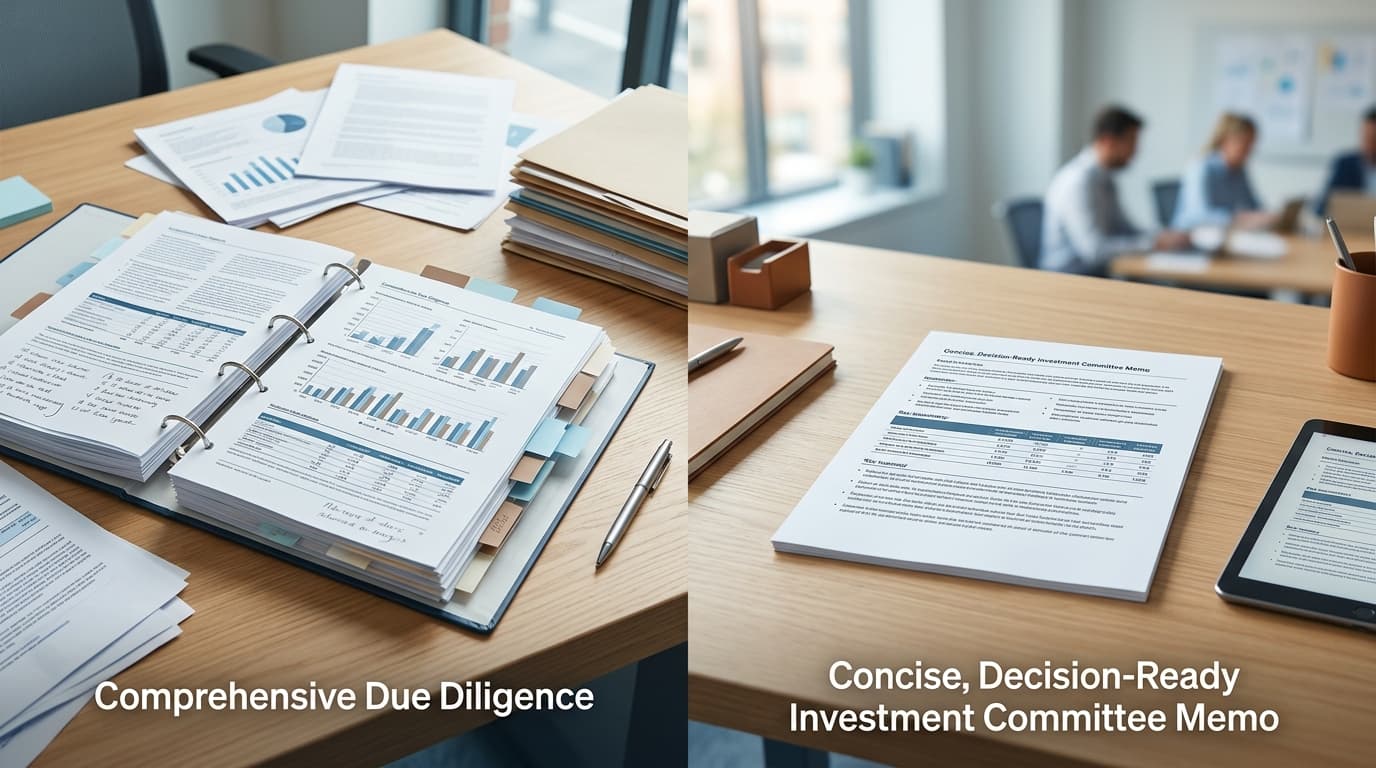
In traditional transaction environments, M&A Advisory Firm Partners & Analysts spend countless non-billable hours manually drafting presentation slides, formatting tables, and compiling static files. This administrative friction often delays deal cycles, preventing partners from focusing on high-value client advisory. By transitioning to AI-native workflows, advisory teams can replace manual, error-prone tasks with end-to-end report automation. Integrating these tools into the transaction pipeline allows deal teams to transition directly from data room document analysis to a complete, deal-ready summary in minutes. The shift from manual slide creation to automated report generation marks an essential evolution in how modern advisory practices operate.
Eliminating Manual Synthesis with Report Builder
The primary bottleneck in legal and financial due diligence is the manual compilation of various findings into a unified, investor-ready report. Using Plausity's Reports & Deliverables module, partners and workstream leads can leverage the Report Builder to automatically output highly structured, professional deliverables. By processing the underlying contract risk analysis and risk assessments, the AI-Analysis Engine instantly synthesizes a cohesive narrative. Rather than starting from a blank page or copying and pasting findings into a template, the deal team can generate an executive summary or a red flag list in a single click, cutting reporting time significantly.
Because accuracy is paramount, this automated process does not rely on generic generation. Plausity serves as a sophisticated red flag reporting software, providing exact, clickable link references back to the target's corporate repository during the AI data room review. This precise source traceability due diligence ensures that every legal claim, change of control clause, or financial liability in the report is anchored to the original document, allowing analysts to verify any flagged discrepancy instantly. Rather than spending days checking page numbers, the deal team can review complex structures with complete peace of mind, transforming the path from data room to report in a unified workspace.
- Instant Executive Summary Drafting: The AI-Analysis Engine translates complex findings across hundreds of uploaded contracts into high-level briefings for private equity and corporate buyers.
- Automated Red Flag Summaries: Risk Radar classifications are grouped dynamically based on materiality, financial impact, and compliance relevance, replacing manual spreadsheet tracking.
- Dynamic Workstream Feeds: Real-time updates automatically feed the master deliverables, ensuring that final slide decks and PDF briefs are always aligned with the latest data room findings.
Aligning Workstreams via the Collaboration Hub
M&A due diligence is rarely a solo endeavor, it requires real-time coordination across legal, financial, and tax advisors. Instead of relying on static spreadsheets sent via email, the Plausity Collaboration Hub coordinates deal team activities, aligning financial and legal workstream leads in real-time. By providing secure cross-organization workflows, external advisors can work seamlessly alongside corporate M&A project leads. This interactive workspace enables active discussion around newly surfaced risks, automated risk notifications, and continuous risk register automation, keeping all stakeholders aligned. The resulting agentic shift enables advisory firms to manage complex workstreams in a central, secure environment.
| Workflow Aspect | Traditional Spreadsheet Tracking | AI-Native Platform (Plausity) |
|---|---|---|
| Risk Identification | Manual review of contracts; prone to missing critical clauses across massive data rooms. | Automated contract risk analysis powered by the AI-Analysis Engine and Data Room Ingestion. |
| Red Flag Classification | Manually assessed and logged into static files; high risk of human error. | Real-time categorization via Risk Radar based on materiality, financial impact, and deal relevance. |
| Source Traceability | Static page references that require manual verification across folders. | Clickable, source-level citations directly linking every finding to the exact data room document. |
| Deliverable Preparation | Days spent manually compiling presentations and drafting executive summaries. | Instant executive summary drafting and professional reporting using the Report Builder. |
For M&A advisory partners looking to protect margins and accelerate execution, clinging to manual document tracking represents a critical bottleneck. Automating the pathway from Data Room Ingestion to finished client deliverable reduces the risk of missed details while elevating the overall quality of transaction advisory. Through an AI-powered combination of precise document parsing, real-time collaboration, and bulletproof source traceability, modern advisory teams can confidently deliver thorough, speed-to-market analyses that stand up to the most rigorous investor scrutiny.
The Bottom Line: Quantifiable Efficiency and Risk Mitigation in Modern Dealmaking
Integrating AI-native platforms into modern transaction workflows delivers immediate, quantifiable efficiency gains that reshape the economics of due diligence. Traditionally, advisory teams and legal leads have spent hundreds of billable hours manually cross-referencing agreements in spreadsheets, an administrative burden that delays transaction timelines and introduces substantial execution risk. According to industry benchmarks compiled by Thomson Reuters, implementing artificial intelligence in document intelligence workflows can reduce due diligence document review time by up to 70% on average. This acceleration enables M&A advisory firm partners and analysts to shift from administrative data collation to high-value strategic advisory, providing clients with robust, institutional-grade transaction oversight.
Direct Resource Optimization and Margin Expansion
By shifting the focus from manual data collection to automated analysis, firms can scale their deal capacity without a linear increase in head count. Traditional manual spreadsheet tracking forces senior partners to spend critical hours auditing the work of junior analysts rather than focusing on transaction architecture. With modern AI-native systems, the initial ingestion of files through automated Data Room Ingestion creates a structured knowledge repository within minutes. The core AI-Analysis Engine performs comprehensive contract risk analysis, uncovering restrictive covenants, change of control provisions, and hidden liabilities that might otherwise escape human review. This direct hours-saved-per-transaction metric represents a significant margin expansion for advisory firms while delivering a highly rigorous risk register automation process to corporate buyers.
| Diligence Capability | Traditional Manual Tracking | Plausity AI-Native Platform |
|---|---|---|
| Document Review Velocity | Manual sampling and slow thematic reading over several weeks | Up to 70% reduction in review time via automated AI data room review |
| Risk Tracking and Registering | Siloed spreadsheets with manually updated cells and text entries | Real-time risk register automation mapping every risk to the precise document source |
| Red Flag Transparency | Disconnected summaries with static text and potential human oversight | Interactive red flag reporting software displaying source-level citations |
| Workflow and Team Alignment | Frustrating email chains and version-control conflicts on spreadsheets | Centralized oversight in the Collaboration Hub with real-time updates |
Institutionalizing Transaction Knowledge and Eliminating Verification Risks
The long-term advantage of adopting AI-native platforms lies in the preservation and institutionalization of transaction knowledge. Rather than allowing valuable insights to remain locked inside static spreadsheets, an AI-powered system creates a permanent, searchable database of every target asset. Every identified risk, highlighted by Plausity's Risk Radar, is permanently linked to its origin in the data room document analysis. This eliminates the verification risks that plague traditional post-signing integration, as legal and financial teams can instantly verify the origin of any finding through source traceability due diligence. Using the automated Report Builder, advisors can then instantly export professional, investor-ready reports that maintain interactive, source-level citations, giving buyers complete trust in the findings from day one.
Plausity brings AI-native analysis to this workstream. Explore Plausity's Risk Radar, or read more on turning flagged risks into IC-ready memos.