Why 100-day plan value creation due diligence matters now
The traditional private equity model of relying on multiple expansion and cheap financing to generate target internal rates of return is no longer sufficient in higher-interest environments. Success in this cycle favours owners willing to improve operations at the companies they have bought, which means value creation has to get off to a quick start and pre-transaction diligence plus a 100-day plan matter more than ever. A 100-day plan value creation due diligence process bridges the critical gap between investment thesis assumptions and post-close operational reality, ensuring that pre-deal findings translate directly into executable workstreams.
Most post-acquisition transformations stall because sponsors treat the 100-day plan as an administrative checklist drafted after closing rather than an operational roadmap validated during due diligence. When deal teams fail to pressure-test baseline metrics, organizational capacity, and operational friction before signing, execution immediately encounters hidden bottlenecks. Early operating control mitigates disruption, aligns leadership, and sets a transparent baseline for performance. Designing actionable value creation plans during the confirmatory diligence window protects deal value from day one.
- Shift from financial engineering to operational efficiency as the primary driver of portfolio company returns.
- Elimination of the post-close latency period where management teams drift without clear operational mandates.
- Direct conversion of red flags and diligence findings into prioritized, owner-assigned remediation tasks.
- Validation of management bandwidth to ensure the organization can handle transformative changes alongside daily operations.
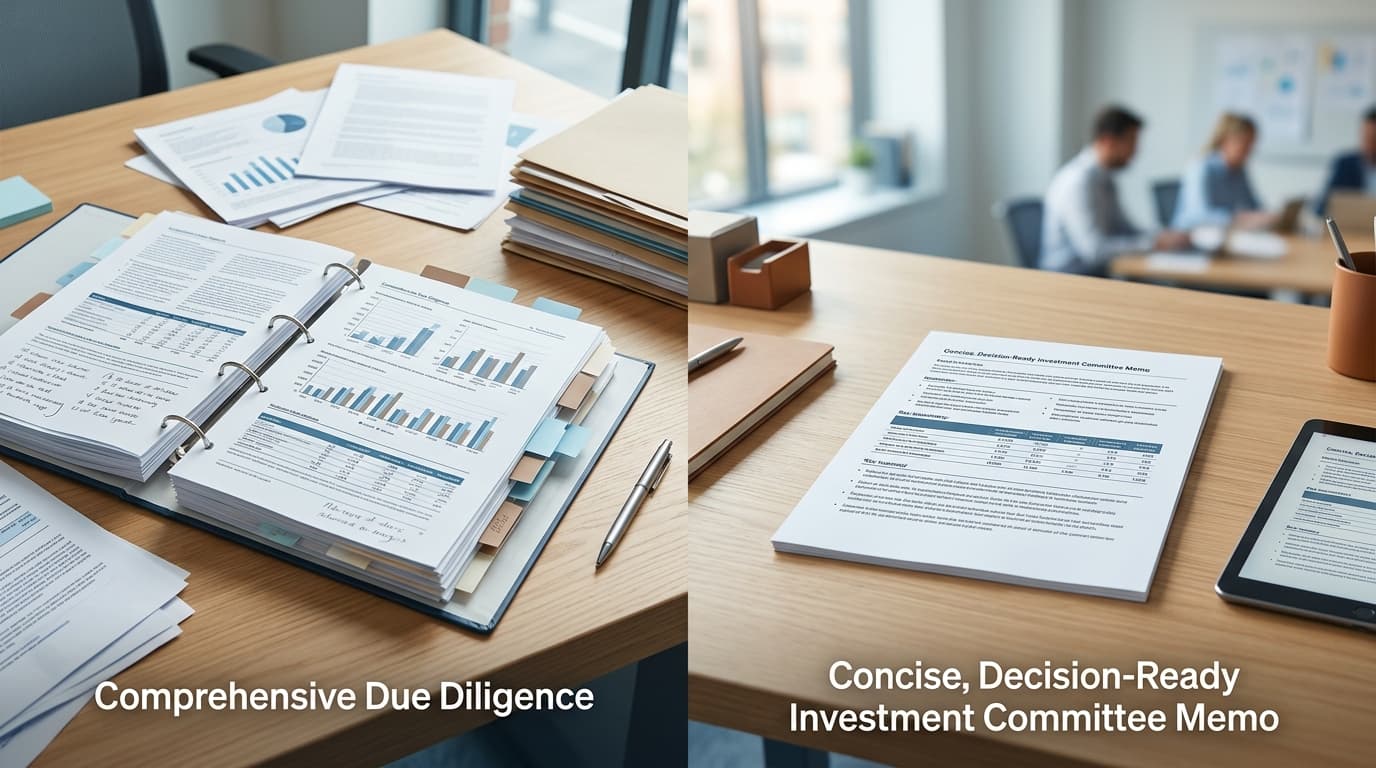
Without rigorous pre-acquisition testing, value creation hypotheses remain theoretical models in an investment committee memo. Operational due diligence must do more than identify risk: it should help translate the deal thesis into a practical roadmap that management and sponsors can execute post-close, and establishing a structured operating cadence early is what creates the mechanism for execution, since without it even well-defined value creation plans remain theoretical.
The main practical framework for 100-day execution
Converting diligence findings into an operational roadmap requires a structured framework that sequences initiatives by impact, complexity, and operational feasibility. One practitioner approach breaks the value creation plan into three categories: quick wins and "no regret" moves that can be executed from Day 1, shorter-term actions with significant value creation potential, and longer-term investments and more transformative moves. This prevents organizational fatigue and ensures that foundational operational fixes precede complex structural transformations.
Sequencing initiatives across three execution horizons
A disciplined 100-day roadmap establishes clear boundaries between immediate quick wins, short-term operational improvements, and multi-year structural investments. In operational alpha due diligence, each initiative is mapped to a specific timeline, resourcing requirement, and expected EBITDA contribution.
| Initiative Tier | Execution Window | Primary Focus Areas | Accountable Owner |
|---|---|---|---|
| Tier 1: Quick Wins & No-Regret Moves | Days 1-30 | Discretionary spend freeze, vendor renegotiations, pricing leakage fixes, hiring freeze on open positions | CFO, with operating partner oversight |
| Tier 2: Short-Term Operational Actions | Days 31-75 | Working capital optimization, sales territory realignment, span-and-layer adjustments, supplier renegotiation | COO and commercial lead, tracked by the transformation office |
| Tier 3: Structural Transformations | Days 76-100+ | ERP consolidation, tech stack modernization, footprint rationalization, cloud migrations | CEO with board and sponsor sign-off |
An early EBITDA bridge over the hold period connects each operational lever directly to the investment thesis, and taking management through the major blocks of value creation within that bridge is how sponsors build the best possible alignment before execution starts. Practitioners report that the challenge seen most frequently in the first 100 days is getting the critical targets and KPIs established and communicated across the teams, so baselines should be set on verified data rather than forecast ambition.
What PE operators and investment committees are really testing
Investment committees and operating partners evaluate more than market tailwinds and historical financial statements; they test whether the portfolio company possesses the structural capability to execute change under private equity governance. The first 100 days should give sponsors a clear view of whether leadership depth aligns with the ambition of the investment thesis and whether systems enable visibility and speed or create friction. Rigorous due diligence investigates management depth, accountability mechanisms, and digital readiness to identify execution friction before signing.
Evaluating leadership bandwidth and accountability
A primary risk in mid-market acquisitions is overestimating the leadership team's bandwidth. Given how much work goes into closing a deal, management of the newly acquired portfolio company often does not have the bandwidth to tackle all of the important post-close action items on their own, which is why sponsors and management teams should address key human capital issues immediately. Diligence should also test how concentrated institutional knowledge is, because when critical processes and relationships depend on a small number of individuals, that creates fragility and growth introduces risk instead of leverage. Conducting structured C-level leadership assessments during diligence exposes operational misalignments early.
- Owner accountability: Verifying single-point executive ownership for every value creation workstream.
- Transformation Management Office readiness: Establishing a dedicated cadence to monitor milestone pacing and unblock operational delays.
- Change capacity: Auditing mid-level management competence and willingness to adopt modern operating playbooks.
- Digital and automation readiness: Assessing whether the technical infrastructure supports workflow automation and modern analytics tools.
Evaluating digital and automated systems is essential for accelerating post-acquisition gains. In modern diligence, sponsors assess whether AI value creation and automated workflow initiatives can be deployed safely in the first 100 days to streamline manual processes without destabilizing core enterprise workflows.
What portfolio companies are expected to show
To satisfy private equity sponsors during the sign-to-close window, target companies must demonstrate baseline operational discipline and data availability. Most newly acquired firms do not have the operations, reporting, or talent infrastructure in place to move quickly: it is not uncommon for a sponsor to encounter significant accounting weaknesses, long reporting lags, disconnected systems, ineffective KPIs, and poor forecasting abilities, which is precisely what stops a fast start.
Data availability and reporting cadence standards
Portfolio companies must establish an institutional reporting rhythm that supports real-time decision-making. Sponsors expect clean data extracts and reliable operational metrics across four critical areas:
- Month-end close velocity: Delivering closed management accounts and variance analyses within 5 to 7 business days post-month end.
- Cash visibility: Implementing a dynamic 13-week rolling cash flow forecast to monitor liquidity, working capital swings, and debt service capacity.
- Commercial pipeline analytics: Tracking pipeline stage conversion, customer acquisition costs, churn cohorts, and customer concentration risks.
- Operational productivity metrics: Providing granular data on labor utilization, unit-level gross margins, and supplier delivery fulfillment.
When a portfolio company lacks unified systems, reporting latency slows down transformation. The month-end close process is a clear indicator: if it is slow or inconsistent, leadership lacks timely insight into performance, which delays corrective action and weakens execution. Sponsoring teams should identify these reporting deficits during diligence so that remediation of the financial reporting infrastructure becomes an explicit Day 1 workstream.
100-day value creation plan: A red-flag table
Operational friction identified during due diligence must be systematically cataloged into actionable risk registers. Identifying execution risks pre-close lets deal teams adjust their 100-day timelines and dedicate resources, in the form of both capital and talent, to the period immediately after closing. Automated risk register automation helps deal teams track these vulnerabilities across complex data rooms.
| Risk / Red Flag | Operational Vulnerability | Impact on 100-Day Plan | Pre-Close Remediation Action |
|---|---|---|---|
| Key-Person Dependency | Critical business logic, client relationships, or technical IP concentrated in one or two founders | Severe operational disruption if a founder transitions out post-close | Mandate retention packages, document standard operating procedures, and initiate succession hiring pre-close |
| Fragmented IT & ERP Systems | Multiple legacy accounting tools, offline spreadsheets, disconnected CRM databases | Slow month-end close, unreliable KPI tracking, blind decision-making | Include ERP consolidation and interim FP&A tool rollout in Day 1 capital allocation budget |
| Unsubstantiated Pricing Power | Margin assumptions based on hypothetical price increases without customer contract review | Immediate customer churn, volume drop, failed revenue synergy targets | Audit historical price realization by cohort and review contractual price-escalation clauses |
| Lack of Dedicated Transformation Lead | No internal change champion; executives already fully absorbed by day-to-day operations | 100-day initiatives stall due to operational fatigue and conflicting daily priorities | Install an interim Chief Transformation Officer or deploy dedicated operating partner support on Day 1 |
Addressing these vulnerabilities before transaction closing ensures that the newly acquired leadership team enters Day 1 with clear boundaries, prioritized objectives, and adequate operational support. Sponsors should also plan to bring on additional resources, full time or external, as needed to help existing staff avoid burnout and to increase bandwidth in the key areas that need additional support.
The 100-day value creation evidence checklist
Deal teams must demand specific operational evidence before signing to confirm that value creation initiatives can be deployed immediately. Transformation teams are expected to come prepared: perform adequate diligence on IT, cyber and other key areas, and identify the items needed to remediate risk and the opportunities to create value before the acquisition. The checklist below details the critical data items required across financial, commercial, technical, and human capital workstreams.
- Financial & Working Capital: Granular accounts receivable and accounts payable aging schedules, inventory turnover by SKU, supplier contract terms, and historical 13-week cash flow actuals.
- Commercial & Sales Operations: CRM opportunity logs, pipeline conversion rates by rep, customer concentration tables, net revenue retention cohorts, and discount authorization policies.
- Technology & Systems Architecture: Complete software inventory, cloud hosting infrastructure maps, cybersecurity audit reports, technical debt assessments, and enterprise license agreements.
- Human Capital & Governance: Comprehensive organizational charts with reporting layers, compensation benchmarks, key-employee retention agreements, sales commission plans, and turnover data by department.
If documentation is fragmented or missing during confirmatory diligence, sponsors should treat the gap as an operational liability. Fail to correctly identify internal weaknesses upfront, and you can spend years paying for that mistake, so missing baseline data warrants contingency reserves and a dedicated diagnostic sprint early in the hold period.
How to use this in your next diligence workflow
Transforming due diligence from a defensive risk-checking exercise into an offensive value creation engine requires institutional discipline. The first 100 days should produce a clear, actionable roadmap: a small number of high-impact initiatives, assigned ownership and accountability, measurable milestones, and realistic sequencing. Deal teams should synthesize findings across legal, financial, commercial, and technical streams into that single roadmap so it can be handed to operating partners at signing.
How Plausity supports the workflow
The platform enables private equity deal teams and operating partners to convert raw data room findings into structured, execution-ready roadmaps. By deploying its AI-Analysis Engine across virtual data rooms, investment teams can automatically ingest thousands of contracts, financial models, and operational audits in minutes, identifying underlying risks and margin improvement levers.
Using Report Builder, deal teams instantly synthesize cross-advisor findings into standardized, investor-ready diligence reports and 100-day execution blueprints. Every flagged operational risk, KPI baseline gap, and synergy opportunity remains traceable back to source documents, giving investment committees and portfolio executives absolute clarity.
To accelerate your transition from pre-deal investigation to post-close operational execution, explore how Plausity powers value creation plans across modern private equity portfolios.
How Plausity supports the workflow
Plausity is an AI-native due diligence and deal intelligence platform. For PE teams turning diligence findings into a 100-day value creation plan, Plausity helps convert scattered workstream memos, KPI baselines, and initiative-owner assignments into a structured, source-backed evidence base that stays traceable across the deal team and operating partners.
Deal and operating teams can use AI-powered diligence analysis to translate diligence findings into initiative-level owners, dependencies, and quick wins, then track execution and risk with findings and risk intelligence through the first 100 days and beyond. Plausity is a document-and-workflow layer, not a substitute for professional judgement: it does not independently provide legal, financial, tax, commercial, or technical advice, and it does not guarantee investor decisions, valuations, or diligence outcomes.