Why this matters now
Private equity deal teams are transitioning from generic AI tools to grounded, purpose-built diligence workflows because competitive deal surges demand radical compression of transaction timelines without sacrificing risk coverage. Broad-purpose chatbots fail under institutional audit requirements, whereas specialized diligence platforms automate data-room triage, transcript review, and risk registration to materially compress diligence cycles. By implementing a grounded data-room ingestion engine as the operational foundation, deal teams eliminate low-leverage document mechanics, accelerate triage, and establish verifiable source traceability across hundreds of virtual data room files before competitive auction deadlines.
In modern private equity, compressed transaction windows and expanding data room volumes create severe operational bottlenecks for investment professionals. General partners still absorb a large share of staff hours in manual data assembly and reporting rather than analysis. Traditional diligence workflows that rely on manual folder navigation lose critical days during time-sensitive bidding processes. When applied to unstructured data rooms, domain-specific AI automation cuts document processing and review time by up to 75%, allowing investment teams to shift focus from manual document collation to strategic thesis evaluation.
Generic consumer AI models introduce unacceptable operational and regulatory exposure in institutional dealmaking. Open-web models produce hallucinated conclusions that cannot be traced to a reliable source, and general-purpose chatbots have shown hallucination rates of 58 to 88 percent on legal questions, which leaves no defensible audit trail for investment committee or regulatory scrutiny and creates compliance exposure through unclear data provenance. In contrast, purpose-built private equity AI workflows establish strict zero-retention architectures, direct clause-level lineage, and multi-document reasoning tailored to deal execution. Firms comparing options in this category often start from a buyer's guide to AI-native diligence platforms rather than a general-purpose assistant.
- Clause-Level Traceability: Grounding every finding in specific data room files and exact page coordinates.
- Data Room Triage: Automatically classifying nested folder hierarchies and identifying missing materials.
- Matter-Level Isolation: Guaranteeing deal data remains isolated without model re-training exposure.
- Structured Workstream Integration: Feeding extracted insights directly into investment committee materials.
The main practical framework
Deciding which diligence workflows to automate first requires prioritizing high-volume, repeatable tasks that consume associate bandwidth without adding strategic judgment. The practical framework begins with automated data-room triage and structured document ingestion. Platforms built for this step parse deeply nested folder structures, resolve version conflicts and identify missing materials needed for accurate analysis before deeper review begins. This frees associates to focus on hypothesis testing rather than manual folder auditing.
The second priority in the automation framework is expert-call and transcript synthesis. Traditional manual transcript review consumes 10 to 20 hours per deal phase. Grounded AI systems analyze cross-call sentiment, surface conflicting operator statements, and extract structured qualitative evidence into M&A due diligence workflows in minutes, ensuring expert interviews yield maximum strategic value.
The final layer coordinates financial and commercial workstreams into unified deal outputs. Automated cross-referencing aligns Quality of Earnings (QofE) findings with commercial diligence models, ensuring seamless generation of deal-ready reports without manual copy-pasting across disparate spreadsheets.
- Phase 1 - Data Room Ingestion and Triage: Parse folder structures, normalize document formats, and detect missing diligence files.
- Phase 2 - Qualitative & Transcript Synthesis: Extract sentiment, cross-reference expert commentary, and flag thematic contradictions.
- Phase 3 - Quantitative Workstream Alignment: Parse three-statement financial models, adjust EBITDA line items, and audit contract terms.
- Phase 4 - Executive Report Generation: Compile citation-backed findings into structured investment committee formats.
What investors, lenders, buyers, or operators are really testing
During due diligence, institutional investors, lenders, strategic buyers, and operating partners stress-test the investment thesis against empirical data room evidence. Stakeholders demand rigorous proof that target revenue growth, customer retention rates, and margin expansion claims are backed by audited records rather than seller pitch decks.
Automated diligence workflows systematically ingest Confidential Information Memorandums (CIMs) and Vendor Due Diligence (VDD) reports to validate underlying assumptions. AI built for financial diligence absorbs the mechanical work of spreading financial statements, cross-referencing figures against source documents and flagging inconsistencies between periods and against management accounts, which lets the deal team verify whether historical growth reflects sustainable core operations rather than one-off items. Teams standardizing this step often lean on automated due diligence workflows instead of ad hoc spreadsheet reviews.
Validating market and competitor evidence requires cross-analyzing internal target metrics against broader market signals. AI-driven market work maps the competitive landscape, reconciles top-down and bottom-up market sizing, and screens revenue quality including customer concentration, enabling deal teams to pressure-test market sizing assumptions and competitive moat resilience before committing capital. The same evidence base then supports value creation planning after close.
| Stakeholder Role | Primary Diligence Focus | Key Target Evidence Tested | Validation Method |
|---|---|---|---|
| Private Equity Investors | EBITDA Sustainability & Upside | Customer churn, pricing power, QofE adjustments | Spreadsheet parsing & contract extraction |
| Private Credit Lenders | Downside Risk & Cash Flow Coverage | Debt schedules, leverage ratios, covenant terms | Automated financial model cross-referencing |
| Strategic / M&A Buyers | Synergy Realization & Integration | SOPs, IT infrastructure, headcount overlap | Multi-document operational synthesis |
| Operating Partners | 100-Day Plan Feasibility | Pricing levers, margin leakages, procurement costs | Benchmarking against historical operational data |
What companies, funds, or platforms are expected to show
Institutional standards require absolute auditability and source traceability for every finding in a deal deliverable. Diligence platforms are expected to provide complete traceability for every output they generate, with paragraph or even footnote-level citations that let a reviewer confirm accuracy quickly. For anything going to an investment committee, every material figure must trace back to a source document: firms piloting AI-assisted diligence report that the first question from senior partners is not whether the model can be trusted but whether the team can show where a number came from.
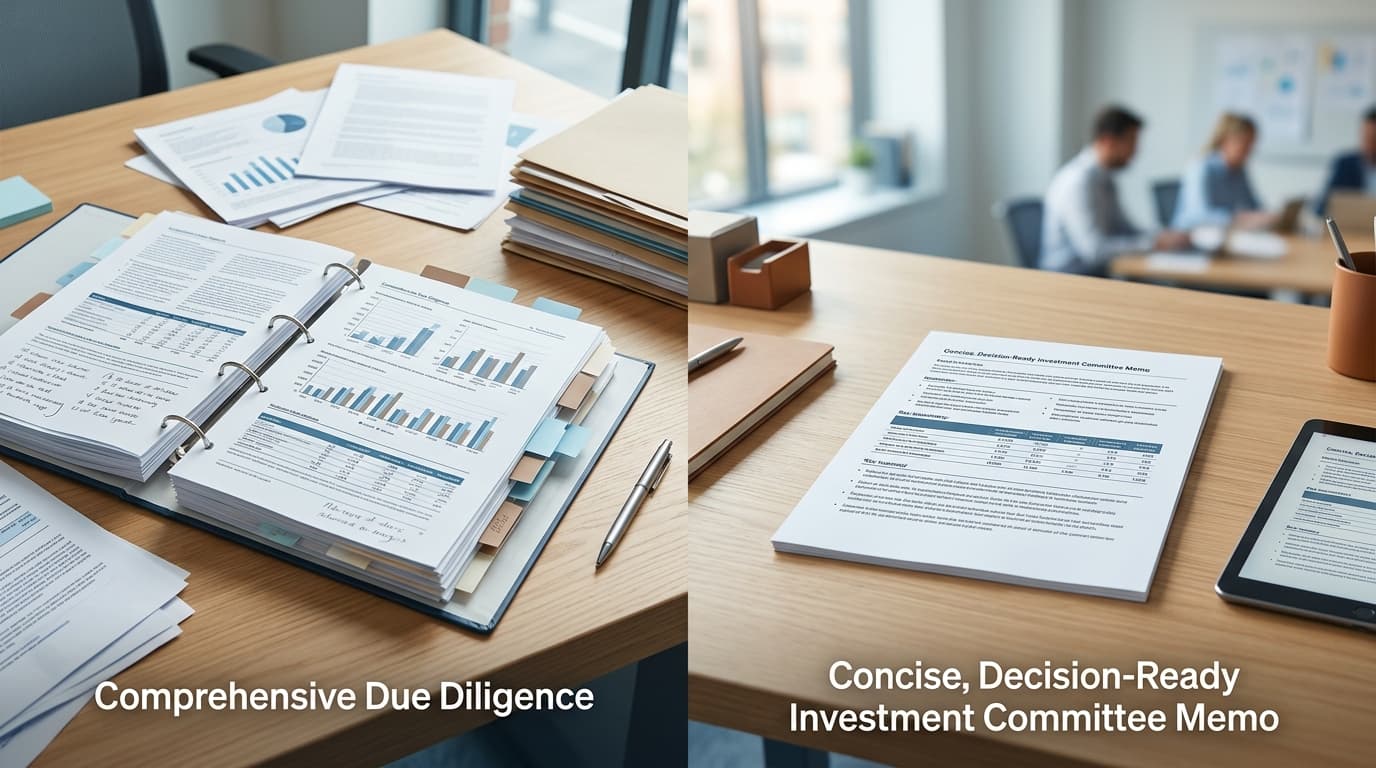
A complete investment committee memo for a mid-market deal typically takes a senior associate 15 to 30 hours to get from a blank page to a draft ready for partner review. Deploying investment committee memo automation enables deal teams to generate grounded narratives supported by structured financial models and verified risk findings, reducing drafting time while strengthening committee defensibility.
- Clause-Level Audit Trails: Every statement must link directly to an underlying contract clause or spreadsheet cell.
- Normalized Financial Reconciliation: Reconciling target management adjustments against independent QofE reports.
- Source Document Provenance: Maintaining strict records of file versions, upload timestamps, and access logs.
- Zero Data Retention Compliance: Guaranteeing that deal material is never stored or used for public AI training.
A red-flag table
Manual risk registers often suffer from information silos, human oversight, and delayed escalation during fast-moving deal processes. Automated systems continuously scan data rooms to build dynamic risk registers that flag financial, legal, and operational anomalies early risk register automation. A materiality-weighted findings layer lets deal teams rank issues by financial and legal exposure across all ingested contracts. Furthermore, integrating structured compliance verification ensures mandatory regulatory standards are evaluated systematically. Using a dedicated risk intelligence platform helps deal teams detect critical liabilities before entering final negotiations.
While AI excels at pattern recognition and document scanning, deal teams must define clear boundaries regarding what NOT to automate. Final investment conviction, strategic deal structuring, and executive character evaluations must remain exclusively human responsibilities.
| Diligence Domain | What NOT to Automate | Common Risk / Red Flag | Automated Signal / Mitigant |
|---|---|---|---|
| Legal & Contracts | Final legal risk tolerance and indemnity negotiation | Hidden change-of-control clauses and termination rights | Automated clause extraction and cross-contract risk scoring |
| Financial & QofE | Final EBITDA adjustment approval and valuation multiples | Aggressive revenue recognition and unbacked add-backs | Spreadsheet anomaly detection and trend deviation flags |
| Commercial & Customer | Assessing qualitative customer relationship health | High customer concentration and silent account churn | Automated revenue density mapping and contract term extraction |
| Operational & IT | Culture fit and executive leadership evaluation | Legacy tech debt, cybersecurity gaps, and SOP absence | Automated documentation completeness audit against standard checklists |
A data-room / evidence / checklist section
Evaluating a target company's virtual data room requires a systematic evidence audit across financial, legal, operational, and technical categories. A well-tuned document processing layer can ingest and index a 50,000-page data room in hours rather than the weeks a team of analysts would need, which is what makes a full evidence sweep feasible inside an exclusivity window. Deal teams running an AI analysis engine over the room can therefore screen and index everything before deciding where to spend senior hours.
A comprehensive data room audit bridges initial findings with post-close value creation. Leveraging a structured due diligence checklist allows deal teams to turn identified operational gaps into actionable 100-day plans, ensuring smooth value creation execution immediately after closing.
- Financial Records: Audited 3-year financials, monthly trial balances, working capital schedules, and QofE reports.
- Legal & Corporate: Material customer contracts, vendor agreements, IP assignments, and litigation histories.
- Operational & Governance: Standard operating procedures (SOPs), org charts, key-person retention agreements, and supplier lists.
- Technical & Security: SOC 2 audit reports, architecture diagrams, technical debt disclosures, and cybersecurity logs.
Practical implications
For deal teams, the practical implication is that automation changes where analyst hours go rather than how many people a deal needs. Document-intensive phases of financial diligence absorb roughly 60 to 70 percent of a diligence team's time, which is precisely the work a grounded ingestion and extraction layer can absorb. Firms that redeploy those hours into thesis testing, management assessment and deal structuring get earlier conviction in competitive processes, provided every automated finding stays traceable to a source file and every judgment call stays with a named human owner.
How to use this in your next diligence workflow
To prepare for the next deal surge, private equity firms should take immediate, practical steps to modernize their diligence operating model. Deal teams should audit current workflow bottlenecks, replace ungrounded generic AI tools with specialized diligence infrastructure, and standardize automated risk register reporting before deal volume accelerates.
How Plausity supports the workflow
The platform is built specifically for private equity deal teams, M&A advisors, and corporate development leads. Data Room Ingestion connects to virtual data rooms to parse PDFs, financial models, and contracts in minutes. The core AI-Analysis Engine performs deep multi-document reasoning to cross-reference complex datasets with full source traceability. Risk Radar automatically flags material legal and financial exposures, while Report Builder drafts investor-ready IC memos and deliverables. Finally, Collaboration Hub provides a real-time workspace for deal teams to coordinate workstreams and refine strategy.
To discover how grounded AI workflows can streamline your deal execution and accelerate value creation solutions, deal teams can establish custom automated pipelines tailored to their specific investment mandates before the next deal surge begins.