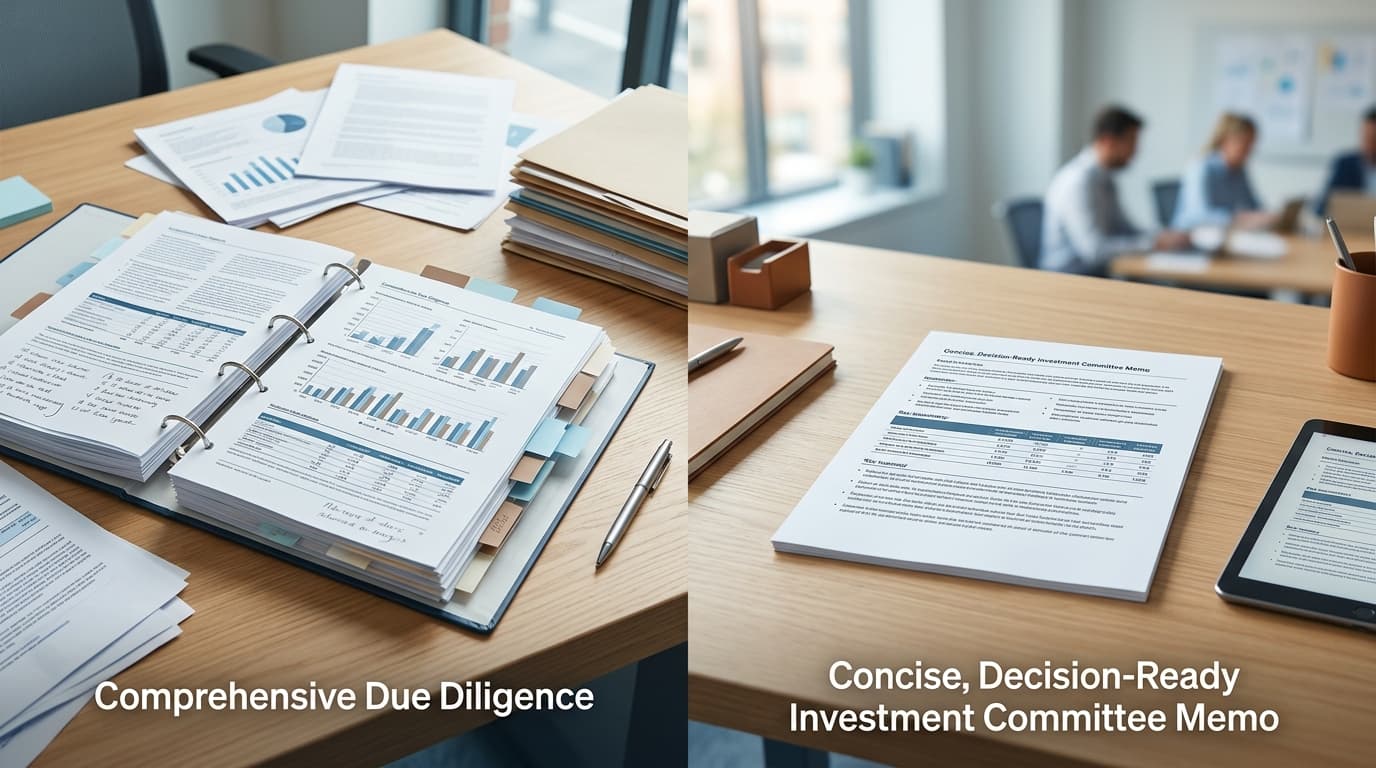
The Data Room Bottleneck: Managing Diligence at Velocity
- Manual data room reviews are highly inefficient, but using AI can help shorten deal cycles by up to 50 percent.
- Connecting Plausity's Data Room Ingestion directly to a VDR secures high-velocity parsing of PDFs and financials.
- A modern red flag report must group findings by materiality, moving from simple keyword matches to contextual risk insights.
- Traceable AI findings with single-click page links eliminate AI hallucinations and ensure auditability under professional standards.
In the highly competitive environment of corporate transactions, mergers and acquisitions routinely demand the review of thousands of documents. Modern transactions often see virtual data rooms swelling with thousands of files, ranging from dense supply agreements to intricate corporate governance logs. For M&A advisory firms and corporate development teams, this extreme influx of information creates a massive cognitive bottleneck that slows down decision-making. Traditional search methods, which rely heavily on simple keyword matching and manual spot-checking, are no longer sufficient to guarantee that every underlying risk is uncovered within increasingly compressed deal timelines.
The Cognitive Strain of Traditional VDR Audits
In a typical mid-market transaction, analysts and project leads must digest contracts, employment agreements, intellectual property licenses, and historical financial models under immense time pressure. Standard keyword queries fall short because they require human reviewers to anticipate the exact terminology and phrasing used across hundreds of diverse target entities. Important liabilities, unusual termination clauses, or restrictive covenants hidden in obscure appendices can easily go unnoticed, escalating transaction risk before a transaction ever closes. This cognitive strain often forces teams to make strategic trade-offs between speed and absolute thoroughness, a compromise that can lead to costly post-merger surprises.
| Review Dimension | Traditional Manual Search | AI-Powered Triaging |
|---|---|---|
| Analysis Scope | Sample-based or keyword-limited reviews | Full-text coverage across 100% of VDR documents |
| Risk Detection | Relies on manual spotting of anomalous terms | Automated anomaly and pattern recognition |
| Speed to First Insight | Days or weeks of document structuring and reading | Minutes to process and organize files upon ingestion |
Streamlining Operations with Virtual Data Room AI
To manage these massive volumes without sacrificing diligence depth, modern investment teams are turning to Data Room Ingestion technologies. Instead of waiting for junior analysts to manually map folder structures and open files one by one, an AI-Analysis Engine can instantly parse, categorize, and cross-reference multiple document formats at scale. This first-pass triage acts as a cognitive multiplier, allowing deal professionals to bypass administrative clutter and focus directly on material risk vectors from day one of the process.
By sitting directly on top of the virtual data room environment, AI-driven systems transition the analyst's role from passive document reader to active strategic investigator. Rather than scrolling through thousands of pages of boilerplate text, the deal team can focus their expertise on interpreting complex regulatory liabilities or evaluating target synergies. This shift not only raises both the quality and velocity of the transaction but also ensures that the resulting deal-ready due diligence reports are built on a comprehensive, uncompromised foundation of factual evidence.
Connecting to the Source: How AI Sits on Top of the VDR
Traditional M&A due diligence often stalls because of the sheer manual effort required to transfer, organize, and analyze files from a virtual data room (VDR). Security and speed are typically in direct conflict during this stage. Modern transaction workflows overcome this challenge by establishing a secure, direct ingestion pipeline that sits on top of the existing transaction archive. By integrating directly with the VDR, Plausity's Data Room Ingestion feature automates the secure processing of complex target documents, including dense PDFs, scanned agreements, and financial models, without requiring teams to manually download and re-upload highly sensitive files. This seamless connection ensures that the underlying document repository remains the immutable, single source of truth throughout the transaction lifecycle.
The Architecture of a Secure Ingestion Pipeline
For M&A Advisory Firm Partners & Analysts and Corporate M&A Project Leads, security is a non-negotiable prerequisite. When evaluating an AI-native due diligence platform, deal professionals must inspect how the system connects to the target data room. Rather than introducing manual file handling, a secure pipeline utilizes automated, read-only API connections to stream files directly into an isolated processing environment. Educational compliance frameworks, such as SOC 2 and ISO 27001, emphasize the importance of data isolation, end-to-end encryption (TLS 1.3 in transit and AES-256 at rest), and zero-retention policies. When these security principles are built into the ingestion architecture, the technology acts as a secure lens over the VDR, analyzing and cross-referencing information without altering the source or leaving vulnerable local copies.
| Feature Area | Traditional Manual Review | AI-Native Ingestion with Plausity |
|---|---|---|
| Data Processing Speed | Highly manual, requiring days or weeks to download, sort, and review files sequentially. | Automated ingestion and categorization of thousands of documents in minutes. |
| Security and Access | Risks associated with local file downloads, manual sharing, and fragmented local storage. | Read-only VDR integration with end-to-end encryption and zero local copies. |
| Source Traceability | Manual bookmarking and typing of document paths, which is prone to human error. | Instant, automated mapping of every finding back to its exact coordinate in the source file. |
From Ingestion to Deep Reasoning
Once files pass through the secure ingestion pipeline, the underlying technology goes to work. The AI-Analysis Engine performs structural layout analysis, optical character recognition (OCR) on scanned documents, and semantic parsing of complex legal and financial text. Because the data room ingestion process is fully automated, the engine can map cross-references across multiple workstreams concurrently. For example, a change-of-control clause in a material contract is automatically cross-referenced with the equity capitalization table and current debt agreements to flag potential consent requirements or accelerated payment obligations. This automated cross-referencing forms the basis of traceable AI findings, giving deal teams the exact clause, paragraph, and page number behind every identified transaction risk.
- Dynamic document classification that automatically organizes mixed file dumps into logical folders
- Automated OCR extraction that makes legacy scans and handwritten text fully searchable and legible for analysis
- Metadata preservation that maintains the original folder hierarchies and file names from the source virtual data room
- Isolated secure execution environments that run analytical processes without mixing client data or training public models
By establishing a secure, auditable, and direct link between the virtual data room and the final report, deal teams can conduct rapid, deep-dive due diligence without compromising on security. The integration of a direct ingestion pipeline ensures that analysts can verify every single output. Instead of searching through folders to confirm a flag, transaction professionals can click a traceable link to inspect the exact clause instantly, ensuring a faster, more robust path to a deal-ready transaction report.
From Raw Data to Real-Time Intelligence: Assessing Risk Profiles
In modern corporate transactions, the sheer volume of unstructured data can obscure substantial liabilities. Traditional due diligence relies on sample-based manual reviews, which often fail to capture isolated but material exposures. According to industry analyses of transaction structures, thorough risk detection remains a primary driver of long-term transaction value, yet deal teams are regularly forced to compromise depth for speed under tight transaction timelines. For M&A Advisory Firms partners and analysts, missing a critical liability can severely impact deal terms or lead to post-transaction disputes. This tension is particularly acute for corporate M&A project leads who must coordinate across multiple specialized workstreams simultaneously.
To systematically address these blindspots, transaction professionals are moving toward automated risk assessment systems. The core AI-Analysis Engine parses thousands of documents in parallel, identifying hidden risks, legal exposures, and critical inconsistencies across complex financial disclosures. By analyzing the semantic relationships between disparate files, this technology flags anomalies that standard search queries miss. Instead of relying on human analysts to manually verify every warranty clause or cross-reference historical revenue tables, the technology automates the baseline classification of risk across the entire virtual data room.
A key component of this automated process is Plausity's Risk Radar. This specialized tool automatically maps and ranks findings by materiality, evaluating each risk based on financial impact, legal exposure, and deal relevance. It ensures that critical deal-breakers receive immediate attention, rather than remaining buried in hundreds of pages of ancillary reports. By applying consistent materiality thresholds, the tool provides a standardized overview of the target company's risk profile, giving private equity funds and corporate buyers the analytical clarity required to negotiate adjustments to the purchase price or draft robust indemnification clauses.
| Risk Category | Traditional Review Blindspot | Automated AI Analysis Approach |
|---|---|---|
| Legal Exposure & Liability | Oversight of change-of-control clauses or restrictive covenants in low-value customer contracts. | Semantic scanning of every agreement in the data room to flag restrictive provisions instantly. |
| Financial Inconsistencies | Sample-based validation often misses discrepancies between ERP extracts and final tax filings. | Comprehensive cross-referencing of balance sheets, trial balances, and external tax reports. |
| Regulatory Compliance Gaps | Manual cross-referencing against evolving international frameworks is slow and prone to oversight. | Automated mapping of corporate policies and operational records against defined regulatory standards. |
Ultimately, transforming raw data room documents into structured, real-time risk intelligence changes how transaction teams operate. Instead of spending the initial weeks of a transaction project simply cataloging files, deal professionals can immediately focus on the commercial implications of identified exposures. By utilizing automated systems, investment teams and corporate development leads can transition from passive document review to active, strategic risk management, ensuring that every finding is validated, quantified, and ready for negotiations.
The Anatomy of a Modern Red Flag Report in M&A
Many companies approach M&A diligence as a high-level search for fatal flaws, but thorough due diligence must inform the broader transaction strategy, valuation, and post-merger integration plans. To achieve this, transaction professionals are abandoning unstructured, hundred-page PDF narratives. Instead, they rely on prioritized deal-ready reports that focus on high-priority findings and precise risks. Modern transactional teams need structured summaries that enable them to react immediately during tight deal cycles.
Core Components of an Actionable Red Flag Report
For M&A advisory firm partners and analysts as well as corporate M&A project leads, the value of any findings-oriented report depends entirely on how quickly it can be parsed. A high-quality risk intelligence framework categorizes exposures by materiality. This enables corporate deal teams to negotiate purchase price adjustments or draft specific indemnity clauses before closing the deal. Setting up a predictable structure within the report prevents critical risks from getting buried in generic qualitative summaries.
- Executive Summary: A concise, high-level overview that highlights critical deal-breakers and summarizes the target company's overall risk profile.
- Prioritized Findings Matrix: A visual grid or list classifying identified issues by financial impact, legal exposure, and operational severity.
- Strategic Advisory Actions: Concrete recommendations for negotiation, ranging from direct valuation adjustments to specific pre-closing covenants.
- Traceable AI Findings: Deep-linked references that map every identified anomaly back to the precise source document in the virtual data room.
Translating VDR Data into Clear Risk Ratings
Transforming thousands of files into structured risk categories is a complex task. By combining virtual data room AI workflows with the core AI-Analysis Engine, teams can ingest and structure target materials in a fraction of the time. Once the platform processes the raw files, its automated Risk Radar system flags anomalies and scores them based on deal relevance. The Report Builder then compiles these prioritized findings into clear, auditable sections, allowing transaction teams to cross-reference every risk with its source documents.
| Risk Level | Core Characteristics | Strategic Resolution Action |
|---|---|---|
| High Risk (Deal-Breaker) | Severe regulatory non-compliance, active intellectual property litigation, or undisclosed long-term debt liabilities. | Direct valuation adjustments, strict pre-closing covenants, or a transaction walk-away decision. |
| Medium Risk (Exposure) | Active change-of-control clauses in material customer agreements, high customer concentration, or expired agreements. | Specific indemnification clauses, targeted representations and warranties, or post-closing corrective measures. |
| Low Risk (Operational Gap) | Minor corporate governance omissions, outdated internal employee policies, or inconsistent administrative records. | Post-closing integration task list or standard operational remediation plans during the post-merger phase. |
The Grounding Principle: Why Every AI Finding Must Link Back to its Source
For investment committees, M&A advisory partners, and corporate M&A project leads, speed is an asset only when backed by absolute verification. In high-stakes transactions, a single unverified claim can derail a deal or lead to significant post-acquisition liabilities. While virtual data room AI tools can rapidly digest millions of data points, the output of any AI system is only as reliable as its audit trail. This is why traceable AI findings are no longer a luxury but an industry imperative. According to research by Bain and Company, while M&A practitioners are eager to adopt generative AI to compress deal cycles, maintaining accuracy and compliance remains the primary hurdle to widespread deployment. To bridge the gap between AI speed and human trust, every observation must be anchored directly to its source.
The Professional Cost of Black-Box AI in Due Diligence
Traditional generative AI models operate on probabilistic patterns, occasionally generating plausible-sounding but entirely fabricated statements, commonly known as hallucinations. In standard text summarization, an occasional error might be negligible; in a red flag report M&A experts rely on, it is a catastrophic failure. Relying on opaque, ungrounded AI platforms risks missing critical change-of-control clauses, understated liabilities, or regulatory compliance gaps. Transaction professionals cannot present findings to an investment committee with a caveat that the AI might have made them up. Under strict regulatory scrutiny, such as under the evolving standards of the EU AI Act or corporate governance rules, M&A project leads require clear proof of the data used to reach any given conclusion.
Core Pillars of Verifiable AI Data Room Analysis
- Exact Page-Level References: Every financial discrepancy or legal exposure identified must point to the precise page, paragraph, and line in the source PDF or spreadsheet.
- Bidirectional Verification: Analysts should be able to click any finding in the final report and instantly open the source document at the exact highlighted section, eliminating manual search times.
- Multi-Document Cross-Referencing: The system must verify that a claim made in an executive summary is consistent with granular disclosures in the schedules and appendices.
- Strict Boundary Controls: The platform must restrict its analysis exclusively to the provided virtual data room documents, eliminating external data contamination or generalized public assumptions.
Bridging the Gap: Plausity's Traceable Report Generation
Plausity addresses this critical need for verification by integrating its central AI-Analysis Engine directly with its automated reporting workflow. Rather than treating document scanning and report generation as separate phases, Plausity maintains a continuous, immutable lineage from Data Room Ingestion to final delivery. When transaction teams use the Report Builder to compile deal-ready due diligence reports, every single synthesized insight, risk rating, or financial exposure is embedded with its precise origin. By ensuring traceable AI findings are hardcoded into the output, the platform eliminates the hours spent by junior analysts back-checking references, converting raw AI data room analysis into authoritative, audit-ready documentation.