Moving From Isolated AI Pilots to an Institutional Operating Model
For general partners, driving real AI transformation in private equity requires moving beyond passive software licensing and isolated tool pilots. While seat licenses for standalone generative assistants are easy to distribute, simply handing software to deal teams or portfolio executives rarely yields measurable P&L impact. Many firms deploy AI across portfolio companies without a standardized operational playbook, leaving investments trapped in expensive pilot phases. True institutionalization requires restructuring workflows so that artificial intelligence is natively integrated into deal sourcing, investment committee preparation, and portfolio value creation.
Core Pillars of an Institutional AI Operating Model
- Operating Model Redesign: Shifting focus from basic tool distribution to systematic workflow transformation, embedding automated processes into daily deal evaluation and operational oversight.
- Fund-Level Baseline Standards: Establishing institutional governance, centralized data architecture, and standardized diligence software across deal teams and portfolio companies.
- Clear EBITDA Impact Metrics: Tying every AI deployment directly to underwriting hypotheses, operational margin improvements, or cost structure optimizations rather than vanity usage stats.
Without clear fund-level baselines, deal teams often adopt fragmented point solutions that create technical debt and lack source traceability. Transitioning to repeatable diligence systems enables funds to standardize how investment professionals analyze data rooms and surface key risks. Platforms utilizing an integrated AI-Analysis Engine ensure that document analysis, financial verification, and committee reporting follow disciplined frameworks. When general partners pair structural governance with clear EBITDA impact metrics, AI transformation in private equity ceases to be an ad hoc experiment and becomes a durable engine for portfolio alpha.
Transforming Investment Teams Across Sourcing, Screening, and Diligence
Investment professionals are shifting from manual target review to structured, AI-driven deal workflows to expand top-of-funnel capacity. Rather than depending exclusively on broker-led processes or static market databases, private equity firms build automated sourcing engines that continuously scan market signals. This transition enables deal teams to establish proactive proprietary deal sourcing mechanisms, evaluating company profiles against firm-wide thesis criteria before competitors enter the process.
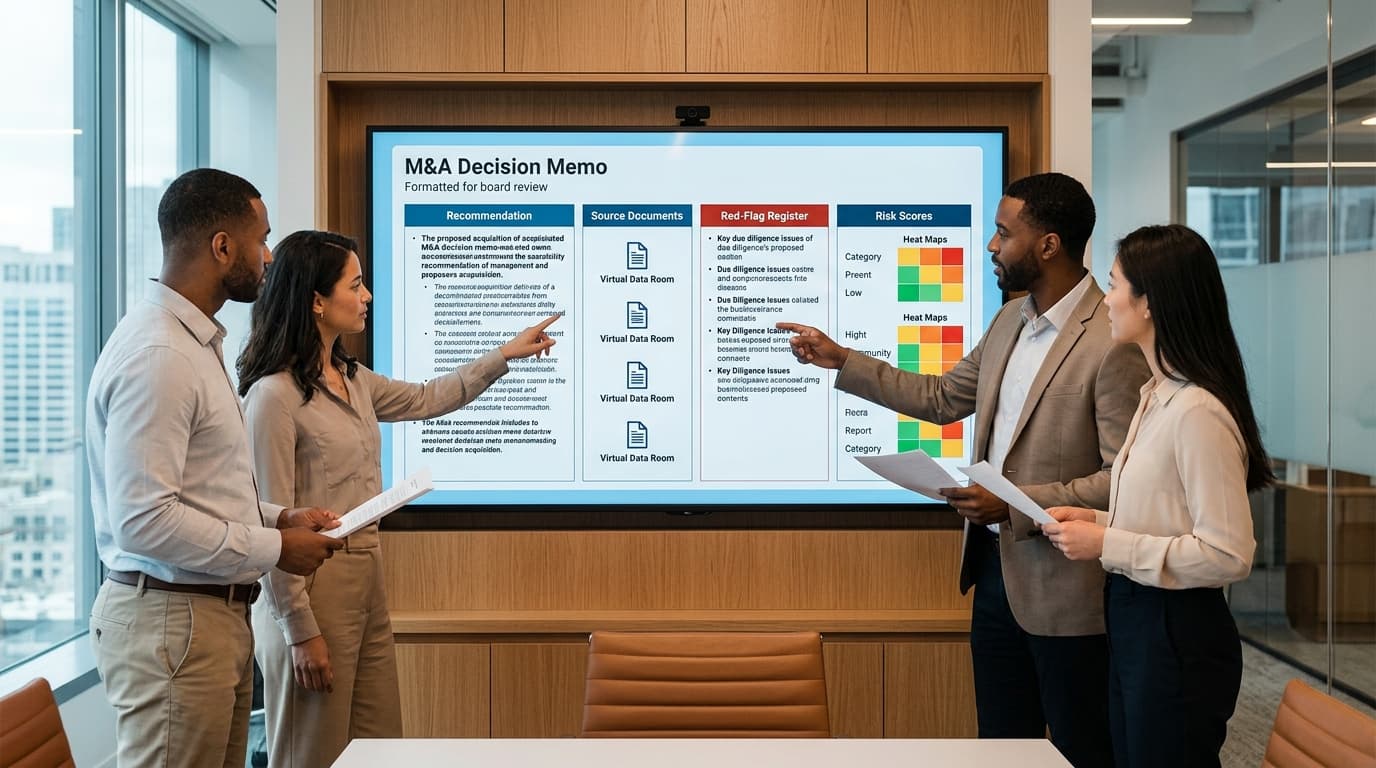
When deal teams move from screening into confirmatory due diligence, virtual data room ingestion becomes the primary operational bottleneck. Leading investment teams deploy Data Room Ingestion to automatically scan, index, and structure thousands of files, financial models, and operational contracts within minutes. Powered by the AI-Analysis Engine, analysts cross-reference historical performance, supplier agreements, and revenue figures, eliminating manual document review and shortening evaluation cycles.
- Automated Screening: Systematic evaluation of market signals and financial profiles to filter high-probability targets aligned with fund strategy.
- Accelerated VDR Processing: Instant indexing of multi-format document repositories using Data Room Ingestion to streamline preliminary data checks.
- Institutionalized Risk Scoring: Objective identification of legal exposure, customer concentration, and financial discrepancies via Risk Radar.
Uncovering critical anomalies early in the transaction lifecycle protects deal team bandwidth and optimizes advisory spend. By embedding Risk Radar into preliminary screening, investment teams establish clear materiality thresholds long before final investment committee presentations. This institutionalized diligence pattern allows deal leads to focus negotiation terms on quantified risk factors rather than discovering structural liabilities during late-stage exclusivity.
Empowering Portfolio Operations and Building Scalable AI Playbooks
Operating partners accelerate post-acquisition margin expansion by moving away from fragmented technology pilots toward institutionalized execution playbooks. Rather than forcing individual assets to design artificial intelligence strategies in isolation, sponsor firms establish centralized operating frameworks that target high-impact business functions. Integrating these deployment standards directly into the post-close roadmap or 100-day framework enables deal teams to turn capability building into a predictable driver of earnings growth.
Standardized Frameworks for Cross-Portfolio Impact
Developing cross-portfolio operational benchmarks allows investment leads to track adoption velocity, productivity metrics, and margin uplift across disparate market sectors. Standardized playbooks eliminate redundant vendor evaluation cycles and ensure that individual portfolio management teams focus on execution rather than basic architecture design.
- Functional Sales and Marketing Playbooks: Deploying automated lead scoring, intent-driven customer segmentation, and predictive churn modeling to accelerate top-line growth.
- Finance and Controlling Protocols: Standardizing routine reporting, invoice matching, and cash flow forecasting to reduce administrative overhead and improve reporting speed.
- Repeatable Value Creation Architecture: Codifying governance standards, data security protocols, and 2-to-4-week proof-of-concept guidelines for rapid capability rollouts across all portfolio holdings.
By institutionalizing these operational playbooks, private equity sponsors establish a repeatable system that scales across varying asset sizes and market verticals. Operating leads can continuously refine performance benchmarks, sharing best practices across portfolio assets to maximize exit valuations and achieve sustainable operational efficiency.
Driving AI Adoption and Technical Capacity Inside Portfolio Companies
While a large share of private-equity-backed companies have already begun some form of AI adoption, mid-market target assets frequently lack the internal infrastructure, data maturity, and technical talent required to scale advanced tools independently. General partners often discover that portfolio management teams struggle with legacy software systems, unorganized data repositories, and limited engineering capacity. Consequently, driving AI capability across portfolio operations demands moving beyond fragmented point solutions toward a structured enablement strategy that builds sustainable technical competencies directly into executive leadership teams.
A Three-Pillar Framework for Portfolio Technical Enablement
- Technical Readiness Assessment: Evaluate existing legacy data architecture, API connectivity, and IT governance during the initial 100-day plan to establish baseline digital maturity and pinpoint high-impact use cases.
- Embedded AI Champions: Deploy experienced operating advisors or upskill internal functional leaders to serve as on-the-ground champions who drive cross-departmental adoption and oversee vendor implementation.
- Centralized Technical Enablement: Provide pre-vetted AI tooling, security templates, and shared platform resources from the general partner level to eliminate redundant infrastructure investments across portfolio assets.
By combining early diagnostic evaluation with hands-on technical enablement, general partners systematically eliminate change management roadblocks and execution friction. Embedding structured technical guidance directly into portfolio company operations ensures that AI initiatives do not remain isolated pilots, but rather translate into measurable margin improvement and scalable enterprise value across the investment holding period. This disciplined transition secures operational alpha while establishing long-term organizational autonomy for portfolio leadership teams.
Streamlining Internal Fund Functions From Finance to Legal and IR
General partners increasingly apply artificial intelligence to transform internal fund operations across investor relations, legal review, and compliance. Rather than treating operational functions as disconnected back-office tasks, leading private equity firms deploy institutional AI frameworks to automate LP reporting, speed up responses to due diligence questionnaires, and strengthen trust across investor touchpoints. Automating structured narrative generation allows deal teams to elevate reporting speed while maintaining strict source traceability.
Core Operational Pillars for Fund-Level AI Automation
- LP Reporting and Communications: Drafting comprehensive quarterly reports and LP updates using Report Builder, ensuring every financial metric and qualitative narrative maintains full lineage back to portfolio source files.
- Legal Review and Compliance: Streamlining non-disclosure agreement reviews, side-letter compliance auditing, and contract analysis without introducing regulatory risk or manual bottlenecks.
- Centralized Deal Operations: Unifying cross-functional workflows, investor communications, and real-time deal insights across fund teams within Collaboration Hub.
By implementing standardized workflows for recurring reporting and compliance, general partners transition their back-office teams from reactive document assembly to strategic LP engagement repeatable diligence systems. Maintaining complete source traceability ensures that every automated deliverable meets institutional audit requirements without compromising speed.
Structuring Governance: AI Leadership Roles and PortCo Champions
Establishing institutional AI capability across private equity funds requires clear accountability, formal governance structures, and aligned leadership at both the General Partner (GP) level and across portfolio companies (PortCos). Without deliberate oversight, artificial intelligence initiatives risk fragmenting into isolated, uncoordinated experiments that fail to generate sustainable value. Investment funds are shifting toward structured operating models where leadership roles, cross-functional steering committees, and PortCo champions create repeatable diligence systems and operational alignment across all asset hold periods.
GP Leadership Archetypes and Governance Structures
At the GP level, leading private equity firms deploy dedicated AI Operating Partners or Heads of Data to drive firm-wide strategy, establish risk parameters, and evaluate emerging technologies. These leaders oversee GP-level steering committees comprising investment partners, compliance officers, and operating partners. The committee sets governance policies regarding data security, model IP, and ethical guidelines, ensuring that deal teams systematically apply AI tools such as Risk Radar during pre-acquisition review while maintaining institutional compliance.
| Governance Role | Primary Focus Area | Key Deliverables |
|---|---|---|
| Chief AI Officer / Head of Data | Firm-wide strategy, AI platform architecture, and GP risk governance | Tooling selection, institutional data security rules, vendor frameworks |
| AI Operating Partner | Portfolio value creation, playbooks, and cross-asset execution | 100-day execution playbooks, capability audits, joint vendor negotiations |
| PortCo AI Champion | On-the-ground operational adoption and business unit integration | Use-case prioritization, functional workflows, local change management |
To drive execution at the asset level, GPs pair central leadership with designated PortCo champions, typically executive tech leaders or business unit owners embedded within portfolio companies. These champions own local rollout plans, report progress back to the GP steering committee, and coordinate cross-asset knowledge sharing. Aligning executive compensation and management incentive structures to specific AI adoption milestones further ensures that portfolio executives prioritize digital transformation alongside traditional operational metrics. Through integrated platforms like Collaboration Hub, GP operating partners and PortCo champions maintain continuous visibility into active initiatives, ensuring governance remains active throughout the investment lifecycle.
Overcoming Common Failure Modes in Private Equity AI Transformation
Despite widespread enthusiasm across private markets, AI transformation initiatives frequently stall before delivering measurable financial return. A primary challenge facing general partners is pilot fragmentation, where individual deal leads or portfolio executives test disparate tools without centralized governance or shared infrastructure. Simply distributing software licenses rarely transforms organizational output; without structural operating model changes, efficiency gains remain isolated and fail to reach the P&L. Private equity firms must move beyond ad hoc experimentation by identifying key operational friction points and establishing systematic accountability across fund teams and portfolio companies.
- Pilot Fragmentation: Uncoordinated tool adoption creates siloed data, security risks, and redundant vendor expenditures across operating companies.
- Executive Change Fatigue: Forcing complex tools onto deal teams and portfolio leaders without dedicated change management creates organizational friction and dampens adoption.
- Absorption Capacity Deficits: Middle-market assets often lack the specialized technical capacity required to deploy and maintain sophisticated AI workflows.
- Governance and Ownership Gaps: Failing to appoint dedicated AI leadership at the sponsor level leaves transformation efforts without strategic priority or value tracking.
To recover stalled programs, general partners replace fragmented point solutions with institutional operating models. Leading sponsors combine centralized technology leadership with localized champion networks, ensuring portfolio leadership receives hands-on change management support. Standardizing execution around repeatable portfolio playbooks allows assets to absorb capabilities predictably. Furthermore, integrating tools like Plausity's findings and risk intelligence capabilities enables investment teams to automate anomaly detection and streamline diligence, grounding AI adoption in clear, measurable value creation.