The Due Diligence Bottleneck in Modern Dealmaking
- Deal velocity relies on eliminating manual document review bottlenecks, which currently affect of professional transaction teams
- Private equity teams must focus on operational depth and early synergy mapping to protect up to of planned deal value
- Venture capital funds require agile diligence structures to quickly evaluate early-stage IP and cap table compliance.
- Modern M&A advisory software enables deal teams to process more transaction pipelines with consistent, traceable output quality.
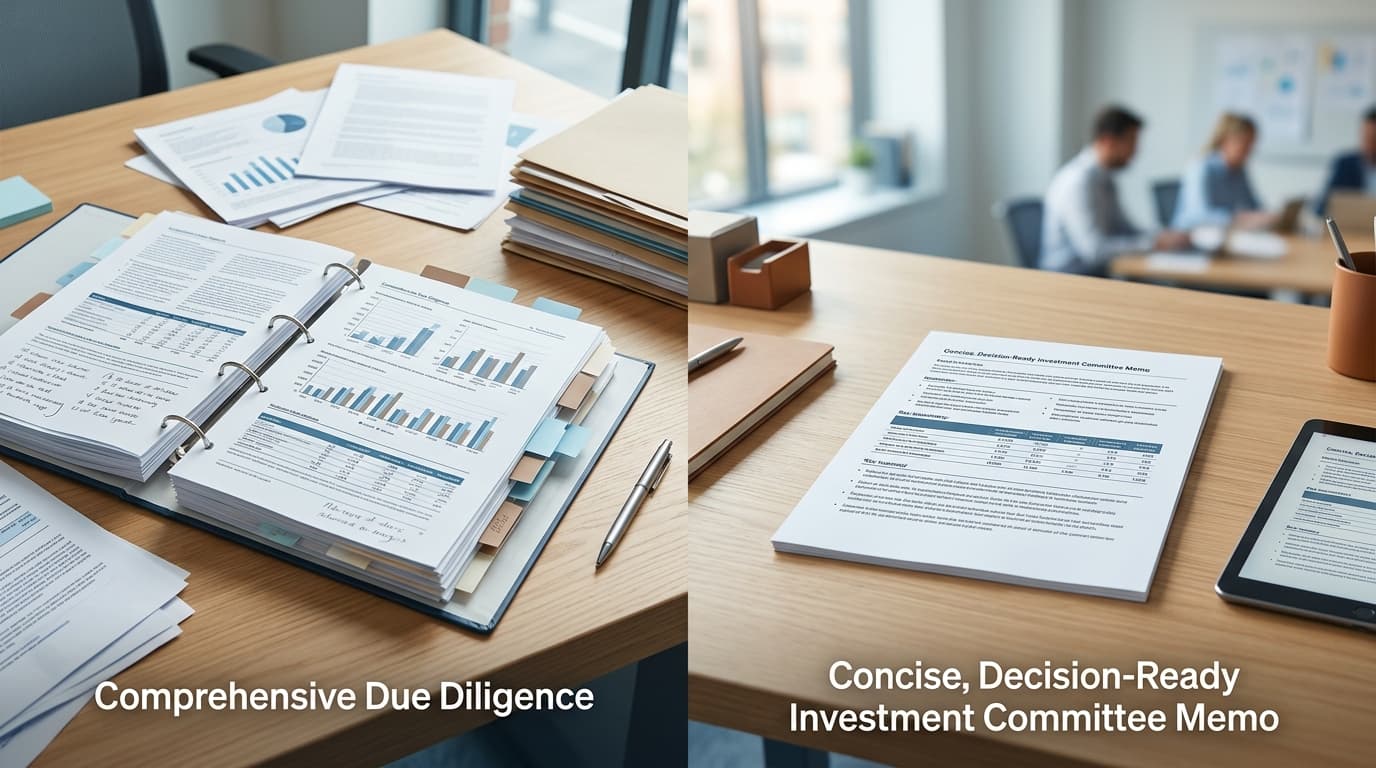
In today's high-stakes transaction landscape, investment and advisory teams face an unprecedented operational squeeze. Transaction timelines are being compressed under extreme pressure from competitive bidders, leaving deal teams with fractionally less time to evaluate complex corporate targets. According to PwC, these compressed deal cycles and increasingly complex target risk profiles put intense pressure on transaction professionals to execute quickly without overlooking critical findings. At the same time, the volume of data stored in virtual data rooms has ballooned, presenting an overwhelming quantity of unstructured materials, contracts, and financial models that must be manually analyzed. Under traditional processes, digesting these massive corpuses is a slow, sequential bottleneck. Deloitte notes that conducting due diligence under these compressed timeframes often forces teams to operate with imperfect access to information, where the margin for error is exceptionally thin.
- High volume of unstructured data: Ingesting, categorizing, and sorting thousands of PDF agreements, complex spreadsheets, and operational reports consumes days of manual analyst time before real risk analysis can begin.
- Increased risk of oversight under speed pressure: The pressure to submit competitive bids on accelerated schedules forces transaction teams to rely on high-level summaries, increasing the probability of missing material liabilities.
- Limitations of traditional checklists: Static checklists fail to capture context-aware risks or cross-reference subtle discrepancies buried deep across multiple disparate corporate workstreams.
- Loss of traceability: In standard manual reviews, findings are frequently detached from their original sources, making it difficult for senior partners to trace a flagged risk back to a specific clause or page.
The failure of traditional checklists is particularly evident when analyzing modern target companies. Static templates assume a standardized target structure, yet modern companies operate in complex regulatory landscapes with intricate compliance requirements. Applying a rigid, generic checklist often means missing the unique, sector-specific risks that actually determine deal value. Furthermore, manual checklists do not scale to handle thousands of pages of unstructured data, creating a massive execution gap. To overcome these limitations, modern transaction teams are moving away from manual tracking toward advanced M&A advisory software and AI-native systems like the AI-Analysis Engine that can dynamically scan documents, cross-reference clauses, and flag anomalies automatically.
This operational friction impacts every transaction profile differently, requiring specialized tools that fit specific deal requirements. Managing due diligence for private equity demands deep commercial and operational underwriting to identify post-acquisition value creation levers for PE funds. Conversely, due diligence for VC funds requires a lightweight, agile approach that matches the rapid pace of early-stage venture rounds. For investment banking teams, the manual overhead of traditional methods limits the number of mandates a firm can execute, prompting many partners to adopt modern platforms to optimize their M&A advisory workflows and scale deal throughput without increasing headcount. Ultimately, modernizing due diligence for deal teams is no longer just an efficiency gain; it is a structural necessity to maintain high transaction velocity and consistent quality.
Due Diligence for Private Equity: Operational Depth and Value Creation
In an era of elevated interest rates and compressed valuation multiples, private equity firms can no longer rely on market-driven multiple expansion to deliver target returns. According to Bain & Company's Global Private Equity Report, the shift toward higher borrowing costs has forced deal teams to find yield almost entirely through post-acquisition operational improvements. This macroeconomic reality is redefining how investment teams approach due diligence for private equity. To build a credible, underwriting-ready investment thesis, deal professionals must identify operational bottlenecks, cost structures, and commercial growth levers long before the transaction closes.
Identifying Operational Margin-Expansion Opportunities
Unlocking margin expansion requires an exhaustive analysis of the target company's operational footprint. Historically, manual contract reviews restricted deal teams to spot-checking only a fraction of customer and vendor agreements, leaving hidden risks and cost-saving opportunities unexamined. By leveraging the AI-Analysis Engine alongside automated Data Room Ingestion, investment professionals can systematically analyze entire repositories of transaction documents within minutes. This automated approach allows analysts to map pricing inconsistencies, volume discount leakage, and vendor redundancies across thousands of pages of unstructured data. The resulting insights feed directly into post-acquisition value creation plans, turning administrative findings into strategic EBITDA levers.
| Operational Workstream | Traditional Manual Bottleneck | AI-Powered Value Acceleration |
|---|---|---|
| Margin Expansion Analysis | Manual sampling of vendor contracts and invoices, leaving potential cost-saving and volume-discount opportunities undetected. | Automated ingestion and cross-referencing of all supply agreements to instantly flag pricing anomalies and procurement redundancies. |
| Compliance & Liability Review | Slow, manual compliance mapping of policies and governance structures, risking missed exposures under frameworks like GDPR or the EU AI Act. | Intelligent risk detection that flags non-compliant clauses, governance gaps, and ESG liabilities across the entire data room. |
| Synergy & Integration Playbooks | Siloed workstream reports that delay the creation of a post-merger integration playbook, stalling day-one execution. | Immediate synthesis of operational findings into structured, traceable playbook entries with direct links to the underlying source documents. |
Evaluating Compliance, Regulatory, and ESG Liabilities
Beyond identifying operational upside, safeguarding transaction value requires deep scrutiny of the target's regulatory standing and corporate governance. Non-compliance with evolving standards like the General Data Protection Regulation (GDPR) or the newly established EU AI Act can result in severe financial penalties and reputational damage. Evaluating these exposures is a critical component of modern due diligence for deal teams. Rather than relying on high-level checklists, analytical teams use Risk Radar to automate the extraction of regulatory policies, data protection agreements, and employment contracts. This technical depth allows buyers to evaluate compliance gaps objectively, ensuring that any identified liabilities are factored into the enterprise valuation or addressed through specific indemnities in the purchase agreement.
While the lightweight due diligence for VC funds might prioritize product-market fit and high-level IP reviews, buyout transactions demand a rigorous assessment of integration readiness. By using structured M&A advisory software capabilities to streamline complex cross-functional workstreams, deal partners can identify cultural, technological, and logistical integration hurdles early. The Report Builder then consolidates these operational findings into investor-ready briefings, ensuring that the transition from due diligence to day-one integration is seamless, highly traceable, and fully aligned with the investment thesis.
Due Diligence for VC Funds: Lightweight and Fast-Paced Evaluation
Unlike the extensive, multi-month timelines typical of private equity buyouts, venture capital transactions require a highly compressed and agile approach. In fast-paced funding rounds, deal teams face the challenge of conducting thorough risk assessments without exhausting founder bandwidth or losing competitive allocations. However, rushing the process can have severe consequences: industry analyses indicate that up to 73 percent of early-stage startups fail or encounter major delays during their initial professional due diligence cycles because of administrative, legal, or financial disorganization. For investment teams, performing structured due diligence for VC funds is not about matching the exhaustiveness of a majority buyout, but rather identifying key showstoppers before capital is committed.
The most critical legal hazard in venture transactions is the chain of custody for intellectual property. In the early stages of a company, software code, product designs, and patents are frequently developed by a fluid network of founders, employees, and independent contractors. If formal IP assignment agreements are missing or contain vague language, the target company may not legally own its core assets. Utilizing automated scanning platforms, such as Plausity's AI-Analysis Engine, enables deal teams to review hundreds of contractor agreements and employment contracts in minutes, flagging missing clauses and ensuring clear IP ownership before drafting terms.
Another frequent point of friction is the capitalization table. Over multiple micro-rounds, angel investments, convertible notes, and SAFEs, a startup's equity structure can become highly complex and prone to manual record-keeping errors. If option pool allocations, warrant triggers, or previous investor rights are incorrectly tracked, it can lead to severe dilution disputes or even collapse future funding rounds. In fact, estimates suggest that up to one-third of venture transactions encounter major hurdles or collapse at final stages due to unresolved capitalization table gaps. Through automated tools like Data Room Ingestion, investment professionals can upload historical corporate records and use the Risk Radar to cross-reference cap table spreadsheets against actual signed shareholder resolutions.
| Diligence Focus | Common Early-Stage Red Flag | Transaction Impact |
|---|---|---|
| Intellectual Property | Missing founder or independent contractor IP assignment agreements | Loss of proprietary assets, expensive post-closing litigation, or compromised valuation. |
| Capitalization Table | Undisclosed option grants or conflicting investor pro-rata rights | Dilution disputes, complex capitalization restructuring, or total deal failure |
| Technology Scalability | Undocumented open-source software dependencies or architecture bottlenecks | Immediate post-investment capital drain to address technical debt rather than growth |
Finally, assessing technology scalability requires a balance between rigorous technical review and founder velocity. Venture capitalists must verify that a startup's software architecture can handle sudden spikes in user demand and comply with evolving security standards, without subjecting founders to weeks of intrusive, manual auditing. Modern due diligence for deal teams leverages centralized workspaces, such as the Collaboration Hub, to coordinate external technical advisors and internal stakeholders efficiently. Once risks are identified, the Report Builder automatically structures the findings into executive briefings, enabling investment professionals to make informed, data-driven decisions that maintain founder momentum while protecting fund LPs.
M&A Advisory Software: Scaling Capacity while Maintaining Quality
Advisory firms face massive pressure to manage multiple client mandates using existing team headcounts. Historically, expanding the deal pipeline meant linear team growth, a luxury that modern cost pressures do not afford. With 80% of M&A executives expecting to sustain or increase deal activity in the coming years, boutique and mid-market firms must adopt advanced M&A advisory software to scale execution capacity. Without these tools, junior analysts are bogged down in manual documentation audits, reducing their focus on high-value client advisory.
Automating Repetitive Drafting and Report Building
One of the primary bottlenecks in transaction advisory is drafting due diligence reports. Investment professionals spend hundreds of hours copy-pasting data, summarizing contract clauses, and formatting slides. Transitioning to automated tools like the Report Builder helps standardize output quality across workstreams. Because the AI-Analysis Engine links every finding back to its source document, analysts can verify facts instantly, eliminating manual double-checking. This allows the deal team to maintain rigorous consistency regardless of the deal size or complexity.
Organizing Multi-Workstream Processes Seamlessly
Executing transactions requires seamless collaboration across legal, tax, and commercial workstreams. Traditionally, this meant fragmented email threads, siloed spreadsheets, and constant follow-ups. By utilizing a central Collaboration Hub, teams can manage tasks and track progress in real-time. This structural alignment ensures that all workstreams feed into a single source of truth, giving M&A project leads complete visibility over risk assessments.
- Accelerated Ingestion: Using Data Room Ingestion to instantly organize and scan thousands of multi-format documents, from tax filings to employment contracts.
- Automated Risk Detection: Deploying Risk Radar to flag material liabilities, unusual change-of-control provisions, and financial discrepancies.
- Consolidated Coordination: Coordinating legal, tax, and financial streams in one digital workspace to avoid duplicate effort.
- Sourced Output Drafting: Generating reliable reports where every analysis point is fully traceable to its page-level source.
Leveraging these advanced transaction solutions allows advisory firms to scale their execution capacity without increasing operational overhead. Ultimately, the goal of modern due diligence software is to liberate analysts from the manual labor of data extraction, allowing them to focus on negotiating terms, identifying valuation upside, and delivering strategic insight to clients.
Due Diligence for Deal Teams: Workflows Built for Real-World Analysts
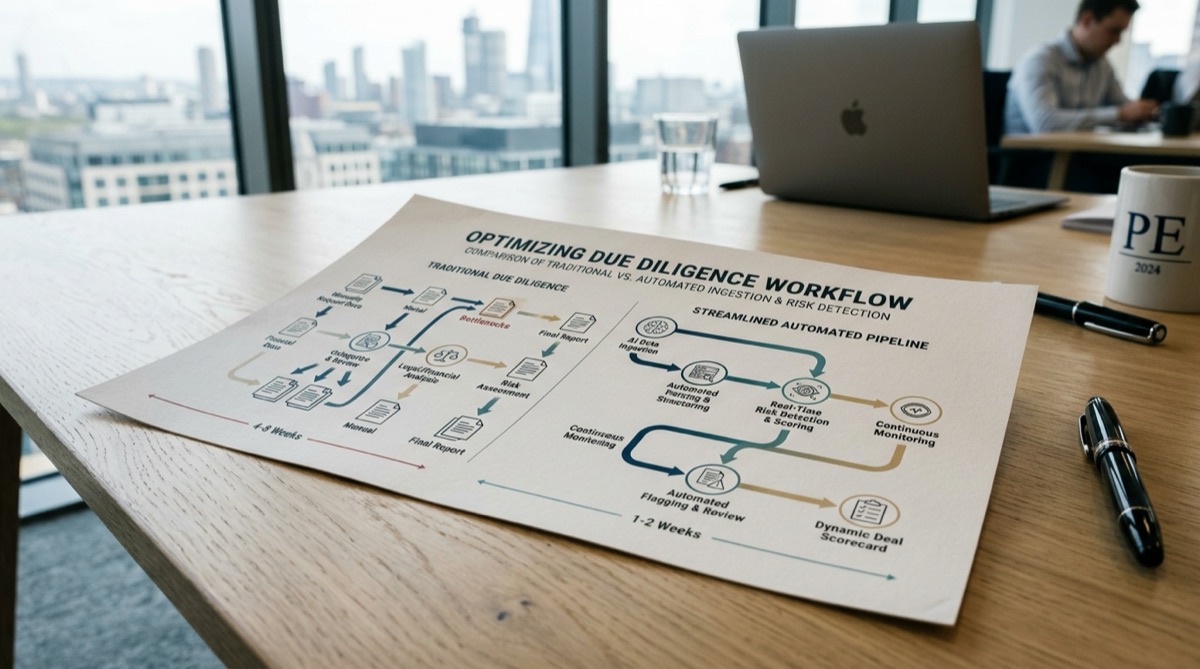
Deal teams in private equity, venture capital, and M&A advisory firms operate under intense time constraints during transaction windows. McKinsey research indicates that generative AI can compress weeks of manual due diligence analysis into days, allowing analysts to dedicate more capacity to transaction logic and post-deal value creation rather than administrative data indexing. To capitalize on these efficiencies, modern transaction teams must replace manual bottlenecks with automated, traceable workflows that support higher deal volume without compromising on quality. Deploying dedicated due diligence for deal teams is the primary lever for standardizing these workloads.
Establishing a secure, direct connection to virtual data rooms (VDRs) represents the critical first phase of an accelerated timeline. In a traditional workflow, junior analysts must manually download thousands of files and organize them into local folders, a process that is highly susceptible to missed updates. Utilizing automated utilities like Data Room Ingestion allows deal teams to link external data rooms directly to their analytical workspaces. This automatic synchronization ingests, structures, and normalizes disparate documents such as contracts, financial statements, and regulatory filings. Once indexed, these documents feed directly into the AI-Analysis Engine for deep evaluation, ensuring that key transactional evidence is captured immediately and remains fully traceable back to its source.
| Workflow Stage | Manual Execution | Automated Platform Execution |
|---|---|---|
| Information Gathering | Manual file downloads from virtual data rooms and offline file sorting. | Direct connection via Data Room Ingestion with automatic sorting of files. |
| Risk Assessment | Reading thousands of document pages to find legal or financial issues. | Algorithmic scanning with Risk Radar to flag liabilities with source-traceable links. |
| Team Coordination | Managing assignments via standalone spreadsheets and scattered emails. | Real-time task tracking and collaboration inside a centralized Hub. |
Moving from ingestion to analysis, the primary challenge is identifying and verifying material deal risks. Analysts frequently spend hours reviewing commercial agreements, tax filings, and corporate policies to surface liabilities. Relying on manually managed checklists increases the risk of overlooking critical clauses. Transitioning this review to automated risk intelligence, such as Risk Radar, allows analysts to instantly isolate and score potential deal-breakers based on materiality and legal exposure. Because every identified risk is linked directly back to its source text, senior decision-makers can verify findings instantly. This level of precision helps VC & PE Fund Investment Professionals maintain standard deal processes and deep diligence depth during highly competitive transactions. It ensures that teams can execute comprehensive due diligence for VC funds and private equity transactions without sacrificing analytical speed.
Finally, complex M&A transactions demand synchronized coordination across multiple specialized themes, including tax, legal, and commercial analysts. Traditional methods of offline communication often lead to isolated information silos and delayed handoffs. Centralizing these workstreams within the Collaboration Hub allows M&A Advisory Firm Partners & Analysts to track task status and assign workstreams dynamically. This real-time coordination helps Corporate M&A Project Leads monitor overall progress across specialties. By combining structured tracking with automated report creation using tools like Report Builder, advisory firms can utilize high-quality M&A advisory software to scale their deal capacity and ensure consistent deliverable standards.
The New Era of AI-Native Due Diligence Platforms
In modern transaction environments, deal velocity has become a primary driver of competitive advantage. Traditional, manual due diligence workflows often represent a severe operational bottleneck, where transaction teams spend days or weeks reviewing hundreds of index folders in virtual data rooms. Research by Bain & Company underscores that a lack of early, systematic diligence and digital underinvestment frequently derails post-deal synergies and transaction timelines. To mitigate these risks, investment and advisory teams are turning to AI-native platforms that can automate complex workflows without compromising analytical depth. For VC and PE funds managing competitive processes, this transition from manual review to scalable technology is critical to securing high-value opportunities before competing buyers can complete their assessments.
Source-Level Traceability and Advanced Ingestion
The foundation of an AI-native due diligence platform is its ability to convert unstructured data into structured intelligence quickly. Using specialised software modules like Data Room Ingestion, deal teams can secure and scan virtual data rooms, importing thousands of multi-format files in minutes. These documents are then analyzed by the AI-Analysis Engine, which reads and interprets contracts, legal structures, and financial models. Unlike standard keyword-search tools, this advanced engine identifies semantic patterns and complex legal commitments. Crucially, to prevent inaccuracies or hallucinations, the platform anchors every finding with source-level traceability. This ensures that any highlighted risk or legal obligation is linked directly back to its exact page in the source document, giving investment professionals a clear audit trail.
| Dimension | Traditional Manual Review | AI-Native Platforms |
|---|---|---|
| Setup and Ingestion | Manual file sorting and folder index mapping over days or weeks. | Rapid, secure scanning of data rooms within minutes. |
| Analysis Scope | Sample-based contract reviews and selective spot checks due to time constraints. | Deep, simultaneous semantic analysis of thousands of documents. |
| Traceability | Time-consuming manual cross-referencing across separate physical or digital files. | Automated findings linked directly to exact source pages to ensure traceability. |
Multi-Format Reasoning and Anomalies Flagging
Beyond basic ingestion, modern transaction software must possess the reasoning capabilities necessary to identify hidden exposures. The Risk Radar acts as an automated risk intelligence tool, evaluating findings based on financial exposure, materiality, and transaction relevance. Rather than checking documents in isolation, the reasoning engine cross-references information across multiple workstreams to surface anomalies. For example, it might compare liabilities listed in financial statements with the actual provisions found in supplier contracts. For M&A project leads, this multi-format reasoning serves as an early-warning mechanism that highlights potential deal-breakers before final transaction documents are drafted.
Educational Compliance: Evaluating Security Frameworks
When selecting due diligence technology, deal teams must carefully evaluate the security frameworks that protect their proprietary deal data. Standard security audits like SOC 2 Type II and certifications like ISO 27001 serve as industry benchmarks for assessing a vendor's internal data-security controls, encryption standards, and threat-mitigation protocols. Additionally, with the rise of automated intelligence, compliance with newer standards like the ISO 42001 framework for artificial intelligence and the European Union AI Act has become highly relevant. These frameworks offer structured guidelines on data privacy, model governance, and algorithmic transparency. Buyers should prioritize platforms that understand these educational standards and implement rigorous, non-custodial data practices to ensure that sensitive company documents are never used to train public models.
For M&A advisory firms, adopting these secure, automated workflows allows teams to standardise high-quality outputs and manage larger deal pipelines with the same headcount. Once the core document analysis is complete, integrated tools such as the Report Builder and the Collaboration Hub allow analysts to instantly compile structured, investor-ready reports, keeping the overall deal momentum high while maintaining absolute precision.