The Bottleneck: Why Manual Investment Committee Workflows Cost PE and VC Teams Precious Days
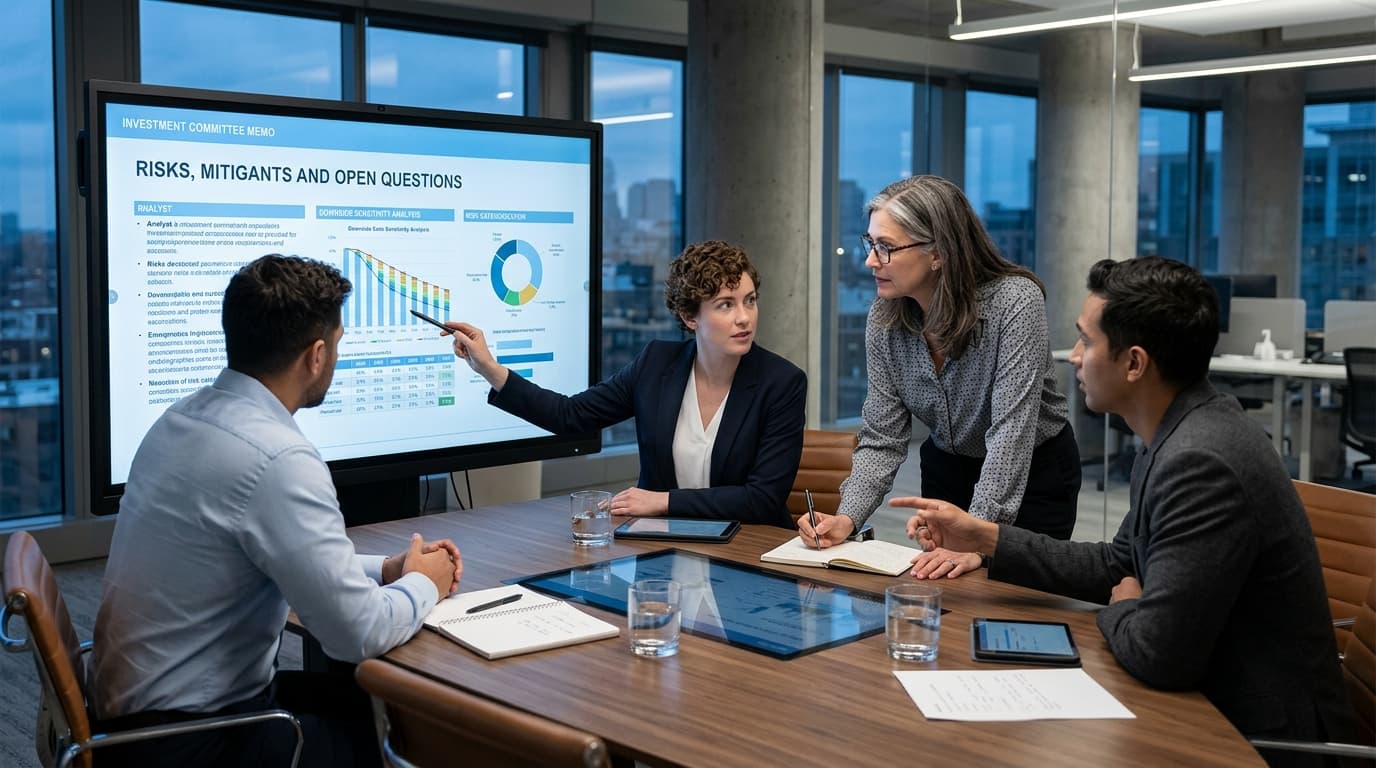
For investment teams at VC and PE funds, the path to a transaction is defined by a high-stakes race against the clock. The traditional investment committee workflow is notoriously bottlenecked by a manual, labor-intensive preparation process. Before an investment committee (IC) can make a nine-figure capital decision, the deal team must ingest hundreds of disparate files inside a virtual data room (VDR), cross-reference management projections against actual performance, and construct an exhaustive decision document. Under intense bid-deadline pressure, this administrative burden becomes more than just an operational headache; it is a strategic risk that can result in missed opportunities or rushed underwriting.
The Hidden Hours: Data Extraction and Sourcing
A senior associate at a mid-market PE fund typically spends 15 to 25 hours on data-gathering and structuring before drafting an investment memo begins. This manual process occurs because teams lack an integrated due diligence report generator to automate compilation. Instead, analysts spend critical days acting as administrative aggregators, manually transcribing figures and cross-referencing footnotes just to build the evidentiary foundation for the deal.
- Scattered Data Extraction: Pulling unstructured historical EBITDA figures, balance sheet items, and customer retention metrics from multi-page PDFs and unformatted spreadsheets.
- Thesis Discrepancy Reconciliation: Manually comparing management's optimistic hockey-stick growth projections in the CIM against the company's actual ledger accounts.
- Risk Mapping and Sourcing: Identifying legal exposures, pending litigation, or key-man risks across hundreds of files, then painstakingly citing the exact source documents for the IC's review.
The Cost of Friction: Missing the Bid Window
Under extreme bid-deadline pressure, slow draft assembly is a critical vulnerability. When a competitive auction has a hard bidding deadline, any delay in compiling findings can result in a rushed investment recommendation, an incomplete risk assessment, or a missed bid entirely. A delayed draft leaves zero room for thorough deal thesis validation or collaborative pressure-testing by senior partners. Deal teams are forced to choose between speed and diligence - a trade-off that is unacceptable when committing massive amounts of capital.
To eliminate this bottleneck, modern funds are shifting toward comprehensive IC memo automation within their investment screening workflow. By integrating AI-native capabilities, such as Plausity's AI-Analysis Engine and automated Data Room Ingestion, investment professionals can instantly synthesize unstructured VDR materials. Instead of wasting dozens of hours on manual collation, teams can begin analyzing structured findings and verifying their core deal thesis against fund underwriting criteria in a fraction of the time. This transition not only preserves hours of analyst capacity but ensures that decision-makers receive institutional-grade, fully audited documents before the bid clock runs out.
Accelerating Decisions: How IC Memo Automation Shrinks Timelines from Days to Hours
In the high-stakes environment of private equity and venture capital, the period leading up to a binding bid deadline is defined by extreme time pressure for VC and PE fund investment professionals. Deal teams must synthesize thousands of unstructured data points, from complex financial models to legal agreements, and translate them into a cohesive investment thesis. Traditionally, the transition from due diligence to the final decision document represents a severe operational bottleneck. The investment committee workflow often grinds to a halt as analysts spend valuable days manually compiling findings, editing templates, and proofreading text. By introducing IC memo automation, investment firms can compress this final, critical sprint, allowing professionals to focus on strategic risk assessment rather than repetitive document compilation.
From Data Room Chaos to Structured Insights in Minutes
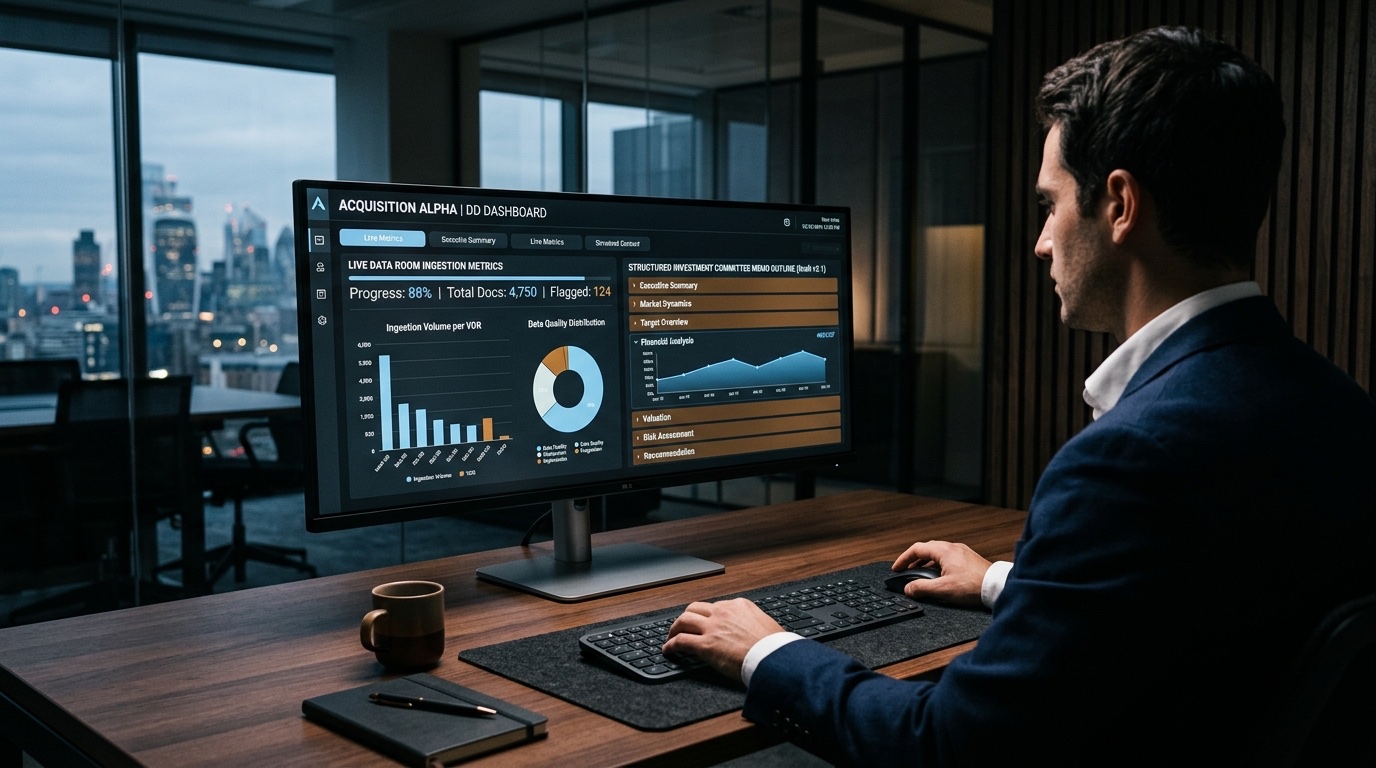
The acceleration begins at the ingestion stage. Rather than assigning junior analysts to manually sort and review hundreds of virtual data room documents over several weeks, modern deal teams utilize automated ingestion platforms. Plausity's Data Room Ingestion tool connects directly to major virtual data rooms in minutes. It instantly scans, processes, and classifies files such as contracts, PDFs, and spreadsheets. This automated pipeline feeds directly into the AI-Analysis Engine, which cross-references data points to ensure that no critical anomalies or legal risks are overlooked during the exploratory phase of diligence.
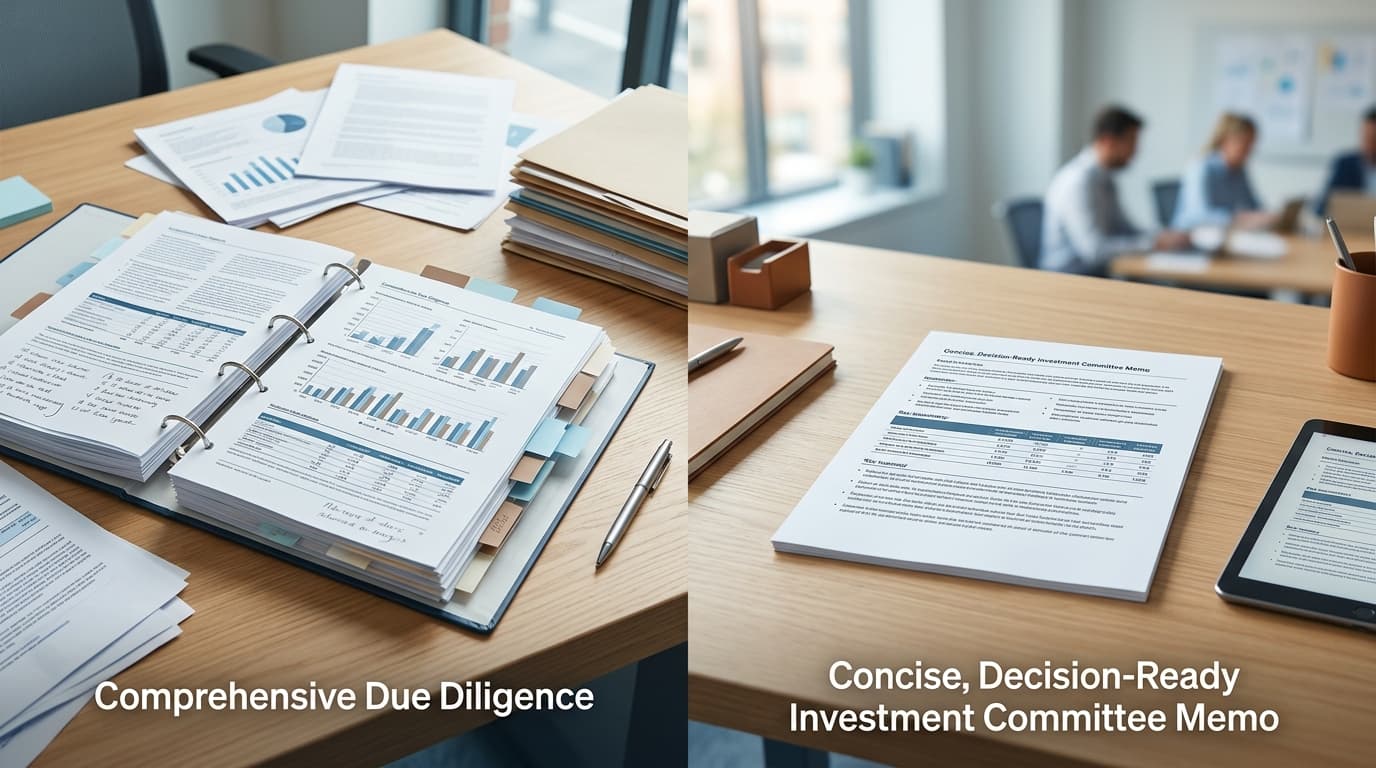
Once the data is structured, the draft creation process begins. Instead of spending several days manually writing the investment committee memo, teams use Plausity's Report Builder as an intelligent due diligence report generator. The platform pulls verified, source-traceable insights directly from the ingested documents to populate professional, investment-committee-ready templates. This automated workflow reduces the drafting timeline from days to mere hours, compressing a process that traditionally consumed up to forty percent of an analyst's total diligence capacity. The efficiency gains of transitioning from raw data room findings to a comprehensive deal-ready report allow teams to meet tight bid deadlines with complete analytical confidence.
| Diligence Workflow Step | Traditional Manual Process | Automated Process (Plausity) |
|---|---|---|
| VDR Setup and Sorting | Manual folder review and document indexing taking days | Automated connection and categorization in minutes via Data Room Ingestion |
| Finding Synthesis | Siloed workstreams and manual copy-pasting across files | Seamless multi-document cross-referencing by the AI-Analysis Engine |
| Memo Compilation | Days of drafting, formatting, and structural editing | Within hours using Report Builder as a due diligence report generator |
| Source Verification | Manual spot-checking of footnotes and original contract pages | Instant, clickable source traceability back to the exact VDR document page |
By modernizing this stage of the pipeline, deal teams achieve more than just speed. When a due diligence report generator automates the tedious mechanics of content generation, it frees senior professionals to focus on deep underwriting validation and deal thesis validation. Rather than rushing to complete a document before a strict bid deadline, the investment committee workflow transforms into a strategic exercise, ensuring that every identified risk is quantified, and every investment thesis is thoroughly stress-tested against the fund's strict capital deployment criteria.
Active Deal Thesis Validation: Aligning Targets with Strict Underwriting Criteria
In a transaction market defined by compressed bidding windows, the ability to rapidly validate a target's core value proposition determines whether a deal team wins a quality asset or retreats. According to the Bain and Company Global Private Equity Report, the industry has entered a hyper-competitive era where the margin for lazy underwriting has entirely disappeared, making rigorous, evidence-based conviction the ultimate differentiator. Traditional manual approaches to deal thesis validation cannot keep pace with these compressed timelines. By deploying an automated investment screening workflow, investment professionals at PE funds can instantly cross-reference incoming data against their fund's strict underwriting rules, ensuring that off-strategy or high-risk targets are flagged or filtered before significant resources are spent.
The Mechanics of an Automated Investment Screening Workflow
Establishing an automated investment screening workflow transforms the early-stage diligence process from a series of ad-hoc checks into a highly structured, repeatable protocol. This system automatically evaluates key metrics against fund rules the moment data becomes available, immediately following the initial Data Room Ingestion phase. For example, if a fund's underwriting criteria mandate that no single customer can represent more than 15% of total revenue, the system scans the customer ledger, computes concentration metrics, and flags deviations. By hardcoding these screening criteria into the initial data ingestion phase, deal teams eliminate human error and bypass the administrative drag of manual Excel reconstruction, allowing them to focus intellectual capital on strategic deal positioning.
Verifying CIM Claims with the AI-Analysis Engine
Confidential Information Memorandums (CIMs) are marketing documents designed to showcase a target in the best possible light, often masking operational or financial vulnerabilities. To uncover the ground truth under extreme time pressure, deal teams leverage Plausity's AI-Analysis Engine to parse, interpret, and verify CIM claims against raw virtual data room (VDR) documents. The engine cross-references qualitative assertions with empirical data. If a CIM highlights a resilient and diversified client base, the platform instantly cross-references this claim against raw invoices, customer contracts, and historical billing files to detect unstated churn, customer concentration risks, or hidden discounting schemes.
- CIM Claim: The target maintains a 95% annual gross revenue retention rate. AI Verification: Cross-references billing ledgers and identifies that selective discounting and contract restructurings mask an actual underlying customer retention rate of 87%.
- CIM Claim: Patents and proprietary intellectual property protect the core product lines. AI Verification: Scans patent registries, active licensing agreements, and legal dispute histories to verify clear title and highlight potential infringement risks.
- CIM Claim: Operational margins are projected to expand by 400 basis points due to scale. AI Verification: Compares historical vendor pricing files against current contracts to identify whether supplier inflation will erode projected margin gains.
Stress-Testing Projections Against Severe Market Assumptions
A robust deal thesis validation process must survive the friction of economic downturns and market volatility. Beyond verifying historical performance, deal teams must stress-test forward-looking financial projections against severe market assumptions, such as sudden customer churn, wage inflation, or supply chain bottlenecks. Using advanced risk intelligence tools to evaluate these conditions, investment professionals can model complex downside scenarios directly from the ingested data room models. The platform calculates the downstream effects of these adverse variables, enabling teams to determine if the target still clears the fund's hurdle rate. These validated projections and verified risks are then seamlessly integrated into Plausity's Risk Radar to elevate the entire investment committee workflow, feeding into the Report Builder as an automated due diligence report generator. This ensures that the deal team transitions from raw due diligence findings to a polished, IC-ready decision document in hours rather than days.
Real-Time Risk Extraction: Spotting Material Exposures with Risk Radar
For VC and PE fund investment professionals, the modern deal-making landscape is characterized by hyper-accelerated timelines. While a standard buyside commercial due diligence process traditionally spans four to eight weeks, competitive auction environments frequently compress this window into a highly demanding two-to-three-week timeframe. This compressed duration creates substantial risk blindspots for investment teams. When analysts and associates are forced to manually comb through hundreds of files in virtual data rooms under extreme time pressure, critical exposures such as off-balance-sheet liabilities, pending regulatory disputes, or restrictive change-of-control clauses are easily overlooked, undermining the core deal thesis validation process.
In a traditional investment screening workflow, the trade-off between speed and depth has historically been viewed as unavoidable. Deal teams either spend valuable days performing exhaustive manual reviews, risking missing the bid deadline, or they truncate their scope, which introduces severe post-acquisition integration hazards. This systemic compromise disrupts the standard investment committee workflow. Rather than entering negotiations with absolute confidence, investment professionals often present highly qualified findings, relying on transitional service agreements or indemnity clauses to hedge against unquantified risks.
Mitigating Blindspots via Automated Risk Radar Identification
Plausity solves this fundamental friction by introducing automated risk detection directly into the deal evaluation process. Through Plausity's Findings & Risk Intelligence capabilities, deal teams can deploy Risk Radar to instantly analyze, categorize, and prioritize material exposures across thousands of documents. By using the core AI-Analysis Engine, Risk Radar cross-references findings against custom underwriting criteria, flagging discrepancies in seconds rather than days. This automated process ensures that even under a compressed three-week timeline, no material contract clause, regulatory filing, or liability is ignored, thereby establishing a bulletproof foundation for deal thesis validation.
| Risk Category | Traditional 3-Week Diligence Blindspot | Risk Radar Automated Mitigation |
|---|---|---|
| Change of Control & Legal Exposure | Restrictive termination terms or ownership transfer penalties are buried in commercial contracts and missed due to sampling limits. | Automated scanning of all commercial and vendor agreements to extract and flag restrictive clauses instantly. |
| Regulatory & Compliance Gaps | Filing discrepancies, pending environmental litigation, or jurisdictional licensing gaps are overlooked under intense time pressure. | Comprehensive cross-referencing of public records and data room filings using the AI-Analysis Engine to detect compliance inconsistencies. |
| Financial & Underwriting Variance | Working capital adjustments or hidden liabilities are not reconciled against the initial deal model due to manual calculation limits. | Real-time extraction and verification of financial tables, highlighting variances that directly affect the investment screening workflow. |
Converting these findings into actionable intelligence is where traditional processes suffer the longest delays. Historically, translating findings from raw notes into a polished format required manual labor that consumed the final 48 hours before an investment committee meeting. By utilizing Plausity's automated due diligence report generator, teams can instantly compile these structured risks into a clear, investor-ready mitigation table. The Report Builder extracts validated risks directly from the Risk Radar log, appending full source traceability to each point. This seamless integration accelerates IC memo automation, transforming the traditional investment committee workflow by turning high-pressure diligence findings into robust, defensive, and IC-ready decision documents in hours instead of days.
Comparing Workflows: Traditional Due Diligence vs AI-Powered Platforms
In a traditional investment screening workflow, deal teams are routinely constrained by the linear nature of manual data room analysis. Analysts must manually review hundreds of legal filings, commercial models, and customer schedules to isolate key performance indicators. This manual bottleneck slows down the overall investment committee workflow, as the synthesis of raw data into analytical prose requires days of repetitive drafting. By transitioning to AI-powered due diligence, private equity and venture capital funds can compress these timelines from weeks to hours while ensuring that every finding is systematically cross-referenced against the fund's underwriting criteria.
| Workflow Dimension | Traditional Due Diligence | AI-Powered Platform (Plausity) |
|---|---|---|
| Evaluation Timeline | Typically up to 46 days on average per transaction | Ready in hours, compressing turnaround times significantly |
| Document Analysis | Manual, linear sampling of virtual data room documents | Automated ingestion and comprehensive processing via the AI-Analysis Engine |
| Risk Assessment | Siloed legal, financial, and technical reviews | Continuous cross-workstream synthesis using Risk Radar |
| Report Generation | Manual assembly of slides and Word documents over several days | Instant drafting of structured deliverables using an automated due diligence report generator |
Real-Time Alignment and Deal Thesis Validation
A common vulnerability in traditional processes is the lack of real-time visibility across workstreams. When commercial analysts discover a regulatory discrepancy, the legal team might spend hours continuing on an obsolete path. To solve this, Plausity integrates a central Collaboration Hub that coordinates deal team activities, aligns disparate workstreams, and shares critical insights in real-time. This interactive workspace enables teams to achieve instant deal thesis validation by mapping newly uncovered VDR findings directly against the fund's preset investment criteria. If a commercial risk contradicts an underwriting rule, the platform flags the deviation immediately, keeping all partners aligned and preventing wasted analytical hours.
Step-by-Step Impact on Turnaround Times
To understand the efficiency gains, we can break down the transition from initial virtual data room access to the completed investment committee memo into a multi-step sequence:
- First, the Data Room Ingestion tool automatically scans and classifies hundreds of multi-format documents, from tax certificates to complex legal agreements, within minutes instead of days.
- Second, the AI-Analysis Engine parses the ingested files to extract structural metrics, identify anomalies, and cross-reference financial statements against raw operational data.
- Third, the Risk Radar evaluates each discrepancy based on financial materiality and transaction relevance, surfacing risks that require immediate buyer attention.
- Fourth, the Report Builder automatically drafts the initial document, turning the consolidated findings into structured, investor-ready sections that match the fund's template.
- Fifth, the investment team utilizes IC memo automation within the platform to refine the drafted narrative, verify citations, and finalize the decision document in a fraction of the time.
Ultimately, compressing these workflows does not mean cutting corners. By shifting from slow, manual extraction to systematic AI-driven synthesis, investment professionals can focus their limited hours on strategic decision-making rather than administrative report compilation. This dual advantage of speed and rigor is what allows modern funds to consistently meet tight bid deadlines with high-conviction decisions.
Plausity brings AI-native analysis to this workstream. Explore Plausity's Report Builder, or read more on how a traceable risk register feeds directly into IC materials.