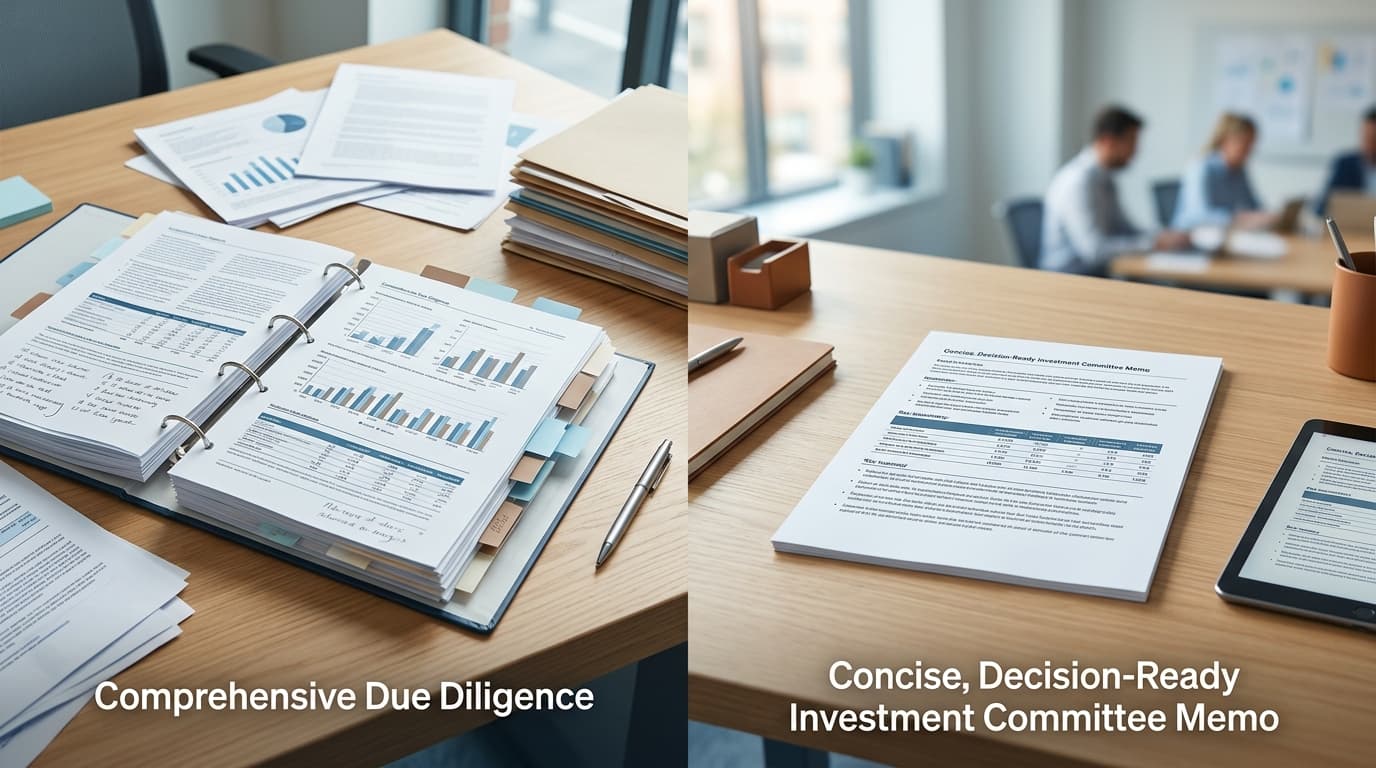
The New Era of M&A: Why Commercial Due Diligence in 2026 Demands Speed
Commercial due diligence in 2026 requires balancing depth with extreme speed. Here is a step-by-step framework to evaluate market dynamics, customer behavior, and competitive moats using an AI-native checklist workflow.
The global M&A market has entered a period of intense reactivation. After a prolonged period of strategic caution, global deal value surged by 40 percent to reach an estimated $4.9 trillion, driven by a wave of consolidation, corporate restructuring, and technology-driven investments. This rapid market acceleration has completely redefined transaction timelines. As discussed in recent M&A trends analyses, deal professionals no longer have the luxury of multi-week exploratory phases. High-quality assets attract multiple competitive bidders almost immediately, making rapid market validation and swift execution the primary differentiators of successful funds.
Navigating the Competitive 2026 Deal Environment
To secure high-conviction opportunities in this environment, buy-side teams must compress the time from initial letter of intent to final binding offer without sacrificing depth. For corporate M&A project leads and investment partners alike, a structured due diligence checklist acts as the operational anchor, with a heavy emphasis on the commercial due diligence checklist to validate market positioning. Traditional commercial due diligence often stalls because analysts spend days manually structuring unstructured files rather than analyzing market dynamics. A modern commercial due diligence checklist must address this structural inefficiency by integrating automated tools that streamline customer cohort reviews, contract analysis, and competitor profiling.
- Data accessibility issues where critical target customer contracts and market feedback are buried in unorganized subfolders.
- Inability to perform real-time customer cohort analysis and churn modeling due to static, outdated spreadsheets.
- Misalignment on commercial due diligence goals, leading to bloated scoping and redundant analyst work.
- Severe delays in translating raw market data into investment-committee-ready insights while competitors move forward.
Overcoming Data Room Bottlenecks and Setting Clear CDD Goals
Overcoming these operational bottlenecks requires shifting from legacy manual research to an AI-native due diligence platform that accelerates data processing. By leveraging Plausity's Data Room Ingestion, deal teams can seamlessly connect to virtual data rooms and scan hundreds of documents in minutes, bypassing the manual categorization phase entirely. Once ingested, the AI-Analysis Engine reads and cross-references multi-format contracts and financial models to establish immediate clarity. This allows M&A advisory partners and analysts to focus their efforts on setting clear commercial due diligence goals, assessing real market demand, and identifying growth opportunities, rather than drowning in data extraction.
Phase 1: Market Dynamics, Sizing, and Structural Headwinds
With global M&A deal value rebounding by 43% heading into 2026, reaching multi-trillion-dollar levels in transaction value, the dealmaking environment has returned to a fast-paced cadence where slow, legacy validation methods represent a massive risk to deal execution. To secure high-yielding assets, investment professionals must verify the target company's commercial runway immediately after entering the virtual data room. This phase forms the bedrock of any modern commercial due diligence checklist, shifting the investment thesis from simple historical financial performance to forward-looking, defensible market realities. By systematically analyzing the target's total addressable market (TAM) alongside structural growth vectors, corporate development and private equity teams can confirm if a target's growth projections are grounded in true customer demand or merely aggressive Excel modeling.
Sizing the True TAM and SAM: Moving Beyond Top-Down Assumptions
Standard commercial diligence often falls victim to top-down market assessments that rely on outdated industry reports or inflated marketing decks. In the 2026 landscape, a rigorous bottom-up calculation of the Total Addressable Market (TAM) and Serviceable Addressable Market (SAM) is essential. Rather than accepting the target's broad classifications, deal teams must build granular market models based on real transactional velocity, average contract values, and actual buyer behavior. Incorporating tools like Plausity's AI-Analysis Engine allows advisors to cross-reference thousands of disparate customer contracts and operational filings within hours, mapping them against the broader M&A trends that define the sector. This level of bottom-up scrutiny ensures that the investment committee relies on verified market volume rather than hypothetical customer bases.
Evaluating Structural Headwinds, Regulatory Shifts, and Geographic Realities
True commercial validation requires an honest evaluation of structural headwinds that can quickly derail growth. For instance, post-globalization realignments and rapid regulatory shifts can instantly restrict a target's geographical expansion plans. When examining cross-border assets, VC and PE professionals must model the localized compliance costs of new regulatory frameworks, such as international data transfer rules or strict supply-chain traceability laws. To automate this cross-reference, M&A advisory teams can leverage Plausity's Data Room Ingestion to parse complex, multi-jurisdictional contracts and regulatory filings, extracting potential vulnerabilities before they manifest as post-deal liabilities. This step acts as an early-warning system, highlighting whether a target's expansion roadmap is operationally and legally viable.
- Verify bottom-up TAM using actual customer transaction sizes rather than accepting broad, top-down analyst reports.
- Assess historical and projected compound annual growth rates against verified sector benchmarks to spot outlier assumptions.
- Map cross-border regulatory threats and localized compliance standards that could impede geographic expansion plans.
- Evaluate raw material and labor dependencies to model potential margin compression from structural supply chain shifts.
- Scan virtual data room contracts using Risk Radar to identify customer concentration risks and restrictive geographic exclusivity clauses.
| Market Sizing Metric | Target-Stated Approach | Diligence Verification Standard |
|---|---|---|
| Total Addressable Market | Broad top-down industry valuation based on generic, non-specialized analyst estimates | Bottom-up mapping using localized contract sizes, verified transaction volumes, and peer group penetration models |
| Serviceable Addressable Market | Aggressive geographic expansion assumptions assuming immediate addressability in new locales | Feasibility analysis of local regulatory barriers, competitor density, and distribution costs |
| Structural Growth Vectors | Assumption of stable demand patterns and zero regulatory friction over five years | Scenario testing against compliance changes, shifting trade policies, and macroeconomic realignments |
Phase 2: Customer Validation and Revenue Stability Analysis
In the highly competitive corporate finance landscape, traditional, labor-intensive diligence processes create severe bottlenecks that can derail a transaction. When evaluating an acquisition target, assessing historical performance is no longer sufficient; deal teams must validate the long-term predictability and resilience of future cash flows. Buyout funds now face average holding periods near seven years, making detailed customer lifetime value calculations a critical determinant of deal success. For corporate M&A project leads and investment professionals, a robust commercial due diligence checklist must prioritize deep customer validation to safeguard expected returns across these extended holding periods.
Analyzing Customer Concentration Risk
Customer concentration remains one of the most critical, yet frequently underestimated, risks in mid-market mergers and acquisitions. When a target company relies heavily on a handful of clients, the loss of a single major account post-acquisition can dismantle the entire investment thesis. M&A advisory firm partners and analysts must evaluate revenue concentration thresholds to determine whether the target's customer base is healthy or dangerously consolidated. This analysis fits directly into the broader due diligence checklist that transaction teams deploy to evaluate commercial viability and business resilience.
| Concentration Level | Single-Customer Revenue Share | Risk Assessment and Mitigation Workflows |
|---|---|---|
| Low Concentration | Below 10% | Clean customer profile. Standard validation of major accounts is sufficient with minimal structural risk. |
| Moderate Concentration | Between 10% and 20% | Manageable risk. Requires deeper contract audits, review of renewal cycles, and structured interviews with key client contacts. |
| High Concentration | Exceeding 20% | Significant operational risk. Requires structuring specific transactional protections, such as earn-outs, alongside comprehensive direct customer validation. |
Cohort Analysis and Customer Churn Assessment
Evaluating customer health requires a cohort-based churn analysis to separate short-term revenue fluctuations from long-term stability. Deal teams must analyze historical cohorts over a multi-year horizon to measure both net revenue retention and gross revenue retention. This cohort-based analysis must be paired with direct customer sentiment tracking, gathering objective feedback on product quality, competitive alternatives, and pricing trends. These efforts align with the latest private equity outlook where firms seek deeper operational clarity to support structured valuation modeling.
Accelerating Validation with AI-Native Workflows
In a fast-paced transaction market, conducting these complex contract and cohort analyses manually slows down deal execution and leaves critical details uncovered. Integrating AI-native solutions into the commercial diligence process transforms how teams handle complex customer contract databases. By utilizing Data Room Ingestion, deal teams can seamlessly upload and organize raw documents from virtual data rooms. Once ingested, the AI-Analysis Engine reads and structures complex customer agreements, instantly identifying critical details such as change-of-control clauses and termination liabilities. This automated extraction allows the Risk Radar to flag customer concentration risks and contract risks immediately, providing partners with the precise, real-time insights needed to negotiate structural protections and ensure transaction security.
Phase 3: Competitive Positioning and Market Moat Evaluation
The year 2026 is experiencing a dramatic resurgence in deal-making activity. According to the Deloitte 2026 M&A Trends Survey, more than 80 percent of corporate and private equity executives expect deal volume and value to rise over the coming year. In this highly competitive landscape, the risk of overpaying for a low-moat target is exceptionally high. Modern deal teams can no longer rely on slow, manual reviews to dissect market positioning. To avoid bidding wars for businesses that lack a true sustainable advantage, implementing a structured commercial due diligence checklist that prioritizes competitive defense mechanisms is critical to avoid overvaluing a business. For corporate development executives and M&A advisory partners, validating these defensibility layers quickly determines whether a target warrants a premium valuation.
Analyzing Pricing Power and Margin Stability
A target's cost structure and defensive capabilities are directly reflected in its financial resilience. True competitive differentiation is demonstrated when a target can maintain stable margins even when raw material costs or market wages fluctuate. By looking at long-term customer cohort retention and contract terms, advisors can identify if the target possesses genuine pricing power or if its margins are vulnerable to erosion. Evaluating these patterns requires auditing massive volumes of customer contracts, invoice histories, and market pricing benchmarks. By leveraging Plausity's Data Room Ingestion tool to instantly process customer billing schedules and supplier agreements, deal teams can map pricing changes over time. The AI-Analysis Engine then compares these historical rates against external market benchmarks to flag margin vulnerabilities.
Identifying Emerging Digital Disruptors and Competitors
A target might appear dominant today, but rapid innovation and regional disruptors can quickly erode its market share. Traditional market research methods often miss stealth-stage competitors or indirect software solutions that are actively poaching enterprise accounts. Due diligence must actively scan patent databases, localized market registries, and industry forums to map the true competitive landscape. With Plausity's Risk Radar, deal teams can scan thousands of pages of industry reports and public regulatory filings to spot hidden digital threats and market-share shifts. Evaluating these disruptors in early stages aligns with the strategic foresight highlighted in the private equity outlook for the mid-decade. This automated cross-referencing provides a dynamic overview of the competitive arena, ensuring that the post-acquisition value creation strategy is built on realistic assumptions.
Mapping Product-Level Moats and Cost Structure Defense
To verify a target's defense mechanisms, deal teams must look past high-level marketing claims and evaluate product-level advantages. This involves comparing the target's development cycle, technological architecture, and switching costs against its primary rivals. A true technology-level moat is characterized by proprietary software components, extensive data networks, or deep integrations that make it highly painful for customers to migrate to a competitor.
| Moat Category | Traditional Review Focus | AI-Native Validation |
|---|---|---|
| Switching Costs | Manual review of random customer contracts for termination clauses and penalty fees. | Rapid processing of all contract variations to highlight standardized vs. bespoke exit terms across the customer base. |
| Pricing Power | Qualitative assessment of historic pricing tables from selected presentation slides. | Automated extraction of actual transaction values to plot realized price trends against competitor benchmarks. |
| Competitive Threats | General industry surveys and high-level marketing material reviews. | Comprehensive analysis of public data feeds, patent filings, and niche reviews to map niche disruptors. |
To systematically execute this phase of your commercial due diligence checklist, investment professionals should follow a structured evaluation framework. The following checklist outlines the essential workstreams required to validate market defensibility:
- Assess customer concentration and contractual lock-in periods to ensure stable recurring revenue.
- Benchmark the target's operating cost structure against localized and international competitors.
- Verify the uniqueness of proprietary technologies by analyzing patents, code repository structures, and technical documentation.
- Cross-examine competitor pricing sheets and discount structures to gauge the target's relative pricing power.
- Identify niche startups and adjacent software solutions that may threaten the target's core product category.
Phase 4: Business Plan Validation and Revenue Forecast Audits
In the competitive landscape of modern M&A, verifying a target company's business plan cannot rely on yesterday's sluggish processes. A modern commercial due diligence checklist must bridge the gap between historical customer performance and forward-looking growth claims. Under pressure to maintain momentum in competitive bidding environments, private equity and venture capital deal teams must scrutinize the target's assumptions with deep financial rigor. Moving from slow, manual verification methods to AI-enabled analysis is crucial to validate market trends and customer cohorts quickly, as discussed in the Private Equity Outlook 2026.
Pressure-Testing Pipeline Conversions and Marketing ROI Efficiency
To build an accurate picture of future performance, investment professionals and M&A Advisory Firm Partners & Analysts must pressure-test management's future projections against historical realities. A critical component of this process involves auditing pipeline conversion rates and evaluating whether historical marketing investments can realistically support the projected growth. Standard practice requires discounting overly optimistic pipeline projections, calculating marketing ROI efficiency, and running worst-case downside models. Studies show that approximately 68% of due diligence firms use AI-powered analytics tools to compress manual review cycles by an average of 35%. This automation allows Corporate M&A Project Leads to shift their energy from collecting static data points to interpreting actual commercial trends.
- Validate historical pipeline conversion metrics against actual closed-won opportunities to check for pipeline inflation.
- Audit historical customer acquisition costs (CAC) and customer lifetime value (LTV) to determine if future CAC projections are realistic under scale.
- Deconstruct the pipeline by lead source to identify dependencies on a single marketing channel or key partner.
- Model a flat-spend downside scenario to test how revenue would perform if marketing investments are capped at current levels.
- Run cohort analysis on historical recurring revenues to identify latent churn signals that could jeopardize future expansion forecasts.
- Discount late-stage pipeline opportunities by applying custom historical win-rate coefficients rather than accepting management's self-reported probabilities.
Streamlining Commercial Diligence with AI-Native Workflows
Integrating advanced technologies into the commercial due diligence checklist directly addresses the trade-off between speed and depth. Using Plausity's Data Room Ingestion, deal teams can seamlessly connect to virtual data rooms and extract large volumes of contracts and sales spreadsheets in minutes. The core AI-Analysis Engine then cross-references historical customer contracts against the projected pipeline to identify revenue mismatches or customer concentration risks. Furthermore, Risk Radar can flag potential pipeline anomalies, such as deals that have remained in the same pipeline stage for an unrealistic duration. This automated pipeline assessment ensures that investment professionals can develop structured, realistic downside models without delaying transaction timelines, while the Report Builder facilitates the generation of investor-ready materials. Embracing AI-assisted diligence empowers deal teams to build high-conviction models based on rigorous, data-driven analysis.
| Validation Vector | Traditional Manual Method | AI-Native Automated Workflow |
|---|---|---|
| Customer Cohort Reviews | Manual pivot tables on sample data with high risk of missing cohort churn signals. | Full ingestion of sales ledgers with immediate, automated cohort retention charts and trend analysis. |
| Pipeline Validation | Superficial review of late-stage deals based on high-level management assumptions. | Direct cross-referencing of active accounts, pipeline entries, and historical customer contract terms. |
| Downside Modeling | Hypothetical percentage haircuts applied uniformly across all target business lines. | Dynamic downside modeling informed by automated customer health scoring and structural risk alerts. |
Operationalizing the CDD Checklist: Implementing an AI-Native Workflow
Traditional tracking of a commercial due diligence checklist often becomes a severe operational bottleneck. In the fast-paced 2026 M&A market, relying on manual processes and disjointed spreadsheets can cause significant transaction delays. According to research from McKinsey, forty percent of corporate respondents report that generative AI technology enables thirty to fifty percent faster deal cycles. By shifting from static checklists to modern transaction intelligence tools, investment professionals can turn manual evaluation steps into a highly automated, secure pipeline that supports speed without sacrificing analytical depth.
Automating the Flow from VDR to Insights
The workflow begins with Data Room Ingestion. Instead of forcing analysts to manually catalog hundreds of folders, this technology securely connects to and scans virtual data rooms within minutes. Once files are extracted, the AI-Analysis Engine runs deep, cross-referenced queries over thousands of target documents. This foundation allows deal teams to transition smoothly from a disorganized data room to a professional deal-ready report that is fully supported by empirical data room facts.
Conducting Deep Analytical and Materiality Reviews
Next, teams can utilize Risk Radar to perform automated material risk checks. This includes scanning commercial agreements to flag customer concentration risks, tracking historical cohort pricing trends, and identifying ungrounded commercial assumptions that would otherwise require manual spreadsheet reviews. Operationalizing these checks ensures that private equity groups and M&A Advisory Firm Partners & Analysts execute a robust, comprehensive end-to-end due diligence assessment across all workstreams, isolating key issues within hours rather than days.
| Workflow Stage | Traditional CDD Approach | AI-Native CDD Workflow |
|---|---|---|
| Data Extraction | Manual downloading, folder-by-folder sorting, and spreadsheet inventory compilation taking weeks | Instant electronic extraction and structured document indexing via Data Room Ingestion in minutes |
| Risk Analysis | Spot-checking customer cohort contracts and assumptions, leaving exposure to manual error | Full-scale automated document analysis and immediate materiality flag detection using Risk Radar |
| Report Generation | Drafting analysis decks from scratch and manually copying and pasting transaction facts | Automated compiling and structuring of investor-ready materials with complete VDR traceability via Report Builder |
To finalize the diligence process, the Report Builder automatically structures and refines investor-ready reports, ensuring absolute traceability by linking every cited statistic or market claim back to its exact VDR file coordinate. At the same time, the Collaboration Hub aligns the entire transaction team, keeping corporate acquirers and PE partners on the same page. Utilizing a specialized AI-native due diligence platform ensures that the commercial due diligence checklist serves as an active, automated framework for value creation rather than a passive administrative exercise.
Plausity brings AI-native analysis to this workstream. Explore how Plausity supports commercial due diligence checklist.