The New Benchmark for Biotech IPO Readiness
Biotech IPO readiness due diligence is the comprehensive audit of a VC-backed life sciences company's clinical evidence, regulatory standing, intellectual property, manufacturing viability, and corporate governance to determine its fitness for public equity markets. Unlike software enterprises that scale on recurring commercial revenue, biopharma issuers must demonstrate scientific rigor and regulatory alignment long before product commercialization. Achieving biotech IPO readiness due diligence requires management to transform raw research notes, clinical trial databases, and agency correspondence into an auditable, investment-grade data room.
In the current market environment, public life sciences investors and crossover funds have shifted dramatically from narrative-driven speculation toward rigorous evidence verification. Most biotech issuers attempt to go public prior to achieving full clinical proof-of-concept, yet clinical development data confirms that only around 10% of investigational drug programs advancing from Phase I eventually secure regulatory approval. Consequently, institutional underwriters enforce strict scrutiny on early endpoints, patient stratification, and statistical power to prevent valuation resets post-listing.
- Evidence over narrative: Public equity investors require direct access to primary clinical data packages, statistical analysis plans, and unfiltered agency correspondence rather than summarized pitch decks.
- Regulatory alignment: Demonstrating written consensus from regulatory authorities like the FDA or EMA on trial design is essential to mitigate late-stage development holds.
- Capital runway and exit positioning: Executing PE exit readiness due diligence ensures that capital structure, manufacturing scale, and board governance align with public market reporting standards.
The Core Framework: Clinical Data and Regulatory Pathways
The core evaluation framework for biotech investor due diligence begins with clinical-stage maturity and trial design integrity. Institutional buyers analyze Phase 1 and Phase 2 protocols to verify that primary and secondary endpoints are clinically meaningful rather than merely exploratory. Diligence teams inspect investigator brochures, institutional review board approvals, informed consent documentation, and safety database exports to ensure patient safety profiles support advancing to pivotal trials.
Parallel to clinical evaluation is the audit of the regulatory pathway across key jurisdictions including the FDA and EMA. Crossover investors scrutinize every piece of formal correspondence, including pre-IND briefing books, End-of-Phase 2 meeting minutes, and Special Protocol Assessment agreements. Establishing clear regulatory alignment reduces capital risk in a sector where peer-reviewed research estimates the mean cost of bringing a new drug to market at approximately $1 billion to $1.3 billion.
For venture backers evaluating exit options, establishing systematic data practices during clinical trials directly supports VC DPI due diligence by providing institutional liquidity partners with verified, unassailable assets.
- Endpoint validation: Verifying that primary efficacy endpoints align with established regulatory precedents for approval.
- Regulatory correspondence audit: Full disclosure of all Type A, B, and C meeting minutes with the FDA, including non-binding guidance comments.
- Safety and pharmacovigilance: Complete tabulations of adverse events, serious adverse events, and dose-limiting toxicities.
The Core Framework: IP, CMC, and Financial Readiness
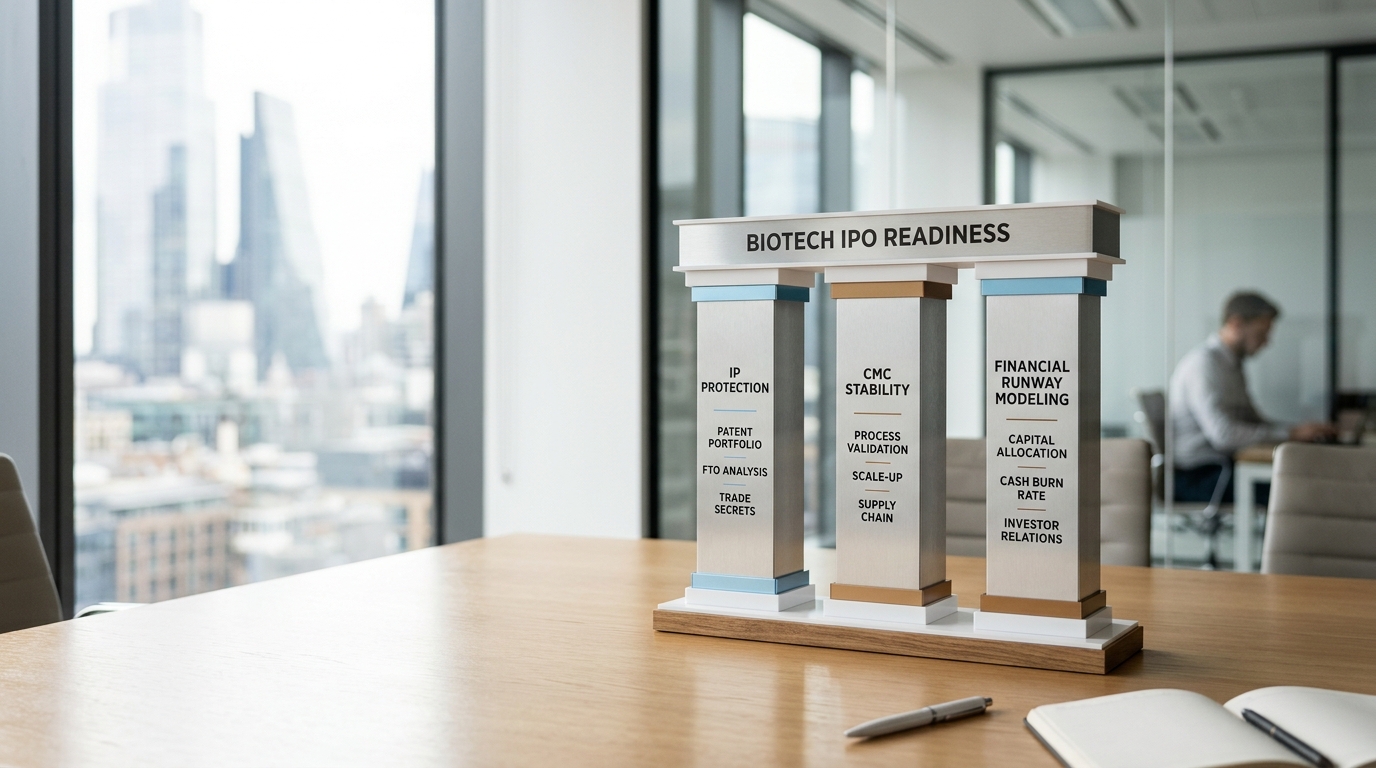
Beyond clinical data, life sciences IPO readiness depends on three operational pillars: intellectual property, Chemistry, Manufacturing, and Controls (CMC), and financial discipline. Patent due diligence requires independent freedom-to-operate searches, evaluation of composition-of-matter coverage, and analysis of patent term extensions. Diligence teams audit licensing agreements with academic medical centers to ensure sublicensing rights, milestone obligations, and royalty stacks are fully documented.
CMC readiness presents a frequent hurdle for clinical-stage biotechs transitioning to public markets. Industry analyses of investigational new drug applications indicate that nonclinical deficiencies and CMC issues represent primary triggers for regulatory clinical holds. Diligence teams verify drug substance stability data, batch release records, analytical method validation, and contract development and manufacturing organization contracts to ensure commercial scalability without supply chain disruption.
From a financial perspective, management must present a detailed cash runway model that guarantees at least 18 to 24 months of operational liquidity post-IPO. Implementing a structured financial due diligence checklist helps CFOs reconcile clinical trial burn rates against R&D tax credits and milestone payments. Simultaneously, conducting a commercial due diligence checklist validates bottom-up epidemiological market sizing, payer mix models, and target reimbursement logic against prevailing health economics.
What Investors Are Really Testing
When crossover funds and life sciences growth investors conduct biotech investor due diligence, they probe far deeper than executive presentations. Investors test the underlying signal behind every scientific and strategic assertion. For example, when management presents positive Phase 2 subgroup data, diligence teams investigate whether the subgroup was pre-specified in the Statistical Analysis Plan or derived via post-hoc exploratory mining. European regulators treat a subgroup claim inside the confirmatory testing strategy as a multiple-testing problem that requires pre-planned procedures controlling the overall false positive rate, while post-hoc subgroup investigation is framed as exploratory and used to inform, not establish, conclusions.
Underwriters also test board governance, executive bench strength, and operational decision-making. Investors verify whether the chief medical officer and head of regulatory affairs have experience navigating public registration statements and FDA advisory committee hearings. Management teams that execute thorough C-level diligence preparation demonstrate to institutional buyers that executive incentives, scientific advisory board oversight, and clinical operations are fully integrated.
Understanding these underlying buyer expectations closely parallels the rigorous questioning frameworks found in PE due diligence questions for C-level teams, where leadership credibility is validated against primary source documentation.
- Post-hoc vs pre-specified analysis: Probing whether reported treatment effects were primary trial objectives or retrospective findings.
- Key person dependency: Assessing whether scientific protocol knowledge resides with founders or within documented corporate operating procedures.
- CDMO supply redundancy: Evaluating single-source manufacturing risks versus dual-sourcing contingent agreements.
What Management Is Expected to Show
To satisfy public-market underwriters and institutional growth funds, executive teams must curate an auditable portfolio of primary scientific and corporate artefacts. Pitch decks and executive summaries are insufficient; management must open access to raw clinical trial datasets, master service agreements, and complete regulatory histories.
Management is expected to align the public market story directly with the risk disclosures drafted for SEC registration filings. Discrepancies between aggressive commercial projections in investor meetings and conservative risk factors in regulatory draft prospectuses create immediate execution delays. Utilizing a structured AI startup data room checklist allows management teams to organize technical artifacts, licensing agreements, and governance records efficiently.
- Clinical artifacts: Clinical Study Reports (CSRs), Statistical Analysis Plans (SAPs), case report forms, and electronic data capture exports.
- Regulatory records: Initial IND submissions, amendments, official FDA meeting minutes, and annual safety reports.
- CMC documentation: Batch release records, certificate of analysis files, validation protocols, and stability study summaries.
- IP repository: Issued patents, pending applications, freedom-to-operate legal opinions, and university license contracts.
Warning Signs and the Data Room Evidence Checklist
Early identification of structural vulnerabilities enables life sciences leadership to remediate deficiencies prior to formal underwriter review. Bringing private-company financial statements up to SEC and PCAOB standards is one of the heaviest lifts: advisers recommend completing a PCAOB audit in the year before going public, and note that the wider IPO preparation process typically takes 18 to 24 months. Regulators also scrutinise how pipelines and market opportunity are presented, so promotional language and market-size claims need documentary support. Preparing for public markets therefore requires systematic audit of potential red flags across clinical, regulatory, and corporate workstreams.
| Diligence Signal | Why It Matters | Recommended Action |
|---|---|---|
| Post-hoc endpoint modification | Undermines statistical validity and raises regulatory concerns regarding trial bias | Re-analyze data against original pre-specified Statistical Analysis Plan |
| Unresolved CMC comparability issues | Risk of FDA clinical hold or requirement to repeat Phase 1 bridging studies | Complete analytical validation and comparability protocols prior to filing |
| Undisclosed FDA meeting feedback | Discrepancies between agency minutes and public narrative break investor trust | Include complete, unedited agency correspondence in data room |
| Expiring composition-of-matter patents | Shortens commercial exclusivity window and depresses valuation | File continuation applications and secure patent term extension analyses |
| Single-source CDMO dependency | Exposes clinical trial timeline to supply chain disruptions | Establish secondary CDMO contracts and qualify back-up facilities |
| Incomplete trial master files | Delays regulatory review and creates compliance liability during audits | Perform comprehensive TMF audit and remediate missing documentation |
To ensure completeness across all operational disciplines, management teams should deploy a standardized biopharma IPO checklist. Comparing preparation workflows against established investor expectations, such as those detailed in VC due diligence questions for AI startups, helps teams maintain rigorous evidence standards.
- Complete Regulatory Correspondence: All IND applications, amendments, and official FDA/EMA meeting minutes.
- Validated Clinical Data Repository: Clinical Study Reports, raw SAS/R datasets, and Statistical Analysis Plans.
- Intellectual Property Vault: Issued patents, prosecution histories, licensing contracts, and FTO opinions.
- CMC & Quality Package: Stability testing data, batch release certificates, and CDMO service level agreements.
- Health Economics & Market Sizing: Bottom-up epidemiological models, payer feedback, and reimbursement analyses.
- Capital Structure & Financial Audit: Three years of audited GAAP financial statements and detailed cap table history.
- Corporate Governance Records: Board minutes, committee charters, conflict-of-interest policies, and D&O insurance.
- Public Narrative & Risk Alignment: Draft SEC registration statements aligned with internal clinical risk logs.
Data Room Checklist and Practical Implications
Biotech and life sciences management teams preparing for IPO should assemble a data room that goes well beyond a standard AI startup data room checklist, since public equity investors and underwriters will test clinical, regulatory, and manufacturing evidence with the same rigour used in a strategic acquisition.
- Full clinical study protocols, statistical analysis plans, and endpoint definitions for lead and follow-on programs
- Regulatory correspondence with the FDA, EMA, and other relevant agencies, including meeting minutes and any clinical hold or CRL history
- Patent portfolio, prosecution status, freedom-to-operate opinions, and license or in-licensing agreements
- Cash runway and financing plan under multiple scenarios, aligned with a financial due diligence checklist
- CMC (chemistry, manufacturing, and controls) evidence, including process validation, scale-up, and supply chain documentation
- Market sizing and reimbursement logic per a commercial due diligence checklist, with payer strategy for lead indications
- Board minutes, committee charters, D&O policies, and evidence of the leadership-continuity questions covered in PE due diligence questions for C-level teams
- Draft risk-factor language, corporate governance policies, and prior investor communications, mapped against PE exit readiness due diligence standards
In practice, biotech CFOs and investor-relations leads benefit from tooling built for findings and risk intelligence, combined with AI-powered diligence analysis, to cross-reference clinical, regulatory, and financial documents at speed. Structured cross-referencing pairs naturally with the distributions-focused view covered in VC DPI due diligence, since existing venture investors will ultimately be evaluated on realized outcomes rather than paper marks.
How to use this in your next diligence workflow
Executing a seamless biotech IPO readiness due diligence process requires deal teams and executives to move beyond manual document review. Management teams should leverage modern deal intelligence tools to organize hundreds of clinical protocols, regulatory letters, and manufacturing contracts into structured workstreams.
An AI-native due diligence platform can assist deal teams, investors, and management in organizing, analyzing, and synthesizing complex transaction materials. With AI-powered diligence analysis, teams automatically process VDR contents, index regulatory filings, and surface critical inconsistencies between clinical reports and public disclosures.
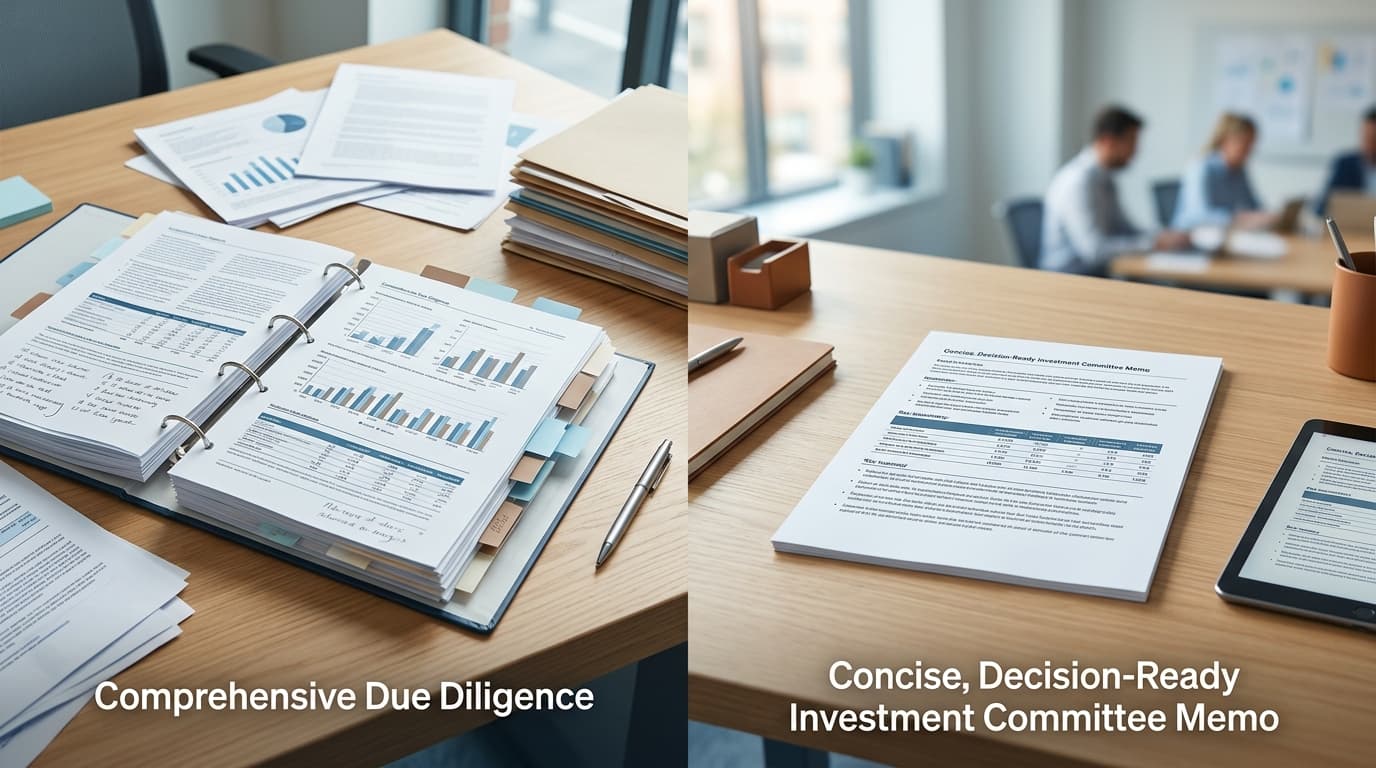
Through dedicated tools like Data Room Ingestion and Risk Radar, deal teams capture actionable findings and risk intelligence across clinical endpoints and CMC documentation. Risk register automation tracks red-flag findings in real time, while Report Builder enables rapid IC memo automation for investment committee and board reviews. Additionally, Collaboration Hub coordinates multi-advisor workstreams across legal, scientific, and financial teams.
Plausity provides intelligence tools to enhance diligence efficiency and document traceability. Plausity does not replace professional judgement, independently provide legal, financial, clinical, regulatory, or medical advice, nor does it guarantee IPO success, regulatory approval, clinical trial outcomes, company valuations, or investment returns.