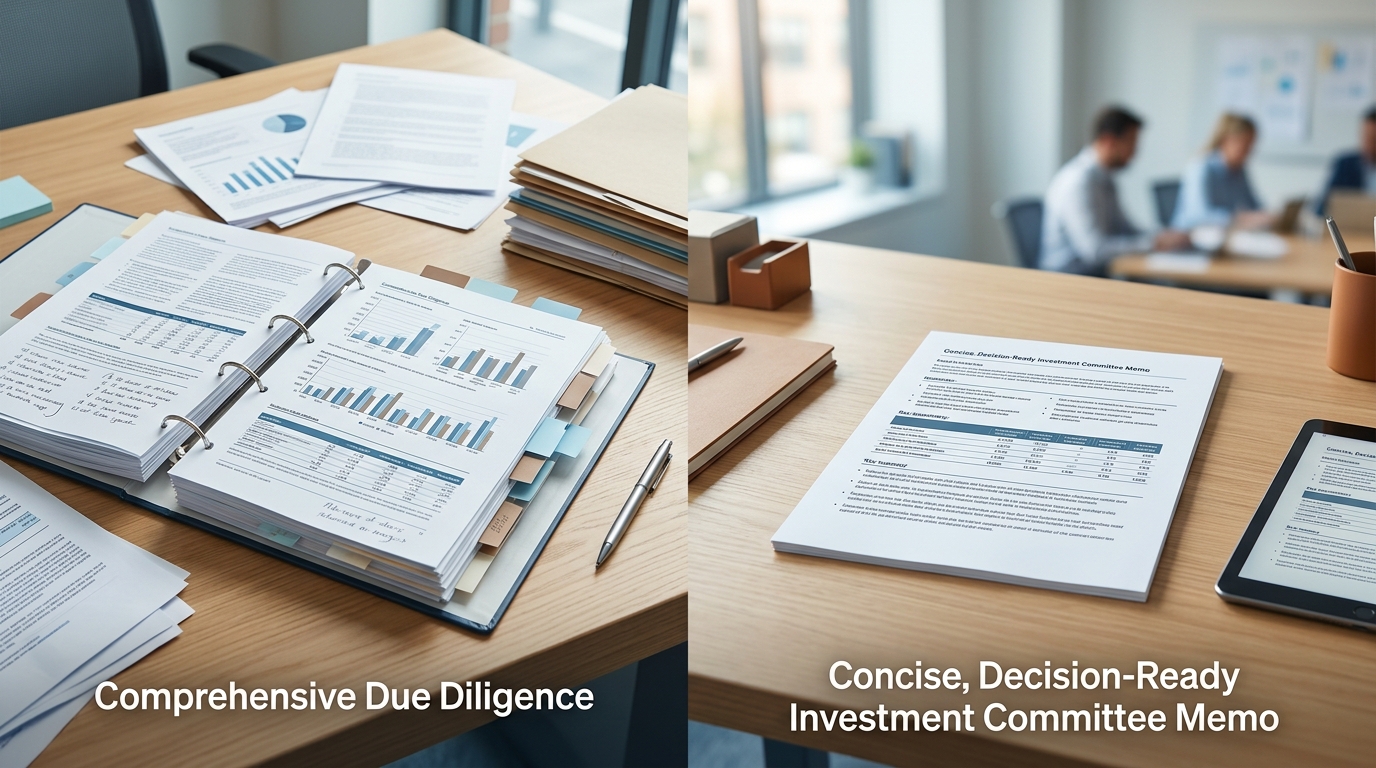
What is a due diligence report?
A due diligence report is the comprehensive written output of a single investigative workstream: financial, legal, commercial, operational or technology. Each report documents what the workstream examined, what it verified against primary records, and what it inferred where full verification was not possible. It is organised by scope, not by decision: a financial due diligence report rebuilds the earnings base and tests the quality of earnings, a legal report maps contracts, litigation and corporate records, and a commercial report tests the market, customers and competitive position. Together these reports form the evidentiary foundation of a transaction, but none of them is, on its own, a decision document.
- Financial due diligence: normalized EBITDA, quality of earnings, working capital behaviour and debt-like items.
- Legal due diligence: material contracts, change-of-control provisions, litigation, IP title and corporate records.
- Commercial due diligence: market size and growth, customer retention and concentration, pricing power and competitive dynamics.
- Operational and technology due diligence: cost structure, organisation, systems, technical debt and security posture.
A red-flag report is a narrower first pass, often delivered within one to two weeks of data room access, whose job is to identify potential deal-breakers early rather than to document everything. It answers one question: is there anything here that should stop the deal before the team spends further budget? Full workstream reports then deepen the picture. The critical point for deal teams is that these reports are inputs, not conclusions. As the analysis of reframing diligence for the investment committee puts it, diligence decks catalogue operational facts, whereas an IC memo evaluates how those facts affect underwriting.
Due Diligence Report vs IC Memo
The two documents share raw material but differ in job, audience and form. A diligence report catalogs findings from one workstream and is read by the people who will act on that workstream: deal team members, workstream leads and external advisors. An IC memo synthesizes the findings of all workstreams into a single, unified investment argument that a committee can evaluate and vote on. The memo format is close to universal: in an Addepar survey of professional investment organisations, 97 percent of investors said they use memos to make investment decisions. For the VC and PE professionals who write and read them, the distinction comes down to this: the report establishes what was found, the memo argues what it means for the decision.
| Dimension | Due Diligence Report | IC Memo |
|---|---|---|
| Purpose | Document findings from one investigative workstream | Synthesize all findings into a decision-ready investment argument |
| Audience | Deal team, workstream leads, external advisors | Investment committee members and approvers |
| Length and depth | Comprehensive per workstream, often dozens of pages | A few pages for early-stage deals to 30+ pages for complex private equity transactions |
| Analysis | Descriptive: what was examined and found | Evaluative: what the findings mean for returns and the thesis |
| Risk treatment | Findings listed and scored within the workstream | Deal-breakers separated from mitigable issues, each paired with a mitigant |
| Evidence | Source documents cited per workstream | Every material claim traceable to underlying data room evidence |
| Recommendation | None; reports what was found | Explicit: invest, pass, or invest with conditions |
| Open questions | Logged as follow-up diligence items | Converted into conditions to close or pre-funding requests |
| Decision role | Foundational input | Primary basis for the approve or decline vote |
Because the memo is the document the committee actually deliberates on, its quality determines whether meeting time is spent debating conviction or reconstructing facts. Teams that simply aggregate advisor reports into a deck force committee members to extract the thesis themselves, which is the gap the discipline of turning diligence into decision logic exists to close.
What information should move from diligence to the IC memo
The filter for what travels from a diligence report into the IC memo is simple: does this finding validate or challenge the core investment thesis, or does it move the price or the structure? Everything that passes that filter must appear in the memo, quantified and sourced. Everything that fails it belongs in the underlying report, available on request but not competing for committee attention.
- Normalized EBITDA and quality-of-earnings adjustments: which add-backs survived testing, which were rejected, and the figure the valuation actually rests on.
- Working capital targets and debt-like items: the peg definition and how it was derived from historical behaviour.
- Customer concentration and retention: revenue share of the top customers, contract durations, terminability and churn evidence behind the headline growth number.
- Material market trends: the demand, pricing or regulatory shifts the thesis depends on, with independent support rather than management projections alone.
- Change-of-control and termination clauses in material contracts: the consent, renegotiation or termination exposure hiding in the contract base.
- Key-person and organisation risks: dependency on founders or individual executives and the retention mechanics proposed to cover it.
A practical discipline is to enforce a three-tier taxonomy as findings move across: facts (verified data points), findings (analytical conclusions drawn from cross-referencing those facts) and judgments (the underwriting implications, such as a price adjustment or an earnout). Conflating the tiers is the most common source of friction in committee review, because a judgment presented as a fact invites the committee to challenge the whole document. The memo should state the judgment, show the finding behind it, and cite the fact beneath that.
What should NOT be copied wholesale into the IC memo
The IC memo is neither a data dump nor a promotional brochure. Committee members are senior investors with limited time; a memo that pads its length with material that does not affect valuation or structure dilutes the analysis and erodes trust in the sections that matter. Concise memos that cover the essentials beat lengthy documents that pad, and anything that does not support the thesis should be cut.
- Exhaustive appendices: full contract schedules, complete data room indexes and every workstream exhibit belong in the data room and the underlying reports, not the memo.
- Raw data room transcripts: verbatim management sessions, expert call notes and interview logs should be synthesized, with quotes used only where they carry decision weight.
- Unquantified observations: an issue stated as a vague concern, with no financial exposure attached and no effect on price or structure, does not earn memo space.
- Workstream boilerplate: methodology descriptions, scope caveats and advisor standard language repeated across reports add volume without adding decision value.
There is also a failure mode in the opposite direction that teams should watch: material risks getting softened rather than copied. When findings pass through successive drafting revisions without their evidence attached, customer concentration becomes a diversified customer base and unbilled receivables become robust growth. Keeping every memo claim linked to its source finding is what prevents that drift.
Presenting key risks, mitigants, and open questions
How the memo treats risk is what the committee is really reading. A strong memo does not conceal vulnerabilities; it isolates them, quantifies their financial exposure and pairs each with a specific structural solution. The practical instrument is a red-flag register in which every material finding carries a disposition, so the committee sees not just what was found but what the team proposes to do about it.
- Deal-breaker: the finding, unmitigated, ends the transaction; the memo states the condition under which the team would walk away.
- Reprice: the quantified exposure flows into price, escrow, indemnity or a purchase price adjustment, and the memo shows the number and its source.
- Mitigate: a named owner carries a specific plan, such as a retention escrow, an earnout or a pre-closing fix, with the residual risk stated.
- Accept: the exposure is understood and priced into the thesis, and the rationale for accepting it is on the record.
Missing evidence deserves the same transparency. Where a claim rests on a management representation rather than a document, or a requested item never arrived in the data room, the memo should say so explicitly and convert the gap into an open item: a specific seller Q&A question, a confirmatory diligence action, or a condition to close. Treating silence in the data room as no news is how inherited risks survive to closing, and an IC memo with unexplained gaps invites challenges that stall the decision. Acknowledging risks directly, rather than hedging them into generic caveats, is what builds committee trust: a memo that pretends a deal is risk-free is one nobody believes.
Synthesizing multi-workstream findings with source traceability
Synthesis is where most memos are won or lost. Financial, legal, commercial and operational findings arrive as separate reports with separate authors, and the memo's job is to merge them into one cohesive narrative about whether the thesis holds. The highest-value insights live in the gaps between workstreams: a churn assumption in the financial model that the legal team's termination clauses contradict, a commercial growth story that the contract base does not support, a key-person risk that the operational review and the retention economics both point to. Presenting the workstreams as parallel summaries, each with its own appendix, hides exactly the tensions the committee needs to see.
Source traceability is what makes such a synthesis defensible rather than merely fluent. Every material statement in the memo should run in an unbroken chain from the claim, to the finding it derives from, to the underlying document, page and version, so a committee member can move from a sentence in the recommendation to the contract clause behind it in two steps. That chain also protects the team: when assumptions are traceable, a later post-mortem examines the decision in context, and when they are not, it examines the people. AI tooling can carry much of the drafting load for the repeatable sections, compiling verified findings into structured memo formats with citations embedded, provided the division of labour stays clear: the tooling structures the evidence, and the deal team owns the judgment about what it means.
How to use this in your next diligence workflow
Plausity is an AI-native due diligence and deal intelligence workspace that supports this workflow end to end. Data Room Ingestion connects to the virtual data room and processes PDFs, spreadsheets, contracts and financial models within minutes, so findings accumulate against their sources from the first week of the deal rather than being reconstructed in the final one. The AI-Analysis Engine then reads and cross-references the corpus across workstreams, creating IC-ready diligence findings with source-linked evidence, while Risk Radar scores findings by materiality, financial impact, legal exposure and deal relevance so the red-flag register is triaged rather than merely listed. Report Builder drafts structured, investor-ready deliverables with full source traceability, and the Collaboration Hub keeps internal teams and external advisors aligned on one version of the findings. Together these capabilities help teams turn diligence analysis into decision-ready synthesis and support evidence-grounded investment committee preparation, without replacing Investment Committee judgment: the committee weighs the evidence and makes the call.
- Ingest the data room on day one, so every finding is captured against its source document from the start.
- Build the red-flag register as workstreams report, scoring each finding on materiality and assigning a disposition: deal-breaker, reprice, mitigate or accept.
- Separate facts, findings and judgments in every memo section, and cite the underlying document behind each material claim.
- Convert missing evidence into explicit open items: specific seller Q&A questions, confirmatory diligence scope or conditions to close.
- Synthesize across workstreams before drafting, so contradictions between the model, the contracts and the commercial evidence surface before the committee does.
- Draft the memo from the source-linked findings base, then pressure-test the thesis and spot-check the evidence chain before submission.
The same workflow scales to the teams that run it: see how VC and PE funds and M&A advisory firms put it to work on live deals. Built for today's investment and deal teams. Trusted by >200 firms.
How Plausity accelerates this workflow
Plausity is an AI-native due diligence and deal intelligence workspace that helps M&A advisory firms, VC and PE funds, corporate development teams and investment-banking teams structure evidence, findings and questions across a data room. Plausity supports evidence extraction, source grounding, findings management and IC preparation — it does not replace human analysts, advisers or investment professionals, does not provide legal, tax, audit, regulatory or investment advice, and does not make autonomous investment decisions. All findings require human review. Built for today's investment and deal teams. Trusted by >200 firms.
To explore the underlying capabilities, see the Plausity AI analysis engine and the findings and risk intelligence product page. For team-level workflows, see how VC and PE funds and M&A advisory firms use Plausity across live deals.