What is an Investment Committee Memo?
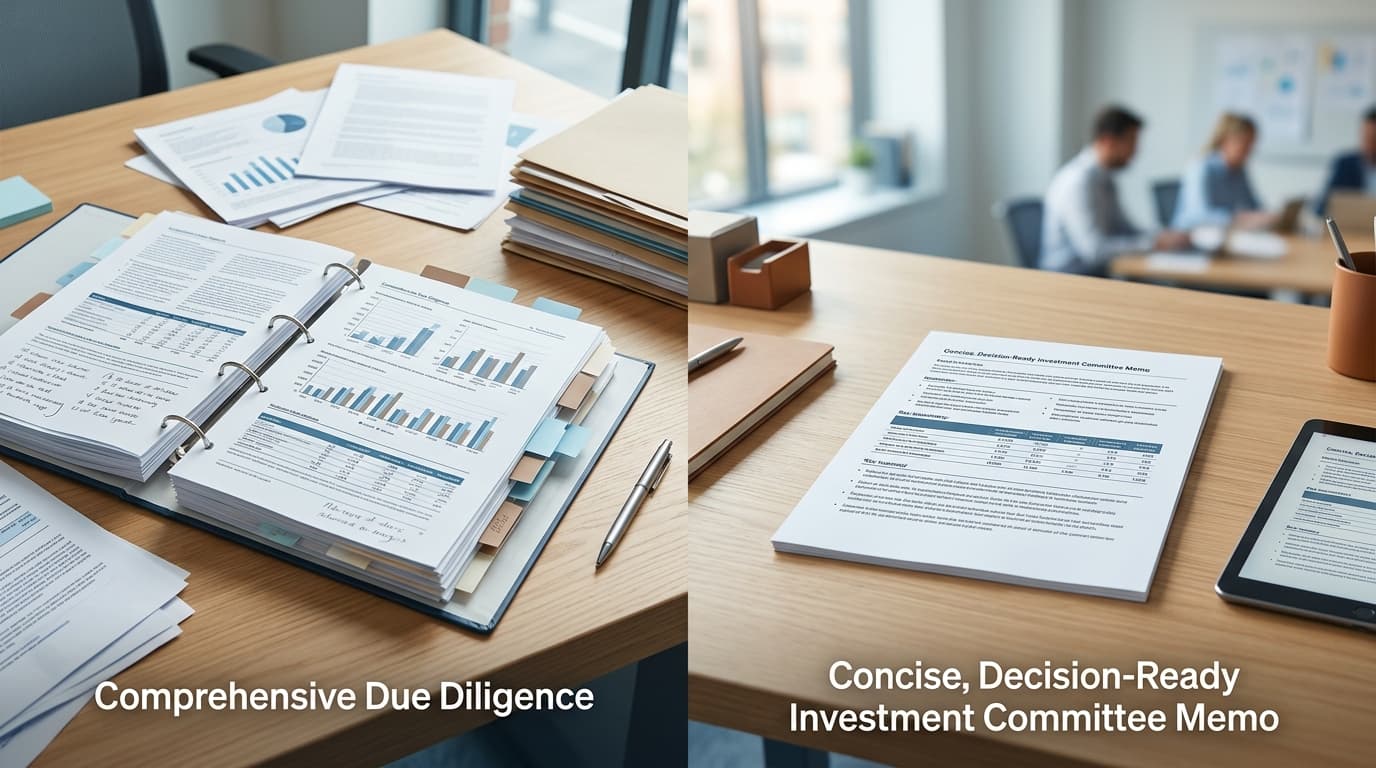
An investment committee memo is the document that condenses weeks of due diligence into a single, decision-oriented argument. It is written by the deal team, read by the investment committee, and structured so that a group of senior professionals can approve, condition, or decline a transaction on the strength of the evidence presented. Research from Addepar underlines how universal the format has become: 97% of the professional investors surveyed use a formal investment memo template and process, and 78% of firms require memo approval before making any investment.
The memo is not a due diligence report. A diligence report documents what was reviewed and what was found across every workstream; the IC memo converts those findings into a recommendation and asks for a decision. Confusing the two produces documents that describe activity without building conviction. The distinction matters enough that it deserves its own treatment: see our guide to the IC memo versus the due diligence report in investment decisions IC memo versus due diligence report.
Standardisation is the point. When every deal is presented with the same structure, the committee stops debating formatting and starts debating substance. A fixed template also prevents errors of omission: if the template demands a risk register, an evidence appendix and an explicit ask, nothing critical survives unwritten. Addepar's research found that the sections practitioners rate most important are deal description, risk factors, team bios and deal terms, which is a useful signal of where the committee's attention actually goes.
Investment Committee Memo Template - Core Structure
The skeleton below is deliberately compact so you can lift it directly into your own template. Each numbered section maps to a dedicated breakdown later in this article.
- Executive summary: the ask, the headline economics and the recommendation in one page.
- Deal snapshot: target, sector, transaction type, size, structure, timing and workstreams covered.
- Investment thesis: the two or three claims that must be true for the deal to work.
- Key investment merits: the evidence-backed reasons the deal fits the mandate.
- Key risks and red flags: what could break the thesis, ranked by materiality.
- Mitigants and conditions to proceed: how each material risk is contained and what must hold before signing.
- Open questions and missing evidence: what diligence did not resolve and why it matters.
- Financial and valuation implications: returns, sensitivities and the valuation bridge.
- Value creation priorities: the levers, sequenced into a 100-day plan and beyond.
- Exit considerations: realistic routes, likely buyers and timing assumptions.
- Recommendation: the explicit decision requested, on the stated terms.
- Evidence and source traceability: every material claim linked to its underlying document.
Deal Snapshot
The deal snapshot is the memo's most factual section and it should read like a term sheet summary: target name and sector, transaction type, enterprise value or round size, proposed structure and security, ownership on a fully diluted basis, key timing milestones, and the workstreams diligence has covered. Precision here prevents the most common opening failure: committee members starting the meeting with the wrong mental model of the business and spending the first ten minutes correcting it. Write the company description in language a non-specialist partner can parse at once, and state explicitly which diligence workstreams (commercial, financial, legal, tax, technology, governance) have been completed and which are still open. For teams running several workstreams in parallel, keeping them reconciled in a single memo is its own discipline, as we cover in multi-workstream due diligence for a single investment committee memo.
Investment Thesis
The thesis states what must be true for the deal to succeed. Keep it narrow: two or three claims, each specific enough that a committee member could disagree with it. 'The market is large and the team is strong' is not a thesis; 'the target can hold its share of a consolidating mid-market segment while gross margin recovers as the new pricing architecture beds in' is. Each claim should carry its evidence with it, because the thesis is the spine to which every other section of the memo attaches. If a paragraph does not reinforce one of the thesis claims, it probably belongs in an appendix or nowhere.
Key Investment Merits
Merits are the thesis claims made concrete: the durable customer relationships, the defensible technology, the contractual revenue visibility, the operational headroom. Each merit should be a sentence of assertion followed by its evidence, and the evidence should be traceable to a document in the data room. A consistent memo format lets committee members compare opportunities on the same dimensions, removing noise so the underlying merits can be evaluated side by side.
The table below is the working reference for the body sections of the memo. Each row names what the section should contain and the mistake that most often undermines it.
| SECTION | WHAT IT SHOULD CONTAIN | COMMON MISTAKE |
|---|---|---|
| Deal Snapshot | Target, sector, transaction type, size, structure, fully diluted ownership, timing, workstreams covered | A vague company description that leaves committee members with the wrong mental model |
| Investment Thesis | Two or three specific claims that must be true for the deal to work, each with evidence | Generic statements ('large market, strong team') that no one could disagree with or verify |
| Key Investment Merits | Evidence-backed merits, each traceable to a data room document | Listing strengths without evidence, or burying the two merits that actually carry the deal |
| Key Risks and Red Flags | The material risks ranked by likelihood and impact, with red flags surfaced early | A long undifferentiated list that treats a cosmetic risk the same as a thesis-breaking one |
| Mitigants and Conditions to Proceed | How each material risk is contained, plus explicit conditions precedent to signing | Asserting mitigants without evidence, or leaving conditions implicit |
| Open Questions and Missing Evidence | What diligence did not resolve, why it matters and who owns closing the gap | Omitting gaps entirely so the committee approves on incomplete information unknowingly |
| Financial and Valuation Implications | Returns by scenario, sensitivity analysis and the bridge from valuation to thesis | Presenting a single base case with no sensitivities and no link back to the thesis |
| Value Creation Priorities | Ranked levers with owners, timing and a 100-day plan | A wish list of initiatives with no sequencing, ownership or quantification |
| Exit Considerations | Realistic routes, likely buyer groups and timing assumptions | A single optimistic exit assumption presented as the plan |
| Recommendation | The explicit decision requested, on stated terms, with any conditions | A hedged paragraph that leaves the committee guessing what is actually being asked |
| Evidence and Source Traceability | Links from every material claim to its underlying document, page and paragraph | Claims that cannot be traced once the meeting moves to challenge |
Key Risks and Red Flags
The risks section is where weak memos go to hide and strong memos go to work. Rank risks by materiality rather than listing everything diligence touched: customer concentration above 20% of revenue, a single-source supplier, a pending dispute, a technology dependency that has never been independently tested. Red flags deserve their own visibility, not a footnote, because a red flag the committee discovers on its own costs more credibility than one the deal team surfaced first. Each risk should be stated as a specific, falsifiable claim with its evidence attached, which is the discipline a structured risk register enforces, as we describe in risk register automation and red flag reporting.
Mitigants and Conditions to Proceed
A mitigant is not a reassurance; it is an argument that a risk is contained, supported by evidence. The real art of the memo lies in the risks and mitigants section, the ability to show, with data and reasoning, why the firm can be comfortable underwriting uncertainty. In practice that means pairing every material risk with either evidence that it is already managed, a structural response such as escrow or earnout, or a condition to proceed: 'signing is subject to confirmation of the top ten customer contracts' is a mitigant the committee can act on, whereas 'management is confident' is not. Conditions to proceed convert residual uncertainty into a checklist the deal team must close before signing, which is the framing we develop in IC memo risk, mitigants and open questions.
Open Questions and Missing Evidence
The most common structural failure in IC memos is silence about what diligence did not find. Missing documents, unanswered information requests and unresolved data inconsistencies are facts about the deal, and hiding them converts an evidence gap into a latent liability for the whole committee. State each open question, why it matters to the thesis, and who owns closing it before signing. A committee that sees the gaps can price them; a committee that discovers them after close cannot. Treating missing evidence as a first-class output of diligence, rather than an embarrassment, is the core argument in our piece on missing documents and AI evidence gaps missing documents and evidence gaps.
Financial and Valuation Implications
This section translates the thesis into numbers. Present returns by scenario (base, upside, downside), the sensitivities that move the answer most, and the bridge from the proposed valuation to the return the thesis requires. A base case without sensitivities invites the committee to do the stress testing itself, usually less charitably than the deal team would. The valuation discussion should also make the assumptions explicit: which figures are management's, which are the deal team's, and which are third-party benchmarks. The stakes are not abstract. Research by Baruch Lev and Feng Gu analysing 40,000 acquisitions over 40 years found that 70 to 75% of M&A deals fail to achieve their stated objectives, which is precisely why the financial section must show what would have to be true for this deal to join the successful minority.
Value Creation Priorities
Value creation is where the memo stops describing the target and starts committing to a plan. Rank the levers by expected impact: pricing architecture, procurement consolidation, sales productivity, add-on acquisitions, working capital release. Sequence them into a 100-day plan with named owners, then a 12 to 24 month horizon for the structural levers. Each lever should carry a quantified estimate and the evidence that supports it, so the committee can see which parts of the return case are underwritten by operational action rather than by market growth. A wish list of initiatives with no sequencing or ownership is a common mistake and an easy one to avoid.
Exit Considerations
Exit thinking disciplines the whole underwriting. Set out the realistic routes (strategic sale, secondary buyout, IPO where genuinely plausible), the buyer groups for each, and the timing assumptions embedded in the return model. Note which thesis claims the exit depends on: a strategic buyer paying for the target's technology platform is a different underwriting from a financial buyer underwriting cash flow. Where the exit case rests on a market condition, state the evidence for that condition rather than asserting it. The same source-linked discipline that governs the rest of the memo applies here, and the reporting layer that carries it is covered in our overview of reports and deliverables.
Recommendation / Decision Framing
The recommendation is not a summary of the memo; it is the ask. State the decision requested (approve, approve subject to conditions, decline), the terms it applies to, and the two or three factors the decision genuinely turns on. A balanced argument builds conviction precisely because it concedes what is uncertain: 'we recommend approval on the stated terms, recognising that customer concentration is the thesis's most sensitive dependency and that signing is conditional on contract confirmation' is stronger than a paragraph of hedging, because it shows the committee exactly where the judgment sits. Make the conditions explicit and assignable, so approval produces a checklist rather than a mood. The committee should leave the meeting having made a decision, not having scheduled another meeting. For the governance layer above the IC, including how findings convert into a defensible recommendation for boards, see our guide to defensible M&A decision documents.
Evidence and Source Traceability
Every material claim in the memo should trace back to a specific document, page and paragraph in the data room. Traceability is what converts the memo from an opinion into a record: it lets a sceptical committee member verify the customer churn figure without leaving the meeting, and it lets the firm reconstruct its reasoning years later when the outcome is known. It also protects the deal team, because a claim that can be checked is a claim that can be defended. Data provenance is the foundation of this discipline, as we set out in data provenance and source evidence in AI due diligence.
IC Memo Checklist
Run this checklist before the memo goes to the committee. Every 'no' is a revision, not a footnote.
- The recommendation appears in the first page and states exactly what is being asked, on what terms.
- The thesis is two or three specific, falsifiable claims, each with evidence attached.
- Every material risk is paired with a mitigant, a condition to proceed, or an owned open question.
- Red flags are surfaced in the memo before the committee could find them elsewhere.
- Open questions and missing documents are listed, with owners and deadlines.
- Returns are presented by scenario with sensitivities, not as a single base case.
- Value creation levers are ranked, quantified and sequenced with named owners.
- Exit routes, buyer groups and timing assumptions are stated with evidence.
- Every material claim links to a specific document, page and paragraph in the data room.
- The memo answers the questions the committee will actually ask, not the ones the deal team finds interesting.
Implementing this investment committee memo structure begins by centralizing your deal data. By establishing version control and securely connecting your data room through data room ingestion, deal teams can ensure that every claim is tied to verifiable evidence. Utilizing a structured approach reduces friction in committee meetings, enabling partners to focus entirely on the merits of the transaction.
How to use this in your next diligence workflow
Plausity is an AI-native due diligence and deal intelligence workspace for M&A, private equity, VC, corporate development, consulting and advisory teams. It supports IC preparation by leveraging multi-workstream due diligence capabilities, turning diligence findings into IC-ready synthesis. Features like our AI Analysis Engine and Evidence Gap Detection help structure source-grounded investment committee materials. Built for today's investment and deal teams. Trusted by >200 firms.
How Plausity accelerates this workflow
Plausity is an AI-native due diligence and deal intelligence workspace that helps M&A advisory firms, VC and PE funds, corporate development teams and investment-banking teams structure evidence, findings and questions across a data room. Plausity supports evidence extraction, source grounding, findings management and IC preparation — it does not replace human analysts, advisers or investment professionals, does not provide legal, tax, audit, regulatory or investment advice, and does not make autonomous investment decisions. All findings require human review. Built for today's investment and deal teams. Trusted by >200 firms.
To explore the underlying capabilities, see the Plausity AI analysis engine and the findings and risk intelligence product page. For team-level workflows, see how VC and PE funds and M&A advisory firms use Plausity across live deals.