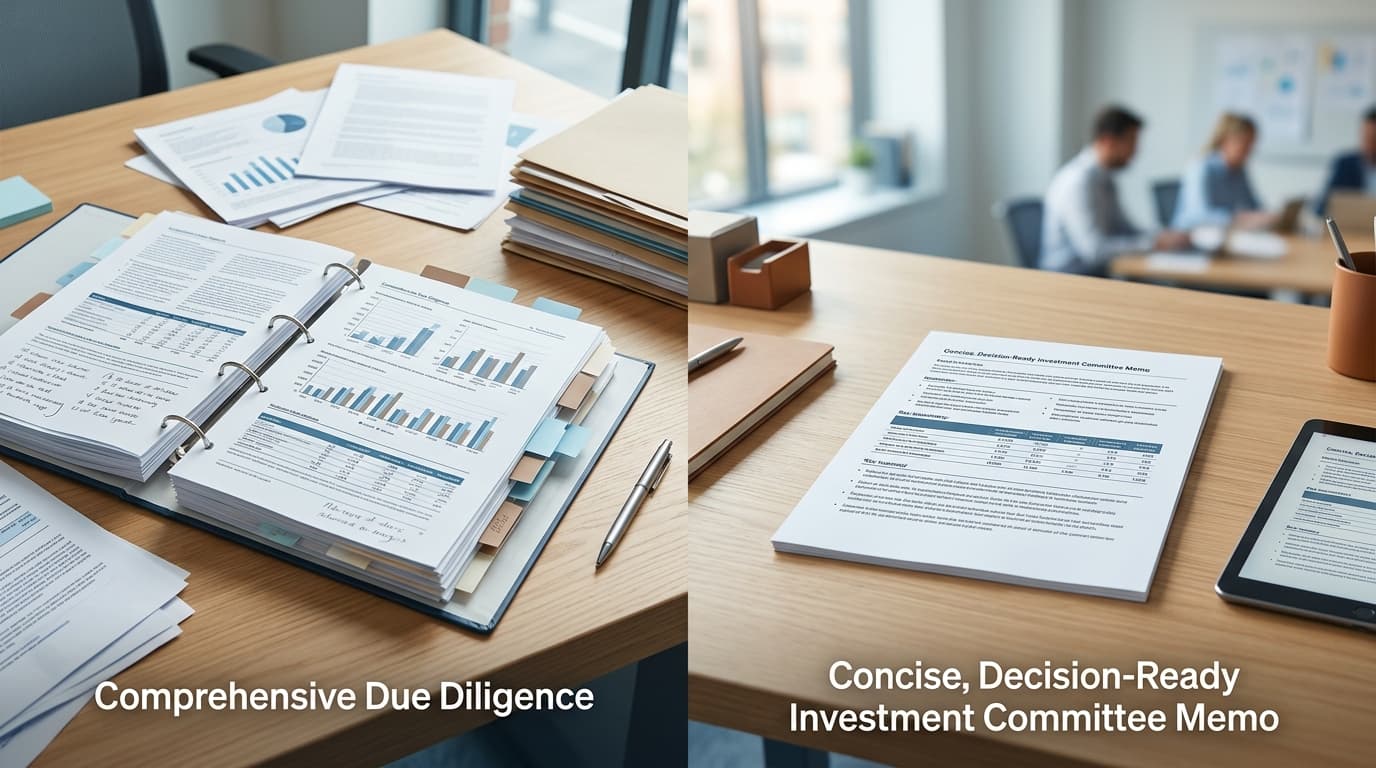
The Strategic Weight of IC Preparation
Investment committee preparation is the structured process of converting weeks of confirmatory diligence into a single, evidence-backed case that a committee can interrogate and act on. It is not the writing of a memo in the final days before the meeting. It is the discipline of deciding, early, which claims the deal thesis depends on, what evidence supports each one, and what remains open, so that by the time the committee convenes every material statement in the pack can be traced to a document, a data source or a named expert. Done well, preparation turns the IC meeting from a defensive exercise into a genuine decision forum: the committee debates judgment calls, not facts that should have been settled weeks earlier.
The stakes justify the effort. In 2025, European private equity transaction volume surged 28 percent to €457.6 billion even as deal count fell, meaning fewer but larger commitments per decision. When each signature carries more capital, the cost of a weak evidence base rises accordingly. The failure modes are well documented: in a survey of senior executives, almost 60 percent attributed disappointing deal outcomes to due diligence that failed to identify critical issues, making poor diligence the most common root cause of deal failure.
Preparation is also the main institutional defence against cognitive bias. Research from the Stanford Long-Term Investing initiative with Addepar found that 97 percent of professional investors use a formal investment memo template and process, and 78 percent of firms require memo approval before any investment is made. A standardised structure forces the deal team to articulate the thesis, the risks and the counter-evidence in writing, which surfaces logical gaps and unexamined assumptions before capital is committed rather than after. The same research notes a subtler point: authors can put a thumb on the scale by de-emphasising inconvenient details, which is why a fixed checklist, applied the same way to every deal, matters more than the talent of any individual writer.
The checklist that follows is organised around one principle: nothing reaches the committee room that cannot be evidenced, and nothing that can be evidenced is left ambiguous. It covers the countdown timeline, the evidence pack, the risk register, scenario analysis and partner alignment, and closes with a readiness scorecard the deal lead can run before the meeting is scheduled. The aim is a committee pack that reads as a decision document, not a data dump.
The 14-Day Timeline: Managing the IC Workflow
A two-week countdown gives the deal team enough runway to close confirmatory gaps while leaving committee members genuine reading time. The most common failure is not a missing analysis but a pack that circulates 24 hours before the meeting, which converts review into skimming and pushes hard questions into the follow-up list rather than the discussion. Treat the timeline as a set of gates, each with an owner and a definition of done.
| Timing | Workstream focus | Gate to clear |
|---|---|---|
| T-14 to T-10 | Finalise data room ingestion and confirm all requested documents are in; freeze the evidence base so late-arriving documents are logged as addenda, not silently merged | Evidence base frozen and indexed |
| T-10 to T-7 | Complete confirmatory workstreams: QoE, commercial, legal, tax; consolidate findings into the risk register with materiality scores | Risk register in full draft |
| T-7 to T-5 | Draft the IC memo: thesis, key findings, valuation bridge, sensitivities; circulate internally to the deal lead and sector partner | Internal draft complete |
| T-5 to T-3 | Secure legal, tax and regulatory sign-offs; confirm conditions precedent and mandatory open items are documented | Sign-offs in writing |
| T-3 to T-2 | Circulate the full pre-read pack to committee members; brief the sector partner and operating partner on the value creation plan | Pre-read distributed |
| T-1 | Rehearse the recommendation: anticipated challenges, fallback positions, minimum acceptable terms | Rehearsal complete |
| T-0 | Present the streamlined live deck; record decisions, conditions and follow-ups in the minutes | Decision documented |
Pre-read pack versus live deck
The pre-read pack and the live presentation serve different functions and should not be the same document. The pre-read is the exhaustive record: full findings by workstream, the evidence trail behind each claim, the complete risk register, the sensitivity models and the open items list. It circulates at T-3 at the latest, precisely so members arrive having digested the detail. The live deck is the argument: the thesis, the three to five findings that drive the recommendation, the downside case and the asks. If the deck has to carry the full analysis, the pre-read has failed; if the pre-read is a summary, members cannot verify the claims. Keep them separate and keep them consistent, with every number in the deck traceable to the same source as in the pack.
Sequencing matters as much as content. Legal and tax sign-offs belong in the middle of the fortnight, not the end, because their findings frequently change the structure or the price, and the committee should see the deal as it will actually be signed. Scheduling them at T-2 leaves no room to absorb a tax structuring change or a newly flagged regulatory condition, and forces the team to either delay the meeting or present a deal the papers no longer describe.
Building the IC-Ready Evidence Checklist
The evidence pack is the committee's assurance that the thesis rests on verified fact rather than management narrative. Its contents vary by sector and deal type, but the core components are consistent across institutional processes, and each should be present, complete and traceable before the pack is circulated.
- Quality of Earnings report: normalised EBITDA, quality of revenue, working capital dynamics and one-off items, prepared or reviewed by an independent accounting firm
- Verified cap table: fully diluted ownership, option pools, convertible instruments and any side letters, reconciled to the company's statutory records
- Commercial vendor report: market size and growth, competitive position, customer references and churn evidence from a named provider
- Financial model with stated assumptions: base case build, revenue drivers, margin bridge and the provenance of every input
- Legal diligence report: material contracts, change-of-control provisions, litigation, IP ownership and employment exposures
- Tax structuring memo: acquisition structure, historic exposures and post-closing obligations
- Regulatory and compliance review: sector-specific licences, data protection posture and any filing conditions
- Management background checks and reference calls, documented with the firm that conducted them
Two disciplines hold the pack together. The first is a single source of truth: one repository where every claim in the memo links to the document that supports it, so that a committee member's question about a churn figure can be answered with the underlying customer cohort analysis in seconds, not a search through email threads. When findings live in separate workstreams and the memo is assembled manually, version drift is inevitable, and a number that changed between the QoE draft and the final memo is the kind of inconsistency that undermines an otherwise strong case. Tools built around this discipline, such as Data Room Ingestion and an AI Analysis Engine, keep analysis anchored to the underlying documents from the first pass.
The second discipline is honest downside modelling. Valuation risk is not hypothetical: in the venture reset, down rounds reached 18.5 percent of new fundings on Carta in the third quarter of 2023, after sitting at 5.2 percent in the first quarter of 2022, and the median Series D valuation fell by 50 percent over the same period. Buyout entries at elevated multiples face the same arithmetic in a weaker exit market. The evidence pack should therefore include the assumptions that, if wrong, move the valuation most, with the supporting evidence graded by strength, so the committee can see which parts of the thesis are load-bearing and how well each one is documented.
Surfacing Red Flags and Managing the Risk Register
The risk register is the connective tissue between diligence workstreams and the committee's decision. It should carry every material finding with a description, the evidence behind it, a materiality assessment across financial impact, legal exposure and deal relevance, and a proposed treatment. A register that lists risks without owners and mitigations is an inventory, not a management tool. Automated risk register scoring supports this by scoring findings on materiality and deal relevance so the register distinguishes the anomalies that should change the deal from the noise that should not.
Deal-breakers versus mitigable risks
The committee's time is best spent on the distinction between risks that kill the thesis and risks that reprice it. A customer concentration finding that contradicts the growth assumption in the model is a thesis problem; the same finding with contractual mitigation and a credible transition plan is a pricing problem. For each red flag, the deal team should document which element of the thesis it touches, whether a structural fix exists (escrow, earnout, warranty, insurance) and what it would cost. This framing lets the committee adjust terms rather than relitigate the diligence, and it demonstrates that the team has already thought past the finding to the response.
Mandatory open items and conditions precedent
When required evidence is missing, the answer is documentation, not omission. Each gap should be logged as a mandatory open item with the evidence requested, who is chasing it and the date by which it must land. Where the gap cannot close before signing, it becomes a condition precedent or a specific indemnity, drafted by counsel and stated explicitly in the memo. A committee that sees a managed list of open items with owners and deadlines can make an informed decision; a committee that discovers an unmentioned gap in the meeting loses confidence in everything else in the pack. Plausity's Evidence Gap Detection is designed to flag exactly these holes while there is still time to fill them.
The IC readiness scorecard
Run this scorecard before the meeting is scheduled. It is a pass or fail gate: any fail means the meeting moves or the gap is explicitly disclosed.
| Criterion | Pass | Fail |
|---|---|---|
| Evidence base frozen: all claims in the memo link to a source document | Every material claim traceable | Any material claim unsupported |
| QoE, legal, tax and commercial reports received and reviewed | All complete | Any outstanding or draft only |
| Risk register signed off by workstream leads with treatments assigned | All material risks scored and owned | Unscored or unowned material risks |
| Mandatory open items documented with owners and deadlines | Complete list in the memo | Any known gap undisclosed |
| Base, upside and downside cases modelled with sensitivities | All three complete and reconciled to the QoE | Downside case missing or unreconciled |
| Sector and operating partner alignment on the value creation plan | Written alignment or no material objection | Open disagreement unstated |
| Legal, tax and regulatory sign-offs in writing | All received | Any pending |
| Pre-read circulated with at least 48 hours for review | Distributed on schedule | Late or incomplete distribution |
Scenario Analysis and Securing Partner Alignment
Committees decide on ranges, not points. Before entering the room, the deal team should have three reconciled cases: a base case built on the evidence, an upside case that identifies what has to be true for returns to exceed the base, and a downside case that stress-tests the load-bearing assumptions. Each case needs explicit sensitivities (price, volume, churn, cost inflation, exit multiple) and a statement of which assumptions are evidence-backed and which are judgment. industry analysis's M&A research notes that many acquirers pay too little attention to the downside scenario and the responses it would trigger, even though outcomes in capability-driven deals can vary far from base expectations. The downside case is where the committee probes whether the team has a plan, not just a forecast.
The execution risk behind those scenarios is largely controllable. Research on strategy execution estimates that 67 percent of well-formulated strategies fail due to poor execution rather than flaws in the strategy itself. For an IC audience, that finding reframes the value creation plan: the committee is not only underwriting a market position, it is underwriting the operating team's ability to execute against it. A downside case with a credible response plan signals exactly that.
Aligning the sector partner and operating partner
Alignment is a pre-committee task, not a meeting discovery. The sector partner should have seen the commercial findings and the thesis while there is still time to challenge them, and the operating partner should have shaped the 100-day plan so the committee sees a unified operational strategy rather than a deal team's optimism. Disagreements surfaced at T-5 can be resolved with evidence; the same disagreements surfaced in the meeting read as a team that has not done the work. Practical mechanics that help: a working session with both partners on the risk register, a shared draft of the value creation levers with owners and milestones, and written confirmation of any reservations so the committee hears a consistent position with caveats stated once, clearly.
Accelerating Deal Synthesis with Plausity
None of the checklist above changes the judgment the committee is asked to exercise. What it changes is how much of the team's time goes into judgment rather than assembly. Plausity is an AI-native due diligence and deal intelligence workspace that supports evidence-grounded investment committee preparation: it helps teams turn diligence analysis into decision-ready synthesis, with the deal team and committee retaining every element of the decision itself.
- Data Room Ingestion connects to the VDR and processes PDFs, spreadsheets, contracts and financial models within minutes, so the evidence base is complete and searchable from the first day of confirmatory diligence
- The AI-Analysis Engine reads, cross-references and reasons across thousands of documents, producing findings across commercial, financial and legal workstreams that a generalist team would take weeks to assemble
- Risk Radar evaluates findings on materiality, financial impact, legal exposure and deal relevance, giving the risk register a consistent, defensible scoring basis
- Findings are source-linked by default: every claim in the analysis traces back to the document and passage it came from, which is what makes the pack IC-ready rather than merely fast
- The Report Builder drafts structured diligence reports, covering executive summary, investment thesis, key findings, risk register, value creation levers and follow-up actions, with the evidence trail intact
The practical effect on the checklist is that the gates become easier to clear without being lowered. The evidence freeze at T-14 is an index rather than a filing exercise; the single source of truth is the default state of the workspace rather than a discipline imposed by the deal lead; and the pre-read pack assembles from source-linked findings instead of being rebuilt from workstream documents. Expert review stays in the loop throughout: findings are reviewed, challenged and signed off by the team, and the committee's judgment is the decision, supported by evidence-grounded IC-ready diligence findings rather than replaced by automation. For funds running this process across a portfolio, Plausity's work for VC and PE funds extends the same evidence discipline from screening through monitoring.
How to use this in your next diligence workflow
Institutionalise the checklist rather than reinventing it per deal. The sequence below turns the preceding sections into a standard operating procedure your next deal team can run from day one.
- Adopt the T-14 timeline and the readiness scorecard as firm standard: same gates, same pass or fail criteria, every deal, so committee members know in advance what a complete pack contains
- Mandate source-linking from the first diligence pass: no claim enters the memo without a link to its underlying document, which removes the reconciliation scramble in the final week
- Run the risk register as a living document from data room opening, with materiality scores and named owners, and review it in the weekly deal call rather than assembling it at the end
- Require the three-case model with sensitivities before the memo is drafted, and have the sector partner challenge the downside case specifically
- Schedule legal, tax and regulatory sign-offs at T-5, not T-2, and treat a late sign-off as a reason to move the meeting, not to present without it
- Circulate the pre-read at T-3 with a minimum 48-hour review window, and keep the live deck to the argument, not the evidence
- Use the Report Builder to generate the structured first draft of the pack from source-linked findings, shifting the team's time from formatting to strategic debate and rehearsal
The committee's decision belongs to the committee. What a disciplined process guarantees is that the decision is made on complete, traceable, honestly-modelled evidence, and that the team in the room has already done the thinking the questions will probe. Built for today's investment and deal teams. Trusted by >200 firms. If you want to see how the workflow fits your firm's process, you can request a demo of the platform.
How Plausity accelerates this workflow
Plausity is an AI-native due diligence and deal intelligence workspace that helps M&A advisory firms, VC and PE funds, corporate development teams and investment-banking teams structure evidence, findings and questions across a data room. Plausity supports evidence extraction, source grounding, findings management and IC preparation — it does not replace human analysts, advisers or investment professionals, does not provide legal, tax, audit, regulatory or investment advice, and does not make autonomous investment decisions. All findings require human review. Built for today's investment and deal teams. Trusted by >200 firms.
To explore the underlying capabilities, see the Plausity AI analysis engine and the findings and risk intelligence product page. For team-level workflows, see how VC and PE funds and M&A advisory firms use Plausity across live deals.