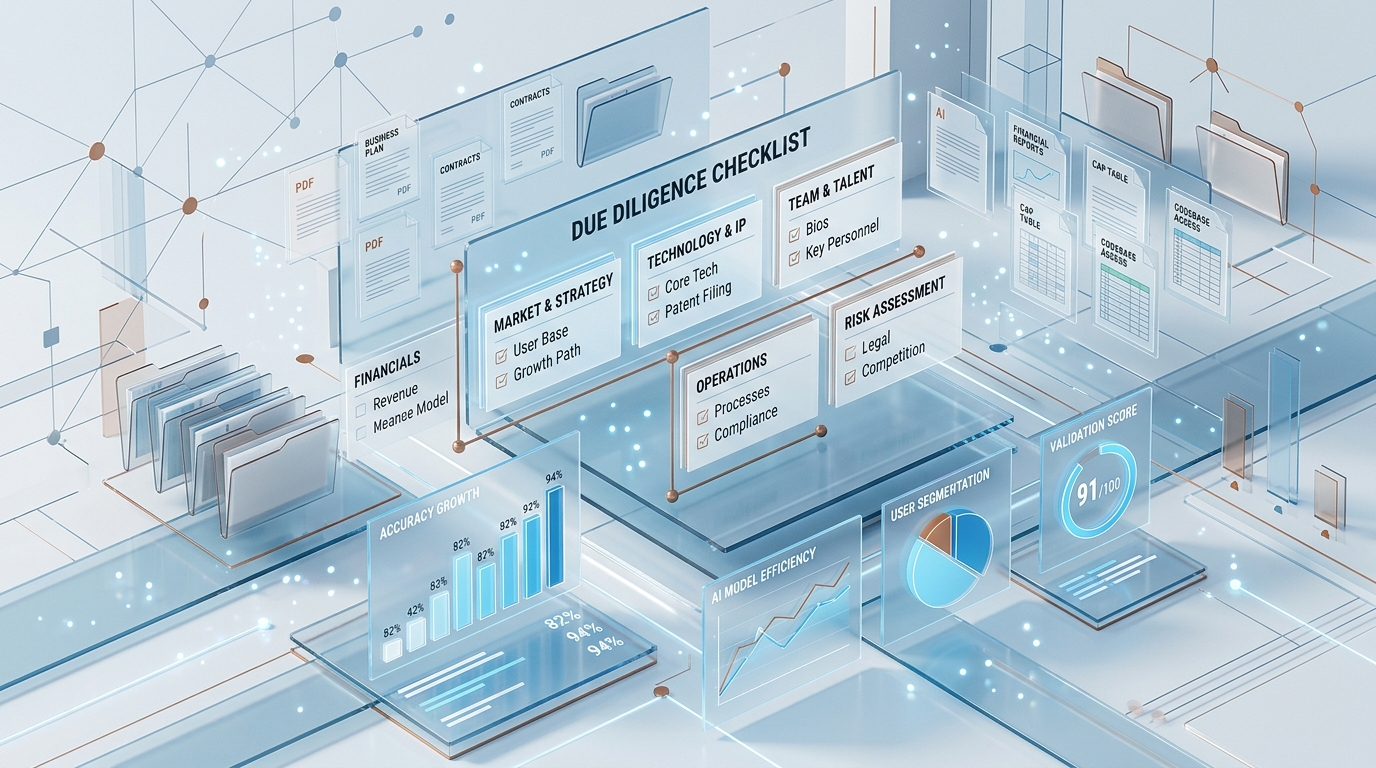
The Shift from Narrative Pitching to Artefact-Based AI Diligence
In early-stage venture capital, investment decisions historically hinged on founder narrative, market TAM sizing, and polished product demonstrations. Today, VC due diligence questions for AI startups focus on verifying tangible technical assets rather than accepting high-level claims. As investment firms adopt AI-native due diligence workflows to scrutinize targets, investors inspect raw operational data to assess true defensibility and commercial viability. Modern tools significantly accelerate document review, allowing deal teams to audit complex AI startup due diligence materials long before issuing a term sheet.
- Narrative Pitch vs. Data Provenance: Moving from verbal assurances of proprietary data to inspecting training consent logs, licensing agreements, and customer data rights.
- Benchmark Demos vs. Evaluation Harnesses: Transitioning from recorded UI walkthroughs to auditing automated test suites, regression benchmarks, and real-world accuracy metrics.
- Gross Margin Assumptions vs. Inference Economics: Replacing static financial models with dynamic compute audit logs, token usage tracking, and cloud vendor cost structures.
- Roadmap Vision vs. Deployment Risk Logs: Shifting from roadmap slides to inspecting production latency metrics, failure handling protocols, and API fallback configurations.
This transition directly impacts how an AI founder due diligence strategy must be executed. Investors recognize that surface-level wrappers around third-party foundation models face rapid commoditization risk. Consequently, when setting up an AI company data room, founders cannot rely solely on pitch decks and financial forecasts. Deal teams analyze model dependency diligence files to evaluate what happens if provider pricing changes, alongside data rights documentation to confirm training data compliance.
Preparing for these detailed AI startup investor questions requires organizing verifiable evidence from day one. By structuring concrete evaluation runs, infrastructure billing details, and compliance logs in advance, founders accelerate deal execution and defend their valuation under rigorous scrutiny.
Model Dependency and Defensibility Against Foundation Model Commoditization
Venture capital investors are moving past pitch narratives to scrutinize whether an AI startup is a fragile wrapper or a sustainable software enterprise. During VC due diligence questions for AI startups, deal teams evaluate how deeply an application relies on underlying foundation models and what happens when frontier providers adjust API pricing or deprecate endpoints. Demonstrating resilience against foundation model commoditization requires showing clear architectural insulation rather than relying on abstract claims about proprietary algorithms.
Evaluating Architectural Insulation and Provider Redundancy
In modern model dependency diligence, investors examine key structural artifacts inside the AI defensibility workflow. Rather than accepting high-level diagrams, technical auditors inspect fallback configurations, fine-tuning scripts, and abstraction layers that decouple user workflows from specific model APIs.
- Multi-model routing protocols: Evidence that requests dynamically route across primary and secondary LLM providers based on latency, cost, or availability.
- Fine-tuning and adapter assets: Codebases and domain-specific training data pipelines that prove custom weights provide measurable performance gains over off-the-shelf foundation models.
- API price-shock contingency models: Financial sensitivity tables illustrating how gross margins withstand API pricing shifts or rate limit enforcement from foundation model vendors.
- Fallback execution logic: Local or open-weight model integration layers capable of running core application features if primary vendor endpoints suffer downtime or deprecation.
Founders who can present these documented technical controls directly inside their data room reassure investors that their product retains enterprise value regardless of foundation model commoditization.
Data Rights Provenance and License Chain of Title
In venture capital due diligence, evaluating an AI company has shifted from accepting broad IP representations to scrutinizing concrete data rights provenance and legal chain of title. Investors now inspect raw dataset manifests, web-scraping consent logs, and third-party data vendor contracts to confirm that all training and fine-tuning data was acquired through lawful channels. Without explicit, documented rights covering every dataset, a startup risks incurring catastrophic infringement liabilities or being forced to retract core model weights. Establishing clear legal title and robust data exclusivity is critical to defending company valuation during a fundraise.
Key Data Diligence Deliverables VCs Inspect
- Training Data Provenance Inventories: Comprehensive manifests detailing exact dataset origins, scraping permissions, paid API licenses, and explicit legal rights to compute derivative model weights.
- Customer Contract Consent Terms: Standard master service agreements and terms of service containing clear, unambiguous opt-in clauses that grant the startup rights to aggregate and anonymize user data for model enhancement.
- Open-Source & Open-Weight License Audits: Documented compliance tracking for foundational models and software libraries to ensure no viral open-source terms or commercial user caps threaten the product roadmap.
- Proprietary IP Assignment Agreements: Executed agreements from all employees, founders, and external contractors assigning full intellectual property rights for custom architectures, training pipelines, and weights.
Unresolved licensing ambiguities or non-compliant training data can render a high-performing AI system commercially unsalvageable after an investment round closes. As VCs evaluate data rooms, investment teams audit explicit data processing specifications and consent frameworks to verify commercial durability. Organizing clear, audit-ready data documentation before launching diligence accelerates deal completion and preserves valuation.
Evaluation Harnesses and Repeatable Accuracy Benchmarking
In early-stage AI pitch decks, performance claims often rely on hand-picked demo cases or generalized public benchmarks. Today, venture capital investors perform technical validation by evaluating whether a startup has built a repeatable evaluation harness. Any technical claim, from low-latency inference to top-quartile accuracy, must be backed by systematic benchmark reports, execution logs, and continuous testing pipelines. Investors scrutinize how founders test their AI models under realistic operational conditions, probing whether performance holds when inputs deviate from standard training samples.
Auditing the Artifacts of Model Reliability
Evaluating an AI startup requires looking past qualitative promises to inspect the precise technical artifacts used for quality assurance. Technical diligence teams expect early-stage founders to demonstrate structured evaluation pipelines that systematically track accuracy, hallucinations, and model drift over time. This involves auditing automated regression test suites triggered on prompt updates, specialized test datasets, and real-world feedback loops. When assessing long-term defensibility, investors closely examine how domain-specific logic is embedded into the evaluation harness to prevent output degradation.
- Custom test datasets: Proprietary evaluation suites reflecting domain-specific customer workflows, adversarial prompts, and complex edge cases rather than standard public benchmarks.
- Regression testing pipelines: Automated CI/CD triggers that evaluate model output quality against established performance baselines whenever system components or prompt templates change.
- Drift and hallucination tracking: Telemetry frameworks and monitoring tools that flag accuracy decay, unexpected model behavior, and edge-case failures in live production.
- Human-in-the-loop validation: Structured feedback and annotation processes that turn production errors into test assertions for future benchmark runs.
Founders who provide transparent, reproducible evaluation harnesses prove that their technical moat rests on systematic engineering rigor rather than disposable model wrappers. Demonstrating continuous benchmark pipelines reassures investors that the product will maintain accuracy and reliability as foundation models evolve.
Inference Economics and Production Gross Margin Sensitivity
Unlike traditional software where marginal distribution costs approach zero, AI applications carry a persistent variable tax on every transaction. Every user interaction requires a model inference request, generating compute costs that scale linearly with usage. As a result, AI product gross margins typically run well below the baseline typical of traditional cloud software. This fundamental economic reality forces venture capital investors to look deeply into an AI startup's cost architecture.
Artefacts Required for Inference Economics Diligence
Narrative assumptions about future API cost drops are no longer sufficient for institutional investors. VCs inspect granular operational files to distinguish structural profitability from temporary cloud credits. Deal teams expect founders to provide concrete data room evidence in four key areas:
- Per-query token consumption logs: Granular traces detailing input and output token counts, model latency, and cost per core user workflow.
- Model routing and caching architecture: System diagrams showing semantic caching, prompt optimization, and small language model (SLM) fallback logic that reduce dependence on frontier models.
- Compute and vendor schedules: Agreements with cloud providers and API vendors detailing volume discount tiers, reserved instance commitments, and API rate limits audit compute and API costs.
- Hybrid monetization terms: Customer contracts pairing base subscription fees with consumption caps or outcome-aligned overage charges hybrid usage-based pricing models.
Providing documented token profiles and architectural safeguards proves to investors that gross margin expansion is driven by intentional engineering rather than temporary vendor subsidies.
Deployment Security, Risk Posture, and Production Compliance
As AI products transition into mission-critical enterprise workflows, security due diligence has shifted from narrative assurances to rigorous artefact inspection. Enterprise clients and VC deal teams scrutinize protection against direct and indirect prompt injection, sensitive data leakage, and improper output handling. In technical cybersecurity due diligence, investors expect concrete evidence of vulnerability management framed around frameworks like the OWASP Top 10 for LLM Applications. Proving enterprise readiness requires presenting live production telemetry and automated containment protocols rather than high-level slides.
Artefacts Required for Production Diligence
- Penetration test results and red-teaming audit logs evaluating vulnerability to prompt hijacking and indirect injection attacks.
- Tenant isolation verification including database schema configs, encryption key management, and user access logs.
- Automated fallback execution logs demonstrating deterministic fallback or human review when model confidence thresholds drop.
- Compliance documentation detailing SOC 2 Type II attestations, GDPR data processing specifications, and telemetry purge schedules.
Production compliance also requires clear operational guardrails when handling non-deterministic foundation models. Investors inspect whether automated fallback mechanisms prevent improper execution when confidence scores dip or when inputs trigger security guardrails. During transaction review, specialized tools like Risk Radar help investment teams audit these access logs, privacy agreements, and risk controls to surface potential liabilities. Demonstrating robust deployment security proves to VCs that an AI startup can pass stringent corporate procurement processes without costly deal delays.
Structuring the AI Company Data Room for Fast Investor Review
Organizing your Data Room Ingestion structure accelerates the diligence cycle and eliminates unnecessary deal friction. As VCs shift from narrative pitches to auditing technical artifacts, an unorganized repository creates immediate doubt about operational maturity. A well-indexed AI company data room allows venture capital funds to run automated compliance scans and verification checks efficiently. Modern AI-assisted diligence tools significantly compress document review times, making structured folder hierarchies and clear documentation essential for fast deal execution.
Essential Folders for Technical and Commercial Diligence
To answer modern VC due diligence questions for AI startups, founders should establish five specialized directories within their virtual data room alongside standard corporate and legal filings:
- Data Rights & Provenance: Data license agreements, copyright clearance documentation, and customer consent forms for model training.
- Architecture & Model Dependency: System topology diagrams, third-party API SLAs, and fallback protocols for foundation model provider changes.
- Evaluation & Benchmark Reports: Reproducible evaluation harness scripts, benchmark datasets, and historical drift audit logs.
- Inference Economics & Cost Models: Detailed unit economics spreadsheets breaking down compute COGS per API call, token usage, and GPU hosting.
- Deployment & Security Logs: SOC 2 certification reports, penetration test results, and data privacy impact assessments.
Providing clear README documentation inside each folder helps investment teams evaluate your AI data rights diligence and inference economics without back-and-forth email exchanges. This structural clarity reduces diligence delays and demonstrates founder excellence throughout the evaluation process.
Red-Flag Signals in VC Due Diligence for AI Startups
| Signal | Why it matters | Diligence action |
|---|---|---|
| Founder cannot produce a written data provenance inventory for training data | Signals unclear or unlicensed data rights that create legal exposure post-investment | Request data source manifests and consent or licensing documentation |
| No repeatable evaluation harness, only cherry-picked accuracy demos | Accuracy claims may not hold across real production traffic | Request evaluation methodology, test datasets, and historical benchmark runs |
| Core product is a thin wrapper over a single foundation model with no abstraction layer | High exposure to provider pricing changes, model deprecation, or feature commoditization | Request architecture diagrams showing model routing or abstraction design |
| No visibility into per-query inference costs or unit economics | Gross margin trajectory cannot be verified independently | Request token consumption logs and cost-per-query breakdowns |
| No documented incident response or red-teaming for the production model | Exposes the company and its customers to unmanaged security and reliability risk | Request penetration test results and incident response documentation |
| Customer usage evidence is limited to logos and anecdotes rather than retention or usage data | Cannot verify genuine product-market fit or renewal likelihood | Request usage telemetry, cohort retention data, and renewal history |
How Plausity Supports This Workflow
Findings from this diligence process should inform deal structuring and post-investment monitoring, not just a one-time investment decision, and this artefact-based approach is closely related to AI impact due diligence and AI disruption due diligence for software targets, which examine broader competitive exposure, and to AI moat due diligence, which tests company-level defensibility in more depth. Plausity is an AI-native due diligence and deal intelligence platform that helps investment teams performing diligence for PE and VC funds analyze company information, structure findings, and compare documents across a data room. Plausity's AI-powered diligence analysis and findings and risk intelligence capabilities help surface inconsistencies in data rights documentation, evaluation records, and cost artefacts. For founders, Plausity helps structure diligence evidence into clearer, evidence-backed materials. This supports evidence review and does not replace legal, financial, technical, or commercial judgement, and does not guarantee funding, valuation, or investment outcomes.