Defining AI in Private Equity: What Deal Teams Need to Know
In private equity, artificial intelligence refers to specialized software engines designed to ingest, cross-reference, and analyze vast volumes of unstructured deal data to automate repetitive analytical tasks without replacing core human investment judgment. Rather than making capital allocation decisions autonomously, AI in private equity operates as an intelligence multiplier across the deal lifecycle. It processes financial models, legal contracts, confidential information memorandums, and virtual data room documents at scale. By handling routine data extraction and pattern recognition, AI enables investment professionals to focus on thesis validation, negotiation, and strategic value creation.
Modern deal platforms combine multi-format data ingestion, automated risk surfacing, and structured report drafting to streamline deal execution from initial review to closing due diligence for PE teams. By integrating Data Room Ingestion with an underlying AI-Analysis Engine, deal teams can automatically extract key clauses, historical financials, and operating metrics within minutes of receiving data room access. Automated tools like Risk Radar evaluate findings against materiality thresholds to flag legal exposures or financial discrepancies, while a Report Builder generates investor-ready memorandum drafts with complete source traceability.
- Multi-Format Data Ingestion: Connects directly to data rooms and ingests PDFs, spreadsheets, and legal contracts without manual reformatting.
- Automated Risk Surfacing: Identifies anomalies, covenant breaches, and revenue concentration risks across thousands of pages.
- Traceable Report Generation: Synthesizes complex analytical findings into structured investment memos while preserving exact links back to source documents.
While these automated systems significantly compress transaction timelines, they are designed to augment rather than substitute human judgment. Critical tasks such as assessing management quality, evaluating competitive moats, and structuring complex deal terms remain strictly within the domain of the investment committee. Deal teams that leverage AI effectively establish faster execution cycles while maintaining rigorous risk oversight.
Why AI Matters Now: Market Context and Execution Pressures
Private equity deal teams face an unprecedented squeeze on capacity. Market dynamics are forcing funds to evaluate higher volumes of confidential information memoranda and process thousands of data room artifacts under compressed exclusivity windows. At the same time, institutional limited partners demand faster capital deployment and higher return hurdles, leaving little margin for error during initial screening or confirmatory end-to-end due diligence.
In competitive auction processes, speed to insight directly determines win rates. Traditional deal evaluation relies on manual document review across disparate workstreams, which risks missing hidden liabilities or slowing down investment committee approvals. Automated information processing alters these operational economics, allowing investment professionals to analyze entire electronic data rooms in parallel rather than sampling a small fraction of total documentation.
- Data room volume expansion: Target companies present thousands of contracts, customer transcripts, and financial schedules, overwhelming traditional manual audit models.
- Timeline compression: Sellers expect preliminary bids and detailed risk assessments within days, favoring deal teams that synthesize data rapidly.
- Analytical coverage gaps: Manual reviews often restrict sample sizes to ten or twenty percent of available files, leaving tail risks undetected until post-acquisition.
To navigate these execution pressures, funds integrate specialized tools like Data Room Ingestion to scan virtual data rooms within minutes data room processing. Accelerating preliminary file parsing enables deal teams to focus human judgment on underwriting core value creation drivers, transforming diligence from a defensive bottleneck into a competitive advantage.
Stage 1: Deal Sourcing and Target Screening
Private equity deal teams are increasingly moving away from purely reactive, broker-dependent deal flow toward continuous, data-driven target discovery. By pairing natural language processing models with structured market databases, corporate registries, web traffic logs, and industry news feeds, investment professionals can monitor entire sub-sectors in real time. Rather than having junior analysts manually screen hundreds of inbound teasers or assemble fragmented industry maps, deal teams deploy modern proprietary deal sourcing workflows to evaluate preliminary investment materials, track expansion indicators, and automatically score candidate companies against fund parameters.
Core Sourcing Workstreams Enhanced by Automated Tools
- Data Aggregation and Market Mapping: Tracking web signals, executive headcount shifts, patent filings, and regulatory databases to map fragmented industries and surface hidden targets.
- Teaser and CIM Ingestion: Ingesting preliminary teaser documents and confidential information memorandums to extract historical revenue, growth rates, and key operational disclosures.
- Automated Thesis Scoring: Ranking prospective acquisition targets against precise investment criteria, such as EBITDA thresholds, geographic presence, and business model characteristics.
Despite these significant efficiency gains in initial thesis matching, relationship-driven origination and direct human networking remain paramount in private equity. Algorithmic screening tools excel at processing vast datasets and uncovering non-obvious targets, but they cannot replace the personal trust required to win founder-led processes. Investment professionals rely on automated tools to remove manual research bottlenecks, allowing deal leads to dedicate more time to cultivating relationships with founders, corporate executives, and trusted advisors. Ultimately, while software accelerates target discovery, human insight and interpersonal rapport remain essential for converting screened prospects into actionable, proprietary transactions.
Stage 2: Initial Due Diligence and Virtual Data Room Ingestion
In the initial due diligence phase, investment teams face mountains of unstructured data across thousands of target files. Private equity firms using AI-enhanced virtual data rooms close transactions an average of 12 days faster than those relying on manual document reviews. Modern workflows leverage Data Room Ingestion to automatically scan, categorize, and process complex electronic data room contents, moving seamlessly from a raw to organized analytical inputs within minutes.
Once ingested, the AI-Analysis Engine parses multi-format documentation, cross-referencing PDFs, legal contracts, regulatory filings, and financial models. The engine performs deep semantic searches and contextual reasoning across disparate workstreams, extracting underlying contractual obligations, working capital dynamics, and hidden liabilities that standard keyword searches frequently miss.
- Document Parsing: Ingests unstructured financial statements, board decks, and vendor contracts across diverse file formats simultaneously.
- Anomaly Detection: Identifies hidden change-of-control clauses, undisclosed liabilities, and revenue reconciliation discrepancies.
- Automated Risk Surfacing: Highlights operational dependencies and customer concentration issues for fast team evaluation.
To synthesize these findings into actionable intelligence, Risk Radar evaluates potential deal risks based on materiality, financial impact, and legal exposure. The tool automatically surfaces anomalies like revenue concentration or restrictive covenants, streamlining risk register management. Crucially, AI operates as an analytical accelerator rather than a final decision-maker: legal, tax, and financial professionals retain full ownership of risk evaluations, validating AI findings to ensure institutional investment standards are upheld.
Stage 3: Investment Committee Memo Preparation and Drafting
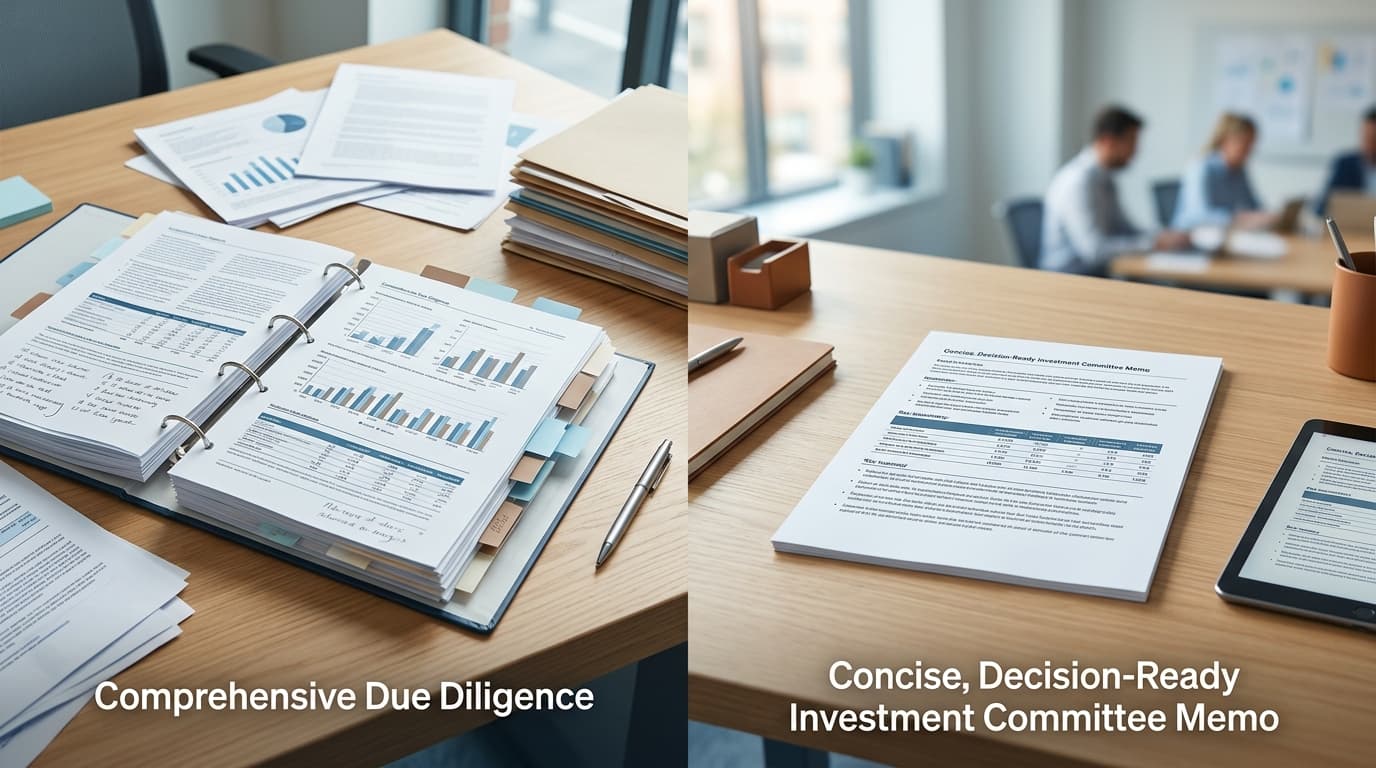
Drafting an Investment Committee (IC) memo traditionally requires deal teams to manually synthesize hundreds of pages of legal disclosures, financial models, and commercial assessments into a coherent deck. This step often creates significant bottlenecks under tight transaction deadlines. Leveraging specialized IC memo automation transforms this process by pulling validated findings directly from diligence workstreams. Purpose-built tools like Report Builder automatically construct initial draft memos, complete with explicit source traceability that links every key claim, figure, and chart back to specific data room records.
Elevating Junior Deal Team Focus to Strategic Judgment
By automating preliminary document synthesis and initial drafting, AI tools significantly compress memo production timelines. This structural shift fundamentally alters the role of junior deal team members: instead of spending long hours aligning slide formatting or copying numbers across spreadsheets, associates and analysts can dedicate their focus to evaluating underlying thesis drivers, stress-testing operational assumptions, and modeling downside risk scenarios.
- Source Traceability: Every statement in the IC memo is mapped directly to underlying virtual data room files and diligence transcripts.
- Workstream Consolidation: Unified findings from commercial, financial, and regulatory reviews are automatically structured into standard IC sections.
- Assumption Stress-Testing: Deal teams reallocate time toward testing sensitivity variables, competitive moats, and valuation risk scenarios.
While automated engines produce structured initial drafts, the final recommendation remains entirely human. AI provides the speed and evidence trail needed for thorough preparation, allowing investment professionals to focus on qualitative nuances, management assessments, and ultimate value creation logic.
Stage 4: Portfolio Monitoring and Value Creation Workstreams
In post-acquisition management, private equity teams deploy AI capabilities to convert disparate financial reporting packages into structured, real-time performance intelligence. Operating partners and deal teams use automated monitoring layers to continuously track portfolio company key performance indicators, detect financial performance variances, and benchmark operational metrics across holdings. Rather than spending days manually pulling revenue, gross margin, and EBITDA figures from monthly management accounts, automated systems consolidate financial disclosures to flag budget deviations instantly. This allows investment professionals to execute a disciplined 100-day plan and focus energy on high-impact operating initiatives.
- Financial Variance Tracking: Automatically scans monthly reporting packages to surface revenue and margin deviations against underwriting targets.
- Operational Benchmarking: Cross-analyzes cost structures, headcounts, and working capital efficiency against sector peers and portfolio holdings.
- Automated Trend & Leakage Detection: Identifies emerging market tailwinds, shifting customer retention trends, and cost overruns before they impact quarterly EBITDA.
- Add-On Target Scouting: Continuously evaluates adjacent market targets for strategic tuck-in opportunities that accelerate buy-and-build strategies.
Where Human Operating Judgment Remains Essential
While AI engines excel at processing structured data and identifying margin trends, driving real operational alpha relies on human leadership. An algorithm can highlight margin compression or supply chain friction, but operating partners must diagnose root causes, realign management incentives, and guide complex turnarounds. Modern tools such as Plausity's Risk Radar assist deal teams by continually flagging operational exposures and tracking performance variances across assets, but strategic decision-making, executive coaching, and organizational alignment remain firmly in human hands.
Stage 5: Exit Readiness, Vendor Diligence, and Operational Guardrails
Preparing a portfolio asset for exit requires assembling rigorous vendor due diligence (VDD) packages that can withstand aggressive scrutiny from competing buyers. AI accelerates exit preparation by continuously structuring historical operational performance, customer contracts, and regulatory filings into clean, audit-ready materials. Using Report Builder, deal teams auto-draft structured VDD deliverables anchored directly in source documents, ensuring consistent data quality across every workstream. Converting unstructured virtual data room contents into transparent vendor reports reduces buyer friction and shortens the transaction timeline.
Despite these speed advantages, deploying AI models across high-stakes transactions demands strict operational guardrails. Uncontrolled adoption of public or unvetted software tools risks compromising non-public materials, generating hallucinated financial metrics, or breaching non-disclosure obligations. To maintain institutional control, deal leads must implement structured protocols that govern how confidential data enters AI pipelines and how outputs are verified prior to IC review or buyer dissemination.
| Risk Domain | AI Exposure & Red Flag | Mandatory Guardrail |
|---|---|---|
| Data Confidentiality | Feeding proprietary target data into public AI models, exposing trade secrets or breaching non-disclosure agreements. | Require SOC 2 Type II compliant enterprise platforms operating under strict zero-data-retention clauses. |
| Model Hallucination | Accepting AI-generated revenue projections or contract summaries without direct verification against source records. | Enforce mandatory source traceability, requiring interactive line-level linkage for every quantitative claim. |
| Legal & Regulatory Exposure | Relying on unvalidated automated flags during compliance reviews, missing critical regulatory liabilities. | Deploy specialized tools like Risk Radar alongside mandatory legal counsel review for high-impact findings. |
Combining structured automated reporting with strict risk protocols enables private equity firms to accelerate deal closure while shielding themselves from reputational and legal harm. Integrating an automated risk register into exit workflows ensures that every operational assertion presented to prospective buyers remains verifiable, consistent, and audit-ready throughout negotiations.