AI Use-Case Inventory: Auditing Active Deployments vs. Roadmap
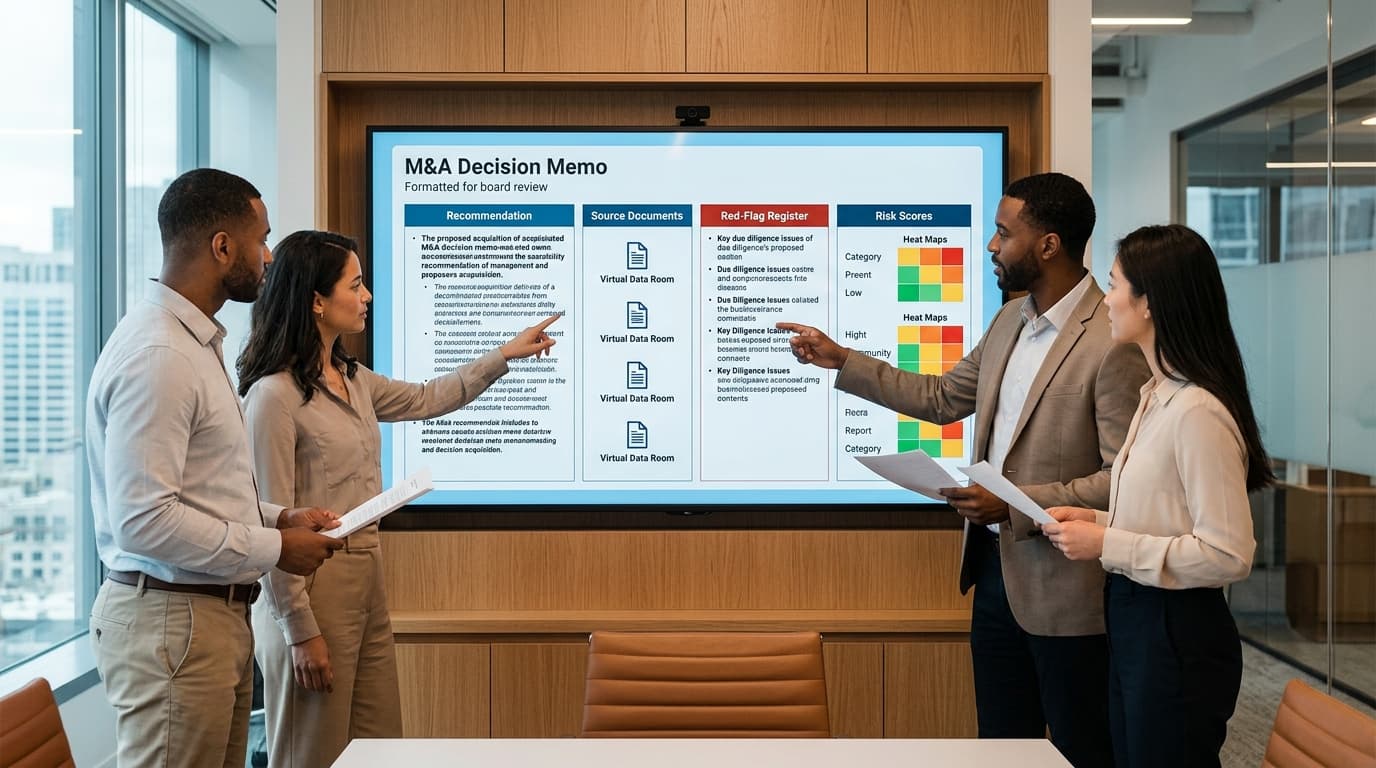
In private equity deal making, management teams frequently present artificial intelligence capabilities that are early-stage pilots or conceptual roadmaps rather than mature assets. To prevent overvaluing superficial technology claims, deal teams must transition from narrative descriptions to verifiable technical evidence. A meaningful share of generative AI projects are abandoned after proof of concept due to poor data quality, escalating costs, or unclear business value. Conducting a thorough AI due diligence audit requires systematically isolating functional production software from experimental prototypes.
Verification Pillars for Target Company AI Claims
- Production Software Logs: Request active user logs, API call volumes, and daily active user metrics to verify that internal teams or end customers routinely rely on advertised AI features.
- Pilot Project Technical Viability: Review proof-of-concept repositories, model latency benchmarks, and error logs to determine whether early-stage initiatives can scale without exponential cost increases.
- Vendor Contract & License Audits: Audit software licenses, cloud compute invoices, and third-party vendor agreements to confirm active utilization and identify shelfware.
Deal teams can accelerate document verification during virtual data room reviews using Plausity Data Room Ingestion to automatically cross-reference pitch claims against contracts and operating logs. Establishing an audited inventory of active software assets provides investment committees with a defensible baseline for technology valuation.
Operating-Model Readiness: Testing Team Absorption Capacity
Deploying advanced algorithms or software automation across a portfolio asset is rarely a pure software challenge. While foundation models and commercial AI tools are widely accessible, private equity deal teams regularly encounter an execution gap where target companies lack the organizational absorption capacity to adopt new workflows. Industry findings indicate that weak change management and mismatched internal capabilities represent the primary point of failure for AI initiatives in middle-market companies. Evaluating whether management possesses the talent, executive leadership, and structured workflows to absorb modern tools is essential when conducting C-level diligence.
Key Operating-Model Audit Categories
To verify whether a target company can successfully sustain AI enablement, investment professionals should systematically audit three core operational dimensions:
- Key Personnel & Technical Skill Retention: Map critical single-point dependencies across data engineering and product architecture. Evaluate technical talent retention risks, market-rate compensation gaps, and incentive alignment for key operators post-acquisition.
- Cross-Functional Enablement & Training: Review structured enablement programs, prompt engineering literacy, and hands-on training budgets across revenue, operations, and finance teams to ensure broad workforce adoption.
- Change Management & Decision Mandate: Audit whether AI projects are owned by business leads with direct P&L accountability rather than siloed IT units, ensuring executive alignment and direct reporting lines to leadership.
Without structured change management and dedicated operational ownership, software upgrades remain isolated pilot projects that fail to move the needle on earnings. Grounding these evaluation criteria during diligence allows deal teams to draft realistic operational milestones in their 100-day plan, ensuring capability gaps are mitigated long before aggressive margin improvement targets are locked in.
Data Infrastructure and Governance: Evaluating Quality and Ownership
Evaluating a target company's AI capability requires auditing the underlying data assets that power its predictive models and generative workflows. While high-performing algorithms depend on proprietary training sets to generate a competitive advantage, unverified data provenance, poor quality control, and ambiguous IP rights expose acquirers to severe financial and legal liabilities. Poor data quality carries a significant, well-documented cost for enterprise organizations. In private equity due diligence, deal teams cannot rely on executive assurances regarding data assets; they must verify that internal repositories are lawfully acquired, continuously cleaned, and legally permissible for commercial AI exploitation. Rigorous AI moat due diligence requires validating whether data integrations and proprietary data streams deliver actual defensibility or hidden operational debt.
Data Governance Audit Framework
- Intellectual Property and Data Ownership: Review explicit customer terms of service, supplier contracts, and third-party data licenses to confirm the target possesses unambiguous commercial rights to ingest data and train proprietary or fine-tuned AI models.
- Data Privacy, Anonymization, and Access Control: Audit role-based access controls, data masking protocols, and regional privacy compliance (GDPR, CCPA) to verify that personally identifiable information (PII) is securely segregated prior to model training.
- Pipeline Reliability and Data Hygiene: Evaluate the underlying ETL/ELT architecture, monitoring mechanisms, and metadata quality to confirm that input data pipelines maintain high data integrity, minimal drift, and reliable latency across operational workloads.
Beyond historical data hygiene, deal teams must evaluate how targets maintain data freshness and secure cloud infrastructure. Reviewing technical deployment and cloud risks ensures the target's underlying architecture can scale without exponential cost increases AI infrastructure exposure. In practice, investment professionals leverage specialized capabilities such as Data Room Ingestion to automatically scan virtual data rooms for vendor agreements, data governance policies, and privacy disclosures. Uncovering data ownership ambiguities or compliance shortfalls prior to closing provides vital evidence for valuation adjustments, post-acquisition 100-day plans, and tailored representations and warranties.
Technology Stack and Vendor Lock-In: Assessing Model Dependency
Evaluating a target company's software architecture requires deal teams to look past surface-level feature sets and audit deep AI infrastructure exposure. When software targets rely entirely on third-party foundation models without abstracted middleware, small API pricing adjustments or model deprecations can drastically shrink profit margins. A substantial share of application software spending is expected to face disruption over the coming years as autonomous agents and external API dependencies reshape software economics. To protect investment thesis assumptions, PE investors and operating partners must inspect whether core intellectual property lives in proprietary workflows or merely thin wrapper interfaces around commercial LLM endpoints.
Core Stack Audit Checklist
- Build vs. buy justification: Audit whether proprietary models or fine-tuned open-source frameworks offer defensible competitive moats over standard commercial API calls.
- Foundation model abstraction: Verify that software architecture uses model-agnostic orchestration layers to enable seamless model switching if vendor costs escalate.
- API terms and data retention: Review vendor contracts for clauses regarding model retraining rights, rate limits, and operational knowledge retention.
- Codebase security and maintainability: Perform automated source code analysis to uncover security vulnerabilities, unvetted open-source dependencies, and technical debt.
A thorough code audit also examines raw compute consumption patterns and GPU hosting costs. Without model routing and caching strategies, scaling user throughput causes infrastructure expenses to compound linearly. Uncovering these dependencies early allows deal teams to model realistic post-acquisition tech debt refactoring expenses into the valuation.
Workflow Automation Potential: Identifying Margin Levers
Evaluating workflow automation potential requires deal teams to look past top-line efficiency promises and audit specific unit economics at the process level. Rather than assuming blanket operational gains, investment professionals must dissect day-to-day workflows to identify high-volume, rules-based bottlenecks. An FTI Consulting survey of private equity decision-makers revealed that workflow automation yields an ROI exceeding 10% for 67% of respondents. To translate this benchmark into defensible underwriting models, diligence teams must evaluate whether target operations can absorb task-level automation to expand throughput without proportional headcount growth.
Mapping Core Workflows Across High-Impact Departments
Conducting task-level feasibility audits across core business functions helps identify concrete margin levers before deal completion. Mapping repetitive operational steps against current labor allocations establishes a clear baseline for post-close operational expansion.
| Functional Area | Target Automation Levers | Operational Impact & Feasibility |
|---|---|---|
| Sales & Commercial Ops | Automated RFP response drafting, lead qualification, and dynamic pricing updates | High feasibility; accelerates pipeline velocity and expands sales rep capacity |
| Customer Support & Success | Tier-1 inquiry triage, self-service response resolution, and customer churn risk alerts | Medium feasibility; lowers unit servicing costs while improving response times |
| Finance & Administration | Contract leakage auditing, automated invoice processing, and financial variance analysis | High feasibility; captures direct leakage and accelerates month-end closing cycles |
Prioritizing these specific automation opportunities provides the foundation for an actionable value creation playbook post-acquisition. Investment teams should evaluate each lever based on data availability, systems integration complexity, and team change readiness. Documenting concrete task-level throughput rates ensures that margin expansion targets reflect verifiable operational facts rather than speculative pitch deck claims.
Financial Impact: Modeling Cost Structure and EBITDA Expansion
Evaluating AI opportunities during due diligence requires deal teams to transition from generic margin assumptions to a granular total cost of ownership (TCO) financial model. Diligence must explicitly separate one-time capital expenditures, such as initial data pipeline re-engineering, workflow integration, and model fine-tuning, from recurring operating expenses including API inference usage, foundation model subscriptions, cloud compute, and internal engineering overhead. Failing to model variable token consumption and ongoing maintenance frequently erodes projected operational margins.
- Capital Expenditure vs OPEX: Quantify fixed software licensing, variable token or API query fees, host infrastructure, and implementation advisory costs across the planned holding period.
- Net Run-Rate EBITDA Uplift: Isolate sustainable operational cost savings and revenue acceleration from temporary implementation expenses to isolate true EBITDA margin expansion.
- Multiple Risk Sensitivity: Discount projected efficiency gains to account for organizational execution delays, model retrain cycles, and third-party vendor price escalation.
Stress-Testing Valuations Against Operational Risk
Quantifying net EBITDA impact is vital for building a credible investment committee thesis. Research indicates that structured operational AI deployments can deliver a meaningful annualized EBITDA uplift by the time of exit. However, translating initial operational gains into terminal value requires rigorous stress-testing against execution bottlenecks.
Investment teams must construct sensitivity scenarios that haircut projected margin improvements based on employee adoption friction, data remediation timelines, and governance overhead. Factoring these operational variables into financial models ensures that portfolio financial targets remain realistic, aligning deal pricing with verifiable value creation levers rather than unhedged technology narrative.
Regulatory and Compliance Exposure: Navigating EU AI Act Risks
Evaluating regulatory exposure is no longer a post-closing legal checklist item; it directly impacts transaction valuation and exit multiples. Under global regulatory frameworks, non-compliant deployments carry substantial administrative fines and potential operational injunctions. Deal teams evaluating target software and portfolio operations must audit compliance posture against risk classification tiers to ensure models do not introduce undisclosed liabilities.
Regulatory Risk Audit Checklist for Deal Teams
- Risk Classification Tiers: Categorize all deployed and planned models under the EU AI Act risk levels, identifying prohibited practices (such as manipulative AI or unauthorized biometric scraping) and high-risk applications in critical infrastructure, human resources, or biometric identification.
- IP and Copyright Compliance: Audit training dataset lineage, web-scraping disclosures, and licensing terms to verify that proprietary models do not infringe third-party intellectual property or violate foundation model terms of service.
- Data Processing and Privacy: Validate lawful basis under GDPR for personal data used in model fine-tuning, automated profiling, and third-party API data sharing.
- Automated Decision Governance: Verify existence of logging, human oversight controls, model drift monitoring, and algorithmic bias safeguards required for enterprise-grade deployments.
To protect downside valuation during holding periods, investment committees should require management to provide documented compliance evidence rather than verbal assurances. Incorporating a dedicated legal audit into your broader AI impact diligence process ensures that regulatory remediation costs, operational constraints, and intellectual property risks are fully accounted for before deal signing.
Red-Flag Signals in AI Due Diligence for Private Equity
| Signal | Why it matters | Diligence action |
|---|---|---|
| Management describes AI initiatives only in roadmap or pilot terms, with no production deployment evidence | May signal an aspirational narrative rather than a functioning capability | Request a use-case inventory distinguishing live production systems from pilots and roadmap items |
| No documented data governance policy or unclear data ownership across systems | Exposes the target to compliance risk and undermines the durability of any AI-driven moat | Request data governance policy, access control documentation, and data lineage records |
| AI use cases lack a named business owner or budget line | Initiatives without clear ownership rarely survive post-acquisition integration | Request an ownership map tying each AI initiative to a named executive and budget |
| Core workflows depend entirely on a single external model vendor with no fallback | Creates margin and continuity risk if vendor pricing or availability changes | Request vendor contracts and architecture documentation showing abstraction or redundancy |
| Value creation plan cites AI-driven EBITDA improvement with no underlying unit-economics model | Cannot be underwritten or verified independently | Request the cost-benefit model and assumptions behind projected margin expansion |
| No board-level reporting or monitoring cadence for AI programs | Signals weak governance over a fast-moving and potentially high-risk area | Request board minutes or reporting packs covering AI program oversight |
How Plausity Supports This Workflow
Findings from this diligence process should inform the value creation plan and post-close monitoring cadence, not just an initial investment decision. This is closely related to PE due diligence questions for C-level teams and to value creation diligence more broadly. Plausity is an AI-native due diligence and deal intelligence platform that helps investment teams performing C-level diligence preparation and diligence for PE and VC funds analyze company information and compare documents across a data room. Plausity's findings and risk intelligence capabilities help surface inconsistencies between AI use-case claims and underlying evidence, complementing workstreams such as a commercial due diligence checklist, software technology due diligence, and risk register automation. For management teams, Plausity helps structure diligence evidence into clearer, evidence-backed materials. This supports evidence review and does not replace legal, financial, tax, commercial, or technical judgement, and does not guarantee funding, acquisition, valuation, or investment outcomes.