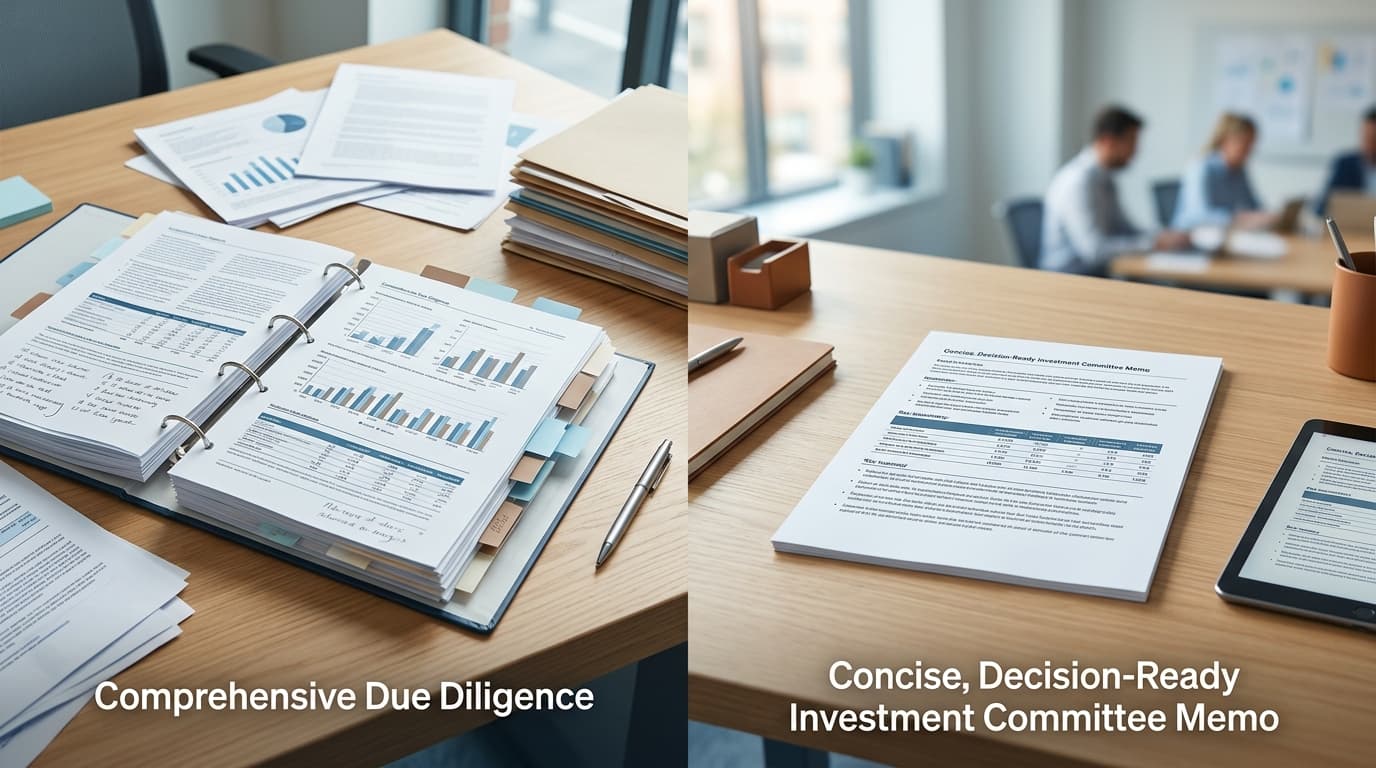
Deal Sourcing and Initial Market Mapping
Deal teams in private equity, investment banking, and corporate development increasingly deploy artificial intelligence to replace manual target scanning with automated market mapping. By ingesting unstructured web content, corporate registries, job board signals, and sector databases, AI engines build broad target universes within hours. Industry benchmark research indicates that 35% of generative AI adopters in M&A now apply the technology to target identification. Rather than relying on static industry codes, software models group companies by thematic relevance, underlying technology stacks, and niche market positioning.
- Thematic Market Mapping: Classifying privately held targets using proprietary taxonomy and web footprints rather than rigid industry codes.
- Automated Target Universe Construction: Ingesting thousands of company websites and registry filings to generate qualified lists of candidates.
- Initial Financial and Metric Filtering: Screening targets against preliminary criteria such as estimated headcount growth, revenue ranges, and geographic footprint.
- Signal Intelligence Tracking: Monitoring hiring trends, product launches, and regulatory disclosures to detect transaction readiness before formal processes begin.
While these automated pipelines dramatically expand pipeline coverage, human judgement remains indispensable during early deal sourcing stages. AI systems can identify companies that match numeric or keyword criteria, but investment professionals must evaluate strategic fit, assess soft management signals, and decide which founders to contact. AI accelerates the evidence-gathering phase of sourcing, allowing deal teams to spend less time on manual list-building and more time developing thesis-driven relationships.
Data Room Ingestion and Cross-Document Comparison
Virtual data rooms in complex transactions routinely contain thousands of unstructured files across multi-format PDFs, financial spreadsheets, corporate charters, and customer contracts. Historically, deal teams spent weeks manually cataloging these uploads, creating severe bottlenecks during tight diligence windows. Modern Data Room Ingestion solutions eliminate this friction by processing multi-format data rooms rapidly, automatically parsing unstructured content into a queryable knowledge layer for accelerated deal execution.
Identifying Discrepancies Across Versions and Counterparties
Beyond simple file classification, an effective AI due diligence workflow applies deep semantic comparison across distinct documents, counterparties, and revision histories. Leveraging advanced tools like the AI-Analysis Engine, deal teams can instantly cross-reference statements made in transaction materials against underlying operational evidence. This cross-document synthesis focuses human attention on critical discrepancies across three main diligence areas:
- Contractual Version Mismatches: Identifying conflicting indemnification caps, change-of-control triggers, or restrictive covenants between preliminary drafts and executed agreements.
- Operational Baseline Inconsistencies: Cross-referencing management presentation revenue metrics against customer contracts and audited financial schedules to surface reporting gaps.
- Market Standard Deviations: Benchmarking target company contract terms against prevailing industry standards to highlight non-standard liability exposures or unusual termination clauses.
Automated cross-document comparison transforms document review from a passive reading exercise into an active, risk-focused audit. Junior analysts and advisory partners avoid missing hidden liabilities buried deep within appendixes, enabling the transaction team to shift immediately from manual document processing to high-value commercial analysis and valuation decisions.
Risk Identification and Exposure Flagging
During M&A due diligence, legal exposure and financial anomalies are often buried deep within thousands of contract pages and audit schedules. Change of control provisions in key agreements represent a significant third-party consent risk because an unconsented ownership shift can allow critical counterparties or licensors to terminate contracts. Modern deal teams deploy specialized tools like Risk Radar to scan target documentation automatically, flagging material liabilities, regulatory compliance gaps, and financial discrepancies early in the review process.
Surface Material Liabilities Against Exposure Thresholds
Rather than treating every contractual nuance equally, automated risk detection engines cross-reference uncovered clauses against the buyer's custom risk criteria and materiality thresholds. This allows M&A advisory firms and deal teams to prioritize critical liabilities, such as restrictive covenant breaches or uncapped indemnities, while filtering out routine operational noise. AI surfaces the evidence and pinpoints precise document locations, but human deal professionals evaluate whether an identified risk justifies a purchase price adjustment, custom indemnity protection, or deal termination.
- Change of control triggers in customer, supplier, and IP licensing contracts that require counterparty consent
- Regulatory compliance lapses and undisclosed legal liabilities that pose post-closing enforcement risks
- Financial anomalies between audited financial statements and underlying data room schedule items
By automating the systematic scanning of complex data rooms, deal teams replace manual line-by-line reading with targeted verification. This ensures that no hidden liability escapes notice, freeing senior advisors to focus on negotiating risk mitigation terms and refining overall valuation.
Cross-Advisor Coordination and Workstream Alignment
In complex transactions, deal execution frequently stalls when financial, legal, tax, and technical specialists operate in isolated silos. While external specialists focus on domain-specific risks, private equity deal leads and corporate development managers bear the burden of consolidating contradictory findings, tracking open questions, and reconciling mismatched valuation inputs across separate advisor decks. Research from Deloitte shows that 35% of organizations realize the most value from generative AI in dealmaking through advisory-led implementation, underscoring the necessity of seamless coordination between internal deal sponsors and external advisors. By serving as a shared intelligence workspace, modern platforms help M&A advisory firms and corporate teams align multi-disciplinary workstreams without replacing individual professional judgment.
- Unifying Multi-Advisor Findings: Automatically aggregating independent inputs from legal, accounting, and commercial streams into a single structured overview, highlighting conflicting target EBITDA adjustments or contractual liabilities across deliverables.
- Eliminating Duplicated Diligence: Scanning incoming query logs and document requests to flag redundant work between accounting auditors and legal teams, preserving advisory budgets and target management bandwidth.
- Continuous Risk Tracking: Linking surfaced risks directly to source files within the data room, ensuring every advisor operates from identical, verified primary documents.
Integrating tools like Collaboration Hub allows deal teams to coordinate complex multi-advisor engagements smoothly. Instead of spending critical days chasing status emails or manually mapping overlapping findings, transaction leaders can direct their focus toward evaluating strategic deal trade-offs, refining negotiation leverage, and making sound final investment decisions.
IC Memo Drafting and Management Interview Prep
Drafting investment committee (IC) memos and preparing for executive interviews traditionally absorb hundreds of junior deal hours. Modern M&A technology streamlines this transition by turning raw data room findings into structured deliverables and targeted management Q&A strategies. Industry research shows that 90% of M&A organizations now utilize generative artificial intelligence in deal processes, shifting the focus of junior analysts from tedious formatting to higher-level qualitative evaluation.
- Automated Outlining: Assembling preliminary IC memo sections using synthesized evidence from virtual data rooms.
- Source Traceability: Linking every assertion and financial figure back to its exact document source for auditability.
- High-Priority Questioning: Extracting hidden discrepancies to build targeted interview agendas for C-level teams.
To execute this workflow, deal teams rely on specialized capabilities within their workspace. The AI-Analysis Engine continuously cross-references ingested disclosures and extracts key findings with precise page citations. Next, the Report Builder auto-drafts candidate narrative blocks for the memo, ensuring that strategic risks, revenue breakdowns, and valuation assumptions are fully documented. Implementing systematic IC memo automation allows deal leads to enter management sessions with rigorous, data-backed lines of inquiry while retaining full oversight over final investment decisions.
Buyer-Side vs. Sell-Side Process Acceleration
While artificial intelligence accelerates processing across the entire deal lifecycle, buy-side and sell-side teams leverage automated workflows to resolve fundamentally different operational bottlenecks. Buy-side diligence centers on rigorous counterparty verification and risk discovery, whereas sell-side preparation focuses on compiling clear, comprehensive transaction collateral and disclosure documentation. Across both perspectives, AI compresses manual document synthesis into structured evidence without displacing human decision-making.
On the buy-side, deal teams encounter massive data volumes that must be vetted under strict exclusivity deadlines. Research indicates that using generative AI for due diligence document review delivers up to a 75% efficiency improvement over traditional manual methods. By deploying Data Room Ingestion, buy-side analysts can instantly parse multi-format target files, cross-referencing commercial agreements against financial models to verify underlying earnings and flag contractual liabilities.
- Buy-Side Document Verification: Automating cross-file verification between customer contracts, financial disclosures, and regulatory filings to surface anomalies before buyer management Q&A sessions.
- Sell-Side Disclosure Schedule Drafting: Scanning corporate repositories to draft preliminary disclosure schedules and representations-and-warranties exceptions, reducing the risk of missing material liabilities.
- CIM and Vendor Report Synthesis: Aggregating historical financial reports and operational files to accelerate Confidential Information Memorandum (CIM) preparation and deal-ready summary drafting.
For sell-side M&A advisory firms, automated document preparation shortens the time required to bring a company to market and minimizes friction during counterparty diligence. Streamlining disclosure assembly ensures that potential red flags are addressed prior to data room launch. Crucially, while AI accelerates the compilation of disclosure schedules and CIM drafts, senior advisors maintain sole accountability over transaction narrative, equity positioning, and final valuation terms.
Non-Negotiable Human Judgement and Deal Accountability
While tools for AI diligence automation and the broader AI M&A process dramatically accelerate data extraction, document comparison, and multi-file verification, the final responsibility for investment outcomes sits firmly with human deal leaders. Automated engines can flag financial anomalies, surface hidden liabilities, or highlight unusual contract indemnities, but converting raw findings into a defensible risk weighting or a realistic valuation requires deep industry experience. Leading dealmakers stress that human accountability remains non-negotiable in AI deal execution, as algorithms cannot replace strategic judgment, negotiate counterparty terms, or take personal responsibility before an investment committee.
Core Deal Responsibilities Reserved for Human Deal Teams
- Final Valuation and Synergy Modeling: Stress-testing financial models, challenging revenue growth projections, adjusting discount rates, and validating operational synergy targets based on macroeconomic shifts.
- Commercial Risk Weighting and Price Negotiations: Determining whether surfaced legal exposures or EBITDA adjustments warrant purchase price markdowns, specific indemnity protection, or complete transaction withdrawal.
- Management and Leadership Quality Assessment: Evaluating executive team culture, operational resilience, and post-merger integration capability through targeted management due diligence.
- Fiduciary Responsibility and Governance: Defending transaction logic before the investment committee, satisfying LP requirements, and taking personal accountability for long-term capital deployment.
To support rigorous verification without slowing deal velocity, modern platforms ensure full source traceability. Plausity tools like Risk Radar allow junior analysts and senior partners to verify every AI-synthesized finding against exact source pages in the virtual data room. By grounding automated insights in verifiable source documentation, AI shifts the deal team's focus from manual document processing to high-value synthesis, strategic decision-making, and relationship building.
Red-Flag Signals in AI-Assisted M&A Workflows
| Signal | Why it matters | Diligence action |
|---|---|---|
| AI-generated figures reach an IC memo without a documented source trace | Unverified numbers can silently distort an investment decision | Require every AI-assisted figure to carry a traceable link to its source document |
| Deal team relies on automated screening output with no human spot-checking | Automated tools can miss context that a human reviewer would catch | Require a documented human review step before screening conclusions are finalized |
| No clear ownership of which findings were AI-assisted versus independently verified | Blurs accountability if a finding later proves incorrect | Require findings to be tagged by source and reviewing analyst |
| Cross-advisor workstreams use inconsistent AI tools with no shared findings repository | Creates duplicated effort and conflicting conclusions across the deal team | Require a single shared findings and risk register across all advisors |
| Management interview questions are generated without review by a senior deal team member | May miss deal-specific nuance or fail to probe known risk areas | Require senior review of AI-drafted interview questions before use |
| Final investment conclusions are attributed to a tool rather than the deal team | Undermines accountability for the ultimate investment decision | Require final conclusions and sign-off to remain explicitly with the deal team |
Workflow Checklist for Responsible AI Use in M&A
- Documented policy on which diligence tasks may use AI assistance and which require exclusively human review
- Shared findings and risk register accessible to all advisors on a deal
- Source-traceability requirement for every AI-assisted figure or claim
- Named reviewer for each AI-drafted document before it moves forward
- Version control across document comparison outputs
- Escalation path for AI-flagged risks that require senior partner judgement
- Clear record of which IC memo sections were AI-assisted versus independently drafted
- Post-deal review of where AI assistance helped or fell short, to refine the workflow
How Plausity Supports This Workflow
Findings from an AI-assisted diligence process should feed directly into a shared findings and risk register, not sit in disconnected tool outputs, and this is the same evidence-based approach described in this AI-native due diligence software overview. Plausity is an AI-native due diligence and deal intelligence platform that helps deal teams analyze company information, structure findings, and compare documents, including for workstreams such as a financial due diligence checklist and software technology due diligence. Plausity's AI-powered diligence analysis, findings and risk intelligence, and risk register automation capabilities help surface and trace findings back to source documents. This supports evidence review and does not replace legal, financial, tax, commercial, or technical judgement, and does not guarantee funding, acquisition, valuation, or investment outcomes.