The 2026 Dilemma: Why Legacy VDRs Fall Short of Audit Ready Due Diligence
The traditional private equity due diligence software landscape is undergoing rapid disruption. For decades, legacy virtual data rooms (VDRs) served as passive storage lockers, functioning as secure folders designed for file sharing but incapable of reading, cross-referencing, or analyzing their own contents. As investment cycles compress, relying on manual file reviews within these static repositories creates critical operational bottlenecks. Deal teams face a high-stakes trade-off: spend hundreds of hours manually auditing thousands of documents or move quickly and risk missing catastrophic legal, financial, or operational red flags. In today's market, maintaining a competitive edge requires shifting from static folders to an active AI-native platform that acts as a comprehensive deal intelligence platform.
The Limits of Manual File Reviews and Static VDRs
In mid-market and large-cap transactions, a single target company can upload tens of thousands of files: complex supplier agreements, multi-jurisdictional employment contracts, tax filings, and historic financial models. Manually evaluating these documents is not only slow but highly error-prone. Deal teams are frequently forced to sample only a subset of contracts, introducing immense risk. Furthermore, traditional VDRs provide no automated oversight to detect discrepancies between files. Without technology like Plausity's Data Room Ingestion, which connects directly to VDRs and automatically structures unstructured content, analysts spend days simply organizing PDFs rather than performing strategic analysis. To achieve true audit ready due diligence, firms must automate the initial layer of data processing and move straight to automated analysis.
Generic LLMs and the Threat of Hallucinated Diligence
To accelerate the review process, some deal teams have experimented with generic, consumer-grade large language models (LLMs) or general-purpose corporate AI portals. However, these generic-AI tools present severe existential risks in high-value transactions. First, they lack data privacy and security; uploading proprietary target data to public or loosely secured commercial models violates strict non-disclosure agreements (NDAs) and exposes sensitive deal info. In fact, a recent Deloitte M&A survey found that 67% of dealmakers highlight data security as their primary concern when adopting artificial intelligence. Second, generic models are prone to hallucinating facts, numbers, and dates. In a transaction context, where an overlooked change-of-control clause or unrecorded tax liability can destroy millions in value, an unsourced AI response is useless. True traceable AI due diligence requires a secure, closed-loop AI-Analysis Engine designed specifically for M&A due diligence software, ensuring every single claim is directly backed by an immutable hyperlink to the source page.
The Rise of AI-Native Deal Intelligence Platforms
To protect their deal pipelines and speed up transaction timelines, private equity due diligence software is rapidly evolving. Today, 86% of corporate and private equity leaders have integrated artificial intelligence into their M&A workflows, with 83% investing $1 million or more specifically for their deal teams. Rather than relying on generic tools or basic keyword searches, top-tier VC & PE Fund Investment Professionals are moving toward an AI due diligence platform. Modern platforms combine automated Data Room Ingestion with specialized reasoning engines to conduct deep-dive financial and legal analysis. For instance, Plausity's Risk Radar automatically scans incoming files for double-materiality gaps and regulatory compliance, while the Report Builder compiles these findings into structured, investor-ready summaries. By replacing human-driven manual sampling with comprehensive, automated document coverage, deal teams achieve complete audit ready due diligence without compromising speed.
To help PE and M&A teams evaluate these solutions, the table below highlights the structural differences between legacy VDRs, generic-AI software, and AI-native platforms in 2026.
| Feature | Legacy VDRs | Generic-AI Tools | AI-Native Platforms |
|---|---|---|---|
| Core Functionality | Passive secure file storage and basic keyword searching. | Ad-hoc Q&A and text summarization without domain training. | Active document reasoning, automated risk detection, and audit-ready report generation. |
| Source Traceability | Manual, where analysts must locate and cross-reference files by hand. | None. Answers are generated without reliable, page-level document citations. | 100% traceable. Every analytical claim is linked directly to the underlying document and page. |
| Data Security | High security but lacks analytical capabilities. | Low to moderate security; risk of data leakage and public model training. | Enterprise-grade security baseline designed for sensitive deal data. |
| Risk Identification | Relies entirely on manual discovery by human legal and financial analysts. | Inconsistent; lacks specialized financial and legal materiality filters. | Automated via features like Risk Radar to surface material discrepancies instantly. |
What is an AI-Native Deal Intelligence Platform?
In the high-stakes landscape of private equity due diligence software, a fundamental shift has occurred. Traditional workflows relied on Virtual Data Rooms (VDRs) as passive document repositories, placing the entire burden of reading, cross-referencing, and risk identification on overstretched deal teams. In contrast, an AI-native deal intelligence platform is a dynamic, active reasoning environment. It does not just store documents, it reads, interprets, and audits them in real time. According to Bain & Company's Global M&A Report 2026, tech-driven transactions and rising deal values have put immense pressure on investment teams to accelerate due diligence workflows while maintaining rigorous accuracy. An AI-native platform addresses this pressure by transitioning diligence from manual document retrieval to automated, deep-reasoning synthesis.
Active Document Reasoning vs. Passive Storage
The core differentiator of a modern AI due diligence platform lies in active document reasoning. Legacy VDRs function as static digital filing cabinets, requiring analysts to manually search for keywords, download PDFs, and piece together findings in separate spreadsheets. This passive approach is not only slow, but it also creates severe information asymmetry. Modern M&A due diligence software equipped with native machine-reasoning capabilities, such as Plausity's AI-Analysis Engine, can digest entire data rooms within minutes. By utilizing advanced autonomous AI agents, these platforms analyze complex financial models, legal agreements, and corporate filings side-by-side. Instead of simple keyword matching, the platform understands semantic context, mapping connections across tens of thousands of pages to extract actionable deal intelligence.
Traceable AI and Complete Audit Readiness
While generic AI tools can draft quick summaries, they suffer from two critical flaws that make them unsuitable for institutional transaction environments: hallucination and lack of traceability. In private equity due diligence software, an unverified claim is a liability. An AI-native due diligence platform solves this by design through traceable AI due diligence. Every insight, risk flag, or summary generated by the system is linked directly to a specific sentence, page, and document in the source data room. This ensures audit ready due diligence, allowing VC and PE fund investment professionals to instantly verify any finding. If a risk is surfaced, a single click takes the analyst to the exact contract clause or financial statement that triggered the alert, eliminating guesswork and establishing complete compliance.
| Capability | Legacy VDR | Generic AI Tools | AI-Native Platforms |
|---|---|---|---|
| Document Processing | Requires manual, document-by-document reading and manual categorization. | Processes text via standard API but struggles with complex table formats and large multi-document uploads. | Automated document ingestion, classification, and multi-format extraction via purpose-built engines. |
| Search & Retrieval | Basic keyword or phrase search with no understanding of context or synonyms. | Semantic search available but limited to single documents without cross-referencing capabilities. | Active multi-document reasoning that connects disparate data points across the entire data room. |
| Risk Detection | Relies entirely on human eyes to catch legal discrepancies, contract liabilities, or financial anomalies. | Can highlight general legal terms but lacks industry-specific materiality analysis or risk ranking. | Automatic risk identification based on custom materiality thresholds, surfacing red flags instantly. |
| Traceability & Auditability | Manual process of noting down file names and page numbers for compliance. | Generates summaries without reliable, direct source citations, risking hallucinations. | Provides deep traceability with direct source links, ensuring every insight is verifiable and audit-ready. |
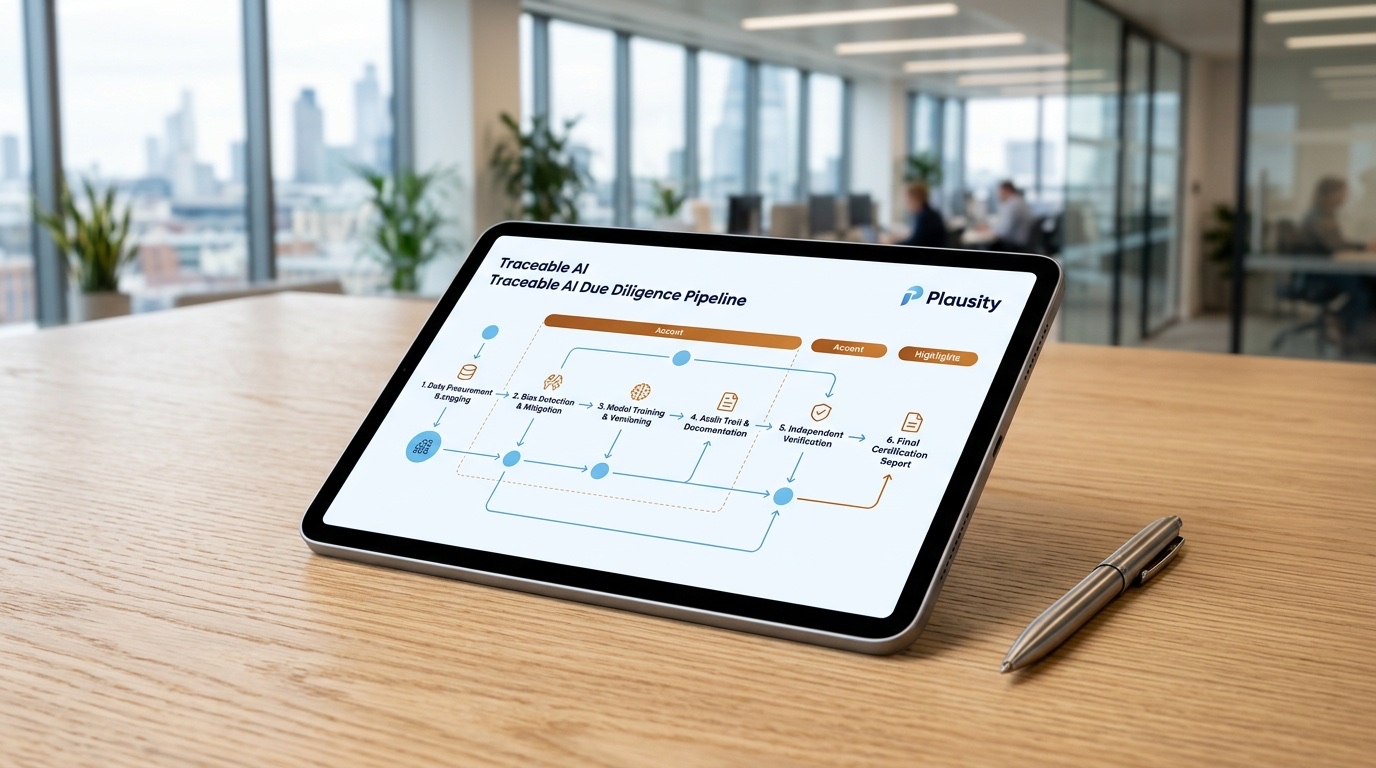
To bridge the gap between simple document storage and actionable deliverables, Plausity's platform integrates these native capabilities into a unified workspace. Through Data Room Ingestion, the software connects to existing VDRs, instantly transforming unstructured PDF and spreadsheet chaos into a structured knowledge base. Once ingested, the AI-Analysis Engine runs deep semantic audits, while the Risk Radar automatically flags inconsistencies and material exposures. Finally, the Report Builder compiles these verified findings into professional, investor-ready summaries, while the Collaboration Hub coordinates deal team tasks. By uniting ingestion, reasoning, and reporting, this integrated approach turns due diligence from a defensive checklist into a strategic deal intelligence playbook.
Comparing Legacy VDRs, Generic AI, and AI-Native Platforms
In the modern transaction landscape, evaluating private equity due diligence software requires distinguishing between three fundamentally different technological approaches. Historically, deal teams relied exclusively on virtual data rooms (VDRs) as secure, passive storage lockers. While the global VDR market remains large, projected to reach approximately $3.78 billion in 2026, these systems are static. They require professionals to manually download, organize, and read thousands of documents. Conversely, the introduction of generic AI copilots and general-purpose large language models (LLMs) promised to accelerate this manual review, yet their lack of financial specialization and deterministic reasoning introduced severe hallucination risks and data-security vulnerabilities. To achieve true deal intelligence, modern investment committees are shifting toward specialized AI-native due diligence platform technologies that combine secure multi-document reasoning with absolute source traceability.
Data Ingestion: Bulk Storage vs. Semantic Scanning
The fundamental difference begins at the moment of document ingestion. Legacy VDRs excel at bulk document storage and permission management, but they treat folders as flat PDF repositories, relying on basic keyword searches that fail to recognize synonymy or deal context. Generic AI tools can parse single documents when prompted, but they lack the infrastructure to ingest entire multi-gigabyte data rooms securely. This capability gap is addressed by modern M&A due diligence software through features like Data Room Ingestion, which performs semantic scanning across the entire document ecosystem. By mapping connections between structural legal agreements, financial models, and operational reports, an AI-native system transforms unstructured data room chaos into structured, queryable knowledge. This shift ensures that the AI-Analysis Engine can analyze the interdependencies of multiple documents simultaneously, rather than processing files in isolated silos.
Verification and Source Attribution: Hallucination vs. Traceable AI
A critical point of failure for general-purpose AI models in financial transactions is the lack of verifiable citation. In high-stakes transactions, a hallucinated contract clause or an incorrect EBITDA figure can lead to catastrophic valuation errors. Generic LLMs operate on probabilistic text generation, meaning they cannot guarantee that a generated summary is fully anchored in the underlying files. In contrast, a specialized deal intelligence platform is built with a strict verification contract, delivering traceable AI due diligence. Every financial metric, operational claim, or identified risk must map directly back to a specific document, page, and paragraph within the data room. By utilizing dedicated tools like Findings & Risk Intelligence alongside Risk Radar, investment teams can instantly cross-reference findings. This level of traceability is the only way to achieve audit ready due diligence, ensuring that any report delivered by Report Builder can withstand the scrutiny of investment committees, legal counsel, and regulatory audits.
| Evaluation Dimension | Legacy VDRs | Generic AI Tools | AI-Native Platforms |
|---|---|---|---|
| Document Processing | Passive storage with manual folder indexing and basic keyword search. | Single-file upload limit, unable to scan or map entire directory structures. | Automated Data Room Ingestion with semantic mapping across the entire document ecosystem. |
| Analysis & Reasoning | None. Requires deal teams to manually read, cross-reference, and analyze files. | Basic summarization, prone to hallucinating facts and missing complex transaction context. | Dedicated AI-Analysis Engine designed for multi-document reasoning and cross-referencing. |
| Risk Identification | Manual due diligence checklists and human spot-checking of red flags. | Requires complex prompting, lacks financial materiality and transaction risk frameworks. | Automated Risk Radar that categorizes legal, financial, and operational risks by materiality. |
| Citation & Traceability | No automation. Teams must manually catalog citations in spreadsheets. | Probabilistic text generation with no verifiable source or paragraph-level attribution. | Traceable AI due diligence with direct, clickable links to exact document pages and paragraphs. |
| Reporting & Outputs | No native drafting capabilities. Reports are built manually from scratch. | Drafts general-purpose text, requires heavy editing and verification of all facts. | Report Builder automatically drafts structured, investor-ready deliverables. |
Ultimately, selecting the right AI due diligence platform represents a structural decision about deal team efficiency and risk mitigation. While legacy VDRs remain necessary for safe file hosting, they do not offer any analytical leverage. Generic AI tools provide speed but introduce a level of hallucination and security risk that is unacceptable in institutional M&A. By contrast, an AI-native workspace integrates secure ingestion, deep contextual analysis, and absolute traceability into a single environment. For private equity and advisory teams evaluating their toolkit, the standard of traceable, audit-ready performance has become the new benchmark for competitive advantage in the 2026 deal landscape.
Core Evaluation Criteria for Private Equity Due Diligence Software
The transaction environment in 2026 demands unprecedented analytical speed and depth. For VC and PE fund investment professionals, traditional methods of manual document auditing are no longer viable. Selecting the right private equity due diligence software has transitioned from an operational choice to a core strategic advantage. To cut through the noise of legacy data repositories and generic generative algorithms, modern M&A advisory teams require a rigorous framework to evaluate tech solutions. Software selection must be judged across three primary dimensions: the depth of document and spreadsheet ingestion, the traceability of generated insights, and the platform's capacity to identify technological disruption risks in target companies.
Ingestion Depth for Complex PDFs and Financial Models
A primary point of failure in traditional transaction workflows is the inability of software to parse unstructured and highly complex formats. Legacy virtual data rooms act as passive file cabinets, forcing deal teams to download, organize, and manually cross-reference thousands of documents. When evaluating an AI-native due diligence platform, investment teams must assess how effectively the system handles unstructured PDFs, scanned files, and dense spreadsheets without losing context. With Plausity's dedicated Data Room Ingestion capability, files are automatically classified and structured. The system’s core AI-Analysis Engine then performs cross-document reasoning, allowing analysts to query across the entire dataset and surface critical financial anomalies or hidden liabilities within minutes instead of weeks.
Traceable AI and Audit-Ready Insights
Generic artificial intelligence tools often suffer from the black-box problem, generating summaries or assertions without visible proof. In high-stakes M&A, unverified claims introduce severe liability and compliance risks. To achieve an audit ready due diligence standard, every single data point, risk assessment, or financial projection must be fully defensible. When choosing a deal intelligence platform, look for platforms that offer traceable AI due diligence through deep-link citations. Plausity’s Risk Radar and Report Builder solve this by anchoring every finding to its specific page, paragraph, or spreadsheet cell. This level of granular traceability ensures that when deal teams present investment memos, every claim is instantly verifiable, eliminating the risk of algorithmic hallucinations.
AI Disruption Risk Mitigation and Compliance
Beyond analyzing a target's financial health, modern technology due diligence must evaluate how vulnerable a target company's core business model is to artificial intelligence. Recent industry surveys indicate that approximately 60% of buyers now prioritize AI disruption risk mitigation as a key transaction checklist item. A comprehensive AI due diligence platform should not only streamline the audit process but also assist analysts in identifying these existential technology risks. The platform must help evaluate the target's proprietary data advantages, its vulnerability to automation, and its compliance with evolving regional guidelines. By identifying these factors during the preliminary stages, investment teams can adjust their valuations and protect their portfolios against sudden post-acquisition obsolescence.
Differentiating Diligence Platform Architectures
| Evaluation Criteria | Legacy VDR Systems | Generic AI Tools | AI-Native Platforms |
|---|---|---|---|
| Core Architecture | Passive document repositories with basic keyword searching. | General-purpose chatbots retrofitted with simple query wrappers. | Purpose-built workflow environments with integrated document-level reasoning. |
| Document Ingestion | Manual folder organization requiring substantial human effort. | Strict token context windows that struggle with complex PDFs and models. | Automated structural parsing of scanned assets, spreadsheets, and contracts. |
| Traceability | Completely manual audit trails and offline document tracking. | Unverified summaries prone to hallucinations with no original sources. | Clickable, granular citations pointing back to specific pages and paragraphs. |
| Risk Mitigation | Provides no automated risk analysis or material discrepancy flags. | Lacks the domain-specific logic to isolate complex legal or financial exposure. | Specialized algorithms that surface anomalies and evaluate material exposure. |
Plausity in Action: A Modern Traceable AI Due Diligence Platform
As global mergers and acquisitions activity rebounds toward an expected 4 trillion dollars in transaction value in 2026, transaction professionals require more than just standard cloud storage. They need a comprehensive deal intelligence platform that can proactively reason across thousands of files. Traditional virtual data rooms function as passive document repositories, placing the entire burden of search on human analysts, while generic generative AI models present significant accuracy and hallucination risks. To address these limitations, Plausity operates as a secure, specialized private equity due diligence software suite designed to deliver complete, audit ready due diligence with direct traceability to source files.
Streamlining Ingestion and Multi-Document Reasoning
An advanced AI due diligence platform must eliminate the friction between data gathering and deep analytical work. Plausity resolves this by deploying Data Room Ingestion to establish direct connections with legacy virtual data rooms. Rather than manually sorting through folders, the tool processes complex contracts, operational files, and financial models in minutes. Once these documents are organized, the core AI-Analysis Engine performs multi-document reasoning to identify structural relationships and trends. This specialized M&A due diligence software goes beyond simple keyword matches, analyzing semantic context to help investment professionals understand exactly how clauses in disparate agreements interact.
Sourcing Material Liabilities with Risk Radar
Identifying deep transactional anomalies requires more than summarizing individual files. It demands active cross-document validation. Plausity's Risk Radar functions as an automated risk-assessment layer, evaluating findings based on financial exposure, materiality, and deal relevance. For example, if a customer contract contains an unusual change-of-control clause, the system automatically cross-references this clause with the target company's capitalization table to highlight potential unaccrued liabilities. By highlighting these critical discrepancies, deal teams can mitigate severe valuation risks before entering final negotiations, securing a foundation for traceable AI due diligence.
Generating Investor-Ready Outputs and Aligning Deal Teams
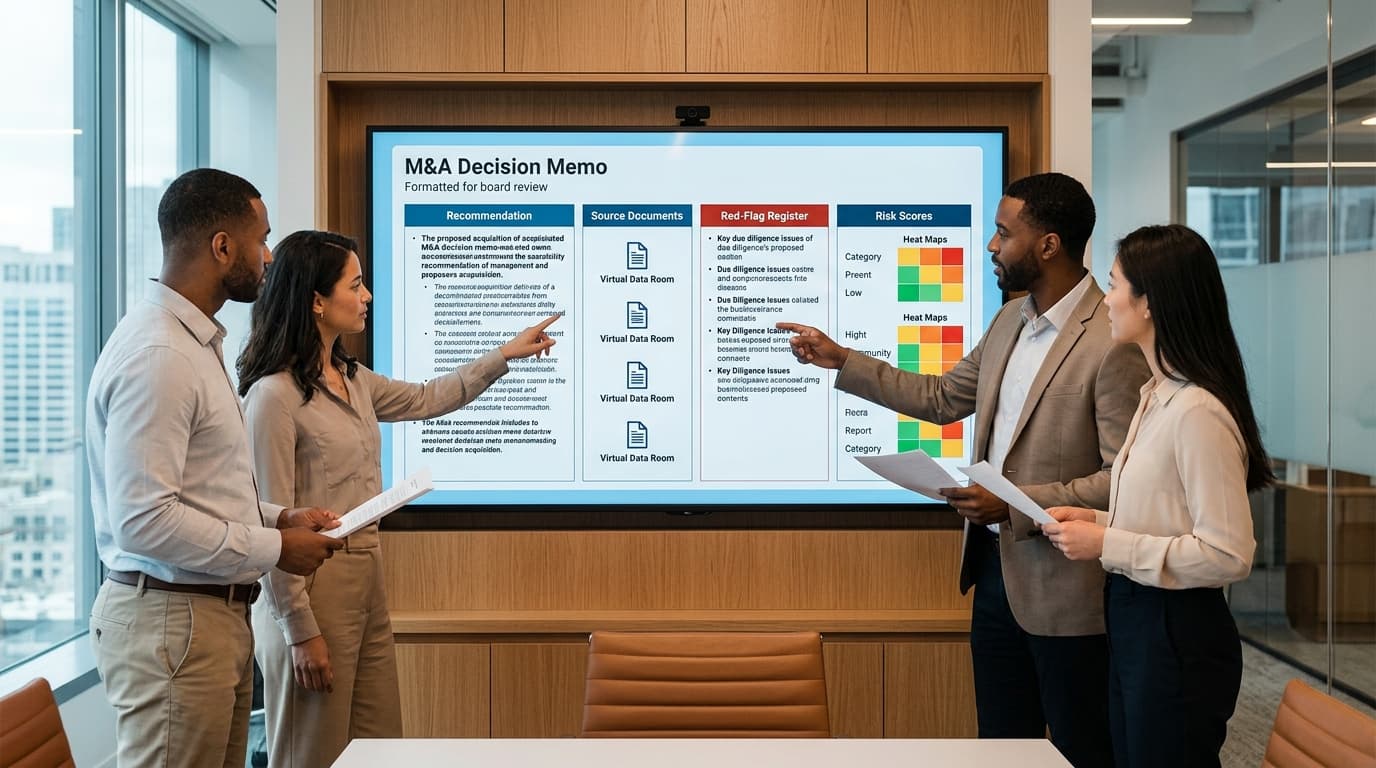
The final stage of any transaction review involves translating complex findings into structured, professional reports. Plausity's Report Builder automates this entire step, converting raw analysis into structured draft reports, red flag summaries, and executive presentations. Because every drafted claim is linked directly back to its original page and document in the target's data room, investment committees can verify findings in seconds, guaranteeing audit ready due diligence. To keep the broader transaction group aligned, the Collaboration Hub coordinates all workstreams in real-time, ensuring that legal, financial, and operational advisory teams remain perfectly synchronized throughout the deal cycle.
- Secure Ingestion: Seamless data synchronization from traditional repositories using Data Room Ingestion to eliminate manual file-sorting overhead.
- Autonomous Reasoning: In-depth commercial evaluation powered by the AI-Analysis Engine to understand multi-document relationships and legal definitions.
- Active Risk Mapping: Targeted vulnerability scanning through Risk Radar to detect change-of-control conflicts, compliance gaps, and financial liabilities.
- Traceable Report Generation: Rapid creation of investor-ready briefings via Report Builder with automated back-linking to source materials, helping compress deal cycles by 30 to 50 percent.
- Streamlined Coordination: Real-time workstream alignment using the Collaboration Hub to ensure advisory partners and investment professionals remain fully synchronized.
The Strategic Payoff of Traceable AI Due Diligence in M&A Due Diligence Software
In a highly competitive transaction landscape, the difference between a successful close and a value-destroying acquisition rests on the depth and speed of pre-deal analysis. Historically, mergers and acquisitions face high hurdle rates, with multiple industry studies by Harvard Business Review and Bain estimating that between 70% and 90% of M&A transactions fail to achieve their projected synergies or target returns. A primary driver of these disappointing outcomes is due diligence oversight, where deal teams fail to identify critical operational liabilities, customer churn, or structural integration bottlenecks in time. To mitigate this risk, modern VC & PE fund investment professionals are moving away from passive document hosting and generic AI tools toward a dedicated, traceable AI due diligence approach. Utilizing a specialized AI-native platform allows investment teams to move from simple keyword searching to deep, verifiable reasoning.
Compressing Timelines: From Weeks of Manual Audits to Hours of Targeted Review
The traditional diligence process represents a severe bottleneck. Investment professionals routinely spend weeks manually parsing thousands of commercial contracts, legal documents, and financial files. This slow pace often costs funds their competitive edge, especially when multiple buyers compete for the same high-quality asset. By contrast, deploying modern private equity due diligence software dramatically compresses transaction timelines. Implementing automated tools accelerates initial document processing and analysis cycles by 30% to 50% through AI agent technology. Platforms like Plausity achieve this by deploying rapid Data Room Ingestion to instantly scan and structure unstructured data, passing it directly to a secure AI-Analysis Engine. Rather than reading documents line-by-line, deal teams can query entire virtual data rooms and receive comprehensive, synthesized summaries in minutes.
Mitigating Integration Failures: Spotting Hidden Liabilities Before the Close
A rapid timeline is worthless if speed compromises quality. Generic AI tools often hallucinate or omit critical details, creating severe legal and financial risks during transactions. To achieve true audit ready due diligence, investment professionals require absolute traceability, meaning every synthesized point must map directly back to a specific clause, page, and document. When identifying post-merger integration risks, such as problematic customer contract change-of-control clauses or hidden product liability issues, specialized platforms act as an early-warning system. By utilizing an automated Risk Radar, deal teams can flag materiality gaps, financial anomalies, and regulatory compliance issues early in the transaction lifecycle. This evidence-based approach ensures that findings are not merely guessed but are traceable to their precise primary sources in the data room.
- Instantaneous Connection: Streamlining the transition from chaos to structured knowledge through Data Room Ingestion.
- Deterministic Traceability: Utilizing the AI-Analysis Engine to trace every risk assessment and financial insight directly to its original document and page number, ensuring an audit-ready trail.
- Structured Risk Scoring: Leveraging the Risk Radar to evaluate findings based on financial exposure, legal liability, and deal relevance.
- Automated Reporting: Generating polished drafts using the Report Builder to streamline the synthesis of investor-ready briefings.
Securing the Bid: Gaining Competitiveness in High-Velocity Deal Environments
In modern private equity, deal-making velocity is a competitive differentiator. When multiple premium funds target the same asset, the firm that delivers a comprehensive, risk-adjusted bid first often secures the exclusive right to negotiate. By combining the speed of the AI-Analysis Engine with a centralized Collaboration Hub, deal partners, advisory firms, and legal counsels can align on findings in real-time. This eliminates redundant communication loops and accelerates decision-making workflows. Integrating a modern deal intelligence platform does not just save administrative costs, it transforms due diligence from an administrative gatekeeper into a strategic driver of deal success, giving investment committees the confidence to act swiftly and decisively.
Plausity brings AI-native analysis to this workstream. Explore Plausity's AI-Analysis Engine, or read more on how traceable red-flag reporting works in practice.