Why AI infrastructure financing matters now
The rapid expansion of artificial intelligence is fundamentally altering technology capital formation, forcing a structural migration from corporate equity funding to debt and project financing structures. In 2025 alone, the five largest hyperscalers issued approximately $121 billion of US corporate bonds, more than four times their 2020 to 2024 annual average of $28 billion, while private credit lenders extended additional multi-billion-dollar facilities to AI-related platforms. As balance sheets become strained by multi-billion-dollar annual commitments, specialized credit vehicles, asset-backed securities, and off-balance sheet lease commitments are becoming the primary funding mechanisms across the ecosystem.
The Shift From Equity to Debt and Structured Capital
For venture capital and private equity investors, this capital migration transforms traditional underwriting. Infrastructure projects no longer rely purely on cash flow from software operations. Instead, deals are structured around special-purpose vehicles (SPVs), multi-year take-or-pay capacity agreements, and collateralized GPU assets. Investors evaluating this landscape must understand how private credit and off-balance sheet liabilities interact with corporate debt profiles.
- Structural reliance on private credit: Direct lenders are bridging multi-billion-dollar funding gaps that commercial banks cannot absorb under traditional regulatory limits.
- Proliferation of uncommenced lease obligations: Hyperscalers hold hundreds of billions of dollars in off-balance sheet commitments that do not yet appear as GAAP liabilities.
- Tenor and asset-life mismatch: Borrowers are taking on medium-term debt to finance hardware that may experience accelerated economic obsolescence.
Evaluating AI infrastructure financing requires looking past top-line booking numbers to scrutinize true debt-service capacity, capital structure mechanics, and underlying collateral durability.
The main practical framework for AI capital
The AI capital formation framework rests on three distinct tiers: core hyperscaler balance-sheet capital expenditure, lease-backed project finance, and asset-backed private credit facilities. With Goldman Sachs Research expecting the largest technology companies leading the buildout to spend a combined $5.3 trillion of capital expenditure from 2025 through 2030, traditional operating cash flows are insufficient to fund the entire physical buildout alone.
Mapping the Stack: Equity, Structured Leases, and Asset-Backed Debt
To manage this immense capital burden, operators and sponsors distribute risk across segmented tranches:
| Capital Tier | Primary Structure | Key Diligence Metric | Underwriting Risk |
|---|---|---|---|
| Hyperscaler Capex | Corporate balance sheet cash and investment-grade corporate bonds | Cash flow from operations to capex ratio | Cash drain on core software margins |
| Lease-Backed Project Finance | Special-Purpose Vehicles (SPVs) backed by take-or-pay leases | Counterparty credit rating and lease termination clauses | Contract enforceability and non-performance risk |
| Asset-Backed Credit (Neoclouds) | Asset-backed loans secured by GPU clusters and cluster collateral | Loan-to-value (LTV) and chip utilization rates | Rapid hardware obsolescence and residual liquidation discounts |
When conducting AI credit risk analysis across these tiers, deal teams must examine how subordinated debt and intercreditor terms behave if utilization drops or anchor tenants renegotiate terms.
What investors and lenders are really testing
Institutional lenders and private equity sponsors are scrutinizing the gap between long-dated demand assumptions and short-term speculative capacity. In past infrastructure cycles, capital followed demonstrated customer utility; in the current cycle, billions of dollars are committed based on model scaling projections that may not translate into durable enterprise revenue.
Circular Financing Loops and Related-Party Demand
A major area of diligence is the emergence of circular financing ecosystems, where vendor investments, equity grants, and compute purchase agreements form closed loops that mask organic end-user demand. Massive commitments, such as the reported five-year, $300 billion cloud computing agreement between OpenAI and Oracle starting in 2027, illustrate how a small group of highly capitalized entities exchange commitments to build unprecedented capacity.
Assessing Hyperscaler Concentration and Counterparty Risk
Diligence teams must test whether platform revenues reflect diversified commercial adoption or single-tenant reliance. Key testing vectors include:
- Cash-funded versus credit-funded revenue: Determining whether tenant payments derive from organic operating profits or venture subsidies.
- Anchor-tenant contract durability: Auditing step-down provisions, power-availability conditionality, and penalty-free early termination clauses.
- Cluster reusability and software lock-in: Evaluating whether GPU clusters can be seamlessly repurposed for external clients if an anchor tenant defaults.
What AI platforms are expected to show
Operators seeking project debt or equity expansion can no longer rely solely on reserved compute orders or high-level growth projections. Underwriters now demand verifiable operational proof across unit economics, utility interconnections, and contractually binding revenue streams.
Secured Power and Physical Site Viability
The primary bottleneck for AI infrastructure has shifted from chip availability to energized power capacity. Lenders require documented proof of signed interconnection agreements, utility queue status, and advanced cooling infrastructure before issuing credit.
- Energized power agreements: Verified contracts with local utilities rather than preliminary interconnection queue positions or letters of intent.
- Long-term Power Purchase Agreements (PPAs): Fixed-rate energy supply contracts that insulate operational margins from wholesale electricity price volatility.
- Cooling efficiency and rack density: Validated Power Usage Effectiveness (PUE) metrics and liquid cooling infrastructure capable of sustaining high-density workloads.
Evaluating data center power and power delivery timelines is essential to verify that compute assets can actually be energized before debt amortization begins.
A red-flag table for AI infrastructure deals
Diligence teams must watch for accounting maneuvers and aggressive financial engineering designed to mask structural weaknesses. In particular, adjusting depreciation schedules for compute assets creates an artificial distortion between reported accounting profits and economic reality.
Accounting Arbitrage and Hardware Depreciation Manipulation
For example, when Meta extended the assumed useful life of its servers and network assets to five and a half years in January 2025, it expected the change to cut that year's depreciation expense by about $2.9 billion. While such an adjustment boosts near-term reported earnings, it masks the underlying economic reality where annual chip release cadences degrade the revenue-earning power of older hardware long before it is fully written off.
| Risk Category | Specific Red Flag | Economic Reality & Diligence Impact |
|---|---|---|
| Depreciation Manipulation | Extending server useful lives without technical justification, against a shortening chip cadence | Inflates reported net income while hiding hardware obsolescence and replacement capex needs. |
| Vendor Financing Loops | Compute providers receiving equity from chip vendors tied to mandatory hardware purchase quotas | Creates artificial demand signals and inflates top-line revenue without verifiable third-party adoption. |
| Leverage & Tenor Mismatch | Short-dated debt financing long-term power and shell buildouts with uncommitted tenants | Exposes lenders to severe refinancing risk if interest rates stay elevated or compute pricing compresses. |
| Shadow Lease Liabilities | Off-balance sheet take-or-pay commitments exceeding on-balance sheet corporate debt | Obscures true credit health and debt-service coverage under unhedged downside utilization scenarios. |
Identifying these red flags early in neocloud due diligence protects funds from underwriting overvalued collateral with high structural refinance risk.
A data-room evidence and checklist section
A thorough diligence process requires an exhaustive data-room audit of legal contracts, technical specifications, and capital commitments. Investment committees should mandate verifiable documentation for every critical risk vector before approving capital allocation.
Core Diligence Checklist for AI Infrastructure Assets
- Power interconnection and utility agreements: Audited utility contracts confirming substation energization dates, committed megawatt capacity, and tariff escalation caps.
- Cooling and facility engineering specs: Technical engineering reports verifying closed-loop liquid cooling, rack density tolerances, and site water consumption.
- Take-or-pay customer contracts: Binding customer agreements detailing minimum volume commitments, cure periods, billing dispute protocols, and default remedies.
- GPU asset registries and maintenance logs: Serialized hardware registries detailing cluster age, firmware stability, uptime track records, and vendor warranty terms.
- Debt-service coverage models (DSCR): Financial models stress-tested against material declines in spot compute pricing and wider refinancing spreads, with the downside assumptions documented.
Deal teams that systematically audit these five core areas can separate viable infrastructure assets from capital-intensive projects vulnerable to sudden revenue disruption.
How to use this in your next diligence workflow
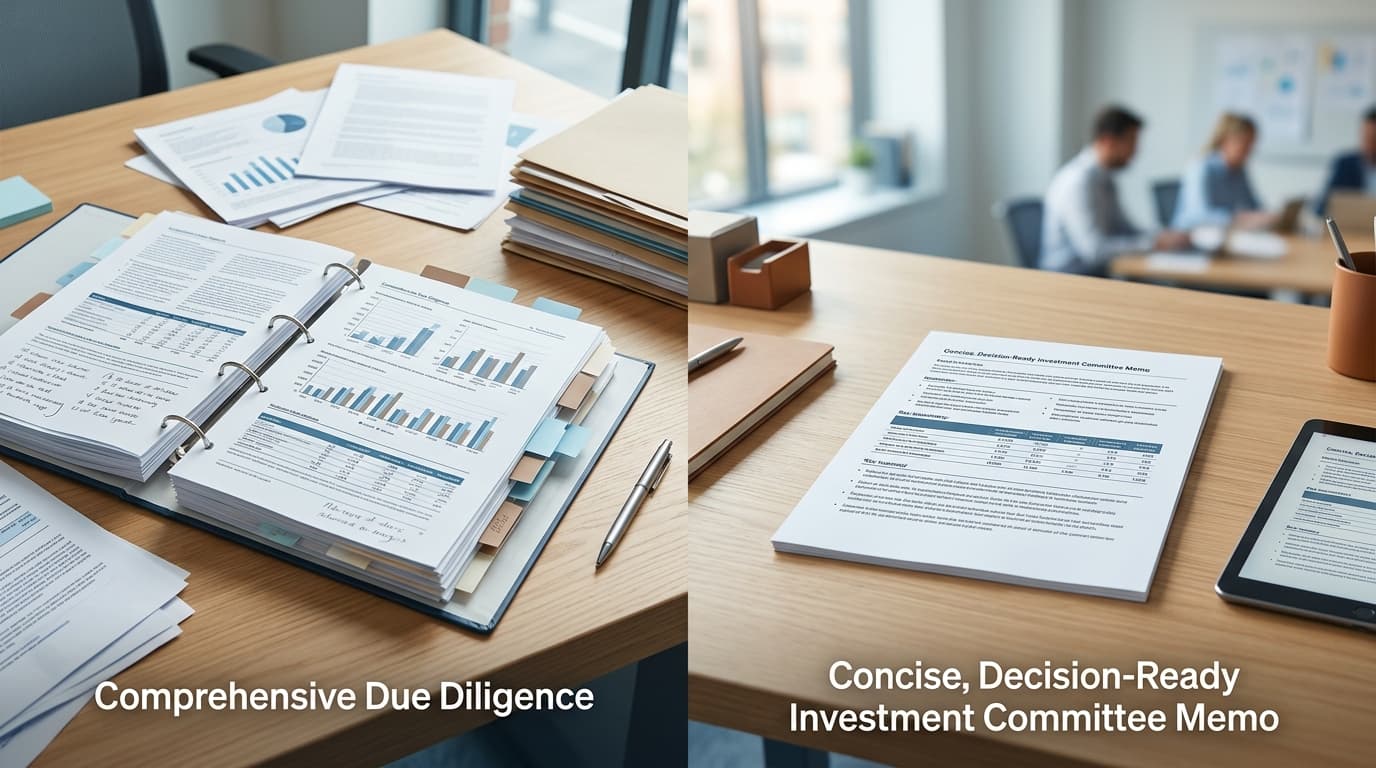
Applying these diligence standards across massive data rooms containing thousands of pages of utility filings, lease agreements, and master service agreements requires a structured, automated workflow. Diligence teams must convert complex legal clauses into actionable risk ratings quickly enough to guide committee decisions.
How Plausity supports the workflow
Modern deal teams increasingly run this analysis on specialized document-intelligence platforms. Deploying an AI Analysis Engine, investment professionals can automatically cross-reference take-or-pay contracts against underlying power delivery timelines and vendor financing covenants.
- Step 1: Ingest complete data rooms: Upload all master service agreements, power purchase agreements, and financing documents into a centralized, secure environment.
- Step 2: Run automated risk detection: Use Risk Radar to instantly identify circular revenue structures, off-balance sheet liabilities, and termination vulnerabilities.
- Step 3: Stress-test debt coverage: Model real-time cash flow sensitivities against compute price deflation and power delay penalties.
- Step 4: Export committee-ready findings: Generate structured findings memos and audit trails with full source traceability to defend investment theses.
By integrating automated document intelligence into the review process, investment committees can evaluate complex AI infrastructure opportunities with complete confidence and speed.