Why this matters now
AI data center power due diligence is the systematic evaluation of grid interconnection capacity, power procurement contracts, thermal cooling constraints, and regulatory permitting required to underwrite high-density compute infrastructure investments. Power access has evolved from a routine utility operating cost into the primary gating factor for digital infrastructure valuations and project viability. With a single 100-megawatt (MW) high-density facility requiring electricity equivalent to roughly 100,000 households, access to reliable, continuous power dictates whether compute capacity can actually be energized on schedule or remains stranded capital.
The exponential surge in artificial intelligence workloads has fundamentally transformed digital infrastructure underwriting. Global data center electricity consumption is projected to reach approximately 945 terawatt-hours (TWh) by 2030, according to analysis by the International Energy Agency. In mature markets, data center expansion now accounts for over 20% of net electricity demand growth. Investors and private credit lenders evaluating AI infrastructure exposure must analyze how localized grid bottlenecks directly threaten operating cash flows and asset valuations.
This rapid growth in energy demand is causing localized grid destabilization, forcing regional transmission operators to enforce stricter interconnection rationing. When massive load additions are introduced without adequate grid reinforcement, transmission lines experience thermal overload, voltage instability, and increased curtailment risks. For private equity sponsors and infrastructure funds, failing to test local grid resilience can lead to delayed commercial operation dates, unexpected capital expenditure requirements for sub-station upgrades, and severe revenue impairment.
- Surging Power Density: Modern AI racks require 40 kW to 120+ kW per rack, compared to 5 kW to 10 kW for legacy enterprise facilities.
- Transmission Line Congestion: Localized grid capacity bottlenecks frequently cap peak power delivery, forcing developers into costly curtailment agreements.
- Stranded Compute Capital: Multimillion-dollar GPU clusters remain non-operational if physical grid connections lag facility construction schedules.
- Rising Regulatory Scrutiny: Municipalities and regional utilities are imposing moratoriums or requiring dedicated off-grid clean power generation before approving large interconnects.
The main practical framework
To underwrite power risk effectively, private credit lenders and equity investors must deploy a structured framework that separates raw power availability from firm, deliverable grid capacity. A core pillar of this framework involves evaluating grid interconnection queue risk. Across major regional transmission organizations in North America and Europe, interconnection queues are severely backlogged. Data from the Lawrence Berkeley National Laboratory shows roughly 8,200 projects actively seeking US grid interconnection as of the end of 2025, representing 1,312 GW of generation plus about 749 GW of storage, and a median duration from interconnection request to commercial operation of over five years for projects built that year. In high-demand data center corridors, study timelines and utility construction backlogs regularly push final interconnection agreements out even further.
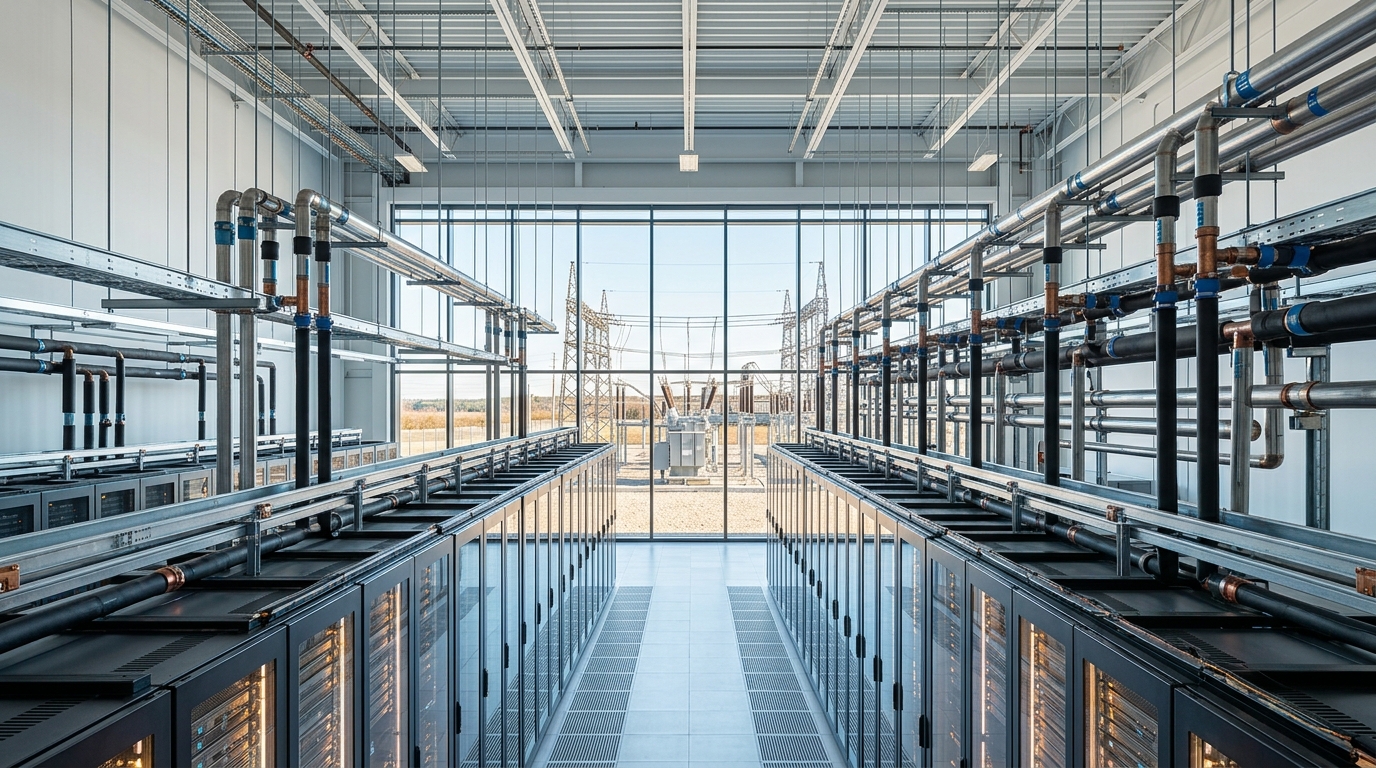
To mitigate grid timeline risk, investors must underwrite alternative energy architectures and hybrid power purchase agreements (PPAs). Primary infrastructure solutions now under review include co-located nuclear power generation, advanced geothermal systems, and large-scale battery energy storage systems (BESS). In AI infrastructure financing, evaluating off-grid or behind-the-meter generation allows deal teams to verify whether a target site can maintain baseload operations during peak grid strain or bridge multi-year delays in utility transmission upgrades.
Underwriting behind-the-meter clean energy requires rigorous analysis of fuel supply logistics, technology readiness levels, and regulatory approvals. Small modular reactors (SMRs) and direct nuclear power purchase agreements offer zero-emission baseload power, but require complex regulatory filings and long equipment procurement lead times. Geothermal installations provide constant renewable energy without weather dependency, yet require site-specific geological validation. Storage systems mitigate short-term power spikes but cannot sustain multi-day grid outages without auxiliary generation.
| Energy Architecture | Baseload Reliability | Interconnection Timeline Impact | Key Underwriting Focus |
|---|---|---|---|
| Direct Grid Connection | Dependent on regional grid mix | Median over 5 years from interconnection request to commercial operation for projects built in 2025 | Utility study approvals, transmission upgrade capex |
| Nuclear / SMR PPAs | Very high: the US nuclear fleet averaged a 91% annual capacity factor in 2025, above every other generation type | Bypasses public grid constraints | Regulatory licensing, fuel supply, long lead times |
| Advanced Geothermal | High and relatively flat year-round, historically the highest capacity factors among renewable technologies | Behind-the-meter siting avoids the 5-plus year queue wait | Subsurface resource rights, drilling capex |
| Grid + BESS Hybrid | Moderate (short-duration balancing, typically 2 to 4 hours) | Buffers interconnection ramp limits | Battery degradation, round-trip efficiency, fire safety |
What investors and operators are really testing
Beyond raw megawatt allocation, institutional investors and site operators must rigorously test physical engineering limits, thermal dissipation architectures, and construction execution. High-density AI chips generate unprecedented heat, triggering a rapid transition from traditional air cooling to direct-to-chip liquid cooling and immersion systems. This thermal shift creates substantial operational and environmental constraints. Direct water-based evaporative cooling systems consume immense volumes of municipal water, drawing heavy public and regulatory scrutiny in water-stressed regions. According to industry data reported by Tom's Hardware, U.S. data centers directly consumed over 17.4 billion gallons of water in 2023.
During neocloud due diligence, technical advisors must evaluate whether a facility's cooling design relies on evaporative cooling or closed-loop waterless systems. Closed-loop liquid cooling eliminates direct water draw during operations but demands additional electrical power for pumping and heat exchange, lowering overall energy efficiency metrics such as Power Usage Effectiveness (PUE). Investors must test whether local water rights agreements are legally binding and whether rising water utility tariffs could impair operating margins over a ten-year hold period.
Construction execution risk and capital expenditure overruns represent another major underwriting variable. Specialized electrical equipment, including high-voltage transformers, switchgear, and backup generators, faces prolonged global supply chain shortages. Industry benchmarks published by Axis Intelligence Research highlight that average shell-and-core construction costs reached $11.3 million per megawatt in 2026, while fully equipped AI data center fit-outs reach $37.3 million per megawatt. The same research cites JLL data showing US average equipment lead times of 42 weeks, with 57% of projects in 2025 experiencing delays of at least three months.
- Long-Lead Equipment Shortages: High-voltage transformers and utility switchgear currently carry procurement lead times exceeding 12 to 18 months.
- Water Rights and Permitting Security: Municipal water extraction permits must be audited for volumetric caps, seasonal drought restrictions, and fee escalators.
- Liquid Cooling Retrofit Complexity: Converting legacy air-cooled white space to direct-to-chip liquid infrastructure requires floor weight reinforcement and specialized fluid plumbing.
- Power Usage Effectiveness (PUE) Escalation: Inefficient cooling designs increase parasitic load, driving up power costs per compute unit and reducing overall facility yield.
What platforms are expected to show
To secure non-recourse project financing and competitive private credit terms, data center developers and compute platforms must present fully verifiable commercial and operational metrics. Lenders expect comprehensive proof of contracted demand, guaranteed minimum utilization rates, and long-term revenue visibility. When auditing AI credit risk, credit committees scrutinize whether power capacity is anchored by long-term take-or-pay master service agreements (MSAs) or subject to volatile spot market compute pricing.
Customer concentration represents a double-edged sword during underwriting. Leasing a facility's entire power capacity to a single hyperscaler or Tier-1 AI cloud provider yields strong credit backing and simplifies project finance debt syndication. However, extreme customer concentration exposes the platform to counterparty contract renegotiation or non-renewal risk upon lease expiration. Lenders require platforms to demonstrate contractual pass-through mechanisms for rising power tariffs, ensuring that utility price increases are borne by tenants rather than eroding the facility's debt service coverage ratio (DSCR).
Investors must also verify compute infrastructure efficiency and rack utilization density. Platforms should present detailed operational logs tracking real-time server load, PUE history, and power quality management. Demonstrating robust power redundancy, such as N+1 or 2N uninterruptible power supply (UPS) configurations and backup generator fuel reserves, is essential to prove that the facility can fulfill strict uptime service level agreements (SLAs) without penalty.
| Metric Category | Underwriting Standard | Target Threshold | Investor Assessment Objective |
|---|---|---|---|
| Contracted Demand Structure | Take-or-pay Master Service Agreements (MSAs) | 10 to 15-year lease duration | Ensures stable cash flows for debt service coverage |
| Power Pass-Through Clause | Full electricity tariff pass-through to tenant | Complete shift of power cost to tenant | Protects project EBITDA from utility power price spikes |
| Power Usage Effectiveness (PUE) | Total facility energy divided by IT equipment energy | 1.15 to 1.25 for AI liquid-cooled sites | Validates energy efficiency and low parasitic power loss |
| Hyperscaler Concentration | Share of capacity leased to single anchor tenant | Capped per lender policy, or offset by credit enhancement | Mitigates single-counterparty default or non-renewal risk |
Red flags and data room evidence
A rigorous due diligence process must systematically flag critical risks that threaten asset valuation or operational continuity. Environmental, permitting, and community opposition risks are increasingly stalling data center developments before groundbreaking. Local municipalities are voicing concerns over noise pollution from cooling towers, grid capacity strain, and municipal water depletion. Utilizing automated risk register automation allows deal teams to cross-examine hundreds of regulatory filings and environmental impact assessments, instantly identifying latent red flags.
The following red-flag framework highlights primary operational and legal risks that warrant immediate underwriting adjustments or structural credit enhancements during transaction diligence:
| Risk Category | Identified Red Flag | Underwriting Impact | Required Mitigation / Action |
|---|---|---|---|
| Grid Interconnection | Unsigned Interconnection Agreement (IA) or unstudied queue status | Commercial operation delayed by 3 to 5 years | Require executed IA and firm utility construction milestone schedule |
| Power Procurement | Merchant power exposure without long-term price hedging or fixed PPA | Volatile operating margins and potential debt default | Mandate fixed-rate PPA or utility tariff pass-through in tenant leases |
| Water Availability | Conditional water permit subject to annual municipal drought review | Facility forced to curtail cooling capacity during summer peak | Require closed-loop air/dry cooling retrofit or secured industrial reclaimed water rights |
| Permitting & Community | Active local zoning challenge or pending noise ordinance litigation | Injunction halting construction or restricting 24/7 operations | Verify municipal approvals, quiet-title status, and acoustic buffer compliance |
| Carbon & Governance | Reliance on unbundled renewable energy certificates (RECs) for green claims | Reputational damage and greenwashing regulatory fines | Validate 24/7 hourly carbon-free energy matching and direct power origin |
To conduct a complete evaluation, deal teams must request a standardized set of evidence files within the target company's virtual data room:
- Executed Interconnection Agreements: System impact studies, facility study reports, and signed utility interconnection agreements showing binding cost allocations.
- Power Purchase Agreements (PPAs): Long-term energy supply contracts, including price structures, curtailment clauses, and delivery point definitions.
- Water Extraction Permits & Rights: Binding municipal water allocation agreements, discharge permits, and drought contingency plan filings.
- Thermal and Electrical Single-Line Diagrams: Engineering schematics verifying UPS redundancy, switchgear ratings, and liquid cooling distribution loops.
- Environmental Impact & Permitting Files: Finalized zoning approvals, acoustic impact studies, air quality permits for backup generators, and local community host agreements.
Practical implications
Findings from power, cooling, and grid due diligence directly influence transaction structuring, purchase price allocations, and credit risk pricing. When diligence uncovers multi-year interconnection delays or unhedged power tariff exposure, investment teams must adjust financial models accordingly. Financial analysts must incorporate higher discount rates, increase capital expenditure reserves for grid upgrades, and adjust baseline cash flow projections to account for delayed commercial operation dates. Integrating standardized technical due diligence frameworks ensures that technical risks are translated directly into financial terms.
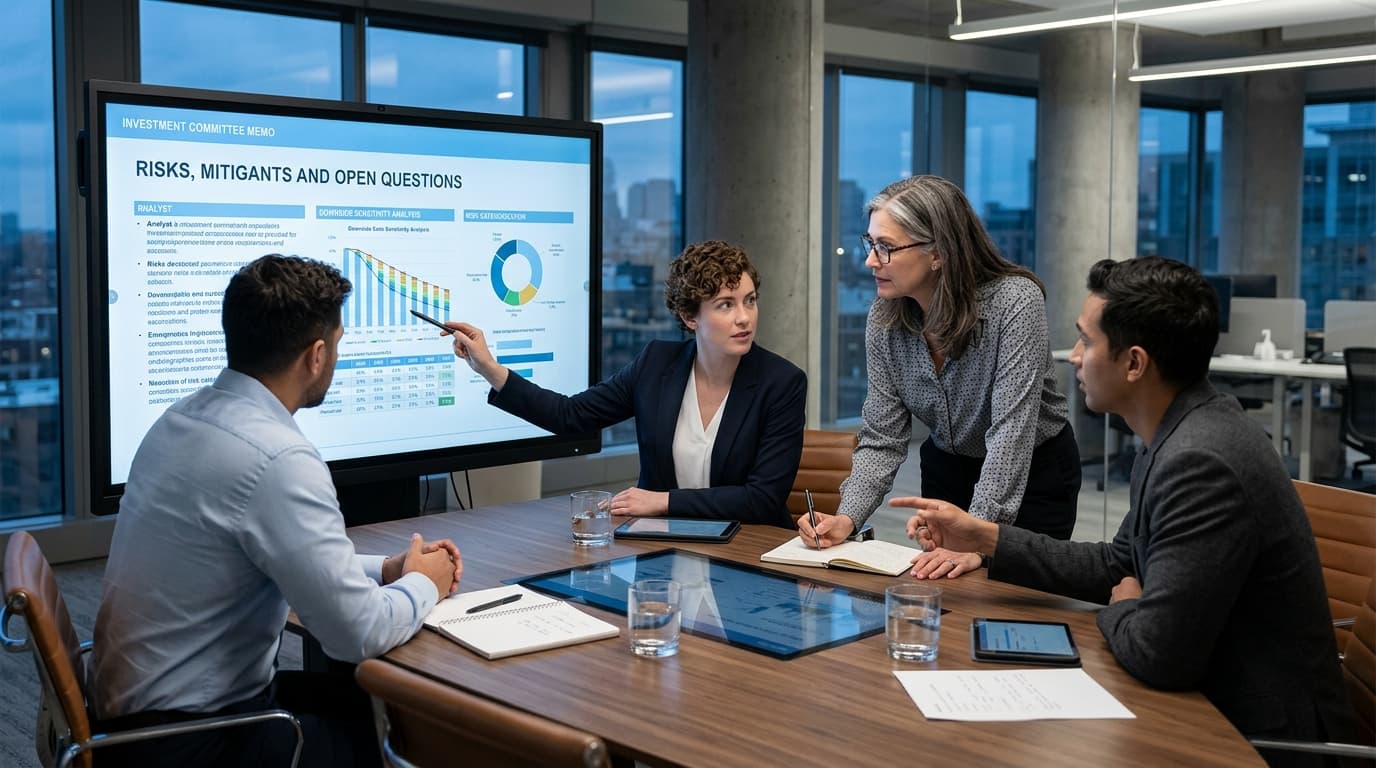
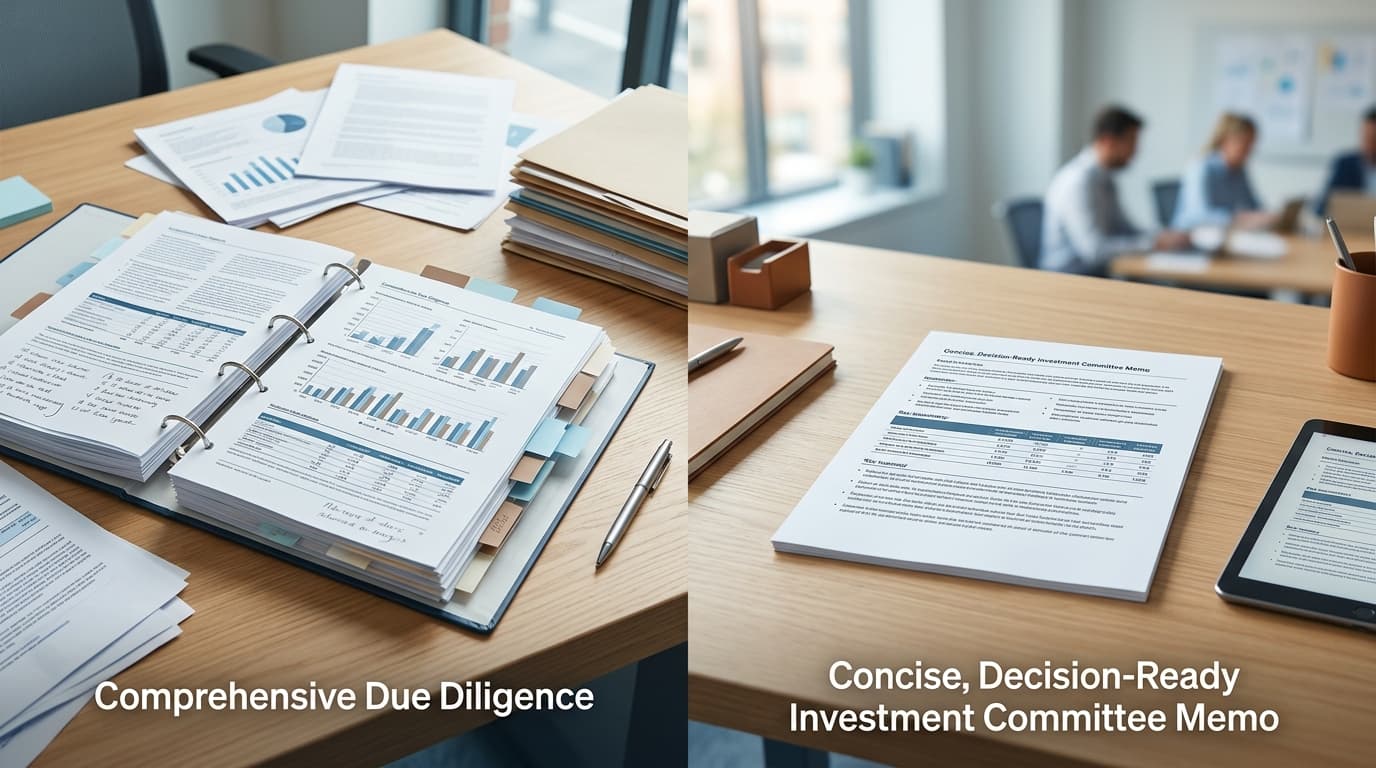
For private equity deal teams and credit committees, diligence findings must be synthesized clearly to drive informed go or no-go decisions. Automating the conversion of complex engineering reports into concise investment committee memos enables investment professionals to present fully vetted risk registers to decision-makers. Rather than burying technical constraints in appendixes, deal teams can explicitly articulate how power availability impacts asset yield and exit multiples.
Furthermore, project finance debt documentation must incorporate specific covenants based on power diligence outcomes. Lenders may mandate minimum debt service coverage ratios tied to contracted energy tariffs, require cash sweep mechanisms if key power supply agreements expire, or establish debt draw conditions linked to utility interconnection milestones.
- Valuation Haircuts: Unmitigated power grid delays or high parasitic cooling loads require upward adjustments to discount rates and downward valuation revisions.
- Earmarked Capex Escrows: Purchase agreements must include seller escrows or price holdbacks to cover potential utility transmission line reinforcement costs.
- Covenant-Driven Debt Structuring: Credit agreements should incorporate debt draw conditions pegged to verified utility commissioning milestones.
- Insurance & Guarantee Requirements: Mandating performance bonds from EPC contractors to guard against supply chain delays on long-lead electrical hardware.
How to use this in your next diligence workflow
Integrating AI data center power due diligence into institutional deal workflows requires a modern, automated approach to evidence processing and risk analysis. Deal teams reviewing complex infrastructure transactions often face thousands of pages of utility engineering studies, legal power purchase agreements, and municipal environmental permits. Relying on manual spreadsheet tracking creates information silos and delays investment decisions. Private equity funds and credit platforms should standardize their diligence processes using an AI-native due diligence platform that ingests multi-format data room files and automatically surfaces critical operational red flags.
By deploying automated diligence workflows, transaction teams can accelerate document triage, audit utility study assumptions against historical benchmarks, and maintain full source traceability for every finding presented to investment committees.
How Plausity supports the workflow
Plausity provides specialized tools designed to streamline complex digital infrastructure due diligence for private equity, private credit, and corporate M&A deal teams. By leveraging its core AI-Analysis Engine, investment professionals can instantly process, cross-reference, and analyze thousands of technical and legal documents across virtual data rooms.
The platform's Data Room Ingestion seamlessly connects to virtual data rooms, rapidly scanning and organizing complex utility interconnect reports, power purchase agreements, and municipal water rights documentation. Once ingested, Risk Radar automatically evaluates findings against materiality thresholds, flagging hidden grid interconnection delays, unhedged power tariffs, and environmental compliance gaps. Deal teams can then utilize Report Builder to auto-generate comprehensive, investor-ready report deliverables featuring full source traceability back to specific data room clauses. Finally, Collaboration Hub coordinates cross-advisor workstreams in real time, ensuring seamless alignment between technical engineering consultants, legal advisors, and investment professionals.
- Automated Document Ingestion: Ingest and categorize hundreds of utility studies, water permits, and PPA contracts in minutes with Data Room Ingestion.
- Automated Red Flag Detection: Surface latent power queue backlogs, cooling constraints, and customer concentration risks using Risk Radar.
- Full Source Traceability: Ensure every finding, figure, and claim in investment committee deliverables is anchored by direct citations using Report Builder.
- Streamlined Team Coordination: Align legal, technical, and financial advisors within a unified, real-time workspace using Collaboration Hub.
How Plausity supports the workflow
Plausity is an AI-native due diligence and deal intelligence platform. For AI data center power diligence, Plausity helps investors and lenders convert scattered PPAs, interconnection queue letters, cooling specifications, and offtake commitments into a structured, source-backed evidence base that stays traceable across the deal team and the credit committee.
Deal teams can use AI-powered diligence analysis to cross-reference power procurement, grid interconnection status, and capex schedules, then organize the resulting risks with findings and risk intelligence. Plausity is a document-and-workflow layer, not a substitute for professional judgement: it does not independently provide legal, financial, tax, commercial, or technical advice, and it does not guarantee project feasibility, credit outcomes, or grid connection timelines.