Beyond the Hype: The Real State of AI in M&A Due Diligence
- AI-native due diligence platforms process multi-format virtual data rooms with complete contextual awareness instead of basic keyword matching.
- Integrating generative AI into transaction workflows can reduce overall M&A process costs by up to 20 percent based on McKinsey research.
- According to Bain, adoption of artificial intelligence tools by M&A executives more than doubled in 2025, reaching 45 percent.
- True end-to-end automation links every analytical risk finding directly back to its source document in the virtual data room for verification.
Modern dealmaking operates under intense pressure, demanding rapid analysis of massive datasets to meet compressed transaction timelines. In this fast-paced environment, automated solutions have transitioned from a luxury to an operational necessity. According to research by Bain, the adoption of artificial intelligence tools in mergers and acquisitions more than doubled in 2025, with 45% of M&A practitioners now utilizing AI in their workflows. This rapid rise in adoption highlights a critical realization among industry leaders: traditional, manual document review processes can no longer keep pace with the scale of modern virtual data rooms.
However, as adoption increases, deal teams are recognizing a clear distinction between generic search wrappers and specialized transaction software. Many early implementations relied on bolted-on AI search tools that merely overlaid keyword indices with conversational interfaces. While these tools assist with basic keyword extraction, they lack the systemic, contextual understanding needed to evaluate complex transactions. For corporate M&A project leads and venture capital teams, relying on surface-level keyword hits introduces significant oversight risks in legal and financial assessments.
The Shift from Bolted-On Search to AI-Native Platforms
An architectural shift from bolted-on AI search to an AI-native platform is redefining M&A due diligence by enabling end-to-end workstream analysis with full source traceability. A bolted-on application typically functions as an external layer, querying documents individually and leaving the user to stitch together separate findings. In contrast, an AI-native due diligence platform is engineered to read, interpret, and cross-reference thousands of contracts and financial files simultaneously. By utilizing Plausity's AI-Analysis Engine, investment professionals can analyze documents holistically across multiple workstreams while maintaining a direct link back to the source documents.
| Capability | AI-Bolted-On Search | AI-Native Due Diligence Platform |
|---|---|---|
| Analysis Scope | Single-document keyword extraction and basic summarizing | Cross-document and multi-workstream reasoning over entire datasets |
| Traceability | Manual lookup of references or simple keyword matching | Deterministic grounding linking findings directly to source documents |
| Workstream Integration | Isolated tools for search, drafting, and reporting | Integrated workflow from ingestion to automated report drafting |
This architectural difference directly impacts how M&A advisory firm partners and analysts coordinate transaction workflows. With an integrated solution, the transaction process begins with automated Data Room Ingestion, which rapidly scans and processes various formats, including contracts and spreadsheets. From there, Risk Radar identifies and evaluates findings based on material risk, financial impact, and transaction relevance. Finally, Report Builder uses this structured analysis to draft clear, investor-ready deliverables. By automating repetitive ingestion and structuring tasks, deal professionals can allocate their time to strategic human judgment, valuation modeling, and negotiation strategies.
AI-Native vs. AI-Bolted-On: Understanding the Architectural Divide
Legacy M&A due diligence software has historically relied on manual keyword indexing and basic optical character recognition to locate critical terms. As generative artificial intelligence has grown, many traditional platforms have quickly added generic AI interfaces as a superficial, bolted-on layer. This approach treats technology as an isolated search utility, analyzing individual files in silos. Conversely, an AI-native due diligence platform is engineered from its core infrastructure to conduct multi-document reasoning, providing transactional context across thousands of complex transaction files simultaneously.
The primary architectural difference centers on how data is analyzed and cross-referenced. Bolted-on search features usually rely on basic semantic lookups that read text fragments within a single file, completely missing relations across different folders. An AI-native architecture, such as Plausity's AI-Analysis Engine, processes documents with comprehensive context. When deal teams use Data Room Ingestion to transfer target files, the engine does not merely scan for keywords; it maps legal, operational, and financial dependencies across the entire workspace. This advanced reasoning prevents dangerous informational blind spots, particularly when vital contract disclosures are distributed across disjointed annexes.
A Structural Contrast of Due Diligence Architectures
To understand how architecture impacts deal workflows, transactional professionals must evaluate how each technology handles information extraction, source verification, and speed. Industry research indicates that implementing advanced automation can reduce overall transaction analysis time by up to 50%. However, the accuracy of this accelerated timeline depends heavily on underlying platform design. Bolted-on search utilities often create significant verification bottlenecks, whereas an AI-native due diligence platform streamlines analysis by keeping every observation systematically grounded in the original source documents.
| Capability | AI-Bolted-On Architecture | AI-Native Architecture |
|---|---|---|
| Context Awareness | Analyzes documents on an isolated, file-by-file basis, relying on basic keyword searches. | Synthesizes data across the entire data room, identifying complex cross-document relationships. |
| Source Traceability | Provides unstructured summaries without direct citations, forcing analysts to manually verify findings. | Links every analytical observation back to the precise page and paragraph of the source document Plausity Facts. |
| Workstream Ingestion | Requires manual segregation of legal, financial, and tax files, resulting in fragmented workflows. | Performs end-to-end due diligence with automated multi-format ingestion and integrated risk scanning how it works. |
For investment analysts and M&A project leads, using platforms that lack native traceability introduces substantial deal risk. When a due diligence automation system flags a high-priority risk, such as an obscure change-of-control clause, but cannot point to the exact source contract, analysts must spend valuable hours tracing it back manually. An AI-native platform mitigates this inefficiency by embedding traceability into every step. This architectural rigor allows VC & PE funds to move at deal speed without compromising on accuracy, compliance, or structural risk mitigation.
The Practical Mechanics of End-to-End Diligence Automation
M&A transactions require rigorous examination, yet deal teams are routinely squeezed into highly compressed timelines. According to research by Deloitte, commercial due diligence typically occurs over a tight window of just 2 to 6 weeks, forcing analysts and partners to absorb mountains of complex information rapidly. For M&A project leads and private equity investors, this high-pressure environment often turns the initial weeks of a deal into an administrative bottleneck dominated by manual document sorting and keyword-searching. This rushed manual review increases the risk of overlooking material legal exposures or financial anomalies, potentially leading to post-close liabilities or mispriced valuations.
True due diligence automation addresses these bottlenecks by replacing fragmented, manual steps with an integrated, automated process. Rather than relying on bolted-on AI systems that only perform basic keyword search or document categorization, an AI-native due diligence platform built with a unified AI-Analysis Engine operates across the entire pipeline. This architecture ensures that data flows smoothly from initial uploading to final risk assessment, allowing investment teams and advisory partners to focus on high-level strategic reasoning and negotiation. This approach enables deal professionals to accelerate analysis without sacrificing risk mitigation.
The Three Phases of the Automated Diligence Pipeline
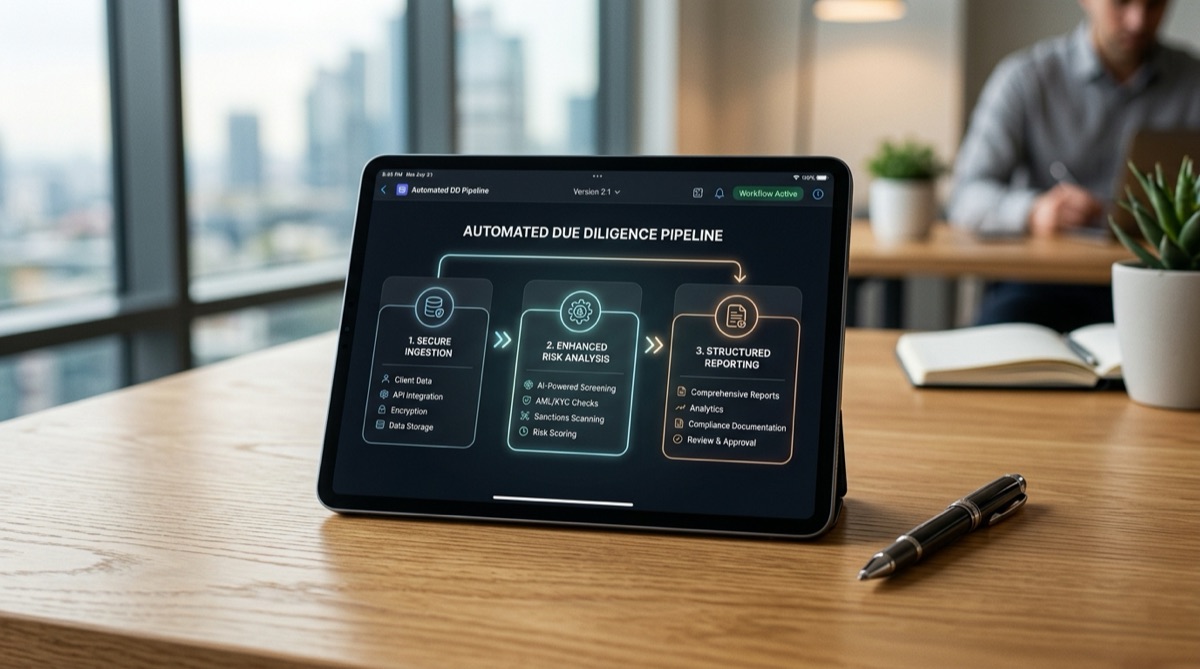
- Phase 1: Ingestion and Pre-Processing. The workflow begins with Data Room Ingestion, which connects securely to virtual data rooms to upload and scan complex files, including PDFs, financial models, and contracts, in a fraction of the traditional time.
- Phase 2: Analysis and Material Risk Detection. Once files are ingested, the platform executes comprehensive risk detection. Using Risk Radar, the platform automatically scans across workstreams to surface and prioritize material financial and legal risks based on deal relevance and legal exposure.
- Phase 3: Structured Drafting and Reporting. Instead of wasting hours manually copying findings into presentation decks, deal teams leverage Report Builder to automatically structure and draft professional, investor-ready reports. These drafts retain absolute source traceability, linking every single finding directly back to its origin document.
Standard manual workflows often prolong transaction cycles or leave crucial questions unanswered until the final days of a deal. Industry benchmarks show that implementing advanced analytics and automated platforms can reduce overall due diligence timelines by up to 40 percent. By managing the practical mechanics of the pipeline through a single, cohesive environment, deal professionals can allocate their hours toward evaluating structural deal dynamics and negotiating terms, rather than compiling slides or sorting folders. This shift transforms due diligence from an administrative sprint into a precise, risk-mitigated strategic tool.
Where Automation Wins and Where Human Judgment Remains Sovereign
The integration of technology into transaction workflows is accelerating rapidly. According to research from PwC, 83 percent of private equity firms plan to deploy data analytics and generative AI in due diligence by 2026, up from 65 percent in 2024. Yet, as deal timelines compress and document volumes grow, successful transaction outcomes still depend heavily on human oversight. While AI-native due diligence platforms can ingest, parse, and analyze thousands of contracts or financial records in minutes, they do not replace the critical strategic reasoning, negotiation skills, and cultural evaluation that experienced deal professionals bring to the table. Instead, the architectural shift to an AI-native approach is about amplifying professional intelligence and mitigating operational friction.
McKinsey notes that while generative AI tools can significantly accelerate document synthesis and screening, transaction success is ultimately determined by strategic synergy valuation and structured deal execution. For PE investment professionals and M&A project leads, AI-native systems act as high-velocity research partners. They identify red flags, surface complex anomalies across disparate data sources, and establish direct traceability back to the original source documents. However, validating these findings, interpreting their implications for company valuation, and determining how they impact negotiation leverage remains a uniquely human responsibility.
Balancing Machine Speed with Human Expertise
To understand this balance, it is useful to look at where automated processing ends and professional judgment begins. An AI-native due diligence platform utilizes tools like the AI-Analysis Engine to perform deep cross-referencing of transaction materials, and Risk Radar to flag inconsistencies or compliance gaps. But the machine only raises the flag: human experts must determine whether a potential risk is a deal-breaker or an opportunity for post-acquisition value creation.
| Diligence Domain | AI-Native Automation Role | Human Professional Judgment Role |
|---|---|---|
| Document Synthesis and Review | Parses thousands of contracts, spreadsheets, and PDFs in minutes using Data Room Ingestion | Verifies regulatory risk materiality and interprets key exceptions |
| Anomaly and Risk Detection | Flags liabilities, compliance gaps, and financial discrepancies via Risk Radar | Determines strategic impact on deal structure, pricing, and indemnification |
| Report Generation and Alignment | Drafts structured summaries and investor-ready reports via Report Builder | Refines messaging, contextualizes findings, and conducts final reviews |
AI-Native vs. AI-Bolted-On Due Diligence
Unlike traditional AI-bolted-on solutions, which merely overlay a basic keyword search or a generic chatbot interface onto an existing database, an AI-native due diligence platform is engineered from the ground up for transaction workflows. AI-bolted-on tools often struggle to maintain context across different workstreams, requiring manual intervention to stitch together insights from legal, financial, and tax documents. In contrast, an AI-native platform performs end-to-end due diligence by seamlessly integrating data room analysis with multi-workstream synthesis, tracing every single automated finding back to its exact source document. This structural traceability eliminates the risk of hallucination or disconnected insights, enabling deal teams to accelerate their analysis without sacrificing rigorous risk mitigation.
To facilitate this collaboration between technology and human expertise, modern deal teams use the Collaboration Hub. This workflow workspace ensures that findings generated by the AI-Analysis Engine are seamlessly shared, assigned, and refined by M&A partners, fund analysts, and legal experts. Rather than working in isolated silos, deal teams can coordinate on a unified platform where every synthesized finding remains traceable back to the source data room file. This prevents the loss of vital transaction context during the intense final stages of a deal, ensuring that human intelligence is fully amplified rather than sidelined.
Verifying Security and Integrity in AI-Powered Due Diligence
Due diligence involves handling highly sensitive corporate assets, proprietary code, intellectual property, and detailed financial statements. For VC and PE fund investment professionals, maintaining transaction confidentiality is not just a regulatory requirement but a fundamental fiduciary duty. As deal teams adopt due diligence automation, the entry of third-party AI systems into the data stream introduces unique cybersecurity risks. The main concern revolves around how large language models handle sensitive business data and whether that information could leak beyond the secure deal room environment. Consequently, evaluating an AI due diligence platform requires a rigorous assessment of its underlying architecture and security protocols rather than accepting broad marketing assertions.
Data Isolation and Model Training Safeguards
The greatest technical risk in modern AI tools is the inadvertent ingestion of confidential business data into public model-training pipelines. Standard commercial artificial intelligence systems may store and process user inputs to continuously retrain and optimize their models, which can result in the leakage of proprietary corporate data. To mitigate this, a robust AI-native due diligence platform must employ strict tenant-isolation policies and zero-data-retention APIs. This architecture ensures that any contract, financial record, or IP analyzed by the AI-Analysis Engine remains strictly confined to that specific transaction's environment, ensuring that the target company's information is never used to train external models or exposed to other users.
Audit Trails and Compliance Frameworks
When assessing M&A due diligence software, corporate M&A project leads must demand transparent proof of enterprise-grade security controls. Safe AI implementations rely on rigorous compliance frameworks such as SOC 2 Type II and ISO 27001, which establish structured controls for data processing, system availability, and confidentiality. These frameworks ensure that automated data-room integrations and file ingestion pipelines follow formal data lifecycle policies. Additionally, systems should maintain granular, immutable audit logs of every prompt, document read, and generated insight. This level of traceability is essential for meeting compliance standards and proving the validity of deal findings during regulatory reviews or post-merger integrations.
| Security Component | Core System Requirement | Operational Risk Mitigated |
|---|---|---|
| Data Isolation | Tenant-specific environments and zero-data-retention API configurations | Prevents proprietary deal room data from being used in model retraining or leaked to external parties. |
| Access Control | Single Sign-On, multi-factor authentication, and role-based permissions | Restricts document access exclusively to authorized members of the advisory and deal teams. |
| Traceability & Auditing | Immutable, time-stamped logs of all activities and source document citations | Ensures full transparency, enabling auditors to track the exact source of every analyzed finding. |
For serious deal professionals, including M&A advisory firm partners and analysts, understanding how it works under the hood is critical to verifying system integrity. The integration of modules like Data Room Ingestion and Risk Radar must occur within a secure boundary that respects strict data governance and GDPR requirements. Rather than relying on superficial assurances, teams must systematically audit their software providers based on these technical criteria. By combining automated diligence efficiency with verifiable security protocols, transaction leads can confidently scale their analytical capacity without compromising the confidentiality of their most sensitive corporate data.