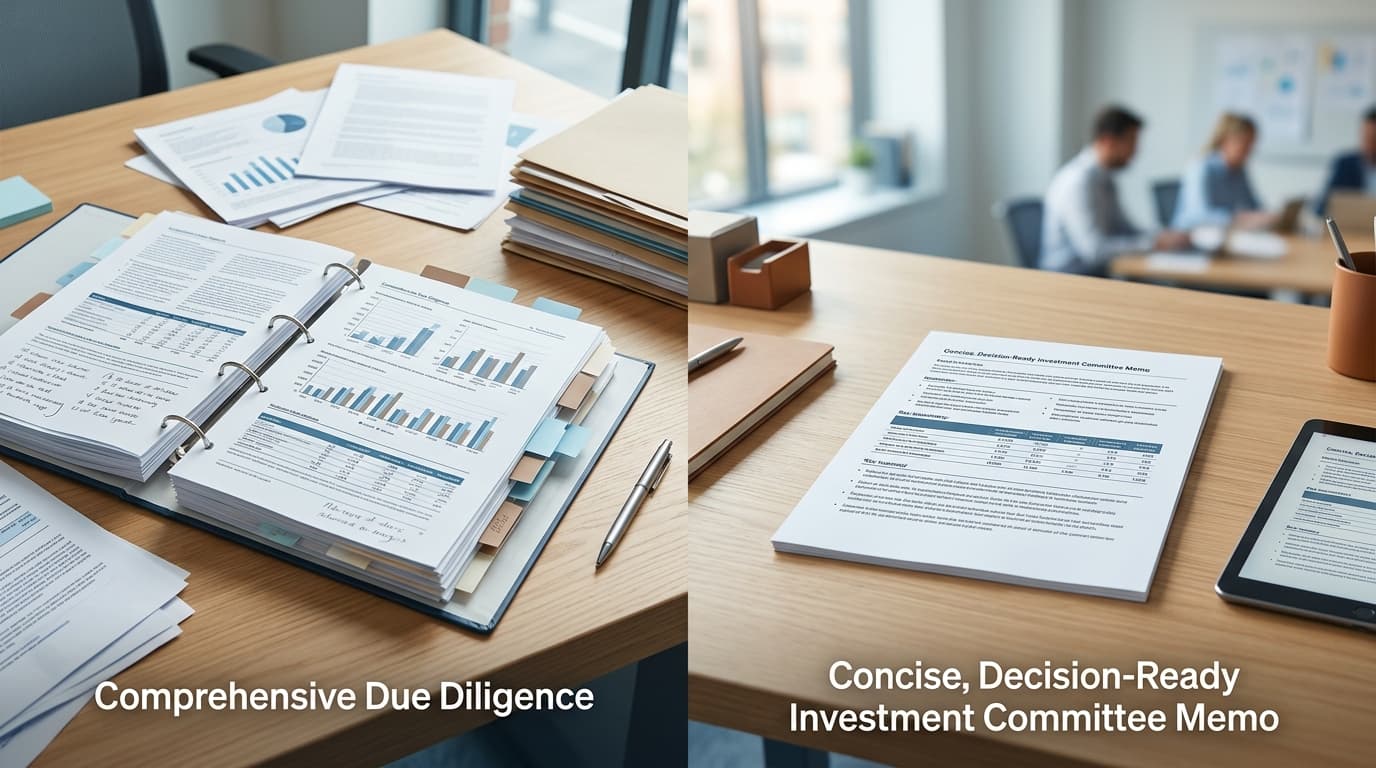
Why the IC Memo Risk Section Matters
The risk section of an investment committee memo is where a deal team either earns or forfeits its credibility. Thesis sections argue for a deal; the risk section is where the committee tests whether the team has genuinely stress-tested that argument. Yet in most memos it is the thinnest part: a long, undifferentiated list of caveats that no one reads closely and no one debates. That is a strategic failure, because the risk section is the committee's primary instrument for preventing post-merger value destruction. The evidence on how often acquirers destroy value is stark. Research cited by the CFA Institute puts the M&A failure rate at 70% to 90% of deals, with flawed due diligence frequently to blame. KPMG's analysis of more than 3,000 public-to-public deals over US$100 million between 2012 and 2022 found that 57.2% of acquirers ultimately destroyed shareholder value, despite deals generating an average 13.2% in TSR above the relevant index in the months before closing.
KPMG attributes value destruction to two recurring causes: acquirers overestimate the benefits and overpay, and they underestimate integration and execution complexity. Both are risk-section failures. A committee that was never forced to engage with an aggressive synergy assumption or an under-resourced integration plan cannot be said to have approved the deal with open eyes. The purpose of the risk section, then, is not defensive compliance. It is to provoke active debate: to give the committee a small number of sharply framed, evidence-backed exposures it can interrogate, price, and condition. A memo that presents risk honestly gives the committee a genuine choice. A memo that buries risk in boilerplate takes that choice away.
- A strong risk section frames exposures as specific, sourced claims the committee can challenge, not generic caveats it must wade through.
- It distinguishes what would change the valuation from what would merely require management attention.
- It connects every material risk to the financial model, so the committee can see the downside, not just hear about it.
- It leaves the committee with open questions to resolve before closing, converting diligence from a report into a decision process.
The Core Framework for Risk Categorization
The first discipline is categorization. Risks that arrive as an unsorted list of forty bullets are noise; risks grouped into a small number of named categories become a map of the deal. The standard six categories cover the exposure surface of most transactions:
- Commercial: customer concentration, churn, pricing power erosion, competitive displacement, pipeline quality.
- Financial: earnings quality, working capital seasonality, leverage and covenant headroom, FX and interest-rate exposure.
- Operational: key-person dependency, single-site production, supplier fragility, systems and data integrity.
- Legal: contract enforceability, litigation exposure, IP ownership gaps, unresolved title questions.
- Regulatory: licensing conditions, pending investigations, data-protection obligations, sector-specific compliance.
- Integration: culture clash, retention of critical staff, systems migration, synergy delivery risk.
Categorization does more than tidy the page. It lets the committee see cross-functional impact: a single supplier concentration issue may surface simultaneously as an operational risk, a commercial risk (revenue at stake) and a financial risk (margin sensitivity). Grouping makes those connections visible instead of leaving the committee to reconstruct them. It also exposes gaps. If the register is heavy on financial and legal entries and silent on integration, the committee knows exactly where the deal team's blind spot sits.
The second discipline is phrasing. A risk stated as 'There may be some customer concentration concerns' invites nothing. A risk stated as 'The top three customers represent a material share of trailing revenue (source: customer contract schedule, p. 12); loss of any one would reduce EBITDA by an estimated X' invites debate. Sharp risk statements share three properties: they name a specific exposure, they quantify it where the evidence allows, and they cite the document that supports the claim. This is the difference between a risk register the committee reads and one it skims past. For teams working on how findings translate into committee documents, the framing guidance in reframing diligence for the IC applies directly to the risk section: separate what the evidence shows from what the team concludes about it.
Red Flags vs. Deal-Breakers vs. Manageable Risks
Not every finding deserves the same weight, and a register that treats them identically dilutes the ones that matter. Three tiers are useful. Manageable risks are quantifiable exposures that can be priced, contracted, or operationally addressed: an IP gap can be closed through escrow arrangements or specific indemnities; a working capital discrepancy can be settled through a purchase price adjustment. Material red flags are findings that challenge the investment thesis itself, such as evidence of revenue recognition practices that contradict the QoE, or a regulatory exposure the target has not disclosed. Deal-breakers are the narrow class of findings that kill the deal regardless of price, most often trust failures: concealed compliance violations, falsified records, or litigation deliberately hidden from the diligence process.
The distinction matters because the two tiers demand different responses. A manageable risk belongs in the risk register with a mitigant attached. A red flag belongs in front of the committee as a condition of proceeding. A deal-breaker ends the process. The cost of misclassifying is high in both directions: treating a deal-breaker as manageable exposes the fund to an unpriceable liability, while treating every discrepancy as a red flag exhausts the committee's attention on noise. The stakes are real. A 2025 analysis of post-LOI deal failures in U.S. private-company M&A found that diligence-driven failures, combining non-QoE findings and quality-of-earnings EBITDA discrepancies, accounted for 46.6% of broken deals, with QoE discrepancies roughly doubling from 10.6% in 2023 to 21.3% in 2025. Accurate severity scoring is not an academic exercise; it determines whether the committee sees the finding that would have changed its decision.
| Tier | Definition | Typical response |
|---|---|---|
| Manageable risk | Quantifiable exposure that can be priced, contracted, or operationally addressed | Risk register entry with a specific mitigant and residual exposure noted |
| Material red flag | Finding that challenges the investment thesis or reveals undisclosed exposure | Escalated to the committee as a condition of proceeding, with evidence attached |
| Deal-breaker | Finding that kills the deal regardless of price, typically a trust or integrity failure | Documented, evidence-linked, and used to exit the transaction cleanly |
Practical Workflow: Risks, Mitigants, and Residual Exposure
The working unit of a good risk section is the triple: risk, mitigant, residual exposure. Every identified risk should be paired with a concrete mitigant, and every mitigant should be tested against a simple question: what exposure remains even after this mitigant is fully applied? That remainder is the residual risk, and it is the number the committee actually underwrites. A customer concentration risk might be mitigated by a contractual revenue guarantee from the departing founder; the residual is what happens if that founder's relationships do not transfer, and the guarantee only compensates rather than preserves the revenue.
The workflow that produces this discipline is straightforward:
- Identify the risk from a specific document or data point, and cite that source directly in the register entry.
- Categorize it into one of the six categories so cross-functional impact is visible.
- Quantify the exposure where the evidence supports a number, and flag it as an estimate where it does not.
- Pair it with a mitigant that is concrete and contractual or operational, not aspirational.
- Score the residual exposure that remains after the mitigant is applied at full strength.
- Assign an owner and a resolution deadline for anything the committee conditions the deal on.
The final discipline is honesty about mitigant strength. Overstating a mitigant, describing an insurance policy as covering an exposure it excludes, or presenting a management verbal assurance as if it were a contractual protection, is the fastest way to lose the committee's trust, and once lost it does not come back on the next deal. A mitigant that survives committee scrutiny is one that names its own limits. Teams looking to tighten this discipline in practice will find the version-control and source-traceability guidance in IC memo version control directly relevant: every mitigant claim should trace back to the document that supports it.
Presenting Downside Sensitivities and Open Questions
A risk that never touches the financial model is an abstraction. The committee approves a valuation and a return profile, not a list of concerns, so each material risk should be connected to a downside sensitivity that shows its exact impact on valuation, internal rate of return, and multiple on invested capital. The framing is simple: if this risk materialises, here is what happens to the model. A churn assumption that degrades by five points, a covenant that tightens, a key customer that walks: each should appear as a modelled scenario with a quantified outcome, not as a qualitative warning. This is what separates a risk section that informs a decision from one that decorates it.
| Risk | Model connection | What the committee sees |
|---|---|---|
| Customer concentration | Revenue line sensitivity: loss of top customer at X% margin | Impact on EBITDA, IRR and MOIC under a defined downside case |
| Covenant headroom | Leverage ratio under a stress-case EBITDA drawdown | Distance to default and refinancing risk at the modelled trough |
| Integration cost overrun | Synergy phasing shifted by 6-12 months | Delayed cash flows and revised IRR under the delayed-synergy case |
| Regulatory approval delay | Closing date pushed by X months, financing cost accrues | Revised timeline, carry cost and deal IRR impact |
Alongside sensitivities, the risk section should carry a short, disciplined list of open questions: the specific evidence gaps and conditions that must be resolved before closing. The distinction is between a vague assumption ('revenue is expected to hold up') and a specific, resolvable gap ('the top customer's contract expires in month three post-close; renewal confirmation is a closing condition'). Open questions should name the missing document, the party responsible for producing it, and the point in the timeline by which it must be resolved. This is where evidence gap detection earns its keep: a gap that is named and owned is a manageable condition, while a gap that is discovered after closing is a write-down. Teams building this discipline into their reporting will find the red-flag reporting guidance in risk register automation useful for keeping the register live rather than static.
Evidence-Backed Deal Intelligence with Plausity
The reason risk sections stay thin is rarely a lack of intent; it is a lack of infrastructure. Pulling together a categorised register, tracing each entry to a source document, and keeping it in sync with the model is manual work that competes with everything else a deal team is doing in the final weeks before an IC date. This is the problem Plausity is built for. As an AI-native due diligence and deal intelligence workspace, it helps teams turn diligence analysis into decision-ready synthesis, creating IC-ready diligence findings that support evidence-grounded investment committee preparation.
Two capabilities do most of the heavy lifting. The Risk Radar identifies and evaluates findings based on materiality, financial impact, legal exposure and deal relevance, surfacing the key risks and anomalies that deserve committee attention rather than an undifferentiated list. The AI-Analysis Engine reads, interprets and cross-references thousands of documents and data points to generate DD-grade analysis, which means each risk in the register can carry a link back to the specific document, page and paragraph that supports it. That source-linked evidence is what makes the risk section defensible: when a committee member challenges a claim, the deal team can produce the underlying document in seconds rather than reconstructing it from memory. The same evidence backbone flows through to the Risk Register in Plausity's report generation, so the memo's risk section and the underlying diligence record stay consistent rather than diverging.
- Risk Radar: surfaces findings scored by materiality, financial impact, legal exposure and deal relevance.
- AI-Analysis Engine: cross-references thousands of documents to produce DD-grade, source-grounded analysis.
- Report Builder: drafts investor-ready reports and deliverables with full source traceability, including the Risk Register.
- Collaboration Hub: coordinates workstreams and keeps findings, comments and evidence in one shared workspace.
- Data Room Ingestion: connects to VDRs and processes PDFs, spreadsheets, contracts and financial models within minutes.
Built for today's investment and deal teams. Trusted by >200 firms.
How to use this in your next diligence workflow
The practical shift for deal teams is to treat the risk section as a workstream in its own right, not a summary written the night before the IC date. Concretely, that means four habits. First, separate material risks from immaterial noise during the screening phase, so the committee's attention is spent on the handful of exposures that could actually change the decision. Second, categorize every risk into the six standard buckets and phrase each one as a specific, quantified, source-cited claim. Third, pair every risk with a mitigant and score the residual exposure honestly, resisting the temptation to overstate protection. Fourth, connect each material risk to a downside sensitivity in the model and convert unresolved evidence gaps into named, owned open questions with deadlines.
None of this requires a bigger team or a longer timeline. It requires that the evidence behind each risk be captured at the moment it is found, linked to its source, and carried forward into the memo without manual reconstruction. Embedding source-linked evidence into daily diligence operations is what makes high-conviction decision-making repeatable: the committee debates the deal, not the data. For teams running this discipline across multiple mandates, the workflow guidance in defensible M&A decision documents extends the same evidence-first approach from the IC memo to board-level reporting.
How Plausity accelerates this workflow
Plausity is an AI-native due diligence and deal intelligence workspace that helps M&A advisory firms, VC and PE funds, corporate development teams and investment-banking teams structure evidence, findings and questions across a data room. Plausity supports evidence extraction, source grounding, findings management and IC preparation — it does not replace human analysts, advisers or investment professionals, does not provide legal, tax, audit, regulatory or investment advice, and does not make autonomous investment decisions. All findings require human review. Built for today's investment and deal teams. Trusted by >200 firms.
To explore the underlying capabilities, see the Plausity AI analysis engine and the findings and risk intelligence product page. For team-level workflows, see how VC and PE funds and M&A advisory firms use Plausity across live deals.