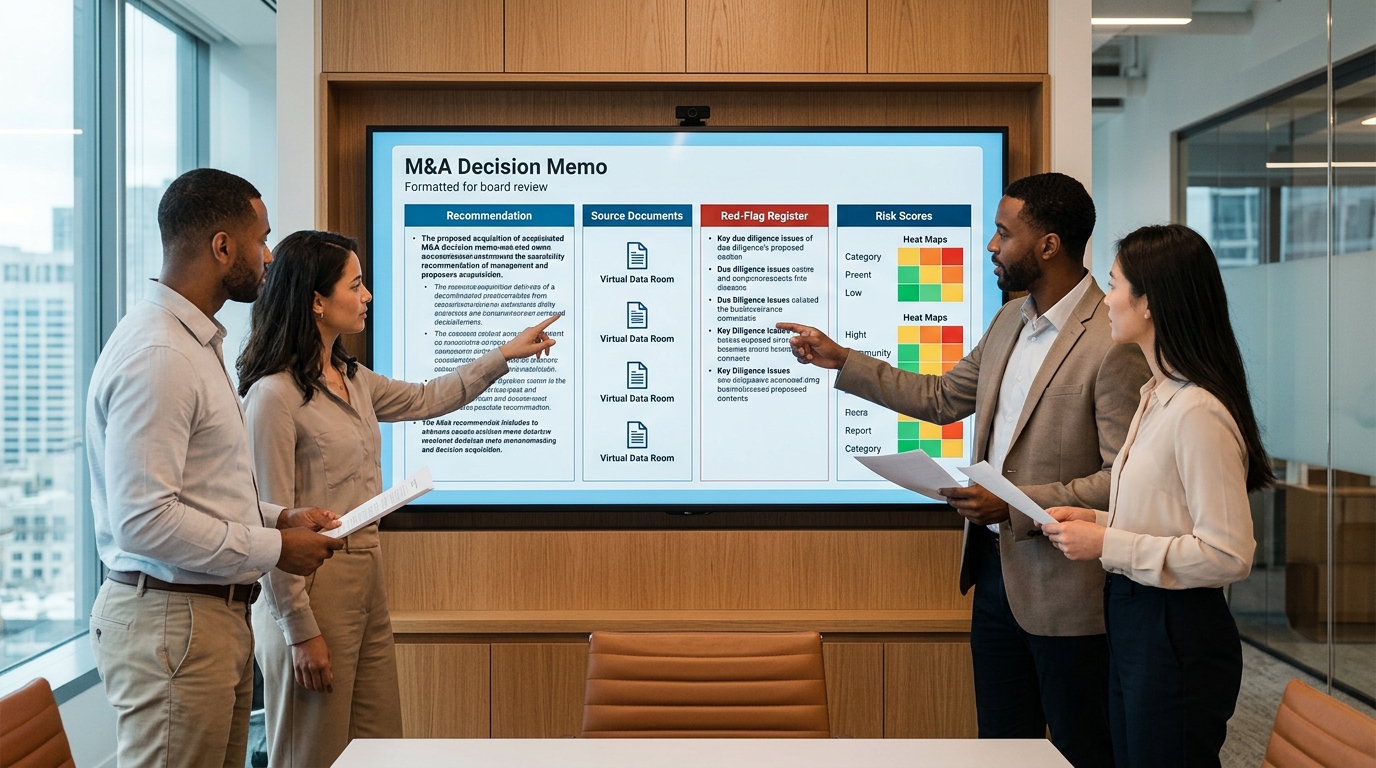
What a board-ready M&A decision document actually is
A board-ready M&A decision document is a diligence deliverable that converts fragmented findings from data rooms, advisor reports and management sessions into a single defensible recommendation a board can approve or reject, with every material claim traceable to an underlying source. It is not a summary of what was found. It is an argument for what the findings mean for the deal, structured so that a director who has never seen the data room can interrogate it, challenge it and, if the transaction is questioned later, defend having relied on it.
The standard anatomy
Formats vary by firm, but the working parts are consistent. A decision document that survives board scrutiny contains:
- Executive recommendation and the approval requested: what the board is being asked to approve, stated before the argument, with any delegations and conditions explicit.
- Deal thesis: why this asset, why now, and what must be true for the transaction to create value.
- Valuation and terms: price, structure, and how diligence findings moved them.
- Risk factors: material findings scored for impact, each with an owner and a mitigation or acceptance rationale.
- Evidence trail: the source behind every material claim, traceable from data-room document to memo sentence.
The format is not ceremony. In a survey of professional investors conducted for the Addepar research brief with Stanford's Long-Term Investing initiative, 97% of respondents reported a formal investment memo template and process, and 78% of their firms require memo approval before making any investment. For the corporate M&A project lead assembling the board pack, the practical implication is that the decision document is a governance artifact rather than a summary deck: it is the record of what the board knew, what it was told, and what it relied on when it approved.
Decision memo vs IC memo: what changes when the audience is a board
An investment committee memo and a board decision memo describe the same deal to different fiduciary positions. The IC memo is written for peer investors who share the underwriting vocabulary, know the portfolio context and can be assumed to read the model. A board memo is written for directors who owe duties to the company and its shareholders, who typically have no deal-team context, and whose approval may one day be examined under legal scrutiny. Content travels poorly between the two without deliberate rewriting.
The fiduciary frame
Directors carry duties of care and loyalty in the M&A context. The duty of care requires that directors be informed and exercise appropriate diligence and good faith in their decisions; the duty of loyalty requires that they act in the corporation's best interest. The litigation environment explains why documented process matters: plaintiff attorneys filed lawsuits in 84% of all M&A deals announced in 2015 and valued over $100 million. A documented, informed process is what boards point to when a transaction is later questioned, and the decision memo is the centerpiece of that record.
The rewrites an IC memo needs before it reaches a board
- Strategic alternatives: boards expect the record to show alternatives were weighed, not only the recommended path.
- Integration readiness: presented as a decision criterion with evidence, not an implementation note deferred to after closing.
- Approval conditions: the explicit conditions, delegations and follow-up approvals the board is being asked to grant.
- Conflicts and process: who authored the analysis, what incentives they carry, and what independent input the board received.
None of these rewrites change the underlying diligence. They change what the document is for: moving from persuading peers to equipping fiduciaries.
The evidence trail: source-grounded findings a board can trace
Source-grounded findings are the framework that makes a decision document defensible. The rule is simple: every material statement in the memo links back to a specific document, data point or expert input, and the provenance and version of that source are preserved. The chain runs from the data-room document, through the extracted finding, to the memo claim, so a director can move from a sentence in the recommendation to the underlying contract clause in two steps.
From data room to memo claim
In practice the chain is built, not reconstructed. Document analysis tooling such as the AI-Analysis Engine reads and cross-references the corpus and attaches each finding to its source, while data provenance discipline keeps version history intact as documents are updated during the deal. Where a claim rests on a management representation rather than a document, the gap is flagged explicitly as an evidence gap, together with what would close it. Boards forgive open questions; they do not forgive claims presented as settled that were not.
Traceability also protects the deal team. The Addepar and Stanford brief describes memos as time-stamped artifacts of the assumptions and logic an investor relied on, which get revisited when deals underperform. When the assumptions are traceable, a post-mortem examines the decision in context; when they are not, it examines the people. Version-controlled findings and memo drafts, kept alongside their sources as described in version control practice, are what make that distinction real.
Red-flag registers and risk-adjusted scoring
A red-flag register turns a list of findings into a decision instrument. The distinction matters because, as M&A practitioners put it, diligence rarely fails at discovery: documents get read and issues get found. Diligence fails at consequence, when a report lands with dozens of findings and no one has said what any of them means for the deal.
The register scores each finding on materiality, financial impact, legal exposure and deal relevance, then assigns a disposition. A report that does not sort findings into buckets, with a named owner and a day-one plan, is a reading list rather than a decision document.
| Disposition | What it means for the deal | What the board sees |
|---|---|---|
| Deal-breaker | The finding, unmitigated, ends the transaction | The condition under which the board would walk away |
| Reprice | Quantified exposure flows into price, escrows, indemnities or conditions | The number and its source, not an adjective |
| Mitigate | A named owner carries a day-one plan and the cost of mitigation | The plan, the owner and the residual risk |
| Accept | The exposure is understood and priced into the thesis | The rationale for accepting, on the record |
Risk-adjusted presentation is the final step. Quantified exposures should flow into the deal economics, the purchase price, the escrow and indemnity structure, and the conditions of approval, rather than sitting in a generic risk paragraph the board reads past. This is where structured scoring such as the Risk Radar capability keeps the register consistent across workstreams, and where red-flag reporting keeps it current as findings evolve.
What deal teams should test before the memo reaches the board
Before the memo moves, the deal team should test the document the way a director will. Three tests catch most failures.
- Test the thesis against hard evidence for synergies. Boards are explicitly advised to ask what hard evidence indicates that synergies will materialize. If the synergy case rests on management projections, the memo should say so and show what independently supports them.
- Test integration readiness as a formal decision criterion. Studies suggest that between 60% and 90% of M&A transactions fail to achieve their original value targets, with integration and execution challenges cited as a primary cause. A memo that treats integration as an afterword invites the board to approve a thesis the organization cannot execute.
- Test the document for author bias, undisclosed conflicts and unowned findings. The Addepar and Stanford brief notes that authors can put a thumb on the scale by de-emphasizing or omitting details, and that incentive structures shape memo rigor. Every material finding should have an owner, and every author with a stake in closing should be visible on the record.
A fourth test is mechanical but decisive: check that the evidence trail survives spot-checking. Pull five material claims at random and trace each to its source. If the chain breaks in a spot check, it will break under board scrutiny, which is the standard evidence-backed diligence exists to meet.
How Plausity supports the workflow
The workspace is a collaborative AI environment for due diligence that supports this workflow from raw documents to a defensible decision document. It structures and accelerates the work of the professionals who make the call; it does not replace their judgment.
- Data Room Ingestion connects to the virtual data room and processes contracts, spreadsheets and financial models within minutes, so findings accumulate against sources from the first week of a deal.
- The AI-Analysis Engine reads, interprets and cross-references thousands of documents and data points to produce source-grounded analysis with traceability to the underlying material.
- Risk Radar evaluates findings on materiality, financial impact, legal exposure and deal relevance, surfacing the risks that belong in the board register.
- The Report Builder drafts structured deliverables with full source traceability, so the board pack and the evidence behind it stay in sync.
- The Collaboration Hub coordinates workstreams and expert review, keeping findings aligned across internal teams and external advisors.
For advisory partners and investment professionals packaging diligence for decision-makers, the same workspace supports M&A advisory firms and VC and PE funds working to the standard this article describes. Built for today's investment and deal teams, and trusted by more than 200 firms.
How to use this in your next diligence workflow
The sequence below runs on a live deal and does not depend on any particular toolset. The capabilities described above map onto it, but the discipline is the point.
- Ingest the data room early so findings accumulate against sources from the start, rather than being reconstructed in the final week.
- Build the red-flag register as findings emerge, scoring each on materiality, financial impact, legal exposure and deal relevance.
- Assign a named owner and a day-one plan to every material finding, with its disposition (deal-breaker, reprice, mitigate, accept) recorded.
- Draft the board memo from the source-grounded findings with the evidence trail intact, flagging every claim that rests on a management representation rather than a document.
- Pressure-test the thesis, the author conflicts and integration readiness before submission, and spot-check the evidence chain on a sample of material claims.
Run this way, the decision document stops being a reporting obligation and becomes what boards actually need: a record of what was found, what it means, and why the recommendation follows from the evidence. That is what makes an approval defensible, in the boardroom and afterwards.
How Plausity accelerates this workflow
Plausity is an AI-native due diligence and deal intelligence workspace that helps M&A advisory firms, VC and PE funds, corporate development teams and investment-banking teams structure evidence, findings and questions across a data room. Plausity supports evidence extraction, source grounding, findings management and IC preparation — it does not replace human analysts, advisers or investment professionals, does not provide legal, tax, audit, regulatory or investment advice, and does not make autonomous investment decisions. All findings require human review. Built for today's investment and deal teams. Trusted by >200 firms.
To explore the underlying capabilities, see the Plausity AI analysis engine and the findings and risk intelligence product page. For team-level workflows, see how VC and PE funds and M&A advisory firms use Plausity across live deals.