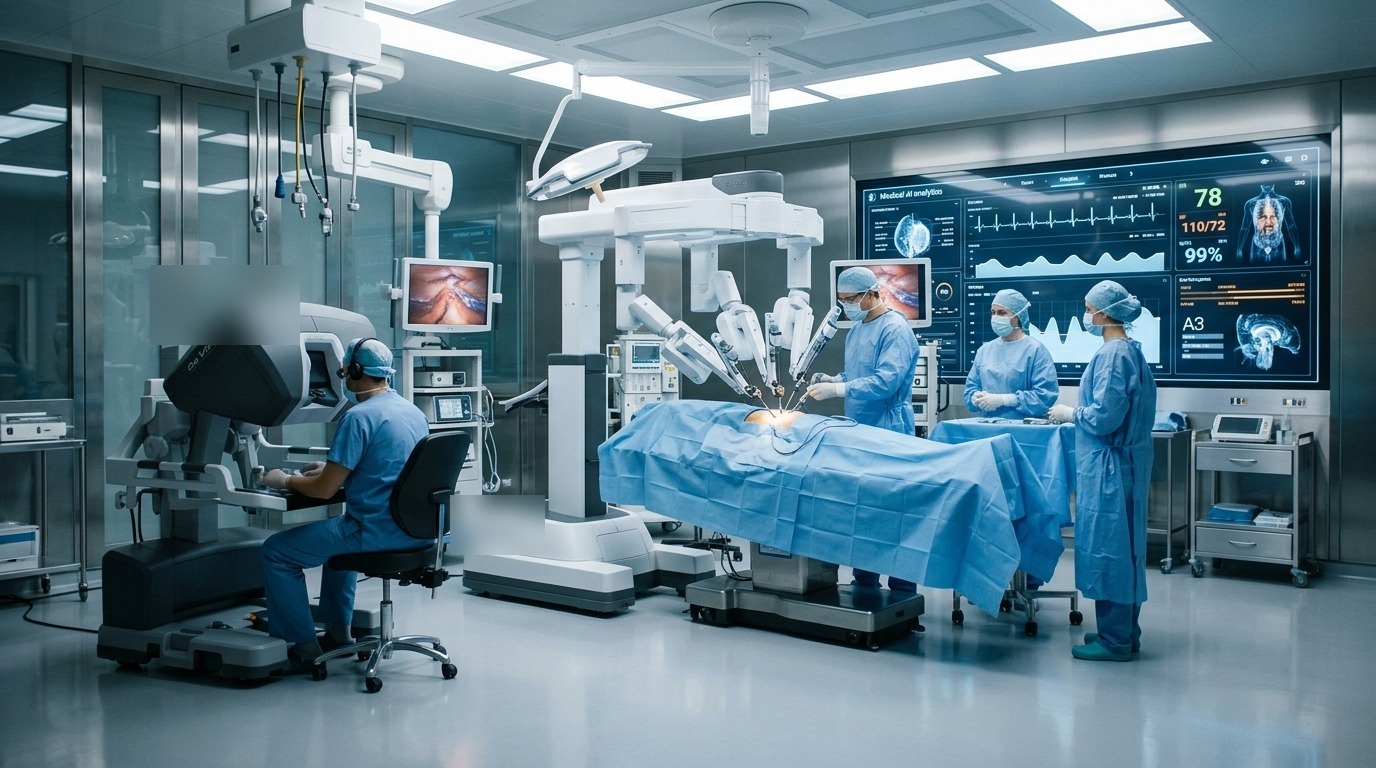
The Expanding Scope of Medtech Capital Allocation
Institutional capital across venture capital, growth equity, and private equity is undergoing a structural expansion within medical technology. While early surgical automation focused heavily on high-volume general surgery and specialized cardiovascular interventions, investors are now allocating capital into a broader spectrum of specialized robotics, AI-driven surgical navigation systems, and healthcare automation platforms. This capital shift is driven by demographic pressure, shortage of clinical personnel, and technological convergence where computer vision and spatial computing meet physical hardware.
According to market analysis from Global X ETFs, technological improvements and evolving payment models are positioning the surgical robotics market to reach $29 billion. Despite this growth trajectory, only a small minority of surgical procedures worldwide are currently performed with robotic assistance. This discrepancy underlines a massive addressable expansion opportunity for specialized medtech platforms. However, underwriting these complex hardware-software assets requires rigorous healthcare robotics due diligence that extends beyond traditional SaaS financial engineering.
For investment teams evaluating medical device investment diligence opportunities, assessing the core growth thesis requires testing whether a target platform solves actual clinical bottlenecks or merely adds costly hardware complexity to the operating theater.
- Capital allocation is diversifying from general laparoscopy into orthopedics, neurosurgery, urology, and soft-tissue intervention.
- Demographic headwinds and surgical labor shortages are accelerating institutional demand for healthcare automation M&A and venture-backed robotics.
- Robotic penetration of global surgical volume remains low, creating a multi-decade growth runway for validated technologies.
- Rigorous robotics VC diligence must combine clinical workflow audits with deep hardware and algorithm validation.
To systematically evaluate these opportunities, deal teams must deploy structured commercial due diligence frameworks commercial due diligence checklist to parse market size, technological defensibility, and capital efficiency before committing funds.
Evaluating Clinical Workflow Fit
A primary root cause of commercial failure in surgical robotics is poor clinical workflow fit. A robotic platform may demonstrate remarkable accuracy in laboratory settings, yet fail commercially if it introduces friction into the operating room (OR) environment. Deal teams conducting surgical robotics due diligence must evaluate how seamlessly the platform integrates into standard clinical routines, sterile fields, and preoperative preparation sequences.
Clinical workflow evaluation requires contrasting cumbersome, high-footprint standalone consoles against zero-footprint or modular systems. Large equipment often requires expensive operating room reconfigurations, dedicated storage, and extended setup times that reduce daily OR throughput. In contrast, platforms designed for compact spaces or modular attachment preserve hospital room capacity and lower barriers to clinical adoption.
- Preoperative preparation and setup time: Does the system add more than 15 minutes to OR turnover?
- Physical footprint and spatial dynamics: Can the system operate within standard sterile fields without structural modifications?
- Interoperability with existing OR infrastructure: Does the unit integrate with existing imaging towers, lighting, and electronic health record systems?
- Staffing requirements: Does the platform mandate additional specialized technicians during procedures?
Clinical diligence guidance published by Hardian Health puts it plainly: some software tools are simply too disruptive to current clinical care pathways rather than enhancing and improving them, and all other value (health economic value, reimbursement, patient outcomes) flows downstream of the product fitting into a clear clinical context. Investors should conduct direct observational audits of live or simulated procedures, and speak to independent clinicians, to confirm that the robotic hardware enhances rather than disrupts surgical efficiency.
Navigating FDA Approvals and Regulatory Pathways
Regulatory strategy forms the core foundation of valuation and execution timeline risk in medtech due diligence. Acquiring or backing a company with an ill-defined regulatory classification can lead to multi-year clearance delays, unexpected clinical trial expenses, and severe capital depletion. Deal teams must audit regulatory filings, pre-submission feedback, and predicate device claims with extreme rigor.
In the United States, the regulatory path for medical robotics and AI tools generally splits between the 510(k) premarket notification pathway, De Novo classification, and Premarket Approval (PMA). While incremental hardware iterations and software modifications frequently rely on 510(k) clearances by demonstrating substantial equivalence to an existing predicate, novel AI capabilities or unprecedented robotic mechanics often trigger De Novo requests or PMA requirements.
| Regulatory Pathway | Clinical Data Expectation | Timeline to Clearance |
|---|---|---|
| 510(k) Premarket Notification | Bench testing, usability data, limited clinical validation | 3 to 9 months |
| De Novo Classification | Prospective clinical study data, software safety testing | 12 to 24 months |
| PMA (Premarket Approval) | Multi-center randomized controlled clinical trials (RCT) | 24 to 36+ months |
A systematic review published in JAMA Network Open analyzed 119 FDA 510(k) clearance summaries for AI- and machine-learning-enabled devices and found discrepancies between clearance documentation and marketing material in roughly one-fifth of the devices surveyed. Investors must ensure that the target company's predicate choices are legally defensible, that marketing claims match cleared indications, and that planned software updates will not trigger secondary clearance requirements.
Analyzing Reimbursement and Hospital Procurement
Securing FDA clearance is merely a license to sell; establishing sustainable revenue requires a clear reimbursement pathway and a realistic hospital procurement model. In AI healthcare due diligence, investors must evaluate whether health systems can bill dedicated procedural codes or if the robotic system must rely on existing DRG (Diagnosis-Related Group) bundled payment structures.
When dedicated CPT reimbursement codes are unavailable, the capital cost of the robotic device represents a direct reduction in hospital margin. To mitigate upfront capital expense barriers, many medtech startups are transitioning toward Robotics-as-a-Service (RaaS) models, equipment leasing, and per-procedure utilization fees.
- Direct CPT code coverage: Does the procedure qualify for specific add-on reimbursement?
- Hospital capital expenditure (CapEx) friction: Does the device require traditional upfront purchases exceeding $1 million?
- Operating expense (OpEx) flexibility: Is the company offering competitive Robotics-as-a-Service (RaaS) or per-use pricing models?
- Consumable annuity streams: What percentage of recurring revenue comes from single-use end-effectors, drapes, and specialized instruments?
Global X ETFs research on surgical robotics notes that new sales models such as equipment leasing contracts, also known as Robotics-as-a-Service, help hospitals avoid large upfront capital expenditures and budget predictably, while for manufacturers the model generates a predictable income stream at higher margins than upfront sales. In deal underwriting, investors must perform thorough reimbursement due diligence to ensure the target's financial projections match real-world hospital buying cycles.
Validating Clinical Evidence and Outcomes Data
Commercial viability ultimately depends on proving superior clinical efficacy, reduced complication rates, or faster recovery times compared to standard of care. During medical device investment diligence, investors must audit the strength, design, and statistical validity of the target company's clinical dataset.
A common pitfall in early-stage robotics VC diligence is relying on single-center retrospective observational studies or small case series. While preliminary data may demonstrate technical feasibility, hospital value-analysis committees require robust, peer-reviewed clinical evidence before authorizing procurement.
- Study design quality: Are outcomes backed by prospective multi-center trials or non-randomized pilot studies?
- End-point selection: Does the trial measure clinically meaningful metrics, such as 30-day readmission rates, blood loss, and operative time?
- Statistical power: Is the sample size sufficient to demonstrate non-inferiority or superiority against standard minimally invasive surgery?
- Post-market clinical follow-up: Is there a structured framework to capture real-world evidence after market entry?
Hardian Health's diligence guidance describes an "evidence alignment problem", where the studies a company conducts do not support the actual product it wants to sell: papers are often published on prototype models rather than the final commercial product, which the guidance warns is not good enough for regulatory or commercial success. Investors must scrutinise whether published clinical results were generated on the final product and directly support the specific marketing claims proposed by management, and confirm the device holds the appropriate approval in each jurisdiction it sells into, whether FDA clearance, CE marking, or UKCA marking.
Hardware-Software Integration and AI Model Risks
AI-enabled surgical robotics platforms sit at the complex intersection of mechanical engineering, real-time sensor processing, and machine learning software. Evaluating these hybrid systems requires a structured tech due diligence checklist to surface latency bottlenecks, hardware-software integration flaws, and algorithm drift risks.
In real-time surgical navigation, software latency is a critical safety parameter. Latency exceeding a few milliseconds between image acquisition, algorithmic processing, and robotic arm actuation can cause haptic misalignment or surgical inaccuracy. Furthermore, AI models trained on homogenous clinical datasets often suffer from performance degradation when deployed across diverse patient populations or varying hospital lighting conditions.
- Real-time processing latency: Does the system maintain deterministic sub-millisecond execution during active surgical tracking?
- Training dataset diversity: Are computer vision models trained across multi-center, multi-ethnic patient datasets and diverse camera models?
- Hardware component supply chain: Are critical sensors, robotic joints, and compute modules single-sourced or subject to geopolitical disruption?
- Cybersecurity and ISO certification: Does the target comply with ISO 13485 QMS standards and ISO 42001 AI management guidelines?
Investors evaluating AI medical devices must audit whether the development team maintains rigorous quality management protocols and continuous algorithm validation mechanisms throughout the product lifecycle.
Gauging Surgeon Adoption and Clinical Usability
The ultimate determinant of long-term medtech success is clinical adoption. Even technically superior robotic hardware will fail to generate target returns if surgeons find the user interface unintuitive or if the system requires an excessively long learning curve.
An estimated 78% of surgeons in the United States show interest in embracing robotics, helped by more medical schools teaching robotic techniques. However, translating surgeon interest into sustained procedural volume requires intuitive human-factors design, ergonomic consoles, and efficient clinical training programs.
- Learning curve duration: How many proctored procedures are required for a surgeon to reach baseline proficiency?
- Ergonomics and console fatigue: Does the system reduce physical strain during multi-hour surgical cases?
- Key opinion leader (KOL) endorsement: Are clinical champions actively advocating for the platform across academic medical centers?
- Subspecialty adaptability: Can the system be repurposed across complementary surgical subspecialties to maximize hospital utilization?
When conducting healthcare robotics due diligence across complex virtual data rooms, deal teams can leverage AI-native platforms like Plausity to streamline document review. By utilizing tools such as Data Room Ingestion to automatically extract clinical trials and Risk Radar to identify regulatory discrepancies, investment teams can rapidly audit target companies and execute thorough AI due diligence checklists across their deal pipeline due diligence services.
Red Flags in Healthcare Robotics Diligence
| Red Flag | Why It Matters | Recommended Action |
|---|---|---|
| Clinical evidence based only on single-center or retrospective studies | Hospital value-analysis committees and payers typically require prospective, peer-reviewed data before procurement | Request the full clinical study protocol and independently verify sample size and endpoints |
| No clear reimbursement pathway or CPT code strategy | Without dedicated billing codes, the capital cost of the device directly reduces hospital margin and slows adoption | Map the reimbursement pathway against comparable cleared devices before underwriting revenue |
| Regulatory predicate device claims that are weakly supported | A poorly defended 510(k) or De Novo pathway can trigger clearance delays or forced relabeling | Audit predicate comparisons and prior FDA correspondence with regulatory counsel |
| AI models trained on narrow or homogenous clinical datasets | Performance can degrade sharply across different patient populations or hospital environments | Request dataset composition details and independent validation results across sites |
| High OR footprint or setup time with no modular alternative | Workflow friction is a leading cause of stalled clinical adoption even when technology performs well in trials | Observe live or simulated procedures and interview independent clinical users |
| Single-sourced hardware components or key manufacturing dependencies | Supply chain concentration can halt production or inflate costs with little warning | Map the bill of materials and qualify alternate suppliers for critical components |
Data Room Checklist and Practical Implications
Founders preparing for investor or acquirer scrutiny should assemble evidence that goes beyond a standard AI due diligence checklist for private equity, since healthcare robotics carries clinical, regulatory, and reimbursement layers that generic software diligence does not test.
- FDA correspondence, predicate device analysis, and clearance or approval documentation
- Peer-reviewed clinical study data, including protocol design and endpoint selection
- Reimbursement mapping, including CPT code status and hospital procurement models such as Robotics-as-a-Service
- Evidence supporting healthcare reimbursement due diligence, including payer mix and policy exposure
- Model training dataset composition and post-market performance monitoring records
- Hardware bill of materials and supply chain dependency mapping
- Findings from a structured software technology due diligence review of the hardware-software integration stack
- Commercial evidence aligned with a commercial due diligence checklist, including surgeon adoption and KOL support
In practice, investors evaluating medtech robotics benefit from tooling built for diligence for PE and VC funds, combining findings and risk intelligence with AI-powered diligence analysis to cross-reference clinical, regulatory, and financial documents at speed. Surfacing these risks systematically, including through risk register automation, helps deal teams avoid underwriting a device on clinical or regulatory assumptions that do not hold up under scrutiny.