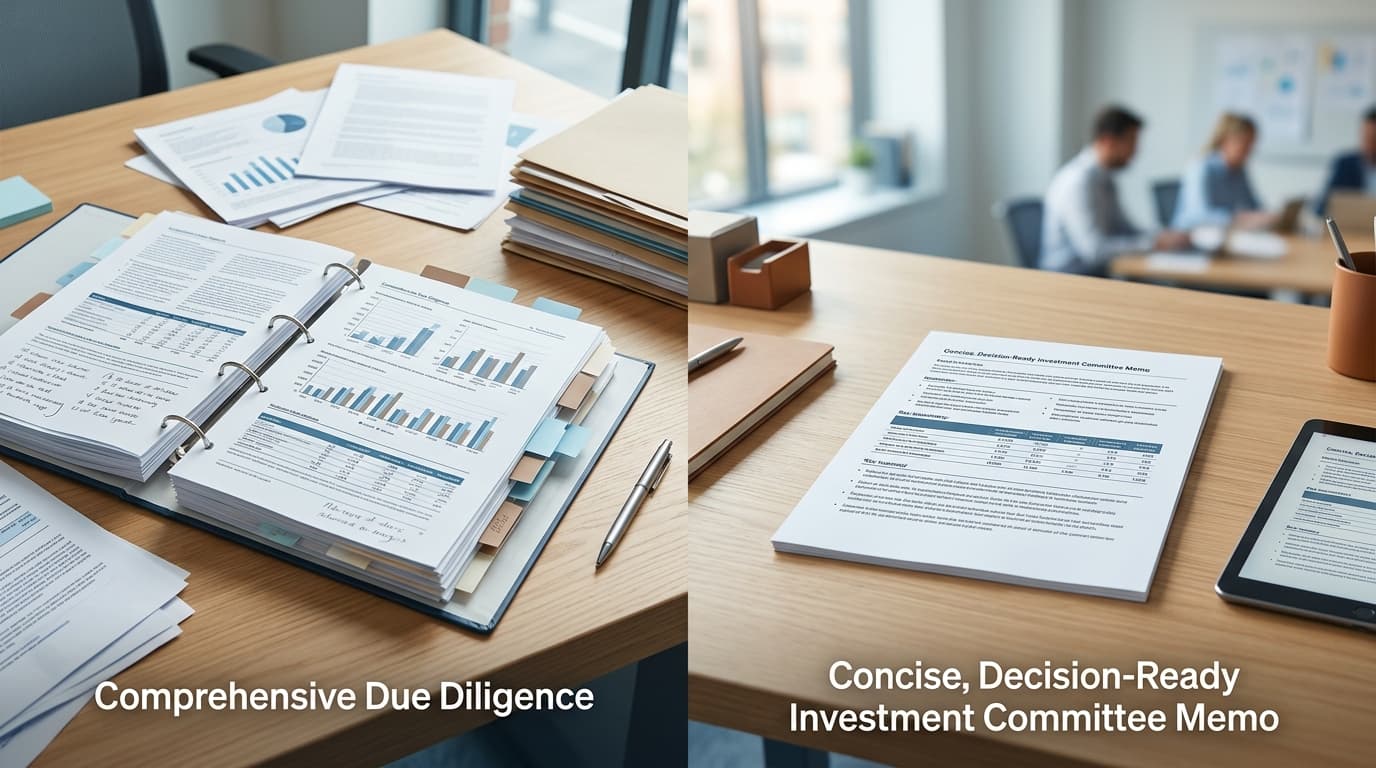
The AI x PE 2026 Paradigm: Shifting from Ad Hoc Pilots to Repeatable Systems
The private equity industry is undergoing a structural shift heading into 2026. Forward-looking funds are moving rapidly from isolated AI experiments to institutionalized, platform-driven architectures. While many firms remain in test-and-learn phases, Bain reports that nearly 20% of portfolio companies have already operationalized generative AI use cases to achieve concrete financial returns. This operational maturation, highlighted in our strategic Private Equity Outlook 2026, signals that the window for proof-of-concept experimentation is closing. To maintain a competitive edge, general partners must now build repeatable intelligence cores that scale transaction speed and operational efficacy.
The primary bottleneck to scaling these returns is the organizational friction of siloed toolsets. Traditional workflows rely on fragmented, ad hoc pilots where deal teams copy and paste sensitive information across generic large language models. Leading funds are overcoming this limitation by adopting unified architectures. An AI-native due diligence platform integrates target intelligence, virtual data rooms, and internal workstream documents into a single, secure environment. By deploying Plausity's AI-Analysis Engine, investment professionals can systematically reason across unstructured data rooms, legal agreements, and risk logs without manual friction.
- From disjointed manual lookups to automated, cross-document analysis through target-specific data rooms.
- From isolated analyst prompts to repeatable, institutionalized due diligence playbooks.
- From static PDF reports to source-linked, traceably audited investment committee inputs.
For VC & PE Fund Investment Professionals, this systemic evolution transforms diligence from an expensive administrative hurdle into a continuous source of proprietary insight. Rather than starting every potential transaction from scratch, deal teams can now leverage a permanent, secure knowledge layer that retains contextual memory across historical analyses and live workstreams. This institutionalized approach ensures that proprietary sector insights, risk parameters, and operational playbooks remain preserved within the fund's own secure infrastructure, driving repeatable outperformance across the entire investment lifecycle.
Systematic Deal Intelligence: Mapping High-Value Pipeline Opportunities
As global private equity deal value rebounded by 19% to reach $2.6 trillion, deal teams are encountering a highly competitive sourcing environment where traditional approaches fall short. Rather than reacting to broker-led deal flows, leading funds are shifting from ad-hoc analysis to institutionalized systems. Deploying advanced deal origination intelligence allows VC & PE Fund Investment Professionals and corporate development teams to proactively scan unstructured market signals, proprietary databases, and advisor materials in real time. This automated pipeline analysis helps professionals surface, qualify, and track high-conviction targets before they reach a crowded bidding stage.
To institutionalize this capability, forward-thinking private equity investors are moving past isolated AI experiments. By adopting an AI-native diligence platform like Plausity, funds can establish a permanent intelligence core. This systematic approach combines seamless, automated Data Room Ingestion with the deep analytical reasoning of the AI-Analysis Engine to process both inbound CIMs and outbound market telemetry. The result is a repeatable AI private equity workflow that accelerates overall transaction speeds, prevents critical information gaps, and scales deal intelligence across the entire investment lifecycle.
- Traditional Deal Sourcing: Relies on manual, reactive screening of intermediary-led teasers, leading to slow response times, high administrative overhead, and missed proprietary opportunities.
- Automated Sourcing Systems: Conducts continuous, real-time scanning of unstructured market signals, executive movements, and niche databases, expanding the fund's deal pipeline.
- Institutional Knowledge: Captures and cross-references all pipeline interactions directly within a centralized platform, preventing valuable deal-team insights from being lost when professionals transition.
Transitioning from reactive scouting to automated pipeline analysis ensures that deal teams focus their resources on high-probability opportunities. By establishing this systematic intelligence layer, funds lay the groundwork for seamless, automated AI due diligence and accelerated investment workflows when targets proceed to the virtual data room.
Next-Gen AI Due Diligence: Streamlining Multi-Format Data Room Analysis
Traditional AI private equity due diligence is historically slow, typically requiring a four- to eight-week cycle of manual contract review, financial spreading, and expert call synthesis to evaluate a target. This intensive process often creates an operational bottleneck that delays transaction timelines and risks missing critical deal-breaker terms. By implementing an AI-native diligence platform, forward-thinking deal teams are changing how they evaluate target companies, compressing traditional six-week analyst review cycles into structured six-day pipelines. This shift to private equity automation relies on rapid, systematic ingestion of the underlying documentation.
- Automatic categorization of multi-format virtual data room files including PDFs, Excel models, tax memos, and corporate records.
- Instant extraction of material provisions such as change-of-control clauses, customer concentration thresholds, and restrictive covenants.
- Parallel processing of extensive customer, legal, and operational workstreams to accelerate the path to the investment committee memo.
Instead of treating documents as disconnected pages, Plausity connects directly to virtual data rooms through Data Room Ingestion to classify and structure information automatically. Once the documents are ingested, the AI-Analysis Engine runs parallel, cross-document reasoning to synthesize key findings and build a traceable intelligence core. This deep-dive analytical capability allows VC and PE fund investment professionals and corporate development teams to identify hidden liabilities and assess legal exposure across thousands of multi-jurisdictional files in minutes rather than weeks. By turning disorganized data rooms into structured, actionable insights, deal teams can secure a distinct competitive advantage in transaction velocity while maintaining absolute audit readiness.
Institutional Risk Auditing: Spotting Material Exposures with Risk Radar
In high-stakes transactions, identifying hidden legal liabilities, balance sheet discrepancies, and compliance risks is a core requirement of transaction security. Indeed, research shows that cybersecurity threats alone can impose an average cost of 2.1 million USD on private equity funds. Traditional, manual risk tracking often relies on fragmented spreadsheets, which can result in overlooked exposures. By transitioning to private equity automation through risk register automation, investment teams can systematically audit targets using an AI-native diligence platform. This ensures that potential liabilities are uncovered early in the deal cycle, preventing costly post-closing surprises.
Targeted Exposure Screening: Multi-Dimensional Materiality Mapping
Rather than scanning documents in isolation, advanced systems utilize Risk Radar technology to surface anomalies across entire datasets. Operating as a core module of Plausity's AI-Analysis Engine, Risk Radar evaluates findings based on financial impact, legal exposure, regulatory compliance, and overall deal relevance. Crucially, the platform maintains absolute source traceability. Every identified risk is mathematically and contextually linked back to its primary document source in the virtual data room. This eliminates hallucination and allows analysts to verify any flag with a single click during rigorous AI due diligence workflows.
- Financial and Tax Anomalies: Detecting undisclosed liabilities, working capital adjustments, and irregular revenue recognition patterns across multiple spreadsheets.
- Legal and Contractual Liabilities: Scanning change-of-control clauses, restrictive covenants, and active litigation threats within commercial agreements.
- Regulatory and Compliance Risks: Evaluating alignment with regional data privacy laws, environmental mandates, and trade constraints.
By establishing this repeatable risk-auditing system, AI private equity leaders can seamlessly move from initial risk detection to strategic synthesis. The audited risks automatically populate the automated investment committee memo and inform the final valuation. Furthermore, this intelligence core does not disappear after signing. The uncovered risk profile directly transitions into the portfolio monitoring and value creation phases, giving operating partners a structured roadmap to mitigate exposures and protect enterprise value from day one.
Automating the Investment Committee Memo: From Raw Data to Board-Ready Reports
Drafting a comprehensive investment committee memo remains one of the most resource-intensive bottlenecks in the transaction lifecycle. While general adoption is in its infancy (Coller Capital reports that high AI integration is limited to just 7% of LPs), forward-thinking PE funds are using private equity automation to bridge the gap between analysis and action. Rather than spending days manually compiling data room disclosures into word processors, deal teams can leverage automated systems to turn unstructured risk factors into clear investment arguments.
This is where Plausity's Report Builder transforms the drafting workflow, helping teams transition from static templates to dynamic documents. The platform automatically aggregates complex inputs from commercial, legal, and financial analyses, structuring them into a cohesive narrative with full source traceability. To streamline the review, these outputs are integrated with a secure Collaboration Hub. This centralized workspace aligns deal teams and operating partners, allowing professionals to iterate on risk assessments and growth projections in real-time. The result is a rigorous memo that dramatically accelerates the path to deal-ready reports and final approval.
- Automated Data Synthesis: Consolidating separate risk registers, financial models, and diligence findings into structured, professional memo sections.
- Full Source Traceability: Embedding direct back-links to specific data room documents, making every financial figure and legal risk claim instantly verifiable.
- Real-Time Collaboration: Enabling deal teams, analysts, and operating partners to co-author and refine key takeaways under a single secure workspace.
By standardizing these workflows, funds eliminate manual re-keying errors and ensure that partners focus their energy on strategic underwriting rather than administrative compilation.
Post-Acquisition Value Creation: Scaling Margins and Portfolio Monitoring
In 2026, private equity value creation relies on institutionalizing operational excellence across the entire portfolio. This operational shift is driven by rapidly escalating software and services benchmarks. Specifically, Vista Equity Partners expects the industry standard for revenue growth plus profit margin to rise from the traditional Rule of 40 to a Rule of 50 or Rule of 60 benchmark due to AI-driven cost reductions. Operating partners can no longer rely on ad-hoc efficiency programs; they need structured, repeatable platforms to drive immediate post-close margin expansion.
To meet these elevated standards, forward-thinking PE funds use the pre-acquisition intelligence gathered by their AI-native diligence platform to fuel their post-acquisition value creation playbooks. Rather than treating due diligence as a transactional check-the-box exercise, deal teams and operating partners use the same underlying data repository to establish a continuous portfolio monitoring workflow. This ensures that the margin leaks, technical debt, and operational risks identified during the transaction phase are instantly mapped to the 100-day post-close integration plan.
- Continuous Risk Tracking: Operating teams use Plausity's Risk Radar to monitor post-close compliance and track how legacy technical debt or legal exposures are mitigated.
- Workflow Automation: Organizations deploy the AI-Analysis Engine to automate manual, document-heavy workflows within portfolio companies, scaling operational efficiency.
- Centralized Performance Reporting: Portfolio monitoring data is structured into investor-ready dashboards with full source traceability back to operational contracts and financial systems.
By embedding these repeatable systems directly into their post-acquisition playbook, investment professionals protect their underwriting assumptions. This continuous intelligence loop guarantees that the proprietary insights developed during due diligence are never lost, transforming the deal team's initial findings into measurable EBITDA growth.
Retaining Institutional Knowledge: Developing the Fund's Permanent Memory
In private equity, intellectual capital is both the most valuable asset and the most vulnerable. When deal teams disassemble or key investment professionals depart, funds routinely lose the deep, qualitative context behind historical deal decisions and bypassed opportunities. While standard data repositories store static files, they fail to retain the reasoning, risk analyses, and cross-workstream intelligence generated during active diligence. Within the broader shift toward AI private equity systems, forward-thinking firms are shifting from fragmented, transactional workflows to a unified, AI-searchable repository of past insights. This permanent knowledge core ensures that historical analyses remain accessible for future deal sourcing, comparison, and continuous fund learning.
- Context-aware sourcing: Deal teams can query historical pipeline data and past diligence findings to evaluate new opportunities against previous look-alike targets.
- Accelerated AI due diligence: Incoming analysts leverage past workstream data to fast-track modern transaction reviews without starting from zero.
- Consistent risk benchmarking: The platform automatically cross-references active files against historical risks to ensure consistent valuation criteria.
- Dynamic knowledge preservation: All extracted risk data, memos, and VDR insights are indexed into a searchable institutional memory.
By leveraging an AI-native diligence platform like Plausity, firms build a central repository that automatically structures, tags, and indexes historical deal intelligence. Powered by the AI-Analysis Engine, the system continuously processes data from past workflows, allowing users to query years of proprietary deal intelligence via natural language. As the private equity outlook evolves toward platform-driven efficiency, establishing a permanent memory becomes critical to maintaining a competitive edge. This systematic approach to private equity automation directly supports what Bain & Company highlights as the critical shift from isolated productivity gains to systemic, technology-driven value creation.
Plausity brings AI-native analysis to this workstream. Explore Plausity's platform for VC and PE deal teams, or read more on how roll-up operators institutionalize diligence across repeat acquisitions.