The 2026 Private Equity Landscape: Navigating the 3.8 Trillion USD Exit Backlog
- The private equity outlook 2026 is defined by a massive PE portfolio company backlog of 32,000 unsold assets worth 3.8 trillion USD.
- LP demand for liquidity has made DPI vs IRR private equity the central battle, with distributions sitting at a low 6% of industry AUM.
- GP-led secondaries and continuation funds secondaries are a vital exit valve, with 77 continuation funds raising 39 billion USD.
- Operational improvements now drive up to of returns for top-quartile funds as multiple expansion and leverage-driven gains fade
- Value creation differentiation PE relies on modern AI due diligence to identify margin and revenue growth opportunities during diligence.
The private equity outlook 2026 is defined by unprecedented pressure to resolve a massive PE portfolio company backlog and return capital to limited partners. For years, general partners focused heavily on deployment and paper valuations, but a prolonged period of high interest rates and divergent bid-ask spreads has severely constrained traditional exit channels like initial public offerings and strategic mergers. As a result, capital distributions to investors have fallen to historic lows relative to total asset value, creating an urgent bottleneck. To maintain investor trust and secure future fundraising rounds, investment professionals must transition from showcasing unrealized multiples to delivering actual cash distributions.
This backlog is not merely a temporary delay but a structural shift in asset hold times. Average holding periods are drifting toward seven years, which fundamentally alters fund lifecycles and delays the recycling of capital. According to the Bain Global Private Equity Report 2026, the industry enters the year sitting on approximately 32,000 unsold portfolio companies with an aggregate value of 3.8 trillion USD. Furthermore, a staggering 61% of buyout-backed assets have now been held for over four years. This aging inventory is forcing firms to explore alternative liquidity routes, as holding onto these assets indefinitely erodes net IRR due to the compounding effect of the fund's cost of capital over time.
| Portfolio Backlog Metric | Current Figure | Primary Industry Source |
|---|---|---|
| Total Unsold Portfolio Companies in Backlog | 32,000 | Bain Global PE Report 2026 |
| Combined Value of Unrealized Backlog Assets | $3.8 Trillion | Bain Global PE Report 2026 |
| Buyout-Backed Portfolio Companies Held Over Four Years | 61% | Bain Global PE Report 2026 |
The Shift to DPI and the Strategic Mandate for Operational Value Creation
This landscape is driving a critical re-evaluation of performance metrics, where DPI vs IRR private equity has become the central debate in GP-LP relationships. While internal rate of return has historically been the primary metric for marketing funds, limited partners are increasingly discountenancing paper returns that cannot be spent. Instead, distributed to paid-in capital, or DPI, is now the watched metric. To generate this liquidity, private equity firms are increasingly turning to continuation funds secondaries as a vital exit valve, allowing them to transfer high-performing assets to new vehicles while offering LPs an option to cash out. However, utilizing these secondary markets successfully requires clean, transparent, and defensible asset data to convince incoming secondary buyers of the target's ongoing viability.
To stand out in a crowded market, GPs must move beyond financial engineering and establish clear value creation differentiation PE. Investors must demonstrate an ability to actively drive revenue growth, improve operational efficiencies, and professionalize governance structures within their portfolio. Achieving this operational alpha requires a rigorous baseline established during the transaction phase. By utilizing AI-native due diligence platforms, deal teams can perform deep, multi-workstream analysis at pace, identifying specific cost-saving opportunities and growth levers before the transaction even closes. For instance, leveraging tools like the AI-Analysis Engine and Risk Radar allows teams to rapidly digest virtual data room documents, flagging material risks and surfacing clean operational data. These insights are then directly converted into actionable post-close roadmaps, turning thorough upfront analysis into realized investment upside.
The Shift in LP Metrics: Why DPI Overcomes IRR in the Search for Real Cash
The global private markets are experiencing a profound structural shift in how limited partners (LPs) evaluate fund performance. Historically, the internal rate of return (IRR) reigned as the primary benchmark for showcasing fund success. However, in an era of prolonged exit backlogs and high capital costs, paper gains are being heavily discounted in favor of actual cash distributions. The private equity market is currently defined by a critical debate: DPI vs IRR private equity. LPs are no longer satisfied with unrealized valuations or Total Value to Paid-In Capital (TVPI) ratios that remain locked in aging portfolios. Instead, they are demanding Distributed to Paid-In Capital (DPI) as the definitive measure of fund health before committing to new capital raises. This change in investor expectations forces sponsors and financial due diligence advisors to re-orient their investment cases toward rapid cash generation.
The urgency behind this transition is underscored by recent McKinsey data on private markets. According to their research, total distributions to paid-in capital fell to approximately 6% of total private equity assets under management (AUM) in the 12-month period ended June 2025. This figure represents an 8-percentage-point decline from the long-term historical 10-year average of 14%. Because these distributions have slowed to a crawl, LPs face severe liquidity constraints, limiting their ability to recycle cash back into new buyout funds. This drought has elevated DPI to a key gating metric. To address these demands, investment professionals and advisory partners must demonstrate a concrete path to liquidity from day one.
This metric shift is further compounded by the high prices paid for portfolio assets in recent years. Buyout entry multiples in the U.S. stabilized at a median of 11.9x EV/EBITDA in the periods leading up to this exit bottleneck. When assets are acquired at high valuations, relying on simple multiple expansion to drive returns is no longer viable. Paper markups become increasingly difficult to trust when the market clearing price for an exit remains uncertain. To bridge the gap between high purchase prices and real cash distributions, general partners (GPs) must focus on deep operational improvement rather than financial engineering or passive holding periods.
| Metric | Technical Focus | LP Sentiment (2026) |
|---|---|---|
| DPI (Distributed to Paid-In Capital) | Realized cash distributions returned to LPs relative to paid-in capital. | Primary benchmark; the gating metric for new fund commitments. |
| IRR (Internal Rate of Return) | Annualized rate of growth of an investment; easily distorted by subscription lines. | Highly discounted; viewed as an unreliable indicator of liquidity. |
| TVPI (Total Value to Paid-In Capital) | Combined realized and unrealized value of the portfolio. | Treated with skepticism due to aging portfolios and lack of market clearing exits. |
Unlocking Value to Drive Realized Distributions
To survive this pivot, general partners are forced to construct highly granular post-acquisition strategies during the underwrite. This is where GP differentiation shifts entirely from deal-making to value creation. Deal teams can no longer afford to initiate operational planning post-closing. Instead, they must perform rigorous analysis during the initial bidding stages. Advanced tools like Plausity's Risk Radar and AI-Analysis Engine allow transaction teams to parse thousands of data room documents instantly, highlighting operational risks and identifying margins of improvement before the transaction is finalized.
Implementing a robust, evidence-backed plan from the start of a transaction is critical to accelerating the timeline to liquidity. By deploying AI-native due diligence tools, deal teams can map complex compliance, financial, and organizational structures to identify quick wins and exit prep strategies early. When every diligence finding is linked directly to its source document, sponsors can execute their post-close plans with high conviction, ultimately shortening the holding period and returning vital cash to LPs to improve their DPI standings.
Continuation Funds and Secondaries: GP-Led Vehicles as the Vital Exit Valve
With traditional exits stalled by the PE portfolio company backlog, alternative liquidity paths have moved to the forefront of the private equity outlook 2026. Among these paths, continuation funds secondaries have emerged as an essential mechanism for general partners to manage aging portfolios. By transferring one or more assets from a legacy fund into a newly established vehicle, GP-led secondaries allow VC & PE funds to retain high-performing, high-conviction assets that require additional time or capital to reach their full potential. Simultaneously, this structure delivers a vital liquidity option to limited partners who wish to exit, addressing the pressing need for realized distributions.
The Growth and Momentum of GP-Led Secondaries
The momentum behind continuation funds secondaries is a direct response to a challenging fundraising and realization environment. According to Preqin data, a record 77 continuation funds raised 39 billion USD in 2024 to ease liquidity pressures across the market. This trend carried robustly into the following years, with the LCap Group noting that secondary transactions have transitioned from a niche, opportunistic workaround into an institutionalized asset-management tool. This shift is closely aligned with the broader market transition from DPI vs IRR private equity metrics, as institutional investors increasingly judge fund performance on actual cash returned rather than unrealized valuation multiples.
| Transaction Dimension | Traditional M&A / IPO | GP-Led Continuation Fund |
|---|---|---|
| LP Liquidity Options | Complete cash realization with mandatory exit | Flexibility to roll over equity or receive immediate liquidity |
| Asset Retention | Zero; ownership is fully transferred to a third party | GP maintains management and retains high-performing asset |
| Valuation Mechanism | Market-clearing price established via competitive auction | Independent valuation, fairness opinion, and lead secondary investor terms |
Structuring and Diligence Challenges in Secondary Deals
While continuation funds secondaries offer an elegant solution to the liquidity crunch, structuring these transactions is exceptionally complex. Because the GP acts as both the buyer (on behalf of the new vehicle) and the seller (on behalf of the legacy fund), the transaction creates inherent conflicts of interest. To satisfy regulatory bodies, incoming secondary buyers, and rolling limited partners, sponsors must establish a transparent, arm-length process. This demands a level of rigorous due diligence and valuation precision comparable to a completely new platform acquisition. To achieve this, sponsors must perform deep-dive reviews of customer contracts, legal risks, and operational capabilities to validate the business case for the extended hold.
As GPs seek value creation differentiation PE firms are increasingly leveraging advanced technology to accelerate these intensive diligence processes. Within these compressed secondary deal timelines, Plausity provides the analytical speed and auditability that transaction professionals require. By utilizing Plausity's core AI-Analysis Engine, deal teams can seamlessly ingest unstructured data rooms and run automated multi-workstream reviews. Plausity's Risk Radar automatically surfaces material legal, regulatory, and financial exposures, tracing every single finding back to its source document for complete validation. This high-velocity intelligence is then synthesized by the Report Builder into structured, professional reports, allowing sponsors to deliver the transparency needed to secure LP approval and close secondary transactions with confidence.
Value Creation Differentiation: Shifting from Financial Engineering to Operational Alpha
The private equity outlook 2026 is defined by a massive macroeconomic shift. Extended high interest rates and compressed market multiples have neutralized traditional financial engineering strategies. Historically, buyouts relied on cheap debt and expanding entry multiples to meet target return goals. Today, with a staggering 3.8 trillion USD PE portfolio company backlog globally, funds can no longer count on rising market tides to rescue underperforming investments. In this challenging climate, the ongoing focus on DPI vs IRR private equity has settled in favor of realized liquidity, which has overtaken paper returns as the primary yardstick for success among venture capital and private equity fund managers.
The Decline of Multiple Expansion and the Rise of Operational Levers
As multiple expansion cools, top-quartile funds are differentiating themselves through rigorous operational adjustments rather than capital structure manipulation. In this competitive landscape, basic corporate cost-cutting measures are no longer sufficient to drive the necessary multiple premium at exit. Industry data reveals that operational improvements and organic revenue growth now generate approximately 39 percent of private equity returns for top-performing funds. Realizing this target requires sponsors to identify specific operational levers - such as pricing optimizations, commercial footprint realignment, and technology-driven efficiency - long before a deal is signed.
| Value Creation Driver | Financial Engineering Era | Modern Operational Alpha Era |
|---|---|---|
| Primary Return Target | Paper IRR and unrealized valuation gains | Realized DPI and consistent cash flow generation |
| Sourcing Leverage | High borrowing levels with cheap debt | Smarter capital structure with a focus on free cash flow growth |
| Operational Intervention | Post-acquisition tactical adjustments | Pre-acquisition planning and systematic technology integration |
Accelerating Value Creation with Early Technology Integration
To establish true value creation differentiation PE, leading private equity firms are shifting their operational planning earlier in the deal lifecycle. Rather than waiting for the post-closing 100-day plan, deal teams are deploying advanced AI-driven due diligence platforms to identify target inefficiencies immediately. Utilizing tools such as Plausity's AI-Analysis Engine and Risk Radar during the preliminary scanning phase allows investment committees to map target liabilities and revenue risks instantly. By automating the extraction of unstructured contracts using Data Room Ingestion, analysts can rapidly build robust, actionable value creation plans based on ground-truth target data.
Bridging the gap between initial risk assessment and post-acquisition execution is the key to surviving the exit backlog. As traditional exit windows remain tight, sponsors are turning to continuation funds secondaries to secure liquidity for their limited partners, but secondary buyers demand the same level of operational rigor. The PE sponsors who integrate technology early to execute precise, operationally driven business plans will ultimately stand out, delivering the genuine alpha that modern institutional investors expect.
AI-Driven Diligence: Scaling Operational Integration from Day One
In 2026, the global private equity landscape is defined by a massive 3.8 trillion USD exit backlog consisting of approximately 32,000 unsold portfolio companies. With traditional exit routes congested and average holding periods lengthening, both private equity sponsors and M&A advisory firm partners face intense pressure to return capital and improve Distributed to Paid-In Capital (DPI) ratios. This shift means operational value creation is no longer a post-close afterthought; it must be underwritten and planned during the due diligence phase itself. The McKinsey Global Private Markets Report highlights that top-performing funds are focusing heavily on early operational transformation to drive margin improvements and revenue growth from the very beginning of the ownership cycle. To do this, leading firms are adopting next-generation technology to identify and validate these operational levers before the transaction even closes.
Accelerating Ingestion to Capture First-Mover Advantage
Traditional due diligence often drags on for weeks, leaving deal teams with little time to construct robust post-acquisition roadmaps. By utilizing Plausity to automate the preliminary phases of due diligence, investment professionals can compress these timelines dramatically. Specifically, the Data Room Ingestion tool connects directly to virtual data rooms (VDRs) to scan and process massive volumes of multi-format files - including financial statements, commercial agreements, and regulatory filings - in minutes. Instead of wasting critical days manually sorting PDFs and organizing folders, deal teams can shift their focus immediately to evaluating high-impact operational synergies and commercial opportunities.
Deep Multi-Workstream Analysis with Perfect Traceability
Once the data room is populated, Plausity's AI-Analysis Engine performs deep, simultaneous analysis across financial, commercial, and legal workstreams. Unlike conventional software that generates generic summaries, this system uncovers granular operational risks and identifies specific levers for value creation. Crucially, every single analytical finding is linked directly back to its original source document in the VDR. This absolute traceability eliminates hallucination risks, allowing investment committees and portfolio operations teams to verify facts instantly and draft actionable integration plans with complete confidence.
- Accelerated synergy validation: Rapidly scanning commercial contracts and vendor agreements with Data Room Ingestion to isolate pricing inefficiencies and supply chain redundancies.
- Comprehensive compliance mapping: Evaluating regulatory risk and corporate governance structures across multiple jurisdictions simultaneously through automated compliance due diligence.
- Traceable underwriting assumptions: Linking financial model inputs directly to verified historical VDR documents, ensuring that the investment case is grounded in audited reality.
- Pre-packaged 100-day plans: Leveraging granular Risk Radar findings to pre-build operational roadmaps that target margin expansion immediately after closing.
In an era where multiple expansion is no longer a reliable driver of returns, the winner of a highly competitive process is often the sponsor who can underwrite a more aggressive yet highly credible operational plan. By integrating AI-driven due diligence tools into their pre-deal workflows, modern private equity firms can transition smoothly from asset evaluation to operational execution, turning the due diligence process itself into a major source of competitive differentiation.
Mitigating Acquisition Risk: Advanced Exposure Analysis in a High-Stakes Era
With the exit backlog reaching historically high levels (including over 18,000 buyout-backed companies awaiting exit) and high entry multiples persisting at a median of 11.9x EBITDA, private equity investors face an exceptionally high-stakes environment. Overpaying for an asset or failing to identify post-merger integration roadblocks can severely drag down holding-period performance. Consequently, rigorous pre-acquisition risk management is critical to protecting margins and ensuring that value-creation strategies are actionable from day one. In this landscape, investment professionals are shifting from basic checklist-driven reviews to systematic, deep-dive exposure analysis that surfaces hidden liabilities in target companies before binding bids are submitted.
Systematic Liability Detection with Risk Radar
Analyzing thousands of virtual data room documents manually often leads to critical details being missed under tight deal timelines. To address this, deal teams utilize risk intelligence tools like Risk Radar to systematically parse legal, financial, and regulatory compliance documents. This core platform component identifies and evaluates findings based on their materiality, financial impact, and deal relevance. By automating the extraction of change-of-control clauses, restrictive covenants, and undisclosed contingent liabilities, Risk Radar ensures that investment professionals can accurately adjust valuation models or structure indemnities during negotiations. These capabilities prevent the post-transaction surprises that frequently derail integration timelines and erode capital returns.
| Analysis Dimension | Traditional Manual Review | AI-Powered Systematic Analysis |
|---|---|---|
| Depth of Coverage | Sample-based audits due to time constraints, often missing tail-risk liabilities. | Comprehensive scanning of all uploaded virtual data room documents, ensuring complete data coverage. |
| Risk Triaging | Manual flagging by junior analysts, risking subjective or inconsistent categorization. | Automated material risk scoring based on financial impact, legal exposure, and deal relevance. |
| Verification and Traceability | Siloed working drafts and manual cross-referencing, increasing verification time. | Direct linking of every analytical finding back to its exact source document for full auditability. |
Institutional Reporting and Real-Time Coordination
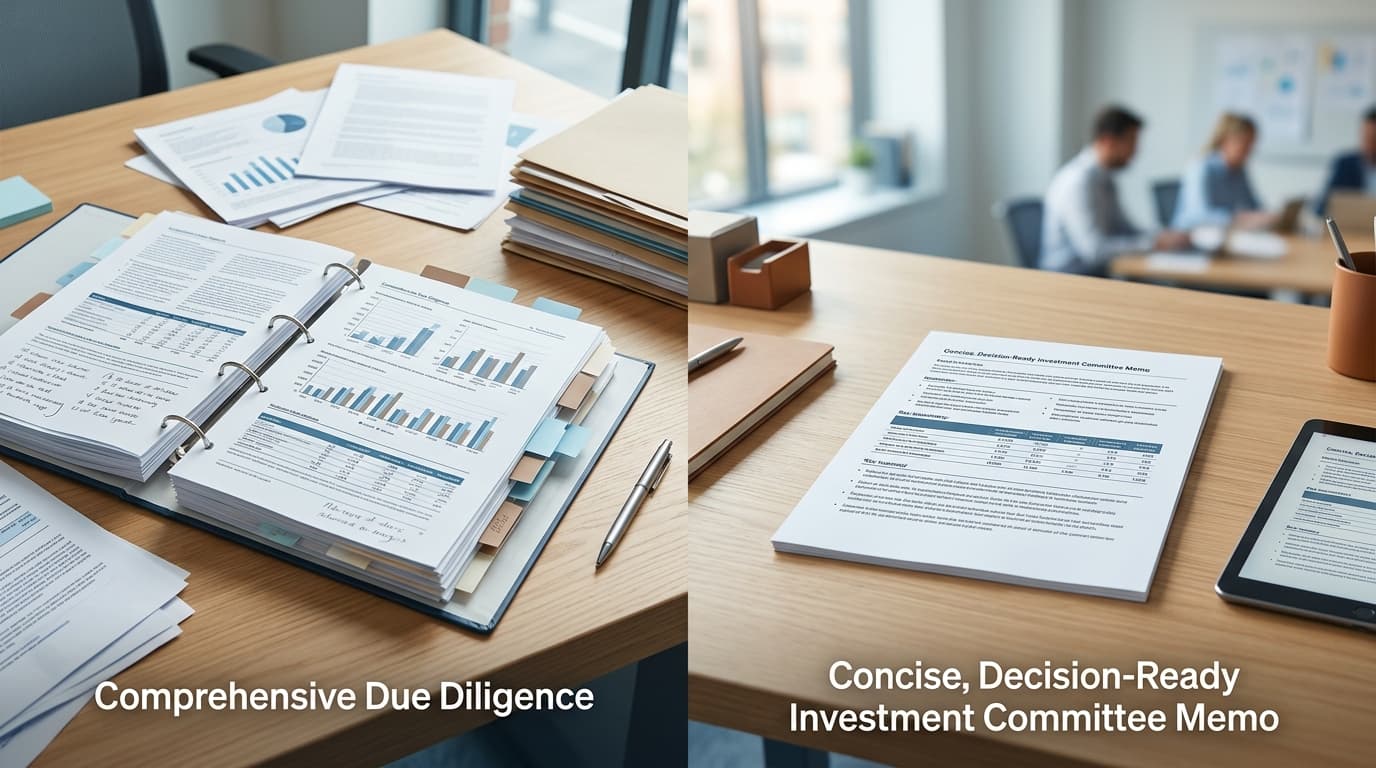
Translating complex risk analyses into clear executive briefings is another major bottleneck for M&A project leads. Using Report Builder, transaction teams can instantly generate structured, institutional-grade due diligence reports that maintain complete traceability back to the underlying source documents. This direct grounding allows investment committees and lenders to verify findings immediately, expediting approval processes. Furthermore, the Collaboration Hub acts as a unified collaboration workflow environment, allowing internal deal teams, legal counsels, and external advisors to coordinate in real-time. By resolving cross-workstream questions dynamically, funds can maintain their deal pace without sacrificing the analytical depth required to mitigate downside risk.