Why Co-Lender Due Diligence Matters Before Stress
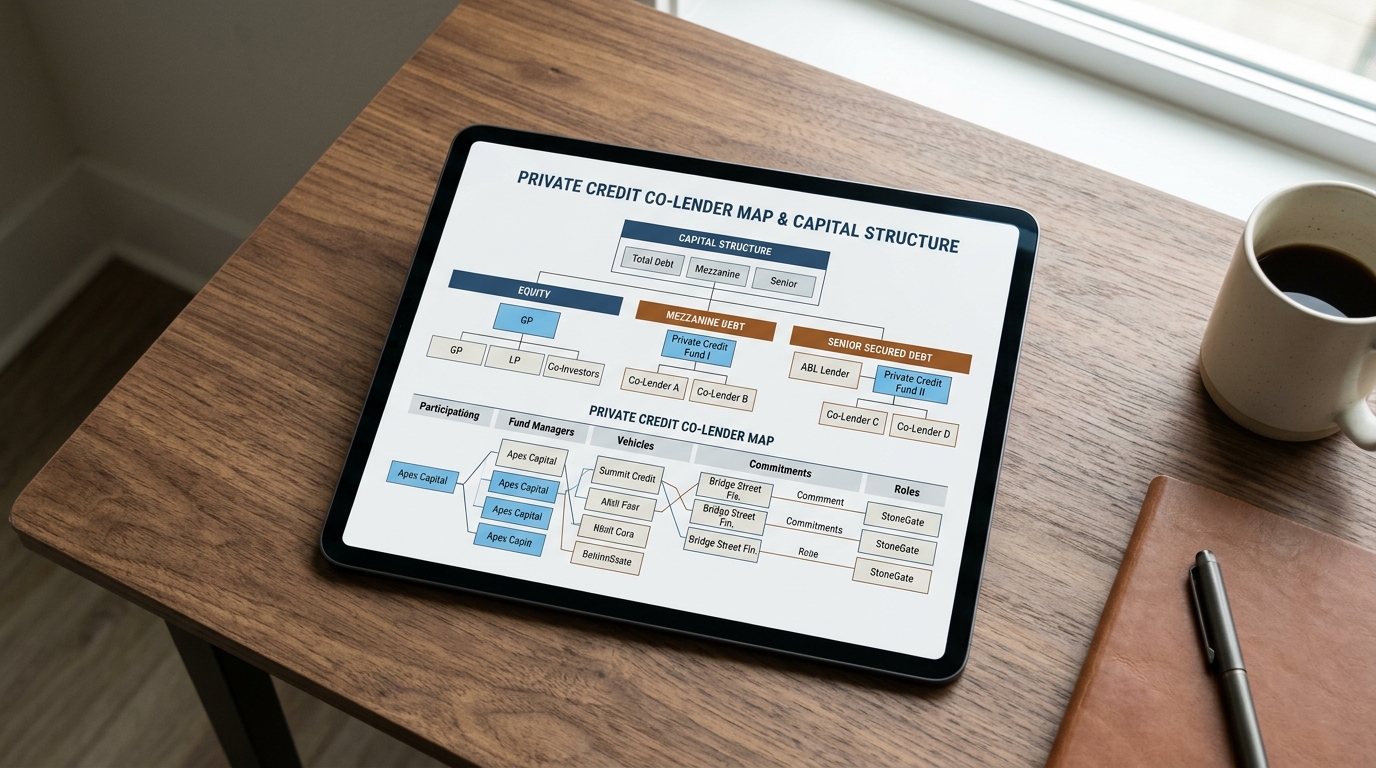
Co-lender due diligence is the systematic mapping and stress-testing of a borrower's complete capital structure, intercreditor hierarchy, voting thresholds, and co-investor concentration before credit stress or covenant defaults occur. Instead of evaluating a credit transaction as an isolated facility, direct lenders and private credit funds conduct co-lender diligence to identify hidden debt stacking, conflicting consent thresholds, information asymmetries, and potential lender-on-lender conflicts ahead of a restructuring event. Mapping these dynamics early ensures deal teams understand exact voting control and recovery priority across all economic scenarios.
Private credit portfolios have expanded rapidly into a multi-trillion dollar asset class, yet many institutional lenders do not systematically map who else holds debt in a borrower's capital structure until a covenant issue emerges. The Financial Stability Board (FSB) warned that the $1.5 trillion to $2 trillion global private credit market faces key structural vulnerabilities, including opaque borrower leverage, complex interconnectedness, and persistent data gaps. When credit stress materializes, lenders that failed to map their co-lender exposure often discover that enforcement rights are constrained by supermajority consent rules or priming provisions hidden within intercreditor agreements.
Establishing a proactive co-lender map prevents costly surprises when covenant enforcement gaps appear during market downturns. In multi-lender arrangements, information rights, amendment histories, and sponsor support commitments dictate whether a credit team can act decisively or remains locked in a passive minority position. Integrating comprehensive capital structure analysis alongside AI credit risk due diligence allows underwriting and portfolio monitoring teams to evaluate counterparty alignment before liquidity stress forces reactive negotiations.
Core Framework for Mapping Co-Lender Exposure
Building an actionable co-lender map requires credit analysts to move beyond basic debt facility summaries and dissect the precise governance framework governing each tranche. The analysis begins with a granular overview of the borrower, sponsor, and facility architecture, verifying total leverage, debt service coverage ratios, and the exact distribution of commitments across term loans, revolving credit facilities, and mezzanine layers.
Evaluating lender group composition and concentration risk is the second critical pillar. Deal teams must identify whether the debt package is held by a tight club of institutional direct lenders, a fragmented syndicate, or funds affiliated with the private equity sponsor. Where lender interests diverge, liability management exercises and other so-called lender-on-lender transactions have shown how a controlling group can use its documentary rights to improve its own position relative to other lenders. High concentration among friendly or sponsor-aligned co-lenders can therefore distort workout incentives, as those entities may weigh sponsor relationship capital against immediate recovery maximization.
Mapping voting rights and consent thresholds early is essential to avoid forced amendments or priming transactions later in the credit lifecycle. Standard credit agreements define distinct voting thresholds that govern facility modifications:
- Required Lenders (a simple majority of commitments): Controls standard operational waivers, covenant modifications, and routine administrative amendments.
- Supermajority Lenders (a defined threshold above a simple majority): Typically required for releasing secondary collateral, modifying financial covenants post-default, or altering specific enforcement remedies.
- Sacred rights (unanimous or all-affected-lender consent): Restructuring counsel notes that sacred rights typically include decisions to extend maturity, delay or reduce scheduled payments, reduce interest margins, change pro rata sharing or payments, increase lenders' commitments, and release all or substantially all of the collateral.
Credit teams must verify whether they hold a blocking position under majority or supermajority thresholds. Lenders holding less than a majority of a facility without explicit veto rights over key credit terms risk being outvoted during distressed amendment negotiations. Evaluating these thresholds is integral to institutional diligence for PE and VC funds managing multi-lender portfolio positions.
What Lenders Are Really Testing vs. Sponsor Reality
During initial credit underwriting, lenders focus on formal legal protections, including intercreditor agreements, security package evidence, and perfected collateral filings. Legal counsel verifies UCC-1 financing statements, mortgage liens, and pledge agreements to ensure first-priority security positions. However, practical experience shows that post-closing collateral perfection is frequently neglected. A UCC-1 financing statement is effective for five years unless a timely continuation statement is filed, and on lapse the security interest becomes unperfected, so missed continuations or untracked multi-jurisdictional assets can quietly erode a secured position.
In contrast to formal legal testing, sponsor reality often presents significant valuation opacity and relationship risk. Private equity sponsors frequently manage multiple portfolio companies across overlapping credit funds, creating complex relationship dynamics during workouts. Sponsors may seek amendment accommodations, such as covenant flexibilities or equity cure extensions, leveraging their overall deal flow to influence lender decisions. Understanding these dynamics is a core component of comprehensive private equity due diligence.
Furthermore, the historical amendment record of a sponsor across prior transactions reveals how they behave under credit pressure. Sponsors that routinely utilize liability management exercises or aggressive debt-stack restructuring require heightened diligence. Credit teams must cross-examine sponsor support commitments against actual liquidity reserves, ensuring that implicit guarantees of equity support are backed by verifiable capital commitments rather than informal assurances.
Lenders must also account for structural leverage instruments utilized at the fund or sponsor level. Examining whether a borrower's equity is pledged under secondary financing options, such as NAV loan due diligence frameworks, clarifies whether upper-tier liquidity strain could force an unexpected sale or restructuring of the portfolio asset.
What Borrowers and Sponsors Are Expected to Show
On the other side of the table, borrowers and sponsors are expected to evidence rather than assert. At minimum, credit teams should expect a complete debt schedule reconciled to the audited balance sheet, a lender-by-lender commitment and hold roster covering every tranche, copies of all executed intercreditor and subordination agreements, and a clean amendment log showing each waiver, covenant reset, and maturity extension with the consent threshold used. Reporting obligations should be documented as covenants, not habits: monthly and quarterly management accounts, covenant compliance certificates, and lender group notices delivered on the same schedule to every holder. Sponsors are also expected to show the substance behind support language, including historical equity injections, remaining cure rights, and the fund-level capital available to back them. Where disclosure gaps persist, an assembled financial due diligence checklist is a practical way to convert missing evidence into named diligence conditions before closing.
Critical Red Flags in Co-Lender Arrangements
Identifying structural vulnerabilities within co-lender arrangements requires examining both documentation terms and participant behavior. Market analysis indicates that payment-in-kind (PIK) toggle utilization has increased, with valuation firm Lincoln International reporting that 11% of tracked private market deals incorporated PIK structures in Q1 2025, up from 7% in late 2021. While structural PIK can support high-growth capital needs, reactive PIK amendments introduced post-origination frequently signal underlying cash flow deterioration.
The table below outlines six critical red flags that credit analysts and monitoring teams must evaluate during co-lender exposure mapping:
| Red Flag Indicator | Structural Category | Operational Risk Impact | Diligence Verification Method |
|---|---|---|---|
| Sponsor-Affiliated Lender Concentration | Co-Lender Composition | Sponsor-backed funds may vote against enforcement to protect equity value. | Cross-reference ultimate beneficial ownership of all participating fund entities. |
| Asymmetric Information Rights | Governance & Reporting | Minority lenders receive delayed financial updates, masking early distress. | Audit credit agreement reporting covenants for equal information delivery schedules. |
| Low Majority Consent Thresholds | Voting Architecture | Facility terms can be amended or primed without minority lender approval. | Calculate exact commitment percentages required to reach each defined voting threshold. |
| Reactive PIK Toggle Modifications | Debt Service & Cash Flow | Defers cash interest to obscure liquidity shortfalls and inflate nominal debt. | Analyze amendment history to distinguish origination PIK from distress PIK. |
| Unclear Intercreditor Priming Terms | Security & Enforcement | Subordinated debt or new capital can prime existing first-lien collateral. | Review intercreditor subordination and lien-release provisions verbatim. |
| Unmonitored Collateral Expiration | Secured Status | Under UCC 9-515, a filed financing statement is effective for five years, and upon lapse any security interest it perfected becomes unperfected unless perfected otherwise. | Conduct periodic public record lien searches across all operating jurisdictions. |
Systematically flagging these structural vulnerabilities through risk register automation allows deal teams to escalate potential exposure to investment committees before covenant breaches occur.
Co-Lender Data Room and Evidence Checklist
To conduct rigorous co-lender due diligence, investment teams must collect and verify specific legal, financial, and operational records. The risk of relying on summary deal memos rather than primary documents is not theoretical: restructuring counsel note that recent private credit disputes include investor suits against loan underwriters alleging the double-pledging of collateral and false financial statements, alongside shareholder class actions against business development companies claiming that risk was inaccurately portrayed. Exposures of that kind typically surface only under stress, when the underlying documents finally get read line by line.
The following checklist outlines the essential documentary evidence required in a comprehensive co-lender data room:
- Fully Executed Credit Agreement and Amendments: Complete primary loan documentation including all incremental facility schedules and side letters.
- Executed Intercreditor and Subordination Agreements: Legal documentation defining payment waterfalls, standstill periods, and lien priorities among lender tranches.
- Lender Commitment and Hold Roster: Detailed schedule showing exact dollar commitments, entity names, and percentage holdings across all facility components.
- UCC Lien Search and Perfection Certificates: Verifiable search reports confirming perfected first-priority security interests across all asset locations, including current continuation filings.
- Information Sharing and Reporting Cadence Schedules: Binding covenants specifying frequency and detail of audited annual, quarterly, and monthly financial deliveries.
- Watchlist and Covenant Compliance Certificates: Historical compliance reporting tracking leverage ratios, interest coverage, and covenant headroom trends.
- Sponsor Support and Equity Cure Documentation: Agreements detailing historical sponsor equity injections, cure rights utilization, and sponsor capital reserves.
- Restructuring and Amendment History Records: Formal documentation of all historical covenant waivers, fee concessions, and structural maturity extensions.
Standardizing this evidence collection process using configurable due diligence templates ensures that credit analysts evaluate every multi-lender transaction against consistent institutional benchmarks.
Practical Implications for Private Credit Funds
For private credit fund managers, direct lenders, and private equity sponsors, mapping co-lender dynamics has direct operational and strategic implications. Federal Reserve researchers note that private credit loans are illiquid because of the lack of a secondary market, that investors acquiring these loans should expect to hold them to maturity or face steep losses if they need an emergency exit, and that the sector remains relatively opaque, which means credit teams cannot afford to treat loan monitoring as a passive administrative task.
Recovery and restructuring scenario planning must be integrated into routine portfolio monitoring. Deal teams should model recovery outcomes under various enforcement scenarios, taking into account the voting alignment of co-lenders. If a borrower faces cash flow pressure, knowing whether co-lenders are likely to support an equity infusion, demand a debt-for-equity swap, or pursue aggressive enforcement determines the lender's strategic playbook.
Furthermore, understanding counterparty risk requires credit funds to evaluate the financial stability and liquidity of their co-lenders. If a co-lender in a delayed-draw term loan or revolving facility faces liquidity constraints, remaining syndicate members may be forced to absorb unfunded commitments or deal with defaulting participants. Evaluating co-lender reliability is particularly vital when assessing independent sponsor due diligence structures where equity capitalization may be fragmented.
Establishing institutionalized monitoring protocols ensures that credit organizations shift from reactive workout management to proactive risk mitigation. Deploying repeatable diligence systems enables fund managers to maintain clear capital structure visibility across hundreds of portfolio holdings simultaneously.
How to Use This in Your Next Diligence Workflow
Integrating systematic co-lender due diligence into daily credit workflows requires modern analytical technology capable of processing complex debt documentation at scale. Institutional investment teams and direct lenders need platform infrastructure that maps capital structures, tracks lender voting control, and surfaces hidden credit risks before portfolio stress materializes.
In practice, credit exposure mapping is streamlined through a handful of purpose-built technology components:
- Data Room Ingestion: Automatically ingests and parses thousands of pages of complex credit agreements, intercreditor contracts, and amendment schedules within minutes.
- AI-Analysis Engine: Reads, interprets, and cross-references multi-tranche debt agreements to map voting thresholds, sacred rights, and payment hierarchy waterfalls.
- Risk Radar: Evaluates legal exposure and structural anomalies, automatically generating red-flag alerts when consent thresholds or PIK toggle terms present risk.
- Report Builder: Drafts investor-ready credit memos and committee deliverables with full source traceability back to underlying loan documentation.
- Collaboration Hub: Connects deal teams, legal advisors, and portfolio managers in a real-time environment to align workstreams and coordinate risk responses.
By replacing manual document checks with an AI-native due diligence platform, credit teams eliminate information blind spots, accelerate underwriting turnarounds, and maintain continuous visibility over multi-lender exposure. Plausity provides decision support tools that enhance analytical rigour without guaranteeing specific investment outcomes or credit approvals.