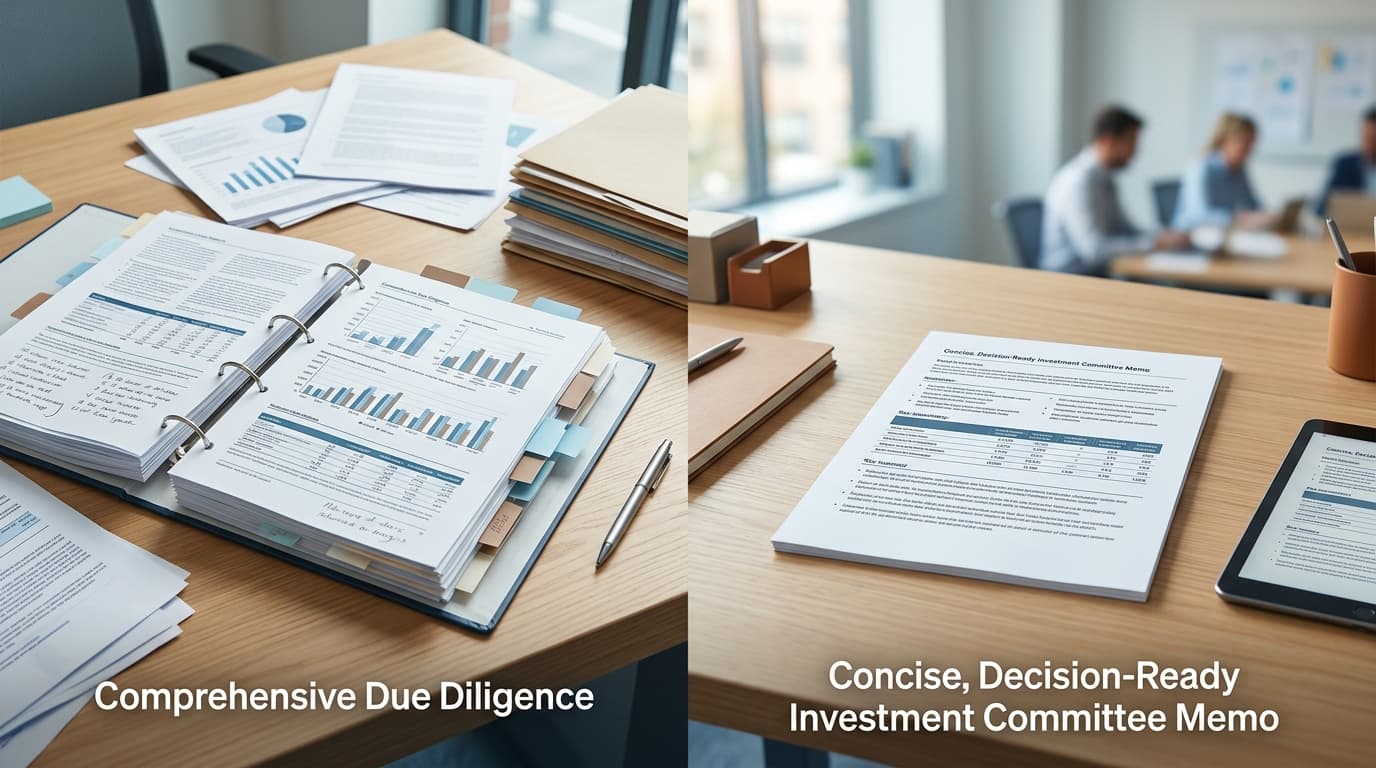
What Is IC Memo Software?
IC memo software is a category of deal-intelligence tooling that turns completed due diligence into a first draft of the investment committee memo — the document a fund's IC actually reads before approving a transaction. Rather than a deal captain manually re-typing findings from six workstream decks into a single narrative, the software synthesises commercial, financial, legal, tax, technical and other diligence findings into one structured draft: thesis, risks, mitigants, open questions and the supporting evidence pack. The best IC memo software does this without replacing the deal team's judgement — it produces a draft, not a verdict.
Buyers typically arrive at this category from one of two directions: either they already run diligence in a connected platform and want the IC memo as the final output step, or they are evaluating it as a standalone add-on to speed up IC prep regardless of where the underlying diligence happened. Either way, the evaluation criteria are largely the same.
Why Buying IC Memo Software Is Different From Buying a Report Generator
A generic document or report generator can format a memo. It cannot tell you whether a claim inside that memo is actually supported by the underlying data room, whether a workstream's findings were fully incorporated, or whether a figure quietly changed between drafts. IC memo software is judged on a different axis: not "does it produce a polished document," but "can the committee trust what's in it." That distinction matters because an IC memo is a decision document with real consequences — a misattributed figure or an unflagged evidence gap that reaches the investment committee is a different order of problem than a typo in a slide deck.
This is also why due-diligence platforms have moved faster into this space than generic AI writing tools: the memo is only as good as the diligence synthesis feeding it, and that synthesis depends on the software already having structured access to the underlying findings, not just a prompt describing them.
The Four-Point Evaluation Checklist
Four requirements separate IC memo software that a committee can rely on from software that just looks the part. These four hold up against independent buyer-category research too: comparison guides for this software category converge on the same checklist — full source traceability rather than an unverifiable narrative, synthesis across every diligence or committee perspective rather than one workstream, a human decision kept outside the tool, and export quality that does not force a manual rebuild before the IC meeting.
1. Source attribution
Every claim, figure, risk and mitigant in the draft should carry a citation back to the underlying data-room document, page and paragraph it came from — not just a well-written paragraph that sounds authoritative. Without this, reviewers cannot verify a finding without re-opening the entire data room, which defeats the purpose of automation.
2. Workstream coverage
A memo built from only the financial model misses the point. The software should synthesise findings across every diligence workstream run on the deal — commercial, financial, tech, legal, tax, regulatory, cybersecurity, ESG and AI-impact, where relevant — rather than forcing the deal captain to manually stitch workstreams together afterwards.
3. Human-in-the-loop control
The software should produce a first draft, not a verdict. Framing, prioritisation, the final investment recommendation, financing structure and the decision itself need to stay with the deal team, the investment committee and their advisers. Treat any tool that claims to make the recommendation for you as a red flag, not a feature.
4. Export formats the committee actually uses
A memo that is excellent inside the platform but can't leave it in a usable format doesn't solve the real problem. IC members and boards typically want Word for mark-up, PowerPoint for the live session, or PDF for distribution and the audit file. IC memo software should export to all three without forcing a rebuild outside the tool.
Red Flags When Evaluating IC Memo Software
- Black-box synthesis — findings appear in the memo with no way to trace them back to a specific document, page or paragraph.
- Single-workstream bias — the tool only ingests financial models or only legal documents, leaving the deal captain to manually merge the rest.
- Overreach on judgement — marketing language implying the software decides whether to invest, rather than structuring the material for the people who do.
- Export lock-in — the memo only "lives" inside the platform's own viewer, with no clean Word, PowerPoint or PDF export for the actual IC meeting.
- Stale evidence gaps — missing documents or thin evidence get smoothed over in the narrative instead of surfaced as open items for the committee to see.
How Plausity's IC Memo Measures Up
Plausity's IC Memo capability was built directly against this checklist. It synthesises findings across every diligence workstream run inside Plausity — commercial, financial, tech, legal, tax, regulatory, cybersecurity, ESG and AI-impact — into a single structured first draft, with every claim, figure and risk anchored back to its source document, page and paragraph. The investment recommendation, framing and final decision stay with the deal team and the investment committee; Plausity produces the draft, not the verdict. The finished memo exports to Word (DOCX), PowerPoint (PPTX) and PDF, so it leaves the platform in whatever format the IC meeting or the audit file requires. For the mechanics of how the underlying diligence-to-memo synthesis works, see how IC memo automation compresses the timeline from days to hours; for the memo's expected structure once drafted, see the IC memo template.
How to Use This Checklist in Your Next Vendor Review
- Ask for a citation trail, not a demo transcript. Pick one figure in a sample memo and ask the vendor to show you the exact source page it came from.
- Ask which workstreams actually feed the memo. A platform that only ingests financials will leave your legal and commercial findings out of the first draft.
- Ask what the software will not do. A vendor that cannot clearly state where human judgement takes over is underselling the risk, not overselling the product.
- Ask to see the export, not just the in-app preview. Open the DOCX or PPTX output yourself before you buy — formatting problems surface here, not in the sales demo.
According to Deloitte's GenAI in M&A survey of 1,000 corporate and private equity leaders, 86% of organisations have already integrated generative AI into their M&A workflows, with 65% having done so in the past year alone — which is exactly why this evaluation discipline matters now: the category is moving fast, and not every entrant has built to the same bar.