Vendor Due Diligence Software for Sell-Side M&A.
Prepare for buyer scrutiny before the data room opens. Plausity is an AI-native workspace for sellers, M&A advisors and investment banks to analyze diligence evidence, identify gaps, surface risks and build a source-grounded view across multiple DD workstreams.
Request a demo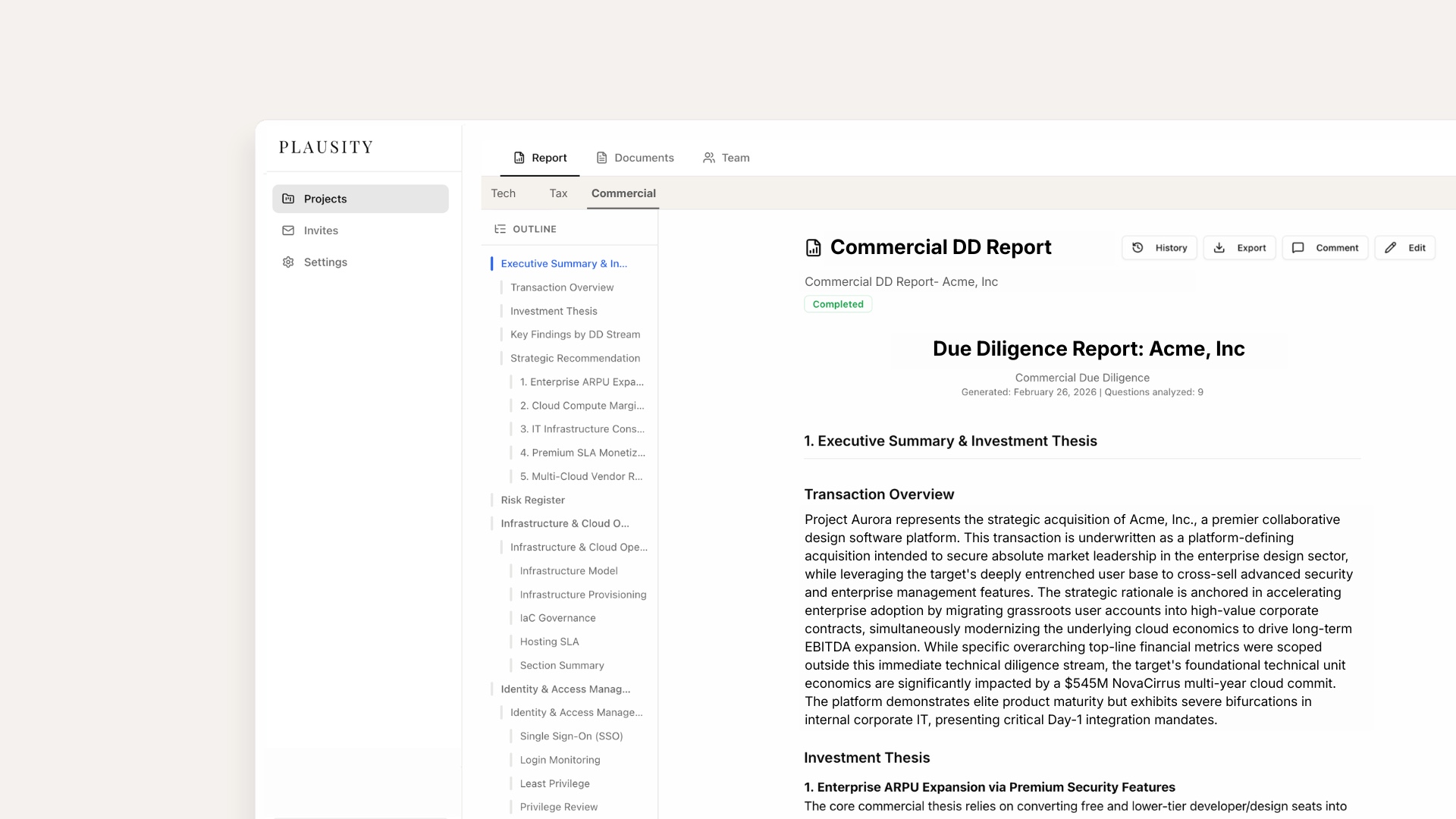
Prepare before buyers start asking.
Vendor due diligence (sell-side DD) is the diligence work the seller and its advisors run before opening the data room to buyers — reviewing available evidence, identifying gaps, surfacing risks and structuring findings so the transaction is defensible under buyer scrutiny. Plausity is designed for this workflow: specialist AI agents run in parallel across commercial, financial, tech, legal, tax, cybersecurity, regulatory and AI-impact diligence, and return findings, risks and evidence-gap assessments with full source traceability. Plausity is not a replacement for an independent third-party VDD provider, does not issue an assurance opinion, and does not create audited financials — it is the AI-native workspace sellers and advisors use to get the target and its data room ready for buyer diligence.
Review the data room from the buyer's perspective
Specialist AI agents read every document — contracts, financial models, cap tables, HR files, IP records, cyber posture, regulatory certifications — and produce structured findings across every relevant workstream. Sellers and advisors see what buyers will see before buyers see it.
Identify evidence gaps before buyers do
Missing Document Analysis surfaces where required or supporting evidence may be missing or insufficient across diligence questions and workstreams — from absent contracts and unfilled disclosure lists to inconsistencies between what management has represented and what the data room actually supports. Close the gaps on your terms.
Surface red flags and material risks proactively
Plausity flags red flags and material risks across every DD workstream, materiality-scored and cross-referenced. Understand what a buyer's DD team will latch onto — and prepare the answer or the mitigation before the buyer asks.
Prepare for buyer questions across the entire diligence
Interrogate the completed sell-side analysis conversationally. Ask which findings lack sufficient evidence, which cross-workstream risks are most likely to attract attention, which assumptions need further support — and get answers tied back to the underlying documents.
Structure the vendor DD package for advisors and buyers
Turn structured findings into deliverables the advisor can hand to buyers or use in management presentations: Word, PowerPoint, PDF and normalized financial datasets in Excel. Every claim traces back to source document, page and paragraph — a defensible package, not a marketing brochure.
| Metric | Target | Benchmark | |
|---|---|---|---|
| Revenue Growth | +18% | +12% | ↑ |
| EBITDA Margin | 19% | 22% | ↓ |
| Employee Retention | 87% | 91% | ↓ |
Explore the Plausity platform
Plausity gave our sell-side team the same rigor a buy-side firm would run on us — before we opened the data room. Every gap surfaced early is a question we've already answered.
Frequently asked questions
Vendor due diligence (VDD), also called sell-side due diligence, is the diligence work performed by the seller and its advisors before opening the data room to buyers. Its purpose is to review the available evidence, identify gaps, surface risks and structure findings so the transaction is defensible under buyer scrutiny — reducing surprise and re-pricing during the buy-side process.
Vendor DD is prepared by the seller / its advisors before or during the sale process to get the target ready for buyer scrutiny. Buy-side DD is performed by the buyer and its advisors after receiving access to the data room, to validate the investment thesis and identify risk before committing capital. Both work on the same evidence set but from opposite perspectives.
A typical VDD covers relevant DD workstreams — commercial, financial, legal, tax, tech, cybersecurity, regulatory, ESG and AI-impact — and produces a defensible view of the target: what the evidence shows, what is missing, what risks a buyer will likely challenge, and how each finding traces back to the underlying source. Not every deal includes every workstream; scope follows the target and buyer profile.
Yes. AI reads and classifies data room content, extracts and cross-references data points, flags red flags and evidence gaps, and produces structured findings by workstream — the volume-heavy, pattern-based parts of VDD. Interpretation, prioritization and the advisor's own opinion remain with the deal team. Plausity is designed as expert-in-the-loop for exactly this.
Evidence Gap Detection reviews the VDR against the expected evidence set for each workstream and diligence question, and surfaces absent, incomplete or inconsistent documentation. It does not guarantee VDR completeness — it makes gaps visible and defensible so your team can prioritize follow-ups before the buyer's diligence team finds them first.
Commercial, Financial, Legal, Tax, Tech, Organisation & Compliance, Regulatory & Compliance (Product & Market), Cybersecurity, ESG, Website Compliance, Background Check & Integrity, Industry Expertise, Value Creation and AI Impact — specialist AI agents run in parallel across the workstreams relevant to the transaction.
No. Plausity is an AI-native workspace for the sell-side diligence workflow — it accelerates evidence review, gap detection, findings and Q&A. It does not issue an independent assurance opinion, does not sign off audited financials, and does not replace the professional judgment of the seller's advisors, auditors, lawyers or tax specialists.
See what the buyer will see — first.
Built for today's investment and deal teams. Trusted by >200 firms. Book a demo and see how Plausity accelerates sell-side diligence.
Request a Demo