The AI Shift in Due Diligence Consulting
Due diligence consulting in 2026 operates on a hybrid model where artificial intelligence automates data ingestion, clause extraction, and baseline anomaly detection, while experienced advisors retain exclusive ownership of commercial judgment, valuation strategy, and client advisory. AI does not replace fiduciaries or deliver formal legal opinions; rather, it eliminates mechanical administrative friction so consulting teams can test investment theses with greater rigor and speed.
According to industry data, only 10% of private funds had incorporated AI into their core operational workflows by late 2023. Today, deal velocity and expanding data room sizes have made automation indispensable for advisory firms seeking to protect project margins while delivering defensible diligence insights. Boutique advisory firms and private equity operating teams increasingly rely on an AI due diligence platform to process thousands of target documents within hours.
| Diligence Dimension | Legacy Consulting Model | AI-Augmented Consulting Model |
|---|---|---|
| Document Intake & Triage | Manual folder navigation and selective sampling across VDR files | Automated parsing and multi-format extraction across all files |
| Risk Identification | Keyword searches and individual analyst memory | Systematic cross-corpus anomaly and clause detection |
| Core Consultant Focus | Data extraction, reconciliation, and slide formatting | Thesis validation, scenario modeling, and client strategy |
| Deliverable Defensibility | Sample-based findings with manual spreadsheet logs | Citation-linked findings traceable to original source pages |
By offloading mechanical parsing to specialized software, advisory teams shift their primary resource allocation from information gathering to strategic interpretation. This structural change enables smaller deal teams to analyze broader target datasets without burning out junior analysts.
Why this matters now
Transaction complexity has accelerated dramatically over the past three years. Modern virtual data rooms (VDRs) frequently house tens of thousands of pages spanning complex commercial contracts, software licensing terms, compliance logs, and multi-entity financial schedules. Traditional manual review struggles to keep pace with compressed exclusivity windows.
Cost pressures also make process efficiency paramount. Sell-side advisory success fees alone commonly fall between 1% and 6% of transaction value, scaling down as deal size rises, and legal, accounting and valuation work sits on top of that, so inefficient diligence workflows directly erode transaction economics. When senior partners and high-rate specialists spend billable hours hunting for change-of-control clauses or reconciling inconsistent customer churn figures, consulting firm margins shrink and client delivery timelines stretch.
Furthermore, manual qualitative review creates a severe operational bottleneck. Reviewing expert interviews, customer calls, and commercial transcripts historically required 10 to 20 hours per deal phase. In fast-moving M&A auctions, losing two days to manual transcript synthesis delays hypothesis testing and weakens negotiation leverage. Modern advisory teams use structured M&A deal team workflows to synthesize qualitative inputs in minutes, allowing consultants to arrive at key findings before management meetings take place.
- Volume explosion: Target data rooms now contain diverse data formats, from unstructured PDF scans to complex financial models.
- Timeline compression: Buyers face shorter bidding windows, leaving little margin for multi-week document discovery.
- Defensibility requirements: Investment committees require end-to-end auditability and verifiable citations for every key assertion.
The main practical framework
Building an efficient diligence consulting practice requires drawing a strict boundary between automated computation and human expertise. Advisory firms that attempt to automate high-level judgment risk producing flawed investment recommendations, while firms that refuse to automate document discovery waste valuable advisory hours.
What AI Should Automate
Purpose-built AI systems excel at high-volume, rules-based, and semantic pattern-matching tasks across large document corpora. Within an advisory engagement, AI should handle:
- Data Room Ingestion: Ingesting, OCR-indexing, and structuring thousands of mixed-format files in minutes.
- Clause and Term Extraction: Rapidly isolating termination clauses, assignment restrictions, indemnity caps, and non-compete covenants across all vendor and customer agreements.
- Variance and Outlier Detection: Flagging discrepancies between reported management accounts, tax filings, and audited statements.
- Thematic Cross-Corpus Clustering: Aggregating recurring operational red flags and customer sentiment patterns across dozens of interview transcripts.
What Experts Must Still Own
Strategic synthesis and risk contextualization cannot be delegated to an algorithm. Senior consultants and deal leads must retain complete ownership of:
- Investment Thesis Formulation: Assessing whether a target's strategic position aligns with the sponsor's fund strategy and value creation playbook.
- Commercial Triangulation: Interpreting market dynamics, competitive moats, and customer concentration risks within broader macroeconomic context.
- Executive and Management Evaluation: Conducting leadership interviews to assess management integrity, operational discipline, and cultural fit.
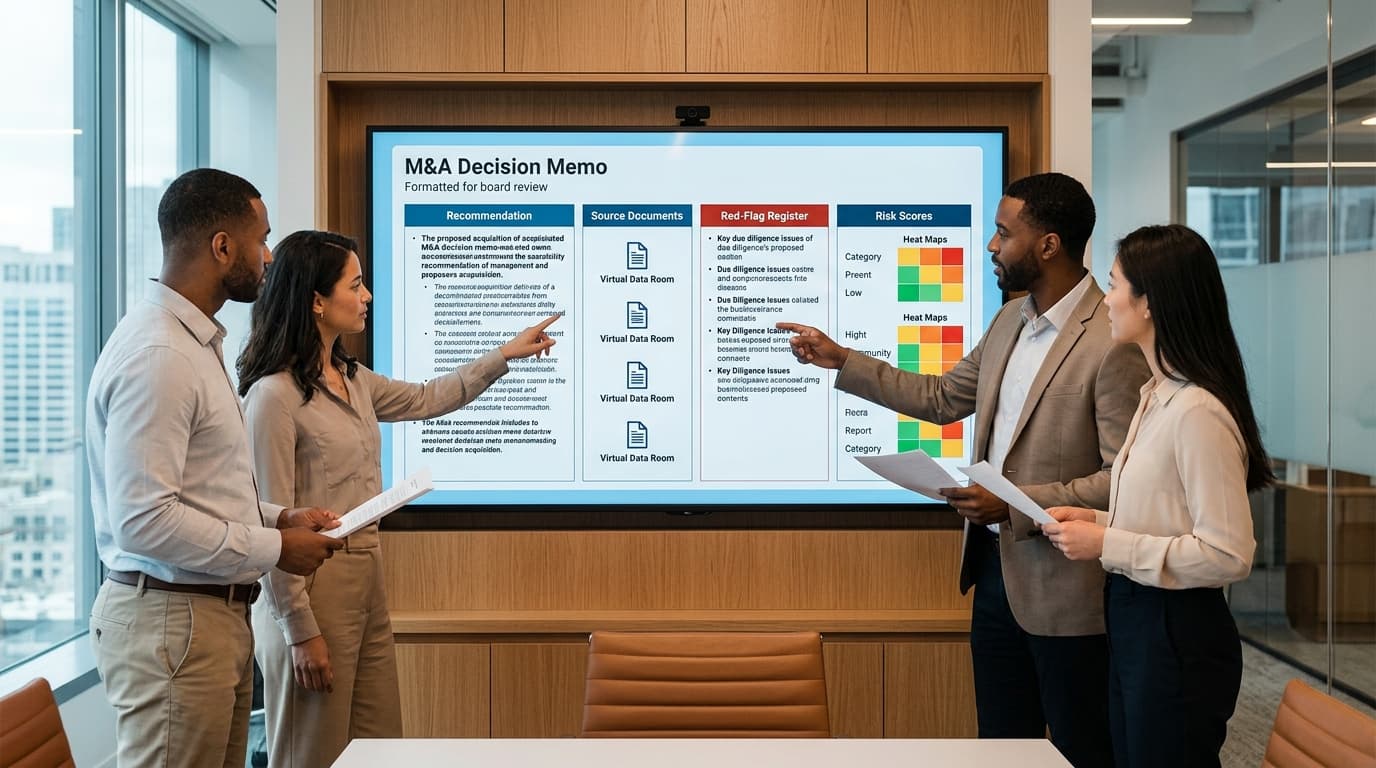
- Investment Committee Memo Framing: Translating technical, commercial, and financial findings into clear trade-offs, structured valuation adjustments, and actionable negotiation points, as covered in modern IC memo preparation.
Consulting Workflow Checklist
Advisory practices can execute a modern, AI-supported diligence engagement by following a structured seven-step operational framework:
- Phase 1: Deal Scoping and Parameter Setup. Establish diligence scope, key hypothesis criteria, and materiality thresholds before data room access begins.
- Phase 2: Automated Data Ingestion. Ingest target virtual data rooms into specialized diligence software to index contracts, spreadsheets, and board decks.
- Phase 3: Automated Extraction and Baseline Audits. Run automated extraction routines to catalog key contract covenants, revenue schedules, and compliance certifications.
- Phase 4: Risk Tagging and Anomaly Triangulation. Surface variance across financial statements, red flag concentrations, and conflicting disclosure points into a consolidated register via modern AI diligence workflow automation.
- Phase 5: Primary Expert and Management Interviews. Conduct targeted interviews with management, suppliers, and industry specialists to probe edge cases identified during automated scans.
- Phase 6: Expert Validation and Synthesis. Senior advisors review all surfaced anomalies against deal context, filtering out false positives and quantifying true financial impact.
- Phase 7: Deliverable Structuring and IC Memo Hand-off. Draft the final commercial due diligence deliverable with complete source traceability, presenting clear findings to the investment committee.
Executing this seven-step process ensures consistent analytical coverage across every transaction workstream without increasing headcount.
Red flags or common mistakes
Integrating AI into diligence advisory requires strict quality controls. Firms that implement artificial intelligence carelessly often encounter three common failure modes:
Relying on General-Purpose AI for Structured Financials
Off-the-shelf consumer chatbots and general large language models are poorly suited for complex balance sheet reconciliation and transaction accounting. Generic AI tools frequently misread multi-tab spreadsheets and invent plausible-sounding metrics when cell structures vary. In practice, using non-specialized AI for structured accounting data can require three hours of manual cleaning per report just to correct formatting errors and calculation drift.
Data Confidentiality and Non-Public Information Breaches
Feeding proprietary transaction materials or unredacted customer contracts into public cloud tools creates severe compliance exposures. M&A advisors are bound by strict non-disclosure agreements and regulatory guidelines. Diligence workflows must operate within isolated, enterprise-grade environments with strict access controls and zero model-training on customer data.
Unverified Hallucinations and Uncited Claims
Presenting ungrounded AI summaries to an investment committee or corporate buyer destroys advisory credibility. Automated risk registers must never present unverified assertions; every identified finding must carry a direct link back to its exact document page and paragraph, ensuring auditability as outlined in risk register automation.
| Common Diligence Pitfall | Underlying Root Cause | Advisory Safeguard |
|---|---|---|
| Hallucinated contract clauses | Using generic LLMs without document grounding | Require citation-linked platforms with direct source page previews |
| Data leakage risks | Pasting VDR documents into consumer web apps | Deploy enterprise software with strict data tenancy and zero data retention for training |
| Excessive data cleanup time | Using text-only models on complex tabular accounting data | Employ specialized ingestion engines built for multi-format financial parsing |
| Ignored edge-case risks | Relying on high-level summaries without human validation | Mandate human sign-off on all material red flags prior to client delivery |
How Plausity supports the workflow
Plausity provides purpose-built AI infrastructure designed specifically for private equity deal teams, M&A advisors, and corporate development professionals. Rather than replacing the consultant's strategic role, it acts as the structural software layer that accelerates document processing and organizes deal evidence.
The platform integrates several specialized tools to streamline the diligence lifecycle:
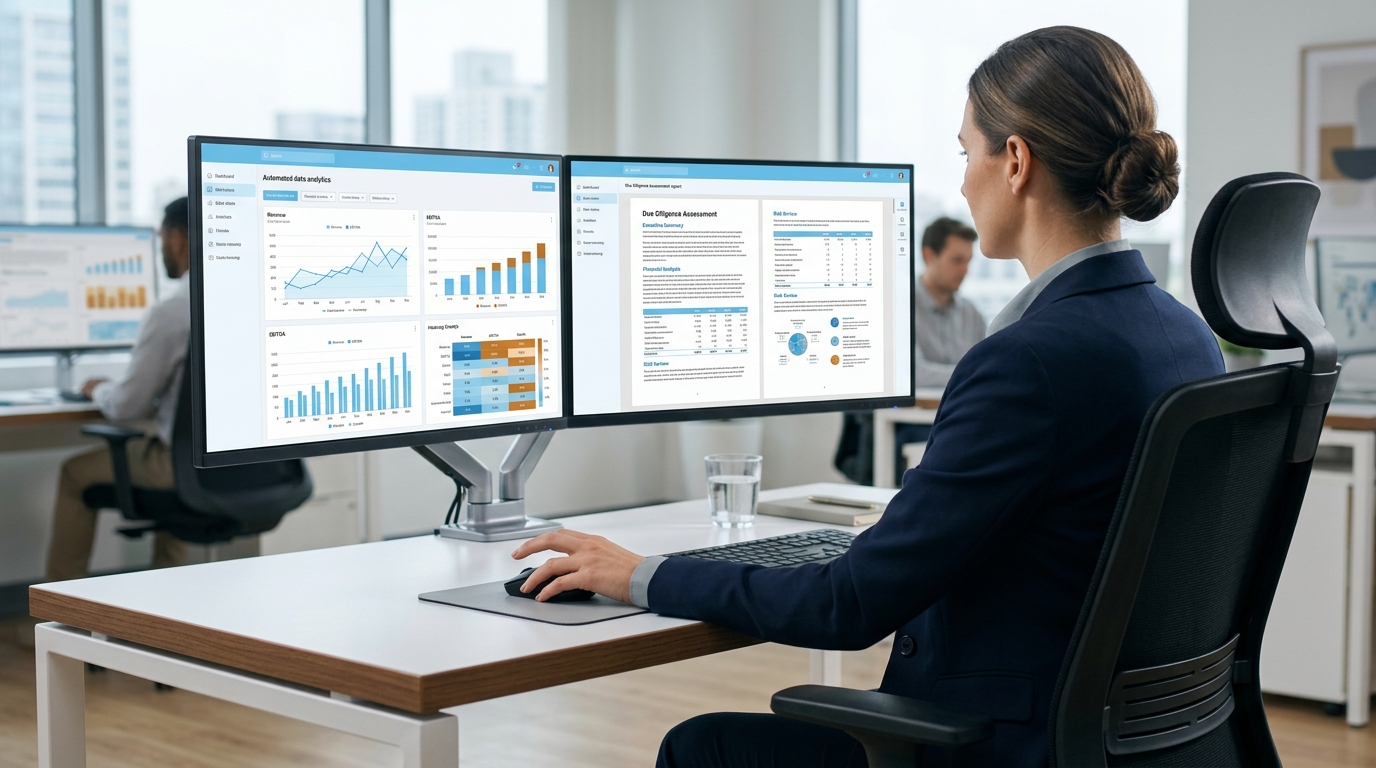
- Data Room Ingestion: Seamlessly connects to virtual data rooms, processing PDFs, financial models, board presentations, and contracts within minutes.
- AI-Analysis Engine: Reads, cross-references, and reasons across thousands of transaction documents to identify discrepancies and extract critical clauses.
- Risk Radar: Evaluates findings based on materiality, financial impact, and legal exposure, organizing red flags into an actionable dashboard for expert review.
- Report Builder: Assists advisory teams in structuring professional, audit-proof deliverables with automatic source traceability for every cited data point.
- Collaboration Hub: Aligns multi-disciplinary deal teams in a centralized workspace to coordinate workstreams in real time.
By handling mechanical extraction and risk clustering, this kind of platform enables advisory firms to maintain audit-proof diligence standards across heavy deal volumes while keeping human expertise firmly in control.
How to use this in your next diligence workflow
As transaction timelines tighten and data room volumes expand, relying solely on manual document review or generic consumer AI creates unacceptable operational risk. Advisory firms that scale successfully in 2026 combine deep sector expertise with purpose-built diligence software.
To modernize your advisory practice, evaluate your current workflow across each transaction phase. Replace manual transcript reading and repetitive spreadsheet tagging with automated ingestion, and ensure every finding presented to your investment committee is backed by direct source citations. Discover how due diligence advisory teams use specialized intelligence platforms to accelerate deal execution, protect engagement margins, and deliver defensible recommendations.