The 2026 M&A Landscape: Megadeals Rebound While the Mid-Market Remains Selective
- Global M&A value increased 36% globally, driven by a resurgence of megadeals including 39 transactions worth over $10 billion.
- The mid-market remains highly selective, prioritizing strong operational fundamentals and transparent valuation models.
- Regulatory scrutiny is tightening, marked by the European Commission's Foreign Subsidies Regulation guidelines on 9 January 2026.
- AI infrastructure has emerged as a top deal magnet, with buyers treating data centers as compute-first assets rather than real estate.
The global mergers and acquisitions landscape in 2026 exhibits a stark divergence between multi-billion dollar consolidations and cautious, highly selective mid-market transactions. Total global deal value has experienced a sharp rebound, surging by 36% compared to the previous year, driven primarily by large-scale consolidations. This recovery highlights renewed corporate confidence, with enterprises pursuing scale and market leadership through substantial capital deployments.
A primary catalyst for this rebound is the return of the megadeal. In the market leading into 2026, there were 39 separate transactions exceeding the 10 billion dollar threshold. For corporate M&A project leads and M&A advisory partners, managing these massive consolidations presents severe logistical hurdles. The sheer volume of corporate records, contracts, and compliance history requires advanced technology to ingest and analyze. Deal teams increasingly rely on systems like Plausity’s Data Room Ingestion to seamlessly process thousands of multi-format documents and spreadsheets within minutes.
The Selective Mid-Market: Prioritizing Stability Over Growth
While megadeals capture major headlines, the middle market behaves quite differently, remaining highly selective. Private equity professionals and corporate buyers are no longer willing to pay high valuation premiums based on speculative future growth. Instead, mid-market buyouts and strategic acquisitions in 2026 focus strictly on target companies that exhibit proven profitability, clear valuation alignment, and robust operational health. This risk-averse stance ensures that transactions are only completed when a target’s underlying fundamentals are fully verified.
- Proven profitability: Buyers demand a track record of stable EBITDA margins and recurring cash flow rather than optimistic projections.
- Valuation alignment: Transactions require highly realistic pricing models to bridge the gap between buyer caution and seller expectations.
- Operational health: Compliance history, supply chain dependencies, and IT infrastructure must be clean and fully documented.
- Risk transparency: Targets must actively identify and mitigate compliance vulnerabilities before inviting due diligence teams.
This intense mid-market scrutiny lengthens due diligence timelines and increases the depth of investigation required. To maintain deal momentum without compromising on risk detection, investment professionals automate core aspects of their review. For instance, Plausity’s Risk Radar automatically identifies and evaluates findings based on legal exposure and deal relevance, helping analysts surface critical liabilities in complex mid-market portfolios as part of their financial due diligence workflow.
| Segment | 2026 Market Dynamics | Strategic Focus Areas | Diligence Mandate |
|---|---|---|---|
| Megadeals (over 10 billion dollars) | Sharp rebound in transaction volume and capital deployment driven by scale consolidations | Market leadership, technology absorption, and cross-border commercial synergies | Broad multi-workstream integration and extensive regulatory review planning |
| Mid-Market Transactions | High selectivity and cautious valuation multiples, with slower overall deal cycles | EBITDA preservation, immediate operational stability, and low risk profiles | Granular verification of contracts, compliance history, and operational liabilities |
Ultimately, both megadeals and mid-market transactions in 2026 demand a highly rigorous approach to data verification. Relying on manual sampling of data rooms is no longer sufficient when buyers require complete confidence in their findings. Employing an AI-native due diligence platform allows transaction teams to cross-reference thousands of documents, ensuring that every finding is traceable and fully verified.
The Regulatory Bottleneck: Managing Elongated Timelines and Complex Enforcement
The anticipated rebound of global mergers and acquisitions in 2026 brings a complex paradox. While a surge in megadeals has reenergized the upper tiers of the market, mid-market transactions remain highly selective. This environment of heightened deal scrutiny is compounded by unprecedented regulatory headwinds. A major driver of this friction is the European Commission's adoption of formal Foreign Subsidies Regulation guidelines on 9 January 2026, which signals a new era of proactive and wide-reaching enforcement. As regulatory bodies worldwide coordinate to oversee market concentration and foreign capital, transaction teams are witnessing a dramatic shift in regulatory scrutiny M&A timelines.
Substantive Hurdles Under the FSR Guidelines
The FSR guidelines published in January 2026 clarify how the European Commission intends to evaluate market distortions and deploy its call-in powers for transactions that sit below standard filing thresholds. Under this framework, the cross-subsidisation test remains expansive. A foreign subsidy can be deemed to distort the internal market if it improves the competitive position of any entity operating in the European Union, even if the subsidy was not specifically targeted at the European market. This means that non-targeted grants or state incentives received by a global parent organization can suddenly delay a regional transaction, demanding immediate, deep-level regulatory reviews.
For corporate M&A project leads and advisory teams, this means that regulatory compliance cannot be treated as a checkbox exercise near closing. It requires an extensive, continuous review of international subsidy records, state grants, and corporate financing from the very beginning. Undertaking rigorous organisation and compliance due diligence early in the deal cycle is now essential to avoid sudden, regulatory-induced transaction freezes.
Operationalizing Compliance Audits with AI-Native Diligence
To navigate these complex regulatory landscapes without stalling momentum, transaction teams must leverage advanced platforms that automate document analysis. By utilizing the AI-Analysis Engine to ingest and map vast corporate datasets, deal professionals can rapidly cross-reference potential regulatory triggers. Combined with specialized findings and risk intelligence features, teams can deploy the Risk Radar to systematically scan contracts, financial models, and subsidy disclosures for exposure areas. This targeted approach transforms how M&A advisory firm partners assess risks, turning a historically manual review of cross-border subsidies into a highly automated process.
- Targeted Subsidies: Direct state funding, tax benefits, or regional grants that directly support European operations or commercial licensing.
- Non-Targeted Subsidies: General corporate funding or incentives received outside the EU that could be interpreted as cross-subsidizing EU activities.
- Below-Threshold Call-In Risk: Discretionary powers that allow the European Commission to investigate smaller transactions based on localized competitive advantages.
- Traceable Data Audits: The absolute requirement for deal teams to link every declared subsidy and regulatory finding back to its primary source document.
Ultimately, managing the regulatory bottleneck requires a fundamental shift in deal execution. By initiating Data Room Ingestion at the earliest possible stage, deal teams can seamlessly upload and structure critical data room files. Rather than reacting to unexpected information requests from regulators, buyers can build a highly traceable compliance file upfront. This proactive preparation ensures that advisory teams can draft comprehensive reports using the Report Builder and collaborate in real-time via the Collaboration Hub, ultimately keeping transactions on track despite an increasingly complex and elongated enforcement environment.
AI Infrastructure and Data Centers: The Multi-Billion-Dollar Deal Magnets
As the global transaction market recalibrates in 2026, technology acquisitions are transitioning into a highly industrial phase. Rather than chasing pure-play software, investor demand is overwhelmingly concentrated on physical digital infrastructure, specifically semiconductors, advanced hardware, and data center assets. This shift is transforming how these assets are evaluated. Data centers are no longer treated as standard real estate holdings; instead, they are valued as compute-first platforms where the underlying power supply and cooling capacity serve as the primary drivers of equity value.
The primary operational bottleneck for data center growth in 2026 is energy. Indeed, AlixPartners reports that 70% of market participants expect data center mergers and acquisitions to accelerate, with a hyper-focus on securing guaranteed power and minimizing latency. Deal teams evaluating these targets face highly complex workstreams that span Power Purchase Agreements (PPAs), grid-connection queues, hardware scalability limits, and increasingly stringent regional environmental regulations. A typical transaction requires auditing thousands of pages of utility contracts, municipal zoning permits, and fuel supply agreements to verify that the facility can support next-generation high-density compute clusters.
| Diligence Domain | Critical Technical & Legal Risks | Key Diligence Objectives |
|---|---|---|
| Power and Grid Access | Grid connection queues, PPA contract structures, and power price volatility. | Verify long-term energy self-sufficiency and contract terms. |
| Environmental & Zoning | Localized emissions caps, noise ordinances, and water cooling restrictions. | Ensure alignment with municipal zoning laws and regional decarbonization mandates. |
| Hardware Scalability | Legacy cooling setups, floor load limits, and rack density limitations. | Assess readiness for liquid-cooling retrofits and high-density GPU clusters. |
Streamlining Digital Infrastructure Audits with AI-Native Due Diligence
Managing these massive multidisciplinary audits requires a modernized approach to document analysis. Traditional manual sampling fails when processing the sheer volume of technical schematics, supply contracts, and regulatory filings typical of a modern digital infrastructure asset. This is where an AI-native platform becomes essential. Corporate M&A project leads and advisory partners can leverage tools designed for private equity targets to run parallel audits across technical, financial, and legal workstreams. By utilizing Data Room Ingestion, deal teams can seamlessly upload and parse massive virtual data rooms containing heavy technical documentation, including PDFs, electrical grid schematics, and complex spreadsheets, in a matter of minutes.
Once the data is ingested, the AI-Analysis Engine reads and cross-references thousands of data points to evaluate structural liabilities. Rather than relying on simple keyword searches, the platform runs deep semantic reasoning to uncover hidden risks, such as restrictive zoning covenants or environmental compliance gaps. Identifying these issues early is critical for compliance due diligence as localized environmental regulations become stricter in 2026. When potential legal exposures or grid anomalies are flagged, the Risk Radar categorizes findings based on materiality and transaction relevance, while ensuring that every single observation remains directly traceable to its specific paragraph in the source documentation risk intelligence.
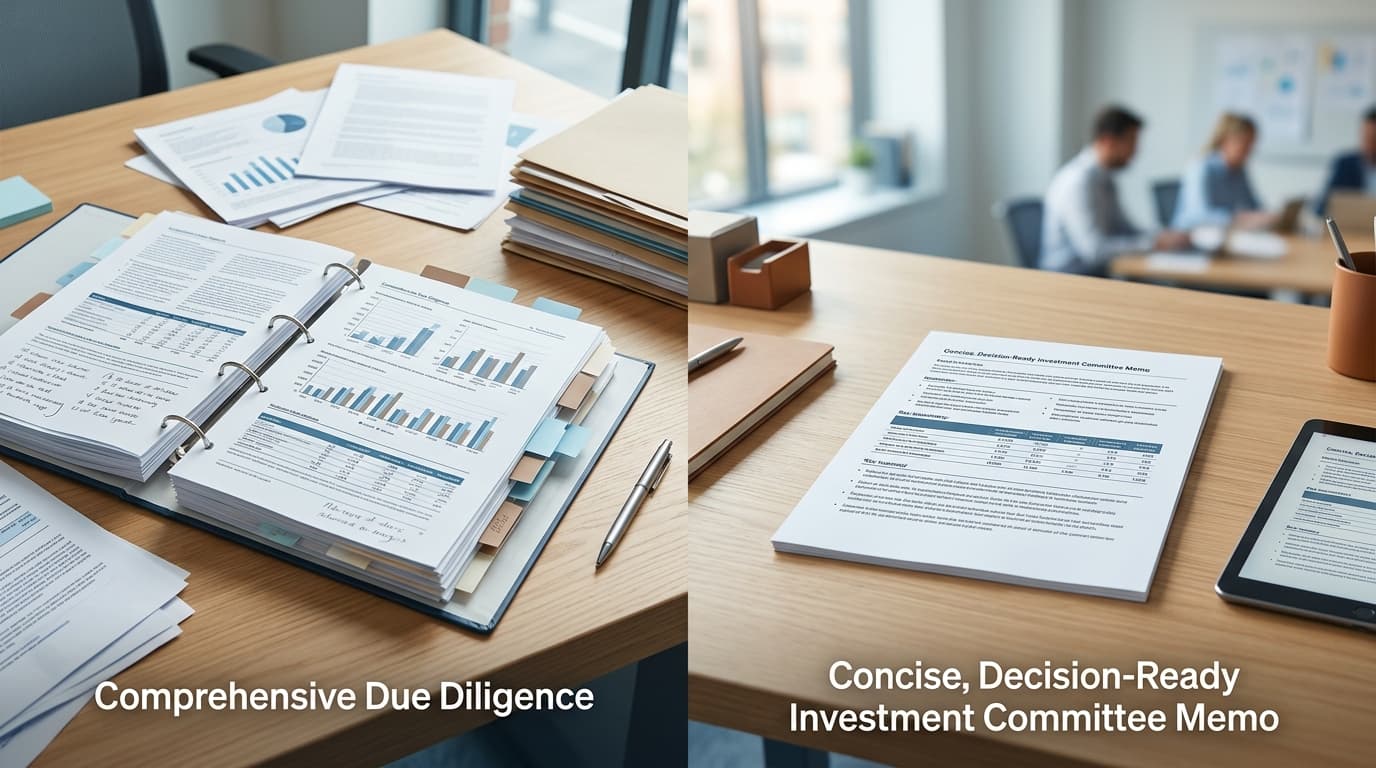
To close the loop, the Report Builder automatically structures the identified findings into professional, investor-ready reports, ensuring that advisory teams can quickly present verifiable risk profiles to investment committees. In an era where power availability and regulatory compliance dictate the viability of multi-billion-dollar megadeals, the ability to rapidly verify operational constraints is the ultimate competitive advantage for modern deal professionals.
Redefining Due Diligence: Deploying AI-Analysis Engine and Risk Radar
As global M&A rebounds with a surge in megadeals and high mid-market selectivity, transaction complexity has scaled exponentially. Managing these multi-workstream processes requires an AI-native platform that can process vast quantities of document data simultaneously. Traditional, manual sample-based diligence is no longer sufficient when deal cycles are compressing. McKinsey research indicates that generative AI is transforming M&A by speeding up deal cycles by 10% to 30% and reducing transaction costs by up to 20%. For private equity firms and strategic buyers, this shift requires a complete restructuring of how information is digested and evaluated.
Accelerating Ingestion in Complex Megadeals
In large-scale transactions, corporate M&A project leads often face thousands of contracts, compliance records, and historical files scattered across virtual data rooms. Deploying Plausity's AI-Analysis Engine allows deal teams to accelerate this critical initial phase. Rather than manually indexing files, the platform handles multi-format ingestion across entire portfolios, extracting key clauses, financial metrics, and operational structures in a fraction of the traditional timeframe. This systematic ingestion establishes a unified source of truth, enabling legal and financial analysts to move from basic reading to high-level strategic reasoning almost immediately.
Uncovering Liabilities and Regulatory Exposures
As regulatory scrutiny over M&A timelines increases, identifying compliance risks early is paramount. By utilizing Plausity's Risk Radar, deal teams can systematically scan ingested data for hidden liabilities, regulatory exposures, and financial inconsistencies. Whether evaluating potential antitrust issues, intellectual property disputes, or complex data privacy obligations, the tool flags critical risks based on materiality and transaction relevance. Rather than relying on static checklists, advisory partners and analysts can rapidly isolate material anomalies across thousands of folders, ensuring that no regulatory hurdle catches the buyer by surprise.
- End-to-end document tracing that links every analytical finding back to its exact page in the source document, providing complete transparency for advisory teams.
- Multi-workstream analysis that processes legal, commercial, and financial documents simultaneously to detect cross-functional risks.
- Real-time risk scoring through Risk Radar, which highlights anomalies based on customizable materiality thresholds.
- Automated structural extraction by the AI-Analysis Engine, mapping complex corporate hierarchies and historical contracts within minutes.
Ultimately, the goal of modern due diligence is not just to collect data, but to surface actionable risk intelligence before a transaction is finalized. By combining rapid document processing with precise risk flagging, deal professionals can confidently navigate the selective mid-market and complex megadeal landscapes. Deploying these advanced tools ensures that legal and corporate development teams can meet shortened transaction timelines without sacrificing analytical depth or deal security.
Streamlining Transaction Delivery: Ingestion, Reporting, and Collaborative Hubs
In a polarized transaction landscape where megadeals command immense capital while mid-market transactions face rigorous selection, deal velocity serves as a vital competitive differentiator. For private equity professionals and advisory firms, administrative friction during the early stages of a transaction directly translates to increased execution risk. According to industry analysis, if megadeals continue at their current pace, 2026 has the potential to be the strongest year for deals over $5 billion since 2021, amplifying the administrative burden on lean transaction teams. Managing this volume requires moving beyond manual data collation toward systemic automation that accelerates transaction delivery without compromising diligence standards.
Automated Data Rooms and Direct Document Traceability
Modern diligence platforms like Plausity address these delivery bottlenecks by replacing disconnected manual steps with unified digital workflows. By employing Data Room Ingestion, transaction teams can immediately connect to and scan complex virtual data rooms, processing high volumes of PDFs, spreadsheets, and contracts within minutes. This rapid intake feeds the core AI-Analysis Engine, which reads and cross-references thousands of data points simultaneously. For corporate M&A leaders and M&A advisory firm partners, this automated flow guarantees that no critical document or obscure clause is overlooked in the initial rush.
- Data Room Ingestion: Secures immediate access and processes multi-format documents, including legal agreements and complex financial models, in minutes.
- Report Builder: Automates the generation and formatting of professional, investor-ready diligence reports and advisory outputs.
- Collaboration Hub: Provides a shared workspace that allows deal teams, legal experts, and corporate leads to coordinate workstreams in real time.
- AI-Analysis Engine: Executes deep thematic reasoning across thousands of files, ensuring complete document traceability back to the original source.
Eliminating Friction in Report Drafting and Advisory Workflows
The final phase of any diligence process often introduces significant delays as teams struggle to compile findings into coherent advisory outputs. Through the Report Builder, users can automatically structure and draft polished, investor-ready reports, significantly reducing the manual drafting cycle. Crucially, the platform preserves complete traceability, linking every quantitative finding or highlighted risk back to its precise source document. When questions arise during final negotiations, team members can collaborate inside the Collaboration Hub to quickly trace findings, resolve anomalies, and maintain momentum. In selective markets, this seamless transition from raw ingestion to verified reporting ensures that transaction delivery remains flawless.