1. Connecting Commercial, Customer, and Revenue Diligence
- Siloed due diligence often hides critical liabilities where commercial, financial, and legal findings overlap.
- Analysis shows that 92 percent of private mergers incorporate a purchase price adjustment mechanism to protect buyer capital.
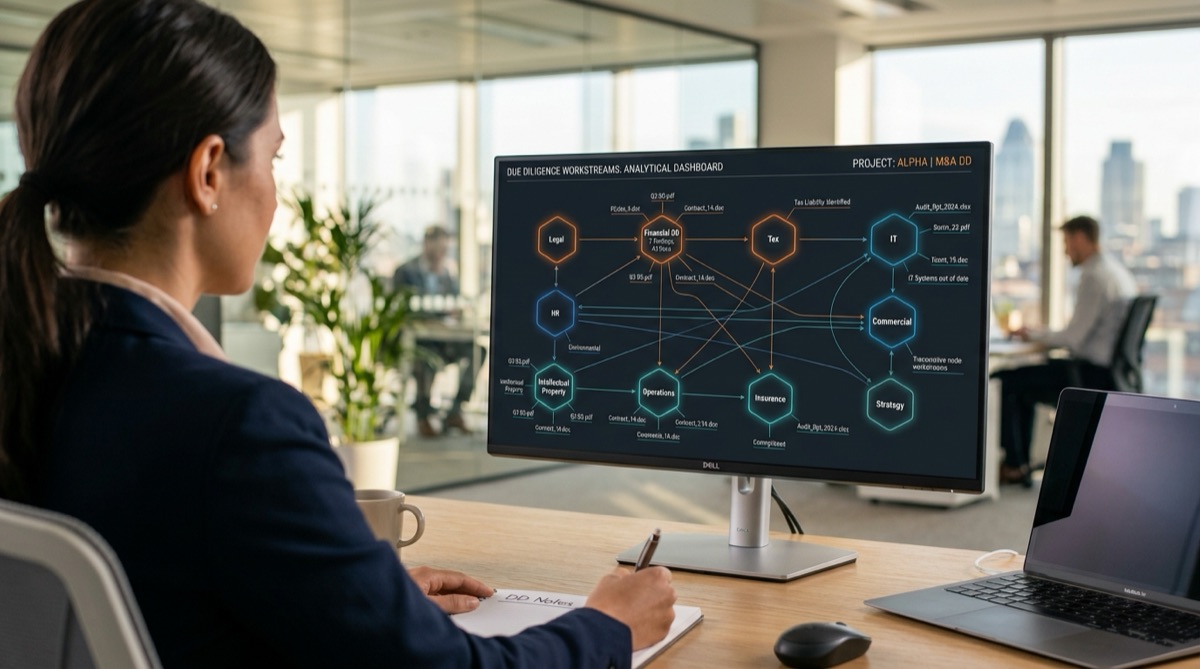
- Connecting all 12 due diligence workstreams under a single digital ledger prevents post-close integration surprises.
In complex mergers and acquisitions, executing commercial diligence, customer diligence, and revenue diligence in isolated silos introduces significant transactional risk. To accurately validate a target company's growth trajectory and defend an investment thesis, deal teams must integrate these three assessments into a unified analysis rather than treating them as separate exercises. When these processes are fragmented, market-level projections can become completely disconnected from actual subscriber retention rates and granular contract terms, leading to overvaluations or missed liabilities.
Plausity helps deal teams overcome these traditional silos by automating the cross-referencing process. By leveraging the AI-Analysis Engine, analysts can ingest thousands of customer agreements, historical pipeline records, and third-party market reports. This allows teams to instantly verify whether the optimistic projections highlighted in commercial diligence are grounded in the actual recurring revenue schedules analyzed during revenue diligence and the real-world customer retention rates verified in customer diligence.
Bridging the Gap Between Market Potential and Contract Reality
A primary challenge for VC & PE Fund Investment Professionals is verifying that a target company's asserted customer lifetime value (LTV) and revenue stability are legally and financially sound. Without rigorous verification, critical issues like high customer concentration or restrictive change-of-control clauses can easily pass unnoticed. Plausity's Risk Radar mitigates this risk by scanning data rooms via the Data Room Ingestion tool and flagging discrepancies between high-level sales decks and legally binding contract realities. This direct source traceability gives VC and PE firms full confidence in their underwriting assumptions.
| Workstream | Primary Deal Objective | Key Data Interdependencies |
|---|---|---|
| Commercial Diligence | Evaluate total addressable market size, competitive positioning, and macro growth drivers. | Provides the market-level demand benchmarks used to test the target company's pipeline assumptions. |
| Customer Diligence | Analyze customer acquisition costs, historical retention rates, satisfaction, and concentration risks. | Grounds high-level commercial growth projections in historical buyer behavior and verified retention metrics. |
| Revenue Diligence | Reconcile contract terms, pricing models, billing schedules, and recurring revenue streams. | Ensures commercial growth models match legally binding commitments and recurring revenue realities. |
Once these commercial, customer, and revenue inputs are aligned, they serve as the foundational dataset for the rest of the transaction. For instance, verified contract values feed directly into financial diligence, including quality of earnings analysis, and purchase price adjustment diligence, while customer agreements inform legal diligence, tax diligence, and antitrust diligence. Simultaneously, the target's broader operational framework is evaluated, with tech diligence and cybersecurity diligence running in parallel with ESG diligence and operational diligence to provide a complete risk assessment. Instead of compiling fragmented findings, deal teams can use Plausity's Report Builder to automatically generate a cohesive, investor-ready report with full source traceability across every workstream, keeping transaction velocity high without compromising analytical depth.
2. Verifying financial integrity with Financial and Tax Diligence
A comprehensive transaction requires seamless synchronization across twelve distinct workstreams: commercial diligence, financial diligence (including a meticulous quality of earnings review), legal diligence, tax diligence, tech diligence, cybersecurity diligence, ESG diligence, operational diligence, antitrust diligence, purchase price adjustment, and customer/revenue diligence. In legacy M&A environments, executing these assessments in manual silos creates critical blind spots. Coordinating all twelve disciplines under a single AI-native platform provides deal teams, including Corporate M&A Project Leads and PE investors, with full auditability and trace-to-source risk verification.
The core of establishing a clean financial baseline lies in executing meticulous financial diligence. Deal teams inspect historical ledger files, trial balances, and revenue sub-ledgers to verify that reported earnings reflect actual economic reality rather than aggressive accounting choices. This baseline is pressure-tested via a rigorous quality of earnings review, which strips away non-recurring items, normalization adjustments, and out-of-period transactions to arrive at a verified Adjusted EBITDA.
Parallel to the financial assessment, a comprehensive tax diligence workstream inspects corporate tax structures, transfer pricing agreements, and historic domestic or international tax liabilities. These tax findings are directly linked to the financial findings, as tax liabilities often impact the final net debt calculations. Ultimately, these combined financial and tax insights prevent costly surprises and lay the foundation for a precise, legally binding purchase price adjustment mechanism.
Integrated Analysis and Risk Identification
To streamline these complex workstreams, M&A deal teams rely on advanced tools. Using Plausity's AI-Analysis Engine and Risk Radar, users can instantly ingest bulk financial files via Data Room Ingestion and scan for inconsistencies. The platform automatically flags how adjustments in one workstream, such as a capital expense adjustment in financial diligence, affect liability exposures in tax diligence. Every identified risk is cross-referenced and linked directly back to its source document in the virtual data room, guaranteeing complete traceability and a faster route to transaction finalization.
| Workstream | Primary Focal Areas | Critical Risk Flags Checked |
|---|---|---|
| financial diligence | Trial balance validation, working capital requirements, and debt-like item definition. | Revenue recognition anomalies, unrecorded liabilities, and overstated assets. |
| quality of earnings | EBITDA normalization, cash-to-accrual conversions, and customer concentration impact. | Aggressive capitalization of expenses, out-of-period transactions, and non-recurring revenue spikes. |
| tax diligence | Historical corporate tax returns, transfer pricing, VAT compliance, and state nexus reviews. | Undisclosed tax exposures, transfer pricing misalignment, and outstanding tax audits. |
| purchase price adjustment | Working capital pegs, net debt definitions, earn-out structures, and post-closing settlement rules. | Uncapped working capital volatility and ambiguous cash-free/debt-free definitions. |
3. Protecting Structural Assets: Legal and Antitrust Diligence
In an increasingly complex regulatory environment, protecting structural assets before signing is vital for transaction success. Executing comprehensive legal diligence and antitrust diligence ensures that buyers are shielded from catastrophic post-close litigation and regulatory hurdles. This protection is especially critical in large-scale acquisitions, where megadeals over 5 billion dollars represented over 73 percent of strategic tech transaction value according to recent market research. Failing to uncover restrictive change-of-control clauses, IP encumbrances, or market concentration barriers can derail even the most promising transaction.
Traditional corporate transactions suffer from manual due diligence silos, where legal counsel, financial analysts, and operational consultants work in isolation. This separation creates massive risk, particularly when legal liabilities intersect with financial realities or technical commitments. Managing these interconnected risks requires coordinating all 12 major workstreams under a single AI-native platform, ensuring full auditability and trace-to-source risk verification. By leveraging Plausity's Findings & Risk Intelligence capability, deal teams can map contractual exposure directly to financial models, uncovering hidden liabilities that would otherwise disrupt purchase price adjustment diligence.
Unifying Multi-Workstream Analysis
With Plausity's AI-Analysis Engine, legal and advisory teams no longer need to manually parse thousands of corporate documents. Immediately after Data Room Ingestion, the core platform processes contracts, licensing agreements, and litigation histories. From there, Risk Radar identifies, flags, and categorizes potential exposures based on their materiality, legal exposure, and transaction relevance. Crucially, Plausity's AI-native due diligence platform links every automated finding directly back to its exact source document, giving VC & PE Fund Investment Professionals, M&A Advisory Firm Partners & Analysts, and Corporate M&A Project Leads total traceability and confidence during intense deal negotiations.
| Diligence Focus Area | Siloed Manual Approach | Integrated AI-Native Platform Approach |
|---|---|---|
| Contractual Risk Detection | Manual sampling of agreements; high risk of missing change-of-control, non-compete, or IP encumbrances. | Automated document scanning via AI-Analysis Engine with 100% contract coverage and trace-to-source verification. |
| Antitrust & Market Analysis | Antitrust diligence conducted in isolation from commercial diligence and customer/revenue diligence insights. | Cross-workstream mapping to evaluate market concentration barriers and customer concentration risks simultaneously. |
| Report Generation | Advisors spend days manually assembling and cross-referencing legal findings into word processor files. | Automated generation of professional, investor-ready reports with Report Builder, linking finding to source document. |
By bridging these workstreams, deal teams can seamlessly transition from legal and antitrust analysis to adjacent evaluations like cybersecurity diligence, tech diligence, or commercial diligence. This holistic, interconnected process ensures that no critical contract term, regulatory barrier, or security exposure remains hidden, allowing M&A professionals to negotiate from a position of absolute data clarity.
4. Managing Technical Debt via Tech and Cybersecurity Diligence
Evaluating software architecture and security is vital for risk mitigation in modern M&A transactions. Rather than evaluating technology in a silo, strategic buyers are increasingly integrating tech diligence and cybersecurity diligence into their wider review of target companies. This approach helps transaction teams identify hidden operational bottlenecks, insecure coding practices, and open-source license violations before the transaction closes, preventing unexpected remediation expenses after the deal is completed.
Unchecked technical debt acts as a hidden tax on post-acquisition growth, slowing down product integration and scaling initiatives. According to industry research, global dealmakers frequently uncover significant cybersecurity liabilities and architectural weaknesses during the diligence phase, which can directly affect valuation and integration timelines. For instance, inheriting a legacy system with unpatched network vulnerabilities or complex, undocumented software architectures can expose an acquirer to severe operational disruption and potential data breaches.
| Diligence Workstream | Primary Assessment Target | Key Material Exposure |
|---|---|---|
| Tech Diligence | Software code quality, structural system architecture, open-source compliance, and engineering team capacity. | High maintenance costs, inability to scale the platform, and intellectual property infringement disputes. |
| Cybersecurity Diligence | Active network vulnerabilities, historic data breaches, identity access controls, and compliance with data privacy standards. | Substantial regulatory fines, post-merger integration delays, and immediate exposure to security breaches. |
To streamline these assessments, deal teams are moving away from manual, spreadsheet-driven processes that create critical blindspots. By utilizing Plausity's Data Room Ingestion, M&A advisory firm partners and corporate M&A project leads can rapidly upload technical manuals, third-party software audits, and cybersecurity policies from virtual data rooms. Plausity's core AI-Analysis Engine then processes these complex files, enabling seamless evaluation across both the tech diligence and cybersecurity diligence workflows.
Once the files are ingested, the platform's Risk Radar automatically identifies and flags potential anomalies, such as restrictive open-source licenses or inadequate vulnerability management protocols. This system links every identified vulnerability directly back to its source document in the virtual data room. This complete trace-to-source verification provides M&A project leads with the precise, auditable insights needed to negotiate purchase price adjustments or draft robust post-merger integration roadmaps.
5. Operational Diligence and ESG Diligence for Long-Term Viability
Evaluating physical workflows and governance metrics reveals deep operational dependencies that traditional manual reviews often overlook. For private equity investors and advisory teams, silos between operational diligence and ESG diligence can result in severe blindspots, hiding critical supply chain fragilities or latent environmental liabilities. When deal teams run these assessments in isolation, they fail to see how a target company's carbon footprint, waste management, or manufacturing constraints interact with its long-term commercial potential. Coordinating these assessments on an AI-native platform allows investment professionals to run a comprehensive compliance due diligence process that maps environmental compliance directly to physical facility footprints.
Evaluating these workflows is critical because operational diligence directly influences other transaction workstreams. For instance, a target company's physical bottlenecks or supply chain vulnerabilities can undermine its projected customer/revenue diligence forecasts. If a plant operates at maximum capacity, the target cannot fulfill the aggressive sales expansion assumed in the commercial diligence files without significant capital expenditure. Furthermore, the operational cost structure directly affects financial diligence findings, including the quality of earnings. When machinery requires immediate upgrades to remain operational, those costs must be factored into the transaction model, directly impacting the final valuation and negotiating stance.
Similarly, ESG diligence has evolved from a secondary compliance checkbox into a critical value-preservation mechanism. A global survey of 115 dealmakers conducted by Boston Consulting Group and Gibson Dunn found that conducting ESG due diligence can protect up to 10 percent of a deal's value, with 66 percent of M&A professionals engaging on ESG topics during transactions. These findings are particularly acute under emerging regulatory frameworks such as the European Union's Corporate Sustainability Due Diligence Directive, where compliance failures can lead to substantial fines. By evaluating a target's governance, environmental impact, and workforce policies, dealmakers identify risks that directly influence legal diligence and tax diligence, such as pending carbon taxes or employee safety litigation.
- Regulatory compliance gaps: assessing pending ESG compliance alignments, carbon tax exposure, and local zoning laws across all facilities.
- Physical asset constraints: identifying capacity bottlenecks, facility maintenance backlogs, and logistics network dependencies that affect output.
- Energy and emissions profiles: measuring greenhouse gas output, water usage, and waste processing efficiency at key manufacturing sites.
- Labor and supply chain resilience: evaluating supplier codes of conduct, modern slavery risks, and local workforce safety incidents.
To manage these interconnected risks, deal teams must break down traditional workstream silos. The Plausity AI-Analysis Engine processes thousands of pages of operational manifests, environmental impact reports, and supplier contracts, while Risk Radar flags cross-workstream vulnerabilities in real-time to provide automated risk intelligence. This end-to-end coverage ensures that operational and ESG findings inform other critical areas, including tech diligence, cybersecurity diligence, and antitrust diligence. For example, operational software vulnerabilities flagged in tech reviews or anti-competitive supply agreements highlighted in antitrust analyses are immediately cross-referenced. Ultimately, having this structured traceability ensures that every operational bottleneck and environmental liability is fully documented, providing the objective data needed to negotiate a precise purchase price adjustment before closing.
6. Refining Valuations: Purchase Price Adjustment Diligence
Aligning transaction terms with final balance sheet metrics is a critical mechanism to ensure fair pricing and prevent post-closing disputes. During private target acquisitions, deal teams perform purchase price adjustment diligence to manage working capital targets, net debt definitions, and escrow accounts. Historical market data from major transactions shows that 92 percent of private targets utilize these adjustments to protect deal value between the signing and closing dates. Failing to verify the underlying definitions and historical trends of a target company's working capital can lead to severe valuation leakage immediately after the transaction closes.
Manual due diligence silos create critical blindspots during complex corporate transactions. When information is restricted to isolated spreadsheets, teams often overlook how different risks interact. Coordinating all 12 major workstreams under a single AI-native platform provides deal teams with full auditability and trace-to-source risk verification. This integrated approach ensures that findings from commercial diligence, financial diligence, legal diligence, tax diligence, tech diligence, cybersecurity diligence, ESG diligence, operational diligence, antitrust diligence, and customer/revenue diligence are directly synthesized. In practice, purchase price adjustment diligence overlaps extensively with financial due diligence to analyze the quality of earnings, manage net debt pegs, and establish realistic working capital targets.
| Workstream Integration | Critical Link to Purchase Price Adjustments | Primary Source Documents |
|---|---|---|
| Financial diligence | Establishes the net debt and normalized working capital pegs that serve as the baseline for post-closing adjustments. | Trial balances, general ledgers, and audited financial statements. |
| Legal diligence | Verifies escrow mechanisms, indemnification caps, and representation limits in the stock purchase agreement. | Executed share purchase agreements, disclosure schedules, and escrow contracts. |
| Tax diligence | Identifies pre-closing tax liabilities and exposures that must be factored into the net debt or equity value calculations. | Tax returns, transfer pricing documentation, and tax audit correspondence. |
| Operational diligence | Surfaces deferred capital expenditure or hidden inventory liabilities that distort normalized working capital. | Asset registries, supply chain contracts, and maintenance logs. |
To streamline this complex analysis, Plausity integrates core platform features to automate document processing and cross-referencing. Using Data Room Ingestion, deal teams can rapidly scan and parse thousands of target company files, including historical balance sheets, ledger details, and SPA drafts. The AI-Analysis Engine then reasons over these documents, cross-referencing working capital definitions against historical actuals to flag discrepancies. This automated verification process is complemented by Risk Radar, which identifies and evaluates legal and financial exposures based on materiality, ensuring that potential purchase price leakage is surfaced early in the transaction life cycle.
For PE funds, M&A advisory firm partners, and corporate M&A project leads, having a unified source of truth is vital for drafting precise closing accounts and negotiating purchase price adjustment diligence terms. Rather than relying on fragmented email threads, teams utilize the Collaboration Hub to coordinate adjustments in real time. Once the final adjustments are validated, Report Builder automatically structures and drafts professional, investor-ready due diligence reports with complete source traceability, allowing deal professionals to defend their valuation adjustments with clear, cited evidence from the data room.