The Stakes of Deal Data: Why M&A Due Diligence Demands Bank-Grade Security
- A data breach carries a global average cost of 4.88 million USD, emphasizing the extreme financial risk of unsecure diligence platforms.
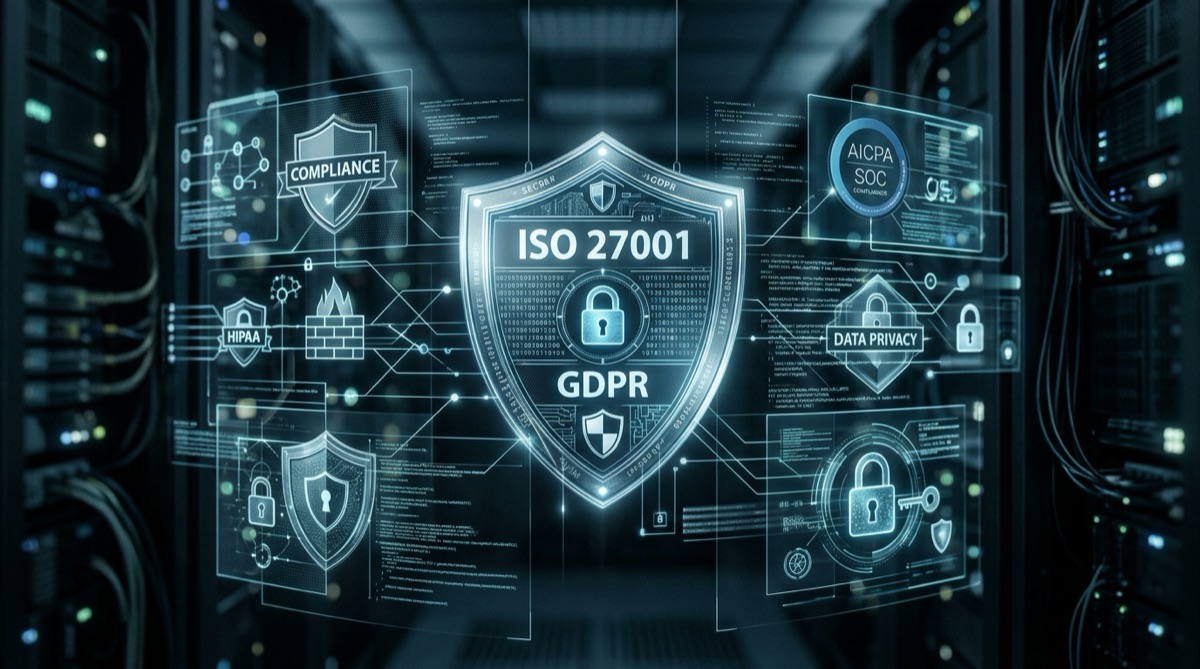
- ISO 27001 and SOC 2 Type II provide the foundational frameworks for information security and operational control verification.
- GDPR compliance requires strict containment of personally identifiable information during target analysis, using techniques like redaction.
- ISO 42001 defines the new benchmark for AI governance, ensuring transaction models are secure and do not leak proprietary deal data.
During corporate transactions, virtual data rooms aggregate the target company's most sensitive information: unredacted employment contracts, proprietary source code, detailed customer databases, and confidential forward-looking financial models. In this highly concentrated environment, data breaches represent an immediate threat to transaction value. According to the IBM Cost of a Data Breach Report, the global average cost of a data breach rose to 4.88 million USD in 2024, a 10 percent increase from the prior year. For private equity firms and corporate buyers, a leak of proprietary technology or customer lists during due diligence can completely erode the strategic advantage of an acquisition, leading to severe valuation adjustments or total deal collapse.
The Limitations of Traditional Virtual Data Rooms
Historically, traditional virtual data rooms served as passive document repositories, focusing primarily on basic access control and encrypted storage. However, modern deal environments require extensive analytical workflows, where data is downloaded, shared, and parsed by external AI applications. When investment professionals, advisory partners, and corporate M&A project leads use unverified tools to analyze deal materials, they expose sensitive data to fresh vulnerabilities. The risk shifts from simple storage security to active processing security: how the data is ingested, where it is cached, and whether the underlying AI models train on private transaction records.
This processing risk is particularly acute during the ingestion phase. Traditional systems lack the automated controls needed to identify and quarantine unredacted personally identifiable information or protected trade secrets. When using automated tools like Plausity's Data Room Ingestion, maintaining end-to-end security requires that the ingestion channel itself complies with rigorous international security standards, ensuring that data is never stored in persistent, unencrypted caches during extraction.
Key Vulnerabilities in Modern M&A Deal Workflows
| Vulnerability Pathway | Associated M&A Risk | Mitigation Strategy |
|---|---|---|
| Third-Party AI Ingestion | Confidential target financial models or proprietary IP are ingested by consumer-grade tools that retain data for model training. | Utilize platforms with an enterprise-grade AI-Analysis Engine that explicitly guarantees zero data retention for model training. |
| Regulatory GDPR Violations | Unredacted employee personal details, executive salaries, or customer databases are shared with external advisory teams without proper safeguards. | Execute automated compliance audits via specialized solutions to flag personal data before distributing data room access. |
| Insecure Local Downloads | Investment analysts download raw, unencrypted spreadsheets onto personal devices, increasing physical and local network threat surfaces. | Centralize all evaluations within a secure workspace like a Collaboration Hub that restricts local copying and downloading. |
For corporate M&A teams and private equity firms, security cannot be treated as a secondary feature of an analysis tool. As cybersecurity risks directly affect post-acquisition integration costs and final deal valuations, transaction leaders must demand verifiable credentials from every vendor processing their data room contents. Evaluating a diligence workspace requires looking past marketing promises and auditing their concrete alignment with established security frameworks, as outlined in a robust security overview, starting with baseline information security standards like ISO 27001 and stretching to modern AI-specific governance protocols.
ISO 27001: Establishing the Bedrock for Deal Data Security
For corporate M&A project leads and private equity investors, safeguarding deal data during due diligence is not a secondary IT concern but a transaction-critical mandate. When high-value corporate deals occur, vast volumes of intellectual property, proprietary financial models, and strategic customer data change hands. The compromise of this information can destroy deal value overnight. According to the IBM Cost of a Data Breach Report, the global average cost of a data breach rose to 4.88 million USD in 2024, representing a substantial risk for organizations handling sensitive target data. To mitigate this risk, deal teams require a systematic, internationally recognized framework to assess the information security posture of the software platforms they utilize.
A Systematic Risk-Based Security Framework
ISO/IEC 27001 is the leading international standard for establishing, implementing, maintaining, and continually improving an Information Security Management System (ISMS). Rather than focusing solely on isolated technical tools, an ISO 27001 certification demonstrates that an organization has built a formal, audited risk management structure to address threats systematically. This distinction is vital when deal teams ingest sensitive files through automated Data Room Ingestion workflows or process high-volume files in an AI-Analysis Engine. The standard guarantees that information security risks are proactively assessed, treated, and monitored by the platform operator.
Operational Safeguards and Access Controls
When evaluating a SOC 2 due diligence platform or an ISO 27001-certified workspace, M&A advisory firm partners and analysts should examine specific operational controls designed to protect transaction data. The standard covers both technical protocols and organizational processes, ensuring that data rooms remain secure against internal and external threats.
- Strict access controls: Role-based access controls and Single Sign-On integrations ensure that sensitive documents are only visible to authorized transaction participants, preventing unauthorized corporate viewing.
- Comprehensive data encryption: Transaction documents must be encrypted at rest using AES-256 and in transit using secure transport protocols like TLS 1.3 to block interception during file transfers.
- Continuous threat monitoring: Continuous vulnerability scanning, intrusion detection systems, and regular third-party penetration testing ensure that system infrastructure remains resilient against emerging security threats.
- Data segregation and isolation: Robust logical segmentation prevents cross-tenant data leaks, ensuring that one deal team's sensitive intellectual property is completely isolated from other platform users.
Ultimately, checking for a robust ISO 27001 risk management framework helps deal professionals establish a solid security baseline for their operational workflows. By choosing a due diligence platform with documented controls, deal teams protect their transaction integrity, fulfill legal duties, and maintain trust throughout the entire transaction lifecycle.
SOC 2 Type II: Continuous Verification of Platform Controls
In high-stakes mergers and acquisitions, the data room represents the single most concentrated repository of a target company's proprietary intelligence, financial records, and employee data. For venture capital, private equity, and corporate M&A teams, safeguarding this asset is paramount. While robust policies around ISO 27001 deal data security and emerging frameworks for ISO 42001 AI governance lay the structural foundation, transactional teams must look for operational evidence that these policies are executed consistently. An industry-standard SOC 2 due diligence platform offers this assurance by subjecting operational security practices to rigorous, independent audits. Unlike static certifications, this framework verifies that a platform's daily operations actually match its written security promises.
Type I vs. Type II: Operational Reality Over Intent
When assessing a technology vendor, transaction professionals frequently encounter SOC 2 Type I and Type II reports, yet the distinction between them is critical for risk management. A SOC 2 Type I report evaluates the suitability of the design of controls at a specific point in time. In essence, it asks whether the platform has built a viable security architecture on paper. In contrast, a SOC 2 Type II report measures the operating effectiveness of those controls over a sustained testing period, typically ranging from three to twelve months. For M&A deal teams processing continuous streams of highly confidential data, a Type II report is the only reliable benchmark because it proves that firewalls, access controls, and logging protocols functioned continuously throughout the evaluated period.
Evaluating the Five Trust Services Criteria
The American Institute of Certified Public Accountants governs the SOC 2 standard through five distinct Trust Services Criteria: Security, Confidentiality, Privacy, Availability, and Processing Integrity. While the Security criterion is mandatory for any SOC 2 examination, buy-side advisory firms and corporate acquirers must pay close attention to the Confidentiality and Privacy criteria when auditing a potential transaction platform. A comprehensive evaluation ensures that sensitive corporate files remain restricted and that customer databases are processed in accordance with global regulatory expectations.
| Trust Services Criterion | Scope of Assessment | M&A Due Diligence Application |
|---|---|---|
| Security | Protection of system resources against unauthorized physical and logical access. | Prevents external breaches and malicious tampering with active data rooms. |
| Confidentiality | Protection of information designated as confidential from disclosure to unauthorized parties. | Ensures proprietary deal terms, financial forecasts, and intellectual property remain restricted. |
| Privacy | Handling of personal information in compliance with the entity's privacy commitments. | Protects employee, customer, and partner personal records from unlawful exposure during document review. |
| Availability | System accessibility for operation and use as committed or agreed. | Guarantees that analysis engines and workspaces remain online during tight transaction windows. |
| Processing Integrity | System processing is complete, valid, accurate, timely, and authorized. | Ensures data parsing, classification, and report generation occur without system errors or data loss. |
Analyzing Vendor Exception Reports
Simply requesting a copy of a vendor's SOC 2 Type II report is only the first step: transaction leads must actively analyze the document's findings, specifically the exception report found in Section IV. This section details any instances where a control failed to operate effectively during the testing window. While minor exceptions, such as a documented delay in offboarding a former employee, are common and typically manageable, systemic exceptions in logical access control, encryption protocols, or vulnerability patching should be treated as high-risk anomalies. A thorough review of these exceptions allows deal teams to evaluate whether a platform's actual operations pose a risk to their transaction data.
In modern corporate environments, evaluating a vendor's technical safeguards is a crucial part of risk mitigation. When importing files via Data Room Ingestion or managing sensitive multi-party communications, deal professionals must ensure that their software partners adhere to robust security frameworks. Reviewing these third-party audit reports alongside a platform's detailed Security Overview provides the empirical assurance required to safeguard sensitive data throughout the transaction lifecycle.
GDPR and Privacy-by-Design: Handling Personal and Corporate Data Safely
During the pre-merger phase, virtual data rooms are filled with highly sensitive files, ranging from employment agreements and customer lists to intellectual property documents. Sharing this information across deal teams without robust protections creates severe regulatory exposure under European data protection laws. Under the General Data Protection Regulation (GDPR), disclosing personally identifiable information (PII) without a lawful basis or appropriate technical safeguards can expose parties to substantial liabilities, including fines of up to 20 million euros or 4 percent of a company's global annual turnover. For corporate M&A project leads and internal compliance officers like data protection officers (DPOs), managing privacy compliance is a top priority when selecting tools to analyze target company data.
Automated PII Redaction and De-identification
To minimize regulatory liability, sellers and buyers must implement privacy-by-design principles before transaction parties access sensitive files. Traditional manual redaction is notoriously time-consuming and prone to human error, which can lead to accidental data leaks. Modern due diligence platforms solve this by integrating automated PII redaction. As soon as documents are uploaded, the system automatically detects, flags, and masks protected data classes, such as individual names, physical addresses, email addresses, and national identification numbers, before the documents are distributed to analysts or utilized by automated engines.
By replacing manual work with automated de-identification, deal teams can secure corporate data and maintain momentum. This process works alongside fundamental security controls, such as those highlighted in a robust platform's Security Overview, including AES-256 encryption at rest, secure data transmission protocols, and strict role-based access controls. These layers ensure that only verified transaction professionals can see specific unredacted deal files, maintaining complete control over who views what data.
Data Processing Agreements and Compliant Hosting
Beyond redaction, compliant data handling requires a clear contractual framework and strict control over where the physical data resides. Under Article 28 of the GDPR, any platform processing personal data on behalf of its subscribers must establish a formal Data Processing Agreement (DPA). Deal professionals should evaluate platforms based on their legal transparency, checking for documents like a comprehensive Specification of Data Processing that clearly details the categories of data subjects, the nature of processing, and retention schedules. Additionally, files must be stored in secure hosting environments within compliant jurisdictions, such as the European Union, to prevent unauthorized international transfers to regions with lower privacy standards.
| GDPR Pillar | M&A Due Diligence Application | Technical Platform Safeguard |
|---|---|---|
| Data Minimization | Ensuring that only personal data directly relevant to the transaction is visible to reviewers. | Automated redaction of employee, customer, and partner PII upon document upload. |
| Integrity and Confidentiality | Protecting deal documents against unauthorized or unlawful processing and accidental loss. | Enforcing AES-256 data encryption at rest and transit, combined with multi-factor authentication. |
| Accountability | Demonstrating that data protection standards are actively monitored and enforced throughout the deal. | Maintaining comprehensive audit logs of all document interactions, platform security policies, and standard DPAs. |
In summary, maintaining compliance during transactions is not a static requirement but an ongoing security posture. When evaluating a platform, deal teams must examine these privacy-by-design capabilities as part of a broader compliance review. Aligning GDPR safeguards with other foundational standards, such as ISO 27001 deal data security for protecting information systems, SOC 2 due diligence platform standards for operational integrity, and ISO 42001 AI governance for managing algorithmic risks, guarantees that sensitive corporate records remain secure from ingestion through final reporting.
ISO 42001: The New Paradigm of AI Governance in Transaction Intelligence
As investment teams rapidly adopt automated workflows, establishing a rigorous framework for Artificial Intelligence Management Systems (AIMS) has become a primary security imperative. Published in December 2023, ISO/IEC 42001:2023 represents the world's first international standard specifically designed to govern artificial intelligence technologies. While traditional security audits assess general data environments, this standard provides a specialized governance structure for AI-specific risks, system lifecycle management, and transparent operations. For transaction professionals conducting compliance due diligence, understanding these parameters is crucial. Platforms processing highly sensitive corporate records via tools like the AI-Analysis Engine must be evaluated against these rigorous management standards to prevent data exposure or analytical drift.
Model Transparency and Bias Mitigation in Diligence
In transaction intelligence, analytical accuracy is paramount. A single ungrounded hallucination or biased assessment in a diligence workflow can lead to severe valuation errors. Under the ISO 42001 framework, specifically Annex A.8 regarding information for interested parties, AI developers must provide transparency regarding system operations and model validation protocols. When evaluating a modern due diligence platform, buyers should look for deterministic grounding. Instead of relying on abstract, black-box summaries, systems must link every identified finding directly back to its source document. This auditable traceability ensures that the outputs of tools like Risk Radar remain fully verifiable by analytical partners and analysts.
Strict Data Isolation and Training Protections
The core of any due diligence workflow is the underlying data room, which contains proprietary intellectual property, employee records, and sensitive financial strategies. ISO 42001 Annex A.7 establishes strict requirements for data quality, provenance, and governance throughout the AI lifecycle. When configuring systems for Data Room Ingestion, buyers must verify that their transaction data is strictly isolated. This means confirming that the vendor utilizes private, dedicated cloud infrastructure and legally guarantees that client data will never be ingested into public LLMs or used for model training. As detailed in an enterprise-grade security overview, absolute data segregation is the only way to ensure that proprietary M&A records remain entirely confidential and secure from external leakage.
Human-in-the-Loop Validation Protocols
While advanced AI models dramatically accelerate document review, human oversight remains a fundamental pillar of responsible AI governance under ISO 42001. Automated platforms must not operate as unilateral decision-makers. Instead, a compliant system supports human-in-the-loop validation, where technology assists but does not replace professional judgement. For example, when using a Report Builder to draft a diligence report, the platform must present its findings in a highly structured, interactive format. This allows deal professionals to verify, edit, and refine the generated data. By utilizing a secure Collaboration Hub, multidisciplinary deal teams can collaboratively review flagged risks, ensuring that human expertise remains the ultimate arbiter before any transaction decision is finalized.
| AIMS Domain | ISO 42001 Focus | Diligence Platform Requirement |
|---|---|---|
| Data Governance (A.7) | Rules for data quality, provenance, and preparation. | Confidential files must be processed in isolated environments with a strict ban on model training reuse. |
| Transparency (A.8) | Clear documentation and explainability of AI system outputs. | The platform must trace every risk assessment directly to the source document with inline citations. |
| Risk Assessment (A.5) | Evaluation of system impact on users and stakeholders. | The platform must offer interactive review controls allowing deal leads to validate or dismiss flagged risks. |
As VC, PE, and advisory firms increasingly rely on automated workflows, adopting the core tenets of ISO 42001 is no longer optional for transaction intelligence. Combining the speed of AI with rigorous governance ensures that deal data remains protected, findings are auditable, and transaction decisions are grounded in objective reality. This standard provides a framework for secure collaboration across teams.