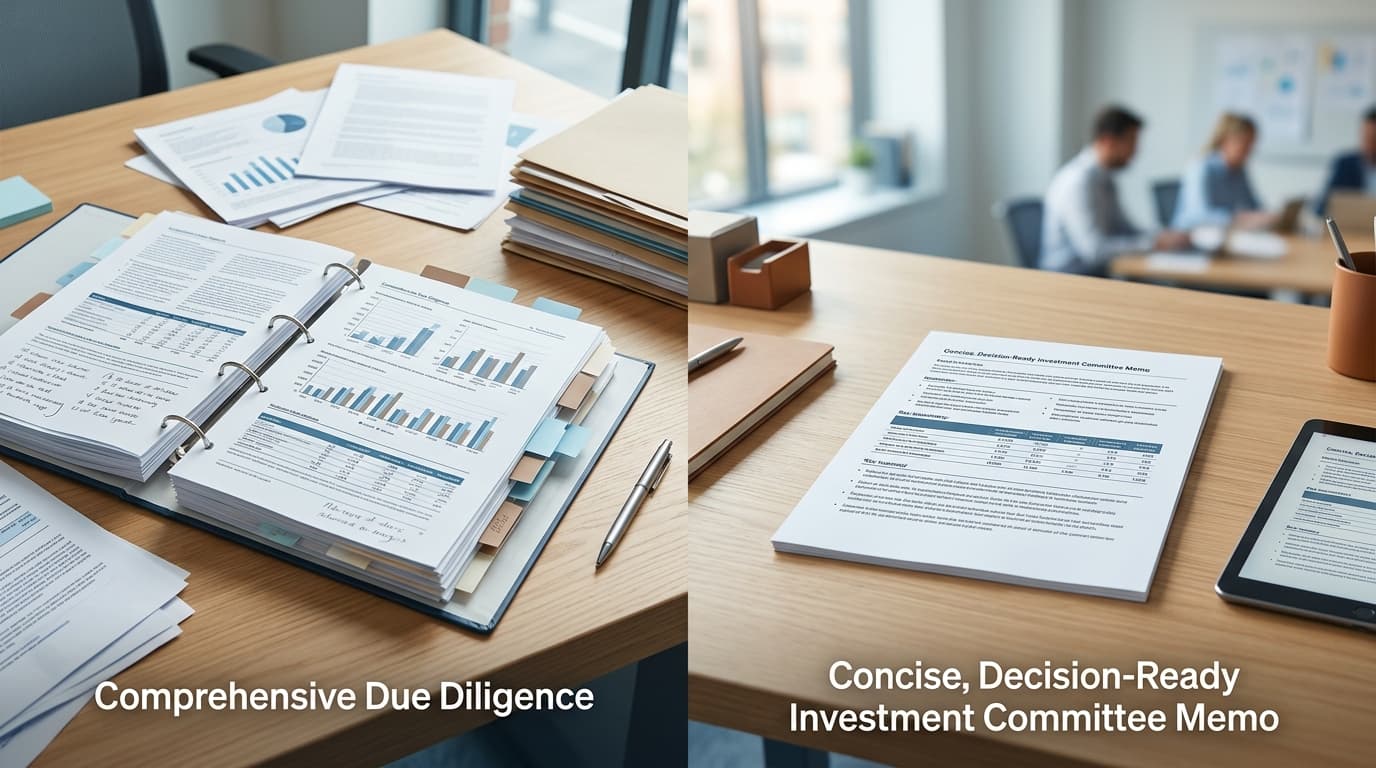
Why AI Verification Matters in Modern Dealmaking
Private equity deal teams and M&A advisers face unprecedented transaction velocity. Compressed diligence windows, expanding virtual data rooms containing tens of thousands of pages, and intense competition for high-quality assets have made manual document inspection a severe operational bottleneck. Dealmakers increasingly rely on modern AI data room analysis software to scan contracts, extract financial schedules, and summarize historical disclosures in hours rather than weeks.
Institutional limited partners are actively demanding technological maturity from fund managers. An LP survey covering 405 limited partners revealed that 66% explicitly expect general partners to integrate AI into due diligence workflows, while 48% expect it in deal sourcing and 45% inside investment committee processes. However, speed cannot come at the expense of evidentiary integrity. An unverified AI response that miscalculates EBITDA adjustments, misinterprets a change-of-control provision, or overlooks a non-compete restriction can destroy deal value and expose investment committees to catastrophic liability.
- Volume overload: A typical mid-market transaction involves 500 to 2,000 documents across dozens of categories, and enterprise-scale deals can involve tens of thousands, spread across legal, tax, commercial, and technical folders. That is more than any team can read with equal depth under deal pressure.
- Compressing timelines: Exclusivity windows have narrowed, forcing teams to evaluate risk profiles faster than traditional manual review permits.
- The verification imperative: Unlike consumer chatbots, deal software must provide deterministic provenance where every extracted figure points directly to its source document.
When evaluating an AI due diligence assistant, investment professionals must look beyond surface-level conversational interfaces. The core question is not whether an AI assistant can summarize text, but whether its outputs are verifiable, auditable, and ring-fenced within secure deal boundaries. That is a question about the underlying analysis engine and how it reasons across documents, not about the chat window in front of it.
The Core Framework for Evaluating Data Room AI
Adopting AI inside confidential transaction environments requires a structured evaluation framework. Deal teams cannot treat deal intelligence tools as generic productivity plug-ins. Instead, platforms must be rigorously evaluated across three core operational pillars: epistemic reliability, architectural security, and auditability.
- Epistemic reliability and hallucination control: The model must be architected to answer exclusively when the data room contains explicit evidence, refusing to extrapolate or fabricate when documentation is missing.
- Controlled vs. connected architecture: Deal data must remain strictly isolated within the deal environment, with matter-level separation and no use of customer documents to train underlying models, rather than streaming through external API connectors that expose confidential target data to third-party retention risks. Contracts with AI vendors should allocate that risk explicitly, covering system security, rights to input and output data, and compliance with applicable data privacy law.
- Granular auditability and permissions: The platform must enforce role-based access control across separate workstreams (such as clean-room finance or restricted HR files) so that the AI assistant only surfaces information to authorized users.
Establishing this tripartite standard ensures that AI diligence workflows strengthen the underwriting process while upholding strict fiduciary and regulatory standards.
What Investors and Advisers Should Test
Before deploying an AI due diligence assistant on live M&A transactions, fund partners, corporate development leads, and advisory teams should benchmark prospective software against the 30 evaluation questions below, grouped into seven functional dimensions. Run them as a scorecard during a pilot on a closed deal, where you already know what the documents say, and compare the answers against the underwriting standards your best due diligence software is expected to meet.
I. Evidence Linking and Source Traceability
- 1. Does every generated answer provide a direct, clickable citation linking to the specific document, page number, and highlighted paragraph in the data room?
- 2. Can the system reconcile conflicting disclosures across multiple document versions (such as an executed agreement versus an earlier redline draft)?
- 3. How does the assistant handle ambiguous contract wording where two separate agreements contain contradictory liability limits?
- 4. Does the AI display the exact excerpted text alongside its synthetic summary for rapid side-by-side verification?
- 5. When asked a question with no supporting evidence in the data room, does the system explicitly state that data is missing rather than hallucinating an answer?
II. Document Extraction and Numerical Accuracy
- 6. Can the tool accurately extract financial figures from complex, scanned multi-column PDFs and embedded tables?
- 7. How does the engine process handwritten annotations, side notes, and low-resolution scanned exhibits?
- 8. Does the AI preserve original currency units, percentage decimals, and financial reporting periods without unauthorized rounding?
- 9. Can the system process complex debt schedules and cap table waterfall mechanics without distorting share classes or seniority?
III. Risk Extraction and Red Flag Detection
- 10. How does the platform identify and surface change-of-control, assignment, and termination clauses across customer and vendor contracts?
- 11. Can the assistant flag non-standard indemnification caps, uncapped liabilities, or unusual governing law provisions across large contract corpuses?
- 12. Does the tool support automated risk register automation by categorizing risks into high, medium, and low severity tiers?
- 13. How does the engine identify hidden covenants, cross-default triggers, and restrictive covenants in credit agreements?
- 14. Can the system cross-reference litigation exhibits with active operational contracts to identify unresolved contingent liabilities?
IV. Governance, Data Privacy, and Security
- 15. Is customer deal data explicitly excluded from training foundation models or third-party AI systems?
- 16. Does the provider maintain a current SOC 2 Type II attestation report and ISO 27001 certification?
- 17. Does the platform provide GDPR-compliant Data Processing Agreements (DPAs) with clear data deletion guarantees upon deal close?
- 18. Where is the data processed and hosted, and are data residency requirements strictly enforceable for cross-border transactions?
V. Virtual Data Room Workflows and Multi-Document Reasoning
- 19. Can the AI synthesize insights across hundreds of files simultaneously to evaluate complex commercial topics like customer concentration?
- 20. Does the platform automatically detect and eliminate duplicate Q&A submissions across different workstream teams?
- 21. How does the tool ingest high-volume data rooms containing diverse file types, including DOCX, PDF, XLSX, and presentation decks?
- 22. Can the assistant track historical data room updates and notify the deal team when newly uploaded files contradict earlier findings?
VI. Investment Committee Memo Support and Report Generation
- 23. Does the platform generate structured summaries tailored directly to investment committee memos with complete source attribution?
- 24. Can the tool export findings cleanly into standardized Word, PDF, or Excel templates without losing underlying footnote links?
- 25. Does the report generator separate objective factual extractions from analytical commentary?
- 26. Can deal teams customize reporting frameworks to match firm-specific investment thesis criteria and scorecards?
VII. Human-in-the-Loop Review and Override Controls
- 27. Can deal team members review, edit, annotate, or reject AI-generated findings before publishing reports to senior partners?
- 28. Does the platform maintain an immutable audit trail of which user reviewed, verified, or amended each extracted finding?
- 29. Can senior advisers establish mandatory approval gates before AI summaries are shared with external co-investors or lenders?
- 30. How does the platform facilitate seamless escalation when the AI detects complex legal or regulatory issues requiring external counsel?
Identifying High-Risk Outputs (Red-Flag Table)
In agentic AI systems, subtle epistemic failures can cause far more damage than obvious software crashes. A model that confidently invents an EBITDA adjustment or misinterprets a critical change-of-control threshold can derail negotiation leverage or lead to severe post-closing disputes. Deal teams must be equipped to distinguish acceptable AI behaviors from dangerous failure modes.
| Diligence Area | Acceptable AI Behavior | High-Risk Failure Mode (Red Flag) | Deal Impact / Material Risk |
|---|---|---|---|
| Contract Analysis | Extracts the exact change-of-control clause with document name and page number citation. | Paraphrases general contract language without linking the underlying paragraph. | Key enterprise contracts terminate post-acquisition without buyer knowledge. |
| Financial Schedules | Preserves exact EBITDA line items and notes specific accounting reconciliation gaps. | Smooths or averages contradictory numbers across different quarterly decks. | Overpayment based on unverified, hallucinated pro-forma earnings adjustments. |
| Debt & Covenants | Flags specific debt maturity dates and negative pledge triggers with verbatim citations. | Summarizes debt obligations in broad qualitative text without concrete numbers. | Unintentional default triggered upon deal close due to overlooked covenant terms. |
| Customer Concentration | Calculates exact revenue contribution per client based on verified customer schedules. | Estimates concentration using marketing pitch decks rather than signed customer files. | Significant revenue loss if top customer churns shortly after acquisition. |
| Missing Data Rooms | Explicitly states that technical IP assignments or regulatory filings are absent. | Assumes standard commercial terms exist and drafts plausible-sounding summaries. | Uncovered intellectual property disputes or major regulatory non-compliance exposure. |
Deal leads must mandate that any finding lacking a direct source citation is immediately flagged for manual verification before entering the deal memorandum.
The Deal Team's Evidence and Data Room Request List
To verify vendor security, model governance, and regulatory compliance, deal teams must request specific documentation prior to granting any AI software access to confidential data rooms. Procurement and legal teams should never rely on marketing claims alone.
- SOC 2 Type II Audit Report: Request the full third-party auditor report covering Security and Confidentiality over a 6 to 12 month observation period.
- ISO 27001 ISMS Certificate: Verify current certification status covering information security management systems.
- GDPR Data Processing Agreement (DPA): Require signed DPAs with clear data residency commitments and explicit sub-processor disclosures.
- Zero-Training Policy: Obtain written vendor commitments confirming that deal documents and user prompts are never retained or used to train public or shared foundation models.
- Data Deletion and Retention Protocol: Secure formal documentation detailing automated data destruction procedures upon transaction completion or project termination.
- Dynamic Watermarking and DLP Verification: Inspect data loss prevention controls, document access logs, and session timeout configurations.
Reviewing these compliance artifacts in advance ensures that target company data remains protected and that the acquiring fund maintains strict adherence to institutional LP governance mandates.
How Plausity supports the workflow
Plausity was built specifically to meet the rigorous verification and security demands of private equity investors, M&A advisers, and corporate development teams. By combining deep document intelligence with strict epistemic boundaries, the platform turns raw data room files into source-linked, verifiable findings that a human reviewer can audit clause by clause.
The platform operates across an integrated architecture designed for zero data leakage and total auditability:
- Data Room Ingestion: Securely scans virtual data rooms, processing high-volume PDFs, financial spreadsheets, and complex contracts in minutes without third-party model exposure.
- AI-Analysis Engine: Reads, cross-references, and reasons across thousands of documents, surfacing accurate answers backed by deterministic, clickable source citations.
- Risk Radar: Automatically identifies and categorizes findings across materiality, legal exposure, and deal relevance to build real-time risk registers.
- Report Builder: Compiles audit-ready due diligence deliverables and investment committee memos with complete source traceability.
- Collaboration Hub: Coordinates workstream activities in real time, aligning legal, financial, and commercial teams within a single role-gated workspace.
By embedding human review controls into every step of the analysis, this architecture keeps dealmakers in full control of investment judgments while accelerating the mechanical heavy lifting of document review.
How to use this in your next diligence workflow
Modern due diligence requires balancing relentless speed with uncompromising accuracy. Deal teams that implement a structured 30-question evaluation framework can confidently adopt AI technology to accelerate deal velocity while insulating their firms against hallucination risks and confidentiality breaches.
To operationalize these standards on your upcoming transaction, integrate the 30-question scorecard into your vendor review playbook. Use Plausity's Collaboration Hub to orchestrate cross-workstream diligence, align advisers, and ensure that every finding presented to the investment committee is backed by verified data room evidence.