Why AI Data Room Analysis Matters Now
AI data room analysis software is specialized deal intelligence technology that automates the ingestion, parsing, cross-referencing, and risk evaluation of thousands of confidential corporate files stored in virtual data rooms. By combining natural language understanding with multi-document reasoning, it allows private equity investors, corporate M&A leads, and advisory professionals to move past static keyword queries and instantly extract structured, source-linked diligence findings across financial, legal, commercial, and operational workstreams without manual spreadsheet triage.
- Accelerated Deal Velocity: Compresses data-room review cycles from weeks of manual document inspection to hours of structured analysis.
- Multi-Document Triangulation: Automatically cross-references claims in confidential information memorandums against contracts, general ledgers, and disclosure schedules.
- Audit-Ready Traceability: Backs every extracted risk, figure, and covenant with exact page-level citations to eliminate analytical hallucinations.
- Granular Red-Flag Detection: Surfaces hidden change-of-control clauses, uncapped indemnities, customer churn patterns, and margin erosion early in exclusivity.
- Workstream Alignment: Connects legal, financial, and commercial teams within a single governed workspace for real-time risk register maintenance.
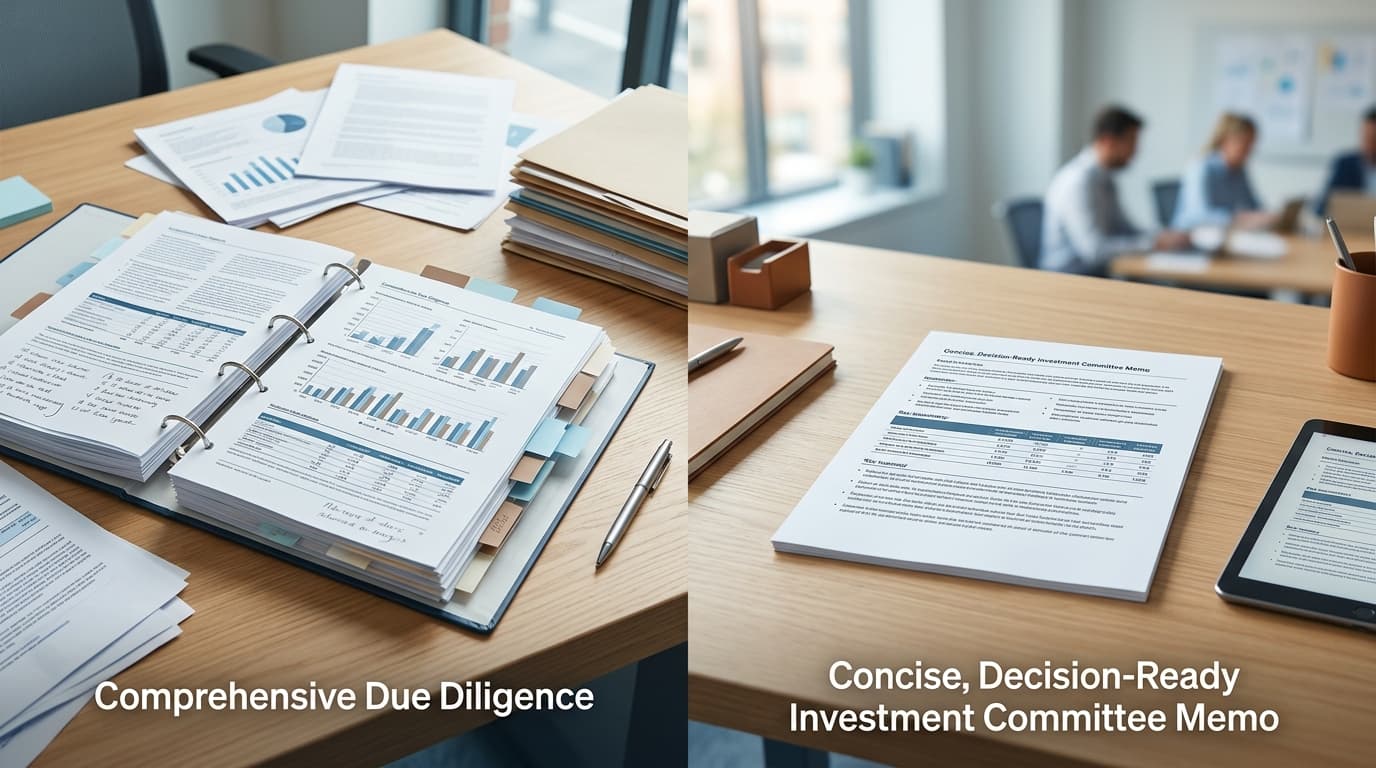
- Institutional Memory: Structures deal findings into standardized templates to streamline investment committee memo creation and post-merger integration planning.
The Escalating Pressure on M&A Deal Velocity and Advisory Budgets
Private equity deal teams and corporate acquirers face an unprecedented expansion of data volume during transaction diligence. Target companies frequently upload thousands of unindexed PDFs, scanned agreements, board packs, and complex financial workbooks into virtual data rooms. Reviewing these assets manually under tight exclusivity windows creates severe analytical bottlenecks and inflates transaction overhead. Published cost benchmarks put total M&A transaction costs at roughly 1% to 4% of deal value, with due diligence alone accounting for 1% to 2% and legal and professional fees adding a further 1% to 3%. Those figures escalate rapidly when external advisors are required to manually audit every minor schedule.
To protect deal margins and accelerate underwriting, investment professionals are shifting from passive document storage to AI-powered diligence automation software. According to Deloitte's GenAI in M&A survey of 1,000 corporate and private equity leaders, 86% of organizations have integrated generative AI into their M&A workflows, with 65% having done so in the past year alone. In competitive auctions where speed and analytical depth determine winning bids, manual search tools in legacy virtual data rooms fall short. Dealmakers require specialized due diligence software capable of contextual reasoning across disparate documents.
The Core AI Due Diligence Framework
Traditional diligence workflows treat files as isolated records, forcing analysts to manually toggle between management presentations, customer master service agreements, and tax schedules. An AI-native diligence framework replaces this disconnected process by creating a unified semantic layer across all uploaded transaction documents, linking qualitative representations directly to underlying operational and financial evidence.
The Four-Stage Deal Intelligence Architecture
Modern deal intelligence software processes unstructured files through a four-stage diligence pipeline designed to surface anomalies and validate core investment theses:
- Ingestion and Document Normalization: Ingesting virtual data room contents across mixed formats (scanned PDFs, spreadsheets, presentations), executing high-fidelity optical character recognition (OCR), and resolving conflicting document versions.
- Entity and Covenant Extraction: Identifying key contractual terms, customer definitions, governing law clauses, non-compete covenants, and termination triggers across thousands of commercial agreements.
- Multi-Document Cross-Referencing: Triangulating qualitative representations in pitch decks and confidential information memorandums against signed customer contracts, billing histories, and audited disclosures.
- Materiality Scoring and Risk Synthesis: Evaluating identified deviations against user-defined materiality thresholds, categorizing exposure levels, and generating verifiable findings backed by source citations.
This structured framework dramatically cuts the time needed for target screening and exploratory review. Screening times for preliminary company assessments drop from a full working day to an hour, enabling deal sourcers and investment professionals to evaluate a higher volume of actionable opportunities without sacrificing analytical depth. Implementing such workflow automation ensures that deal leads spend their time interpreting strategic risks rather than performing administrative document retrieval.
What to Evaluate in Deal Intelligence Platforms
Legacy virtual data rooms (VDRs) were created primarily as secure digital repositories for access control and watermarked file viewing. However, basic keyword filtering and metadata tagging cannot evaluate semantic contradictions across legal clauses or detect subtle shifts in accounting policies. When selecting deal intelligence software for private equity and M&A workflows, investment committees should evaluate several core functional pillars to ensure rigorous underwriting.
Essential Evaluation Criteria for Deal Teams
- Granular Contract and Covenant Analysis: The software must parse complex, non-standard commercial agreements to identify assignment restrictions, change-of-control liabilities, most-favored-nation clauses, and uncapped indemnification caps.
- Cross-Document Version Reconciliation: Diligence platforms must compare multiple iterations of disclosure schedules, credit facilities, and shareholder agreements, flagging silent deletions or retroactive amendments.
- Deterministic Source Traceability: The platform must provide verifiable, page-level citations for every insight, ensuring that analysts can instantly inspect the exact sentence or table row supporting an observation.
- Enterprise-Grade Security and Governance: Diligence software must operate under strict zero-data-retention AI processing standards, SOC 2 Type II compliance, tenant-level data segregation, and granular permission controls to protect non-public transaction data.
- Synthesis for Investment Deliverables: The system must bridge technical, legal, tax, and commercial findings into cohesive workstream summaries, facilitating the preparation of the investment committee memo.
When evaluating a modern due diligence provider or software platform, deal leaders must ensure the technology functions as an analytical multiplier that enhances professional judgment rather than an unverified black box.
Identifying Risks: The Due Diligence Red-Flag Table
In rapid M&A negotiations, undetected operational or legal liabilities can compromise investment returns or trigger post-closing disputes. Automated risk analysis algorithms continuously screen data rooms for structural anomalies, categorizing red flags by financial materiality and legal exposure so deal teams can structure appropriate escrow holdbacks, price adjustments, or specific indemnities.
| Risk Category | Specific Anomaly / Red Flag | Source Document Triangulation | Deal Impact & Value Protection |
|---|---|---|---|
| Revenue & Margin Integrity | Sudden margin compression or abnormal unbilled revenue spikes in trailing twelve months (TTM) | Financial models vs. audited general ledger records vs. customer billing files | EBITDA normalization, purchase price adjustment, working capital peg modification |
| Contractual Assignability | Undisclosed change-of-control provisions and restrictive termination-for-convenience clauses | Top 20 customer MSAs vs. supplier contracts vs. CIM claims | Customer retention risk pricing, closing conditions precedent, transition escrow holdbacks |
| Key-Person & IP Ownership | Key-person dependencies paired with absent IP assignment agreements or weak non-compete clauses | Employment agreements vs. cap table vs. IP disclosure exhibits | Management retention packages, earn-out restructuring, reps and warranties indemnities |
| Regulatory & Compliance | Pending regulatory inquiries, undisclosed environmental liabilities, or licensing lapses | Board minutes vs. regulatory filings vs. legal audit response letters | Specific indemnity carve-outs, R&W insurance policy exclusions, purchase price holdbacks |
Automating the Findings-to-Action Pipeline
Connecting automated anomaly detection directly to an integrated risk register ensures that potential deal-breakers are addressed methodically. Rather than losing crucial findings in siloed email threads or static spreadsheets, deal leads can instantly assign investigation tasks to specialized legal or financial advisors, drafting targeted confirmatory questions for the seller within hours of data room access.
Data Room Request List and Evidence Checklist
High-speed due diligence requires establishing a comprehensive evidentiary baseline before deep review begins. AI triage tools automatically map uploaded data room contents against standardized diligence checklists, identifying missing exhibits, unsigned agreements, or outdated schedules so deal teams can request missing records immediately.
Comprehensive Due Diligence Evidence Checklist
- Corporate Governance & Organization: Certificate of incorporation, corporate bylaws, minute books of shareholder and board meetings (past 3 to 5 years), list of subsidiaries, and organizational charts.
- Financial & Tax Records: Audited financial statements (last 3 fiscal years), monthly management accounts (TTM), detailed chart of accounts, general ledger dumps, debt schedules, tax returns, and transfer pricing documentation.
- Commercial & Customer Data: Master services agreements (MSAs) and statements of work (SOWs) for top 20 customers, standard customer contract templates, churn and retention cohort reports, pricing schedules, and sales pipeline logs.
- Intellectual Property & IT Infrastructure: Registered patents, trademarks, proprietary software architecture diagrams, open-source software (OSS) inventory reports, cybersecurity policies, and recent penetration test findings.
- Human Resources & Compensation: Executive employment agreements, retention and bonus plans, standard employee handbook, non-disclosure and non-compete agreements, and schedule of ongoing employee litigation or grievances.
Ingesting this structured taxonomy into an automated diligence workflow enables deal teams to monitor data room completeness in real time. Instead of spending valuable analyst hours verifying whether all required contract annexes have been provided, the team can focus immediately on qualitative assessment and financial modeling.
How Plausity supports the workflow
This workflow is built specifically for private equity, venture capital, and corporate M&A teams requiring an AI-native platform for diligence and deal intelligence. Designed to structure, accelerate, and organize complex data room analysis under strict human review, the platform provides investment professionals with a comprehensive suite of dedicated tools.
An Integrated Deal Intelligence Platform
- Data Room Ingestion: Seamlessly connects to and scans virtual data rooms, ingesting and processing PDFs, spreadsheets, contracts, and financial models within minutes.
- AI-Analysis Engine: The core engine reads, interprets, cross-references, and reasons over thousands of documents and data points to generate high-quality due diligence analysis.
- Risk Radar: Identifies and evaluates findings based on materiality, financial impact, legal exposure, and deal relevance to surface key risks and anomalies.
- Report Builder: Uses AI analysis to automatically draft, structure, and refine professional, investor-ready due diligence reports and deliverables with full source traceability.
- Collaboration Hub: A collaborative AI-powered workspace that coordinates deal team activities, aligns workstreams, and shares insights in real-time.
By uniting rapid ingestion and cross-document reasoning with granular page-level citations, this approach lets investment teams compress review timelines while preserving complete auditability across all transaction findings.
How to use this in your next diligence workflow
Integrating AI data room analysis into your investment process begins with identifying manual bottlenecks in your current review cycle and standardizing your analytical criteria before entering exclusivity.
Step-by-Step Implementation for Upcoming Transactions
- Map Current Diligence Bottlenecks: Audit past transactions to pinpoint where your associates and advisors spent excessive non-cognitive hours, such as contract scanning, disclosure cross-referencing, or missing document tracking.
- Standardize Your Evidentiary Taxonomies: Establish a structured data room checklist to enable automated document categorization and completeness auditing as soon as target folders open.
- Deploy Data Room Ingestion and Risk Radar: Connect incoming target data rooms to automated scanning tools to surface change-of-control triggers, margin erosion, and customer concentration risks during early review.
- Coordinate Advisory Workstreams via Collaboration Hub: Align legal, tax, commercial, and financial specialists around a single real-time risk register to eliminate redundant email threads and conflicting notes.
- Produce Source-Linked Deliverables with Report Builder: Draft comprehensive investment committee memos and transaction summaries backed by verified, page-level evidence.
To modernize your deal analysis and accelerate transaction timelines with confidence, discover how Plausity helps private equity and M&A professionals structure, analyze, and execute diligence workflows with precision.