The High Stakes of Synergy Validation: Why Paper Projections Diverge from Reality
Synergy projections can make or break an M&A deal. Learn how modern PE and corporate development teams use rigorous synergy due diligence, supported by AI-native platforms, to validate cost savings and protect transaction value before signing.
In modern corporate transactions, mergers and acquisitions increasingly rely on ambitious cost and revenue synergies to justify steep premium prices. According to research by McKinsey, average synergy targets now reach almost 20% of target costs. However, bridging the gap between an optimistic pitch deck and post-merger operational reality remains a notorious challenge. Historical analysis by Bain & Company reveals that approximately 70% of merging companies overestimate these projected scale benefits. Without rigorous, pre-signing synergy due diligence, buy-side teams risk locking themselves into deal models based on flawed assumptions. This gap highlights why modern dealmakers must move beyond superficial financial models and actively pressure-test operational claims before executing any legal agreement.
Deconstructing the Projection Gap: Common Sources of Synergy Bias
The divergence between paper projections and operational reality is rarely caused by simple math errors. Instead, it stems from systemic biases during the pre-deal phase. Sellers often package operational savings under aggressive timelines, assuming immediate post-close integration. In practice, corporate M&A project leads frequently discover hidden IT incompatibilities, conflicting regional labor laws, or key customer churn that quickly erodes the expected upside. When these unvalidated assumptions are integrated directly into the core deal model, they artificially inflate the target valuation. To combat this, sophisticated teams are shifting toward a data-driven approach to value creation due diligence that uncovers these risks during the early stages of data room review.
| Synergy Category | Optimistic Paper Assumption | Due Diligence Operational Reality |
|---|---|---|
| Procurement Savings | Immediate 10% unit-cost reduction by combining purchase volumes. | Existing supplier contracts have multi-year lock-in clauses and volume-pricing tiers that restrict immediate renegotiation. |
| System Consolidation | Seamless migration to a single ERP system within 6 months post-close. | Custom localized software integrations and data-cleansing requirements delay system unification by 18 to 24 months. |
| Headcount Rationalization | Immediate reduction of redundant administrative roles across both organizations. | Severe severance payouts, localized labor union negotiations, and retention bonuses for key staff offset initial savings. |
How Unvalidated Assumptions Impact the Deal Model
When synergy due diligence is treated as a secondary priority, the financial consequences on the deal model are profound. Overestimating cost savings leads to an inflated enterprise value, which in turn reduces the ultimate return on investment for private equity fund investment professionals. Furthermore, delayed synergy realization timelines can trigger breaches of leverage covenants if debt-service schedules rely on early cash-flow bumps. Private equity firms and corporate development teams require a systematic methodology to isolate and verify these synergy levers early in the transaction lifecycle. By embedding robust valuation checks into their end-to-end due diligence workstreams, investment professionals can adjust their purchase-price allocations and structural terms to protect downside risk.
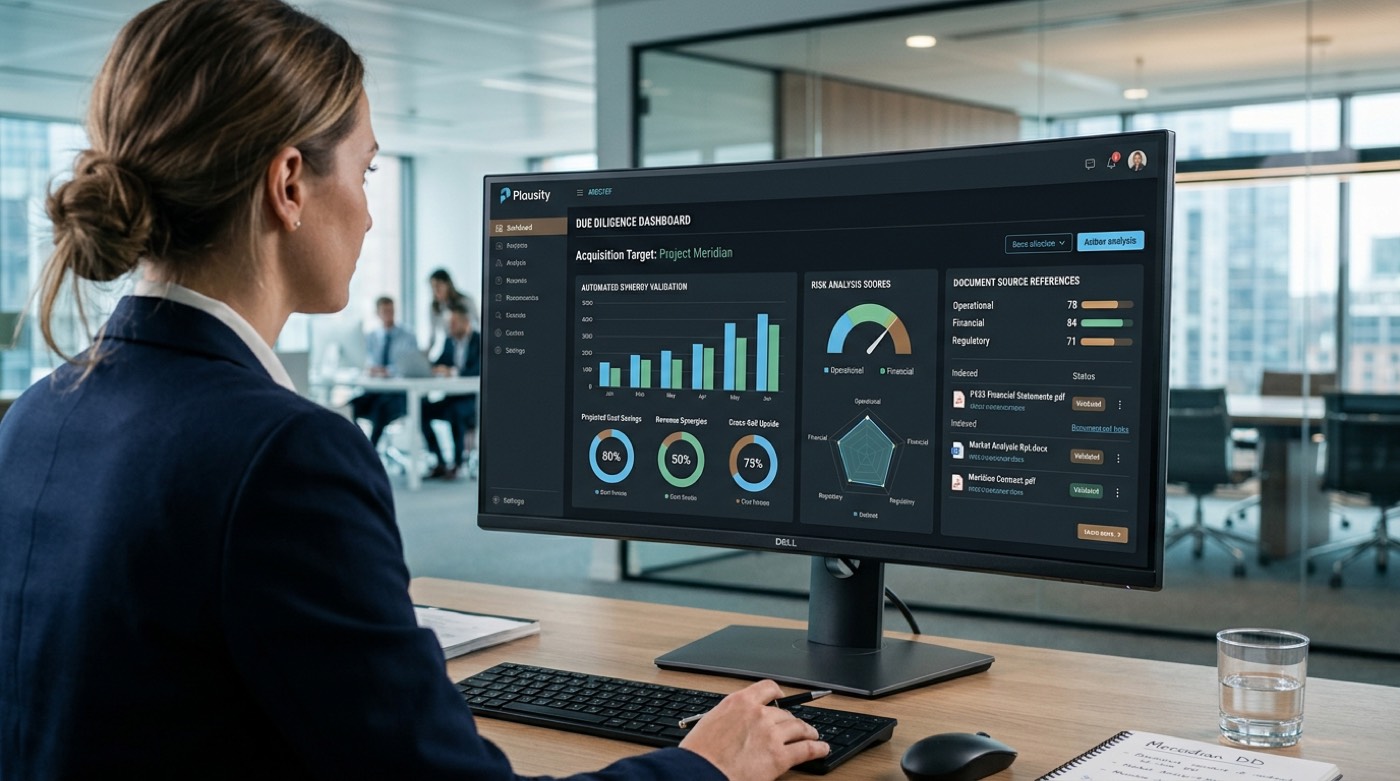
To execute this rigorous analysis at deal speed, modern transaction teams rely on AI-native platforms to parse complex operational documentation. Plausity helps M&A advisory firm partners and analysts automate the initial vetting of source documents. By leveraging Data Room Ingestion to automatically scan and categorize thousands of operational files, teams can rapidly extract supplier contracts, IT architecture maps, and employment agreements. From there, the AI-Analysis Engine cross-references these source documents against the synergy spreadsheet claims to flag discrepancies in real time. Rather than relying on gut feeling, dealmakers are empowered with concrete, evidence-based insights to negotiate from a position of absolute clarity, ensuring that every projected dollar of synergy is backed by operational fact.
Building a Modern Synergy Due Diligence Framework
An effective synergy due diligence process separates high-value M&A outperformers from transactions that destroy capital. According to research from Bain and Company, only 30% of companies manage to achieve their stated synergy targets. Traditional M&A deal teams often treat synergy models as high-level financial spreadsheet exercises completed late in the transaction lifecycle. By contrast, a modern approach turns synergy due diligence into an early, rigorous validation process driven by deep-dive virtual data room analyses. Instead of accepting generic cost-reduction and cross-selling projections, buy-side teams must actively stress-test operational, commercial, and technical compatibility long before signing the definitive agreement.
The Three Pillars of Synergy Validation
An effective framework for validating deal synergies is built on three core pillars: operational alignment, commercial growth feasibility, and technology stack rationalization. First, operational alignment requires a deep dive into redundant cost structures and workflow compatibilities. Deal teams must analyze cost structures to identify where shared service centers, facilities, or back-office staff can be consolidated without harming business continuity. Second, commercial growth feasibility focuses on validating revenue assumptions. Rather than assuming automatic cross-selling success, teams must inspect whether sales teams have the capability, incentives, and pipeline alignment to sell the combined product portfolio. Third, technology stack rationalization involves evaluating IT compatibility. M&A advisors and IT experts must verify if target and acquirer systems can integrate smoothly or if conflicting legacy architectures will demand expensive, multi-year re-platforming efforts.
A Practical Synergy Validation Checklist
To systematically de-risk transactions, corporate development and private equity deal professionals should implement a rigorous, data-room-grounded checklist. Integrating a specialized types of due diligence checklist into the team's operational playbook ensures that synergy assumptions are cross-examined against actual contracts, customer directories, and system architectures. Utilizing an automated platform such as Plausity helps speed up this phase, transforming raw virtual data room inputs into clear, structured insights.
- Customer Overlaps and Concentration: Ingest customer lists into a secure space to calculate true account overlap, identify where existing sales channels might experience churn due to duplicate vendor relationships, and isolate the top customer groups that drive revenue.
- Overlapping Software Licensing: Map out the enterprise software applications, cloud services, and custom tools used by both companies to calculate potential cost savings from volume discounts or redundant license terminations.
- Operational Workflow Efficiencies: Evaluate overlapping manufacturing, supply chain, or service delivery pipelines to verify that headcount reductions or facility consolidations will not impair customer satisfaction scores or operational throughput.
- Revenue Synergy Stress-Testing: Discount the projected cross-selling pipelines based on historical sales cycle durations, product integration timelines, and realistic buyer adoption rates instead of relying on optimistic marketing estimates.
- IT Compatibility and Tech Debt: Examine technical documentation, API architectures, and security baselines to estimate the actual cost and time required to achieve data integration between core operational platforms.
| Synergy Dimension | Traditional Diligence Approach | Modern AI-Assisted Validation |
|---|---|---|
| Cost Synergies | Top-down estimates based on generic industry benchmarks and high-level financial models. | Bottom-up validation of contract terms, software licenses, and operational costs using Plausity's Risk Radar to flag real integration hurdles. |
| Revenue Synergies | Broad assumptions about cross-selling success and automatic market expansion. | Granular pipeline stress-testing and customer overlap analysis using the AI-Analysis Engine to identify target accounts. |
| IT and Tech Stack | High-level IT checklists and post-close systems integration planning. | Pre-close technical due diligence covering architectural compatibility, data security compliance, and license redundancy. |
Ultimately, embedding this three-pillar framework early in the deal lifecycle shifts the transaction focus from hopeful speculation to structured value creation due diligence. Modern deal teams use Plausity's core features like Data Room Ingestion to parse thousand-page contracts, financial models, and customer directories in minutes. This fast-tracks the validation process, enabling Plausity's Report Builder to generate an investor-ready synergy report that provides a clear-eyed view of integration risks and genuine cost-saving potentials before capital is committed.
Quantifying Scale Benefits vs. Structural Transformation
In the high-stakes environment of mid-market and enterprise mergers, deal teams often conflate two distinct value drivers: easily attainable scale benefits and complex, long-term structural transformations. Scale benefits, such as consolidation of bulk purchasing and administrative overhead reduction, represent the low-hanging fruit of post-acquisition integration. They can often be modeled mathematically using baseline financial records. In contrast, structural transformations, like ERP system unifications, supply chain physical restructuring, or cross-brand commercial alignment, demand deep operational changes. Mistaking a complex structural transformation for a simple scale benefit is a primary driver of transaction failure, leading to severe post-merger integration bottlenecks and value erosion.
Validating the feasibility of these synergy types requires significant investment during the pre-signing phase. According to data from PwC, 78% of top-tier M&A organizations allocate 6% or more of the overall deal value to formal integration planning and synergy validation, compared to just 56% of average market performers who meet that funding threshold. High-performing acquirers recognize that finding integration roadblocks in the virtual data room before signing is vastly cheaper than discovering them during post-close operations.
Synergy Dimensions across Core Functions
| Business Function | Synergy Type | Implementation Complexity | Primary Due Diligence Focus |
|---|---|---|---|
| Procurement | Scale Benefits (Volume Pricing) | Low to Medium | Cross-referencing supplier contracts, unit-level pricing lists, and annual purchasing volumes to calculate direct savings. |
| Back-Office | Structural Transformation (ERP & IT) | Medium to High | Reviewing software architectures, overlapping software license agreements, and system migration roadmaps. |
| Commercial | Structural Transformation (Go-To-Market) | High | Comparing historical customer databases, identifying potential churn risks, and evaluating sales team incentive structures. |
To systematically unpack these complexities, modern deal teams rely on advanced tools. Rather than manually parsing thousands of supplier contracts and software agreements, teams utilize Plausity's Data Room Ingestion to automatically extract and structure contract clauses in minutes. Once ingested, the AI-Analysis Engine runs complex cross-references to identify where volume discounts are legally feasible and where software change-of-control provisions could trigger sudden cost increases. This rigorous approach to value creation due diligence ensures that synergy targets are backed by contractual facts, not speculative projections.
By shifting the focus of synergy due diligence from historical spreadsheets to contract-level realities, acquirers can confidently discount speculative deal-value claims before signing. For M&A Advisory Firm Partners & Analysts, this level of analytical granularity elevates client advisory deliverables, turning speculative synergy hypotheses into defensible, deal-ready models. Tools like Risk Radar can then highlight specific integration risks, giving corporate development leads a clear, risk-weighted roadmap for day one.
Accelerating Analysis with AI-Native Due Diligence Platforms
In the modern transaction landscape, validating cost and revenue synergies during mergers and acquisitions is a high-stakes race against time. Historically, up to 83% of corporate acquisitions fail to generate expected shareholder returns, with poor post-deal integration execution frequently cited as the primary driver of value destruction. To prevent these costly failures, corporate M&A project leads are shifting their focus to the pre-signing phase, transforming how they execute synergy due diligence. Traditional, manual methods of scouring files often miss operational risks that threaten value creation. Leveraging an AI-native due diligence platform allows deal professionals to automate the processing of complex documentation, translating raw data into deep, actionable insights before any binding agreement is signed.
Modern transaction teams cannot afford to spend weeks manually reconciling disparate materials inside electronic data rooms. Platforms like Plausity revolutionize this workflow by combining rapid ingestion with deep, multi-format evaluation. Using Data Room Ingestion, deal teams can seamlessly connect to virtual data rooms to scan, import, and process thousands of PDFs, spreadsheets, contracts, and financial models within minutes. Once imported, Plausity's AI-Analysis Engine performs comprehensive, multi-format cross-referencing. This system acts as a central operational brain, analyzing unstructured data points across different workstreams to verify whether the target's financial models match real-world operational capacities, thereby laying a robust foundation for value creation due diligence.
Automating Contract Review and Financial Data Ingestion
Evaluating synergies requires identifying overlapping operations, vendor concentration, and personnel redundancies. When analyzing hundreds of supplier agreements and employment records, human reviewers can easily overlook conflicting terms or hidden liabilities. By deploying Risk Radar, M&A advisory firm partners and analysts can automatically flag duplicate corporate roles, redundant supplier contracts, and inconsistent pricing terms. Risk Radar evaluates these findings based on materiality and deal relevance, ensuring that the integration team is alerted to key risks before signing. For instance, if both companies rely on the same software vendor but pay wildly different licensing rates, the system flags the contract inconsistency, surfacing an immediate post-close procurement savings opportunity.
| Validation Focus | Traditional Manual Approach | AI-Native Assisted Approach |
|---|---|---|
| Contract Analysis | Manual sampling of contracts, which frequently overlooks inconsistent vendor terms or change-of-control clauses. | Automated scanning of all supplier and employment contracts via the AI-Analysis Engine to flag duplicate roles and legal liabilities. |
| Data Processing | Time-consuming extraction of financial models and PDFs from data rooms, delaying the integration planning. | Rapid Data Room Ingestion that processes multi-format files in minutes, accelerating transaction timelines. |
| Risk Prioritization | Subjective assessment of risks based on partial reviews, often missing operational integration hurdles. | Continuous evaluation of material findings through Risk Radar, prioritizing risks by financial impact and deal relevance. |
| Deliverable Generation | Drafting reports manually over several days, introducing formatting errors and disconnected source links. | Automated drafting via Report Builder with full source traceability to specific clauses in the virtual data room. |
Ultimately, a rigorous approach to synergy due diligence is what separates high-value M&A outperformers from transactions that destroy value. By replacing slow, sample-based contract reviews with exhaustive, automated analysis, deal teams can enter negotiations armed with clear evidence. Once the evaluation is complete, the Report Builder automatically drafts, structures, and refines a professional, deal-ready report with full source traceability back to the original documents. This ensures that every synergy claim is grounded in hard facts, providing the executive team with the exact clarity needed to validate deal value before they sign.
Drafting the Investment Case: Turning Diligence into Actionable Integration Models
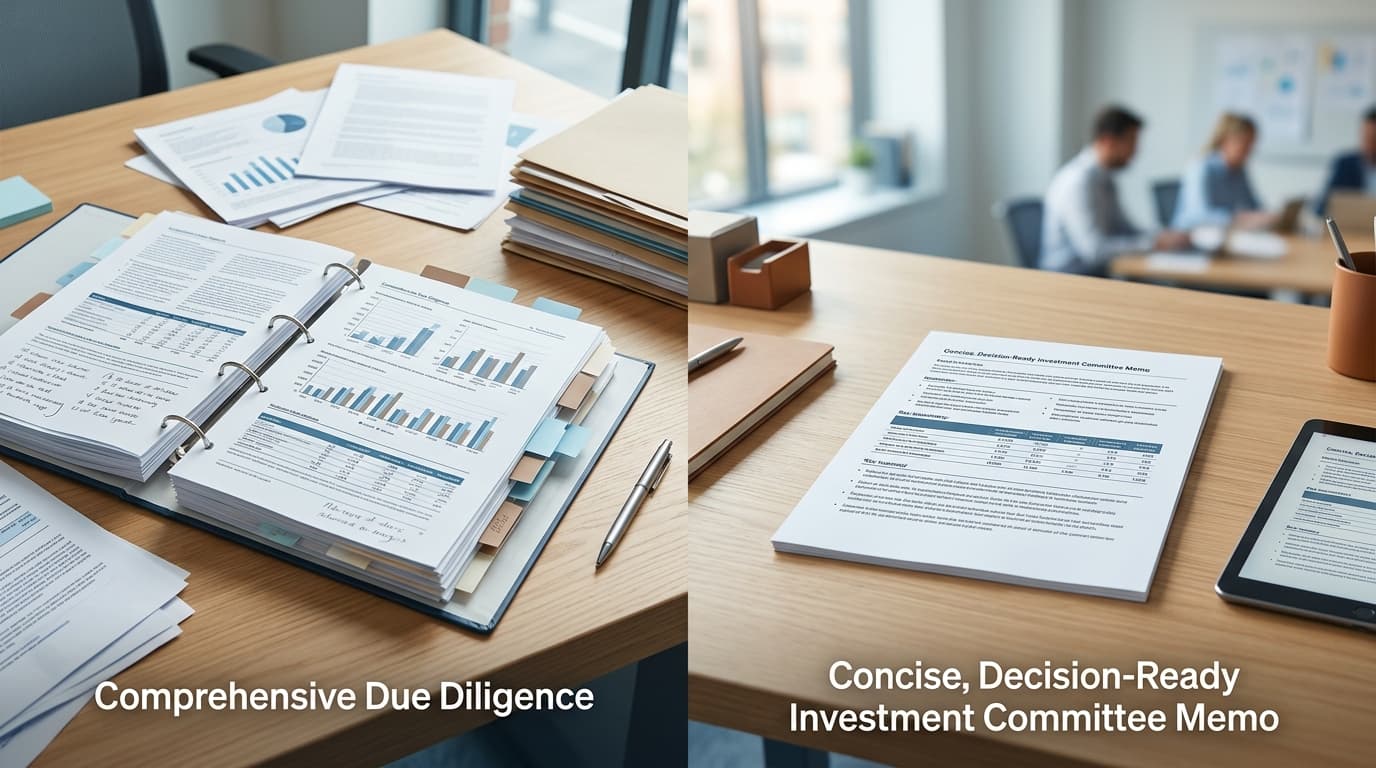
For investment committees and corporate development executives, the final transition from raw due diligence findings to a validated synergy model is where M&A transactions are won or lost. Research indicates that 70% to 90% of mergers and acquisitions underperform expectations due to fundamental errors in synergy evaluation and integration planning. To prevent these costly miscalculations, deal teams must shift from optimistic, high-level projections to a rigorous, evidence-backed approach. This is why modern synergy due diligence requires linking every assumed cost saving or operational efficiency directly to the target's actual data-room files, replacing speculative spreadsheets with verified facts.
Translating Raw Diligence into Traceable Models
Historically, corporate M&A project leads and investment analysts have spent hundreds of hours manually copy-pasting numbers from virtual data rooms into isolated spreadsheets. This disjointed workflow often leads to a complete loss of source context, making it nearly impossible for decision-makers to verify underlying assumptions. Plausity transforms this process by combining Data Room Ingestion and the AI-Analysis Engine to parse, tag, and analyze complex corporate records. When it comes to drafting the investment case, the Report Builder automatically structures the final narrative while maintaining complete source traceability. Every single projected cost saving, FTE reduction, or software consolidation is hyperlinked directly back to the specific contract page or financial model in the data room, giving the investment committee ultimate confidence in the deal's value.
| Synergy Dimension | Traditional Model (Siloed & Assumed) | Traceable AI-Native Model (Plausity) |
|---|---|---|
| Source Verifiability | Siloed spreadsheets with manually copy-pasted assumptions and lost trail of evidence. | Full traceability from the final investment case back to specific pages in the virtual data room. |
| Committee Presentation | Static PowerPoint decks compiled over days under extreme time pressure. | Automated, dynamic reports compiled by Report Builder with instant source hyperlinking. |
| Integration Handover | Isolated models that post-closing teams struggle to translate into operational reality. | Structured, data-driven frameworks mapped directly to verified data-room findings. |
Preparing Committee Deliverables and Aligning Post-Closing Roadmaps
Securing board or investment committee approval requires presenting a defensible roadmap that connects transaction synergies with execution-ready integration timelines. Whether prepared by M&A advisory firm partners or internal corporate teams, committee deliverables must withstand intense scrutiny from skeptical stakeholders. Utilizing Plausity streamlines the path from raw data room files to a professional deal-ready report, showing a direct link between strategic hypotheses and documented target realities. This alignment is critical for modern strategic value creation due diligence, ensuring that the thesis presented to the committee is not just a theoretical model but a practical blueprint for operational success.
Once the transaction is approved and signed, this rigorous model transitions smoothly into the post-closing 100-day plan, giving integration managers immediate clarity on where and how to capture value. Instead of inheriting an opaque spreadsheet of arbitrary financial targets, the operational team receives a structured list of verified initiatives, complete with original data-room context. By grounding synergy due diligence in verifiable data and automating report generation with Plausity, corporate development and private equity teams can execute transactions with speed and high precision, separating M&A outperformers from deals that destroy value.
Plausity brings AI-native analysis to this workstream. Explore how Plausity supports synergy due diligence.