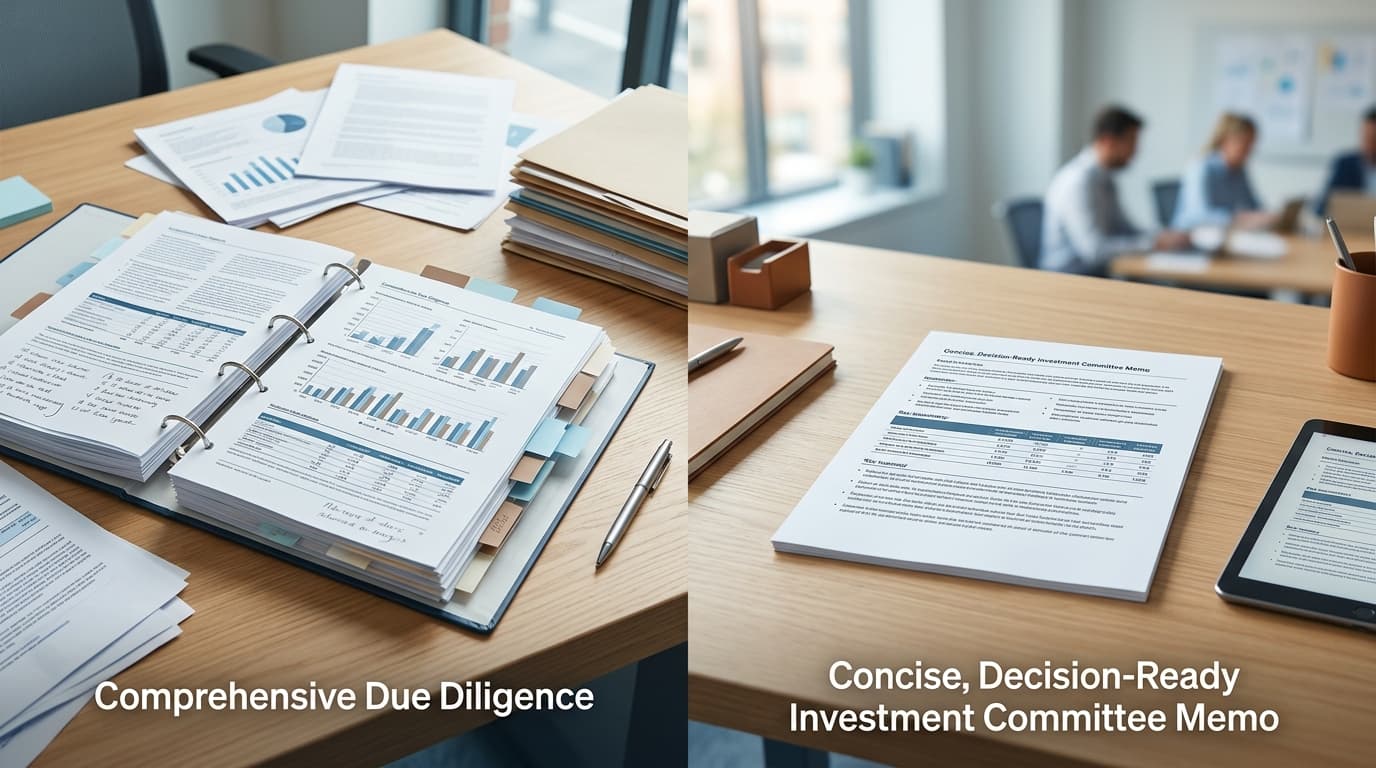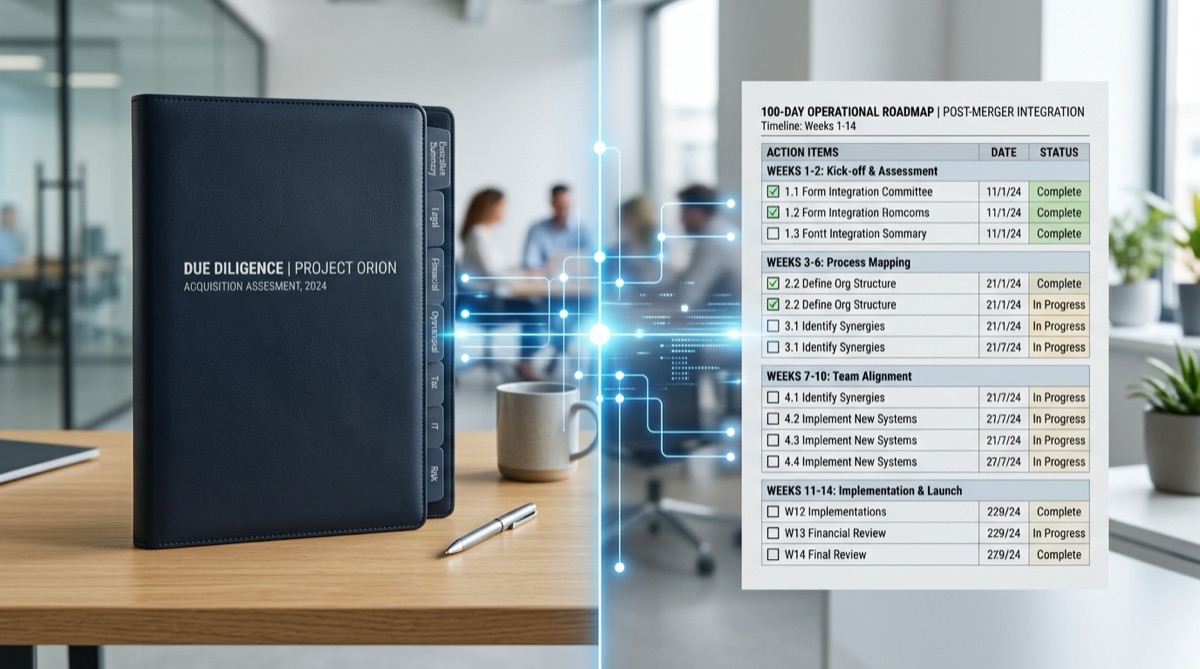
The Value Realization Gap: Why the 100-Day Plan Starts in Diligence
- Integrating early: A staggering 83% of M&A deals fail to boost shareholder returns, making pre-close planning essential.
- Synergy gaps: Research shows 42% of due diligence processes fail to adequately identify operational synergies before signing.
- Day-one tracking: Integration success rates soar to 92% when synergies are systematically tracked from day one of the transaction.
- Talent risk: Up to 47% of employees leave acquired companies within the first year, representing a major operational leak.
For decades, the standard merger and acquisition playbook has treated due diligence and post-close integration as distinct, sequential phases. Under this traditional model, the deal team uncovers risks and seals the transaction, then hands a static folder of findings to the post-merger integration team to execute. This clean break in ownership creates a structural gap that routinely destroys deal value. Historic data from KPMG indicates that 83% of M&A deals fail to enhance shareholder returns. Similarly, research from McKinsey reveals that nearly 70% of transactions miss their projected synergy targets due to integration missteps. To bridge this value realization gap, corporate M&A project leads and private equity sponsors must fundamentally redefine their approach: the 100-day plan must be drafted during the due diligence phase, not after the transaction closes.
Waiting until post-close to design an integration roadmap creates immediate value leakage. When M&A project leads defer synergy planning, they miss the window of maximum leverage. During the pre-close window, buyers retain the option to renegotiate terms, adjust valuations, or even walk away if operational assumptions prove false. A delayed handoff forces integration teams to spend their critical first 100 days diagnosing operational realities rather than executing. This information asymmetry can be mitigated by leveraging advanced AI-native due diligence platforms, such as Plausity's AI-Analysis Engine, to conduct deep document investigation during due diligence. This ensures that the qualitative facts, risks, and operational nuances discovered in the virtual data room directly seed the initial integration roadmap, creating a continuous thread from discovery to execution.
Establishing a Grounded Baseline Pre-Signing
A successful 100-day plan due diligence process requires establishing a realistic, data-backed integration baseline before committing capital. Without a rigorous pre-close assessment, synergy targets are often built on superficial top-down benchmarks rather than bottom-up reality. For example, assuming a flat percentage reduction in selling, general, and administrative expenses without reviewing specific employment agreements, vendor obligations, and software licensing terms can lead to severe operational friction post-close. By analyzing these operational value levers M&A professionals can pressure-test and validate every operational upside pre-signing, ensuring that the post-deal business model is supported by verifiable facts rather than optimistic projections.
| Integration Dimension | Traditional Post-Close Approach | Diligence-Led Pre-Close Approach |
|---|---|---|
| Primary Focus | Avoidance of legal and financial exposure through static compliance checklists. | Dynamic identification and modeling of operational value levers M&A to secure immediate upsides. |
| Synergy Identification | Estimated using generic top-down industry averages and superficial assumptions. | Bottom-up validation using detailed analysis of operational contracts, workforce structures, and systems data. |
| 100-Day Planning | Begins after deal completion, leading to operational delays and handoff friction. | Drafted concurrently with due diligence, ensuring immediate execution on day one of ownership. |
| Risk Management | Siloed risks are flagged in reports but rarely linked directly to operational execution steps. | Critical risks are mapped directly to actionable mitigation steps and owners in the integration roadmap. |
By converting due diligence findings into actionable value creation plans, transaction teams can transition seamlessly from evaluation to execution. Instead of delivering a flat PDF report that gathers dust, M&A advisors can hand over a structured 100-day roadmap where every operational lever and synergy identification M&A opportunity is already linked back to its originating contract, financial model, or compliance document. This continuous alignment ensures that the post-close integration office does not waste precious weeks validating the deal team's assumptions. Instead, they can begin implementing pre-planned initiatives on day one, dramatically reducing the time to value and ensuring that the investment thesis translates directly into operational reality.
Synergy Identification: Pressure-Testing Cost and Revenue Levers
Rather than treating integration as a post-merger exercise, successful acquirers draft their integration strategies during the transaction lifecycle. Historically, a staggering 42% of due diligence processes fail to adequately identify synergies, leaving deal teams with inflated valuations and unrealistic post-close expectations. To avoid this value erosion, M&A project leads and investment professionals must begin synergy identification M&A and stress-testing operational value levers M&A during buy-side due diligence. This analytical rigor ensures that the investment thesis is backed by granular operational realities before binding contracts are signed.
An effective 100-day plan due diligence approach requires grounding hypothetical synergies in raw contract data. By shifting synergy validation upstream, M&A Advisory Firm Partners & Analysts can build defensible valuation models and integration roadmaps that are execution-ready on day one. Instead of relying on top-down estimates or seller assumptions, deal teams must systematically analyze vendor contracts, customer concentrations, and corporate structures to isolate genuine efficiency opportunities.
Categorizing and Validating Value Levers
M&A value levers generally fall into cost reduction or revenue enhancement categories. While cost synergies are highly tangible and easier to model, they require precise verification at the supplier level to prevent post-close friction. For example, identifying redundant vendor contracts and software licensing overlaps requires a thorough scan of all operational agreements. Integrating the target company's data into Plausity's core AI-Analysis Engine via Data Room Ingestion allows teams to instantly extract terms from thousands of documents. This automated approach ensures that potential cost savings are verified against actual legal and commercial obligations, rather than relying on qualitative self-reporting.
| Synergy Category | Operational Value Lever | Required Diligence Input | Verification Method |
|---|---|---|---|
| Cost Synergies | Vendor Rationalization | Supplier & IT contracts | Identify duplicative software applications or volume discount opportunities across entities. |
| Cost Synergies | Structural Redundant Roles | Organizational charts & payroll logs | Map functional overlaps in administrative and support departments to streamline corporate roles. |
| Revenue Synergies | Cross-Selling Portfolios | Customer registers & SKU logs | Analyze historical customer purchase behavior to find matching product and service gaps. |
De-risking the Operational Transition
Identifying synergies is only half the battle: deal teams must also uncover the legal or structural roadblocks that could prevent their execution. Change-of-control provisions, restrictive transfer covenants, and termination penalties can quickly wipe out expected cost-saving benefits during a merger. Performing a rigorous legal due diligence review is essential to flag these risks early. By utilizing Risk Radar, deal teams can scan thousands of pages of contract data to isolate and flag clauses that could delay or block vendor consolidation or asset transfers. This proactive risk assessment helps M&A project leads identify potential integration obstacles before the purchase agreement is finalized.
This structured approach directly feeds into practical value creation plans designed to capture operational gains immediately after closing. Once the synergies are verified and de-risked, they must be translated into the 100-day plan with clear owners, key milestones, and measurable targets. This structured transition bridges the gap between commercial due diligence and real-world execution, converting dry findings into immediate operational momentum.
Operational Value Levers in M&A: Stress-Testing EBITDA Drivers
Rather than waiting until post-close integration to structure the operational roadmap, top-performing private equity firms and corporate development teams draft their 100-day plans during the due diligence phase. This proactive strategy ensures that the strategic thesis is backed by granular operational realities rather than optimistic desktop assumptions. Initiating 100-day plan due diligence before signing allows deal teams to pressure-test the underlying assumptions of the investment model, transforming vague upside targets into a highly structured, risk-adjusted transition framework. By focusing on synergy identification M&A project leads can avoid the typical post-signing scramble, ensuring that day-one execution is precise and immediately focused on key growth initiatives.
Talent Retention and Key-Person Risk
One of the most critical operational value levers M&A professionals must analyze is talent stability. Human capital flight is a primary driver of post-merger value destruction: historical research shows that 47% of key employees leave an acquired company within the first year of a transaction, and that figure climbs to 75% within three years. To mitigate this risk, deal teams must perform exhaustive talent mapping and key-person analysis while the transaction is still in exclusivity. Using Plausity's AI-Analysis Engine, analysts can rapidly review employment agreements, stock option plans, non-compete clauses, and cultural markers across thousands of documents. Identifying which technical leads or sales executives hold the vital relationships before signing allows the integration team to draft customized retention incentives into the final transaction agreements.
Technology Stack and Integration Feasibility
Technology mismatch is another frequent obstacle to successful post-merger synergy realization. Evaluating software-stack compatibility, cybersecurity postures, and database architectures during diligence is necessary to uncover technical debt and integration barriers. With the Risk Radar tool, deal teams can automate the identification of compliance gaps, licensing issues, or software liabilities across the target's digital footprint. This deep visibility protects the investment model from unforeseen integration costs, enabling the development of a realistic, tech-enabled roadmap that transitions findings directly into actionable value creation plans before the transaction is finalized.
| Operational Value Lever | Traditional Baseline Assessment | Pre-Signing Stress-Testing |
|---|---|---|
| Talent Preservation | Headcount tracking and standard salary reviews conducted after signing. | Early key-person mapping and contractual risk profiling during exclusivity. |
| Software Stack Compatibility | Manual inventory list review of systems and licenses post-acquisition. | Automated risk detection and compliance mapping of technical debt pre-close. |
| Operational Capacity | Static review of past throughput data provided by management. | Dynamic bottleneck scenario testing to confirm scalability under target growth. |
Building the Pre-Close Roadmap: Transitioning Diligence Findings to Execution
For too long, corporate development teams have treated due diligence and post-merger integration as separate, sequential phases. In a traditional M&A workflow, the investment team builds a financial model, the legal team reviews contracts, and only after the deal closes does an integration manager receive a static PDF to begin drafting a 100-day plan. This siloed approach leads to immediate value leakage and delays synergy capture. Industry research underscores that structured post-deal execution is critical, showing that 92% of deals where synergies are rigorously validated and tracked from the start are rated as successful. Achieving this benchmark requires deal teams to start building the operational roadmap during the diligence process, long before signing the definitive agreement.
By shifting the 100-day planning process upstream, private equity firms and corporate development offices can pressure-test operational assumptions while they still have leverage at the negotiating table. Utilizing advanced tools like Plausity's AI-Analysis Engine and Risk Radar allows teams to extract structured insights from virtual data rooms in real time. Rather than spending weeks manually reading contracts, corporate M&A project leads can immediately translate verified diligence findings into detailed value creation plans. This early visibility ensures that synergy targets are rooted in operational reality rather than optimistic post-close guesswork.
The Synergy Prioritization Matrix
Not all operational value levers are created equal. Some offer immediate cash-flow benefits with minimal integration friction, while others require complex structural changes that can take years to materialize. To prevent teams from becoming overwhelmed, M&A professionals should plot every identified synergy on a prioritization matrix during diligence. This matrix assesses each lever based on two primary dimensions: estimated EBITDA impact and integration complexity. By organizing these levers before signing, deal teams can secure quick wins on day one and map out resources for more demanding long-term operational shifts.
| Synergy Category | Operational Value Lever | Priority Level | Integration Complexity |
|---|---|---|---|
| Cost Synergy | Consolidating redundant corporate software licensing and back-office tools | High Priority | Low - standard software migrations can be executed quickly post-close |
| Revenue Synergy | Cross-selling complementary product lines to the acquired company's customer base | Medium Priority | Medium - requires sales incentive alignment and joint account planning |
| Operational Synergy | Consolidating overlapping warehouse facilities and physical logistics networks | High Priority | High - requires renegotiating long-term leases and restructuring regional logistics |
Establishing Accountability and KPIs Early
A prioritized matrix is only valuable if it is backed by clear ownership. Too often, synergies fail to materialize because everyone assumes someone else is managing them. During the pre-close diligence window, M&A advisory firm partners and analysts should work alongside target executives to assign a single operational owner to each high-priority lever. Along with ownership, teams must establish specific, quantifiable key performance indicators (KPIs) to monitor progress from day one. These KPIs should be tracked via a centralized system, ensuring that integration progress is transparent to all stakeholders.
- Software License Consolidation: Tracking the percentage of duplicate SaaS contracts successfully terminated or renegotiated.
- Procurement Savings: Monitoring the percentage reduction in direct material costs after combining supplier volumes.
- Sales Cross-Sell Conversion: Measuring the percentage of target-company accounts that purchase the acquirer's core offerings within the initial integration period.
- Organizational Design: Tracking the execution rate of merging administrative functions while maintaining employee retention targets.
By establishing these KPIs and ownership structures before close, the transition from diligence to integration becomes a seamless process. The Collaboration Hub can serve as a central workspace where deal teams and operational leaders coordinate activities and track deliverables in real time. Rather than starting from a blank sheet after signing, the integration team hits the ground running on day one with a fully structured, pressure-tested execution plan.
Leveraging AI-Native Platforms for Operational Due Diligence
Traditional operational due diligence has historically focused on post-close execution. However, leading M&A Advisory Firm Partners & Analysts are shifting integration design into the pre-signing phase. According to research from Bain, operational due diligence should seamlessly continue into value creation planning to ensure a business is ready for implementation at close. By identifying key operational value levers M&A and initiating synergy identification M&A early, transaction professionals can design actionable value creation plans that reduce execution risk.
Accelerating Document Ingestion and Risk Analysis
Operational planning often stalls because analysts spend weeks sorting through unstructured corporate data. This administrative bottleneck is solved by modern platforms. Tools such as Data Room Ingestion connect to virtual data rooms to scan, extract, and process contracts, spreadsheets, and organizational charts in minutes. Corporate M&A Project Leads can then bypass manual sorting and focus on strategic 100-day plan due diligence. Once ingested, the core AI-Analysis Engine evaluates the target's operating model, while Risk Radar automatically flags material risks and compliance gaps based on deal relevance. This automation provides instant risk intelligence, helping teams uncover operational risks before they impact the purchase price.
Structuring the Synergy and Integration Roadmap
A successful 100-day plan requires translating diligence findings into concrete activities. Rather than delivering a static report, deal teams can use Report Builder to generate professional, investor-ready integration documents. Every operational lever is linked directly back to its source document in the virtual data room, ensuring complete traceability. To keep teams aligned, advisors use the Collaboration Hub to manage workflows and coordinate task assignments in real time. This ensures that every synergy target has a verified foundation, a clear owner, and defined KPIs before the transaction is finalized.
| Traditional Operational Diligence | AI-Powered Operational Diligence | 100-Day Plan Impact |
|---|---|---|
| Manual review of documents and siloed files takes weeks, delaying integration design. | Automated ingestion via Data Room Ingestion processes the data room within minutes. | Shifts integration planning to the pre-signing phase to capture synergies faster. |
| Risks and cost structures are analyzed qualitatively, with high potential for error. | Risk Radar identifies and ranks material exposures and financial anomalies automatically. | Reduces transaction risk by pressure-testing operational assumptions before close. |
| Static reports lack direct links to sources, leading to alignment issues post-close. | Report Builder generates deliverables with complete traceability to source documents. | Ensures clear accountability and verified baseline data for operational workstreams. |