Why this matters now
Venture capital and private equity allocations in the space sector have entered a decisive structural transition. The historical era of speculative, lab-stage research and development is giving way to rigorous industrial scale-up underwriting. Institutional investors are no longer underwriting theoretical physics or unproven flight concepts; they are financing operational assembly lines, serial satellite constellation manufacturing, and commercial launch infrastructure. As private capital inflows face higher cost-of-capital environments, the threshold for technical validation and capital discipline has tightened substantially.
This transition exposes an immense capital intensity gap that separates early prototypes from sustainable commercial operations. Deploying an operational Low Earth Orbit (LEO) satellite constellation absorbs billions of dollars of cumulative capital expenditure across production cycles, orbital replenishment, and ground network deployment. When portfolio companies shift from building bespoke hardware units to manufacturing recurring flight units, initial cost modeling frequently breaks down under the weight of recurring scrap rates, supply chain volatility, and specialized component lead times.
The Shift from Prototype Validation to Industrial Unit Economics
Early-stage deep tech investing often celebrates a single successful launch or on-orbit demonstration as proof of commercial viability. However, industrial scale-up due diligence requires evaluating whether a venture can fabricate dozens or hundreds of flight-ready systems on predictable schedules and unit economics. Much like capital requirements across electric aerospace infrastructure, space technology ventures must clear severe regulatory, manufacturing, and operational hurdles before generating positive unit-level free cash flow.
- Capital allocation focus shifting from basic research to high-rate production facilities and specialized tooling.
- Rising scrutiny on working capital cycles, supplier lead times, and multi-year inventory buffer requirements.
- Institutional demand for audit-ready compliance tracking across orbital licensing, spectrum rights, and export controls.
Investors underwriting growth rounds and infrastructure investments must rigorously test whether the target company has engineered a repeatable manufacturing process or merely hand-crafted a sequence of one-off laboratory prototypes.
The main diligence framework
Applying generic software or pure-play SaaS diligence templates to space hardware ventures leads to catastrophic mispricing. Software frameworks assume near-zero marginal production costs, immediate deployment velocity, and agile patch cycles. In sharp contrast, space technology operations operate under unforgiving physical constraints where in-orbit software updates cannot fix structural payload failures, uncalibrated optical systems, or thermal design flaws.
The extreme capital intensity of space hardware requires a specialized underwriting architecture. Developing and qualifying an orbital launch vehicle absorbs years of capital outlay across ground test facilities, flight test articles, and propulsion qualification campaigns, even as launch prices themselves have collapsed: the price of heavy launch to low Earth orbit fell from $11,600 per kilogram in 2004 to $1,500 per kilogram in 2018. Without a tailored diligence model, deal teams risk overlooking critical failure modes in working capital, payload mass margins, and production line ramp rates.
The Three-Pillar Space Diligence Architecture
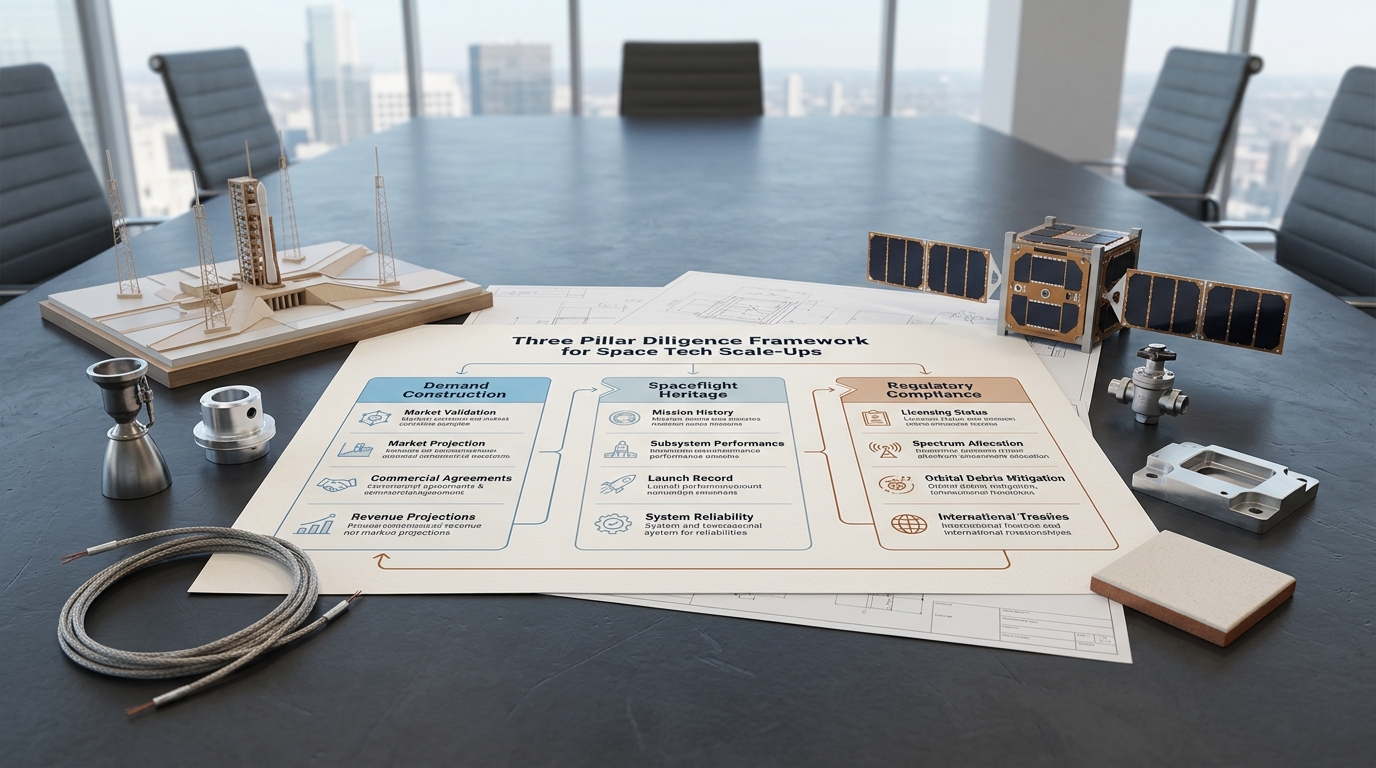
A comprehensive space tech due diligence framework evaluates target assets across three interlocking dimensions: commercial demand construction, spaceflight heritage, and regulatory overlays. Similar to broader infrastructure financing frameworks, each pillar must be audited against primary operational data rather than founder pitch decks.
- Demand Construction and Backlog Quality: Auditing whether contractual order books represent binding, enforceable take-or-pay commitments or non-binding letters of intent subject to cancellation penalties.
- Flight Heritage and Technology Maturity: Verifying component-level and system-level performance against formal standard environments rather than isolated laboratory benches.
- Regulatory Overlay and Dual-Use Compliance: Validating national security clearances, orbital slot allocations, and strict export control compliance regimes.
By evaluating companies through this multi-dimensional lens, deal teams can distinguish between genuine operational moats and narrative-driven technical prototypes.
What investors, buyers, LPs, and advisers should test
When evaluating a growth-stage space tech company, investment professionals must look beyond high-level mission milestones to evaluate shop-floor operations, supplier dependencies, and flight hardware margins. Diligence teams should execute a systematic, numbered operational audit.
Manufacturing Readiness and Tooling Investment
Scaling space hardware from prototype assembly to serial production requires substantial upfront capital before unit costs decrease. Transitioning to medium-rate production typically demands $5 million to $20 million solely in dedicated non-recurring engineering (NRE), precision jigs, environmental test chambers, and cleanroom automation tooling. Diligence teams must audit whether the company's financial model accounts for these upfront tooling outlays or unrealistically assumes linear unit-cost reductions directly from prototype builds.
Launch Cadence and Manifest Dependencies
Revenue realization in space ventures is structurally tied to launch vehicle manifest availability. Investors must scrutinize launch services agreements (LSAs), secondary payload slot commitments, and integration schedules. A six-month launch delay by a primary launch provider can freeze cash generation, double working capital burn, and trigger contractual delivery penalties with downstream constellation customers.
Tier-1 and Tier-2 Supplier Vulnerability
Spacecraft and launch systems rely on highly specialized supply chains, including space-qualified radiation-hardened semiconductors, titanium forgings, carbon-composite structures, and hydrazine propulsion components. Investors must map the complete supplier graph to identify single-source dependencies, geopolitical choke points, and lead times exceeding twelve months. Identifying these bottlenecks is central to building effective value creation evidence packs prior to investment committee approval.
SWaP-C Optimization and Technical Margins
Size, Weight, Power, and Cost (SWaP-C) metrics define satellite and payload economics. Diligence teams must verify that payload mass margins and thermal dissipation budgets have at least a 20 percent buffer relative to launch vehicle capabilities. When payload teams underestimate power consumption or mass growth during scale-up, re-engineering costs multiply rapidly and degrade unit-level margins.
- Validate scrap and rework rates across early production batches against aerospace tolerance baselines.
- Audit the availability and maintenance schedules of specialized thermal-vacuum (TVAC) and vibration test equipment.
- Verify software simulation fidelity against empirical telemetry captured from suborbital or orbital flights.
Red-flag table
During technical and commercial due diligence, certain operational anomalies indicate systemic execution risk. Deal teams should integrate structured evaluation matrices into their risk register automation workflows to ensure critical deal-breaking issues are surfaced early in the process.
| Diligence Dimension | Red Flag Indicator | Operational and Investment Impact | Recommended Diligence Action |
|---|---|---|---|
| Supply Chain Architecture | Single-source dependency on custom radiation-hardened components without secondary qualification | Component obsolescence or supplier disruption halts the entire production line for 12 to 18 months | Audit alternative vendor qualification roadmaps and require safety stock capitalization in the financial model |
| Technical Validation | Performance claims verified only under ambient laboratory conditions without TVAC testing | Payload sensor degradation or thermal failure upon entering orbit, resulting in total asset write-down | Require raw environmental test telemetry and third-party independent technical review reports |
| Customer Concentration | A single government or commercial anchor customer represents more than 40 percent of booked revenue | Extreme revenue fragility where program restructuring or budget reallocation can trigger insolvency | Test contract termination-for-convenience clauses and evaluate commercial diversification pipeline |
| Regulatory Compliance | Operations conducted without clear ITAR technical data handling protocols or active orbital spectrum licenses | Severe civil and criminal enforcement penalties, immediate loss of export authorizations, and grounding | Commission an independent trade compliance audit covering all engineering staff and data repositories |
| Working Capital & NRE | NRE and precision tooling capitalized as operational software expenditure rather than upfront CapEx | Understated true production ramp costs leading to unanticipated capital calls within 12 months | Rebuild unit cost curves by segregating recurring bill-of-materials from non-recurring manufacturing tooling |
When a target asset exhibits multiple red flags across supply chain and regulatory compliance, investors must demand explicit risk discounts or structural deal protections before progressing to term sheet execution.
Evidence checklist and data-room request list
Conducting thorough due diligence on space ventures requires requesting primary engineering artifacts and unredacted legal documentation. Deal teams should issue a targeted data-room request to benchmark the target company's operational maturity, building on standard data room checklist protocols.
Technical Readiness and Flight Qualification Records
Investors must require verifiable documentation demonstrating that hardware components have progressed through recognized Technology Readiness Levels (TRL). NASA defines TRL on a 1 to 9 scale, where TRL 6 denotes a fully functional prototype or representational model, TRL 7 requires the prototype to be demonstrated in a space environment, and TRL 9 applies once a technology has been flight proven during a successful mission. Data rooms must contain test completion logs, vibration test profiles, and thermal-vacuum bake-out reports confirming system maturity.
Regulatory Clearances and Trade Control Documentation
Space hardware and associated engineering telemetry are strictly governed by international trade regulations. Diligence requests must demand International Traffic in Arms Regulations (ITAR) registration records, Export Administration Regulations (EAR) classifications, Technical Assistance Agreements (TAAs), and formal spectrum authorizations issued by the Federal Communications Commission (FCC) or equivalent national telecommunications authorities.
Complete Bill of Materials and Supply Chain Audits
Deal teams must inspect fully indented, multi-level Bills of Materials (BOM) for each major subsystem, including propulsion, avionics, attitude determination and control systems (ADCS), solar arrays, and payload optical or RF assemblies. Every electronic component must include its country of origin, radiation-hardness rating, lead time, and single-source flag to identify supply vulnerabilities.
- Unredacted Launch Services Agreements (LSAs) detailing payload integration schedules, insurance allocations, and delay penalty provisions.
- Customer master service agreements and government contract award notices, verifying firm-fixed-price versus cost-plus structures.
- Quality management certifications, including AS9100 Rev D and ISO 9001 audit findings and corrective action records.
- Intellectual property documentation covering proprietary propulsion designs, patents, trade secrets, and non-infringement freedom-to-operate opinions.
Auditing these engineering and compliance artifacts against transparent criteria ensures that investment committees make decisions based on verified physical realities rather than ungrounded projections.
How Plausity supports the workflow
Evaluating industrial-scale space technology investments presents immense document complexity. A single transaction data room often contains tens of thousands of pages across technical specifications, environmental test telemetry, launch services agreements, ITAR technical data records, and multi-tier bills of materials. An AI-native due diligence platform can streamline these high-friction workflows for investment teams and M&A advisers.
The platform accelerates technical and commercial evaluation across several dedicated capabilities:
- Data Room Ingestion: Securely connects to and scans virtual data rooms, ingesting and structuring thousands of complex engineering PDFs, multi-tab financial models, and procurement schedules within minutes.
- AI-Analysis Engine: Reads, interprets, and cross-references dense technical documentation, parsing payload mass budgets, TRL certification reports, and complex regulatory filings across international jurisdictions.
- Risk Radar: Automatically surfaces hidden anomalies, highlighting single-source supplier vulnerabilities, ITAR compliance gaps, unhedged launch manifest delay clauses, and customer concentration thresholds.
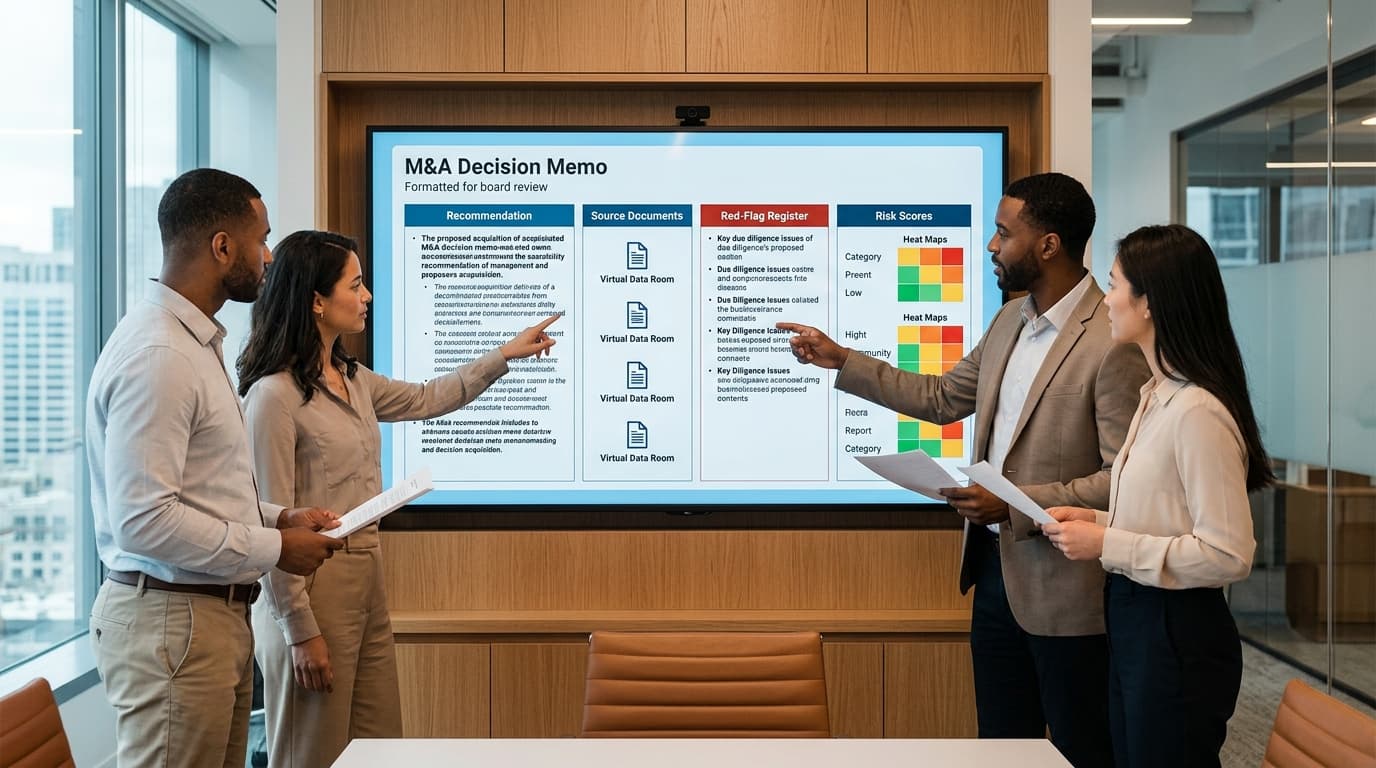
- Report Builder: Synthesizes core diligence findings into structured, professional, and investor-ready deliverables, maintaining full source traceability back to specific paragraphs in the underlying data room artifacts.
By automating the mechanical aspects of document extraction and contract cross-referencing, Plausity enables deal teams to focus their expertise on evaluating physical risks, unit economics, and operational scalability.
How to use this in your next diligence workflow
As space technology investment transitions toward industrial scale-up, deal teams must replace intuition with systematic, evidence-grounded verification. Setting up a structured evaluation workflow before entering the virtual data room ensures that technical risks, regulatory liabilities, and manufacturing tooling shortfalls are identified early in the diligence timeline.
To deploy this framework effectively in your next transaction:
- Configure your ingestion pipeline: Upload technical specifications, BOMs, and regulatory filings into Data Room Ingestion to index all engineering and commercial documentation immediately.
- Coordinate multi-disciplinary workstreams: Use Collaboration Hub to align technical specialists, regulatory counsel, and financial analysts in a unified workspace, tracking key validation milestones and workstream progress in real time.
- Audit key risk parameters: Deploy Risk Radar to scan customer contracts for termination-for-convenience clauses, verify supplier lead times, and audit ITAR compliance registers.
- Generate committee deliverables: Utilize Report Builder to draft an auditable due diligence report that transparently links technical validation findings directly to your investment thesis.
Applying a structured, AI-assisted diligence framework empowers institutional investors to underwrite space tech scale-ups with speed, precision, and complete auditability.