Why Value Creation Evidence Packs Matter Now
Private equity has entered an operational era where macroeconomic tailwinds, cheap leverage, and multiple expansion no longer guarantee fund returns. In modern transaction environments, revenue growth generated 71% of the value created in 2024 buyout exits, cementing operational execution as the primary engine of fund performance. To capture these gains, deal teams must substantiate every underwriting hypothesis with verifiable baseline data before committing capital.
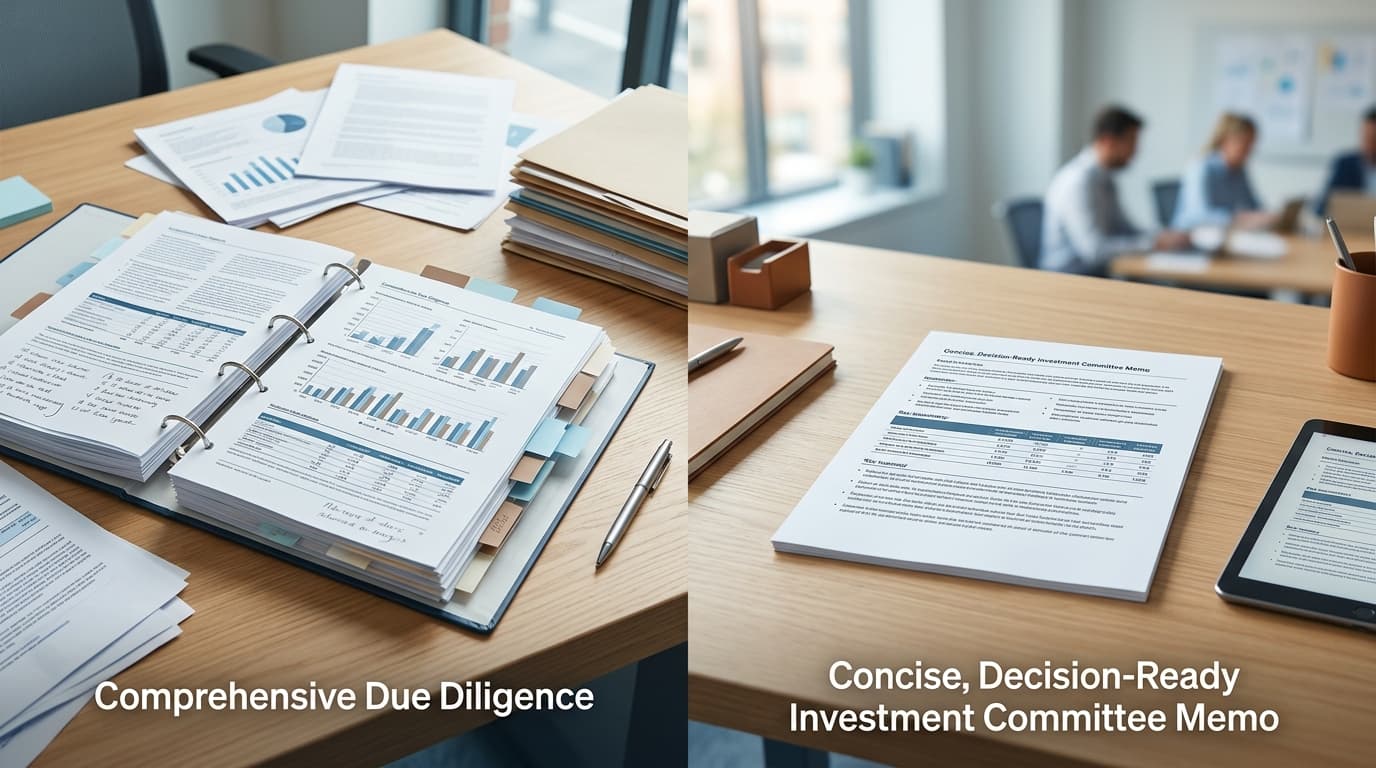
A value creation evidence pack serves as the vital institutional bridge linking pre-close due diligence findings with post-close execution realities. Historically, transaction teams produced extensive commercial and technical reports that gathered dust once the deal signed, forcing portfolio company executives and operating partners to rediscover operational facts from scratch. An evidence pack eliminates this friction by organizing every target initiative alongside documented baselines, system source tags, and clear validation criteria.
- Replaces speculative underwriting assumptions with system-verified operational baselines.
- Translates investment committee memos directly into actionable 100-day execution roadmaps.
- Assigns operational ownership and measurable milestone targets prior to deal closing.
- Identifies operational bottlenecks, legacy technical debt, and vendor constraints early.
- Maintains full audit trails from raw data room files to quarterly board reviews.
By embedding evidentiary standards into early transaction phases, investment committees can underwrite operational improvements with high confidence, ensuring that value creation strategies remain intact from closing through exit.
The Main Practical Framework for Evidence Packs
Building an institutional-grade evidence pack requires a structured architecture that converts raw data room disclosures into execution-ready initiatives. Rather than listing broad strategic ambitions, the framework demands granular operational mapping across commercial, cost, and digital workstreams to establish verifiable value creation plans.
Deconstructing the Evidence Architecture
The framework consists of four sequential layers: diligence finding extraction, operational baseline validation, initiative specification, and accountability governance. Each layer ties directly back to primary system records, ensuring that financial targets reflect technical and organizational realities.
- Diligence Finding Extraction: Ingesting virtual data room contracts, enterprise resource planning (ERP) logs, and customer transaction tables to isolate specific operational anomalies and upside opportunities.
- Baseline Verification: Extracting 12-to-24-month historical metrics directly from source systems to establish undisputed starting points for all target key performance indicators (KPIs).
- Execution-Grade Initiative Scoping: Defining the precise scope, resource requirements, capital expenditure needs, and timeline dependencies across the first 2 to 6 months post-close.
- Governance & Ownership Alignment: Assigning dedicated portfolio company operational owners, reporting cadences, and threshold triggers for variance escalation.
Applying this structure ensures that operating partners enter the post-close 100-day window with fully scoped initiatives, avoiding the delays typically caused by disputed baseline numbers or unassigned responsibilities.
What Investors and Operators Are Really Testing
Operating partners and investment committees scrutinize the evidence pack to ensure that projected EBITDA uplifts are grounded in operational feasibility rather than optimistic modeling. Recent market data indicates that 33% of private equity professionals rank operational improvements as the primary driver of their investment equity story, well ahead of secondary buy-and-build consolidation or financial restructuring.
During technical and commercial reviews, seasoned deal teams apply operational alpha due diligence to evaluate whether the portfolio company possesses the structural maturity to achieve targeted operational milestones within the required time horizon.
Core Diligence Test Dimensions
- Pricing Discipline and Margin Resilience: Verifying whether list-price adjustments can be implemented within the first 6 to 8 months without triggering customer churn or contract renegotiations.
- Sales Capacity and Funnel Velocity: Auditing CRM pipeline hygiene, conversion rates, and sales team capacity to confirm that projected customer acquisition growth is achievable.
- Cost Takeout and Procurement Feasibility: Reviewing master services agreements to validate that supplier consolidation discounts are contractually viable and free of change-of-control penalties.
- Organizational Capacity and Change Bandwidth: Evaluating management bandwidth and middle-management alignment to confirm that operational initiatives will not derail everyday business operations.
When investors test these dimensions against empirical data room records, they eliminate subjective optimism and ensure that every dollar of underwritten EBITDA growth is defensible before signing binding transaction agreements.
What Companies Are Expected to Show: Evidence Checklist
Portfolio companies and target management teams must provide granular, auditable artifacts rather than high-level pitch decks. Deal teams triage these submissions ruthlessly, concentrating on the small set of value creation levers and structural risks that genuinely dictate the investment thesis.
Modern investment workflows leverage AI diligence workflows to extract and reconcile these required data room artifacts across thousands of files, ensuring complete document coverage.
- Historical Cohort Retention Tables: Monthly customer cohort performance, net revenue retention (NRR), and gross revenue retention (GRR) broken down by customer tier and geography.
- ERP and Billing System Extracts: Transaction-level billing files, discount schedules, and standard price lists to evaluate net price realization.
- Supplier and Vendor Contracts: Comprehensive schedules of top supplier agreements, termination clauses, minimum volume commitments, and rebate structures.
- Operational Capacity and Utilization Logs: Machine-level or head-count utilization metrics, shift models, and technical infrastructure capacity limits.
- IT and Software Architecture Maps: Enterprise architecture diagrams, third-party software licenses, API integration dependencies, and technical debt documentation.
- Historical Initiative Tracking Records: Past operational performance data detailing past pricing changes, cost-out programs, or software rollouts to assess historical execution velocity.
Target companies that organize these source artifacts early significantly compress diligence timelines, build credibility with investment committees, and establish a foundation for post-close value delivery.
Red-Flag Table and Practical Implications
When due diligence uncovers gaps in operational baselines or initiative ownership, the entire underwriting model is put at risk. Study evidence indicates that roughly two-thirds of failed value creation initiatives stem from controllable factors such as unrealistic business cases, lack of portfolio company buy-in, or poor implementation rather than external shocks.
Deploying automated risk registers helps deal teams catalog and monitor these operational vulnerabilities throughout the transaction cycle.
| Operational Red Flag | Diligence Finding Pattern | EBITDA & Exit Impact | Recommended Mitigation Action |
|---|---|---|---|
| Untracked KPI Baselines | Management quotes revenue retention without system-level cohort logs | Misunderwrites recurring revenue, risking valuation write-downs | Audit raw billing system tables to reconstruct 24-month cohort retention curves |
| Orphaned Initiative Ownership | Value creation milestones lack assigned executive leaders | Delays execution by 6 to 12 months, eroding early holding period returns | Establish explicit executive initiative ownership and tie to incentive plans pre-close |
| Hidden Contractual Lock-ins | Supplier cost-reduction assumptions blocked by multi-year minimum volume commitments | Negates the procurement savings underwritten in the cost-out case | Review master services agreement termination penalties and adjust cost-out models |
| Severe Technical Debt | Outdated ERP or core software requiring complete replacement before scaling | Consumes unbudgeted capital expenditure and delays go-to-market | Incorporate mandatory IT remediation capital into the baseline sources and uses model |
| Misaligned Middle Management | Incentive schemes tied strictly to volume rather than gross margin or contribution | High operational resistance during pricing or product mix optimization | Restructure commission schedules and performance bonuses prior to deal closing |
Addressing these operational red flags during diligence allows deal teams to adjust purchase price multiples, insert specific indemnity protections, or restructure the 100-day execution roadmap before capital is wired.
How Plausity supports the workflow
Plausity equips private equity deal teams, operating partners, and M&A advisors with an AI-native diligence platform designed to transform unstructured data rooms into structured, audit-ready value creation evidence packs.
- Data Room Ingestion: Securely scans and processes thousands of virtual data room documents, including complex spreadsheets, ERP extracts, contracts, and presentations, within minutes.
- AI-Analysis Engine: Automatically interprets, cross-references, and evaluates multi-format operational data to surface hidden margin leakage, pricing variance, and efficiency upside.
- Risk Radar: Continuously scans transaction files to identify and quantify operational risks, compliance exposures, and contractual restrictions against value creation hypotheses.
- Report Builder: Compiles validated diligence findings, initiative scopes, KPI baselines, and risk summaries into investor-grade evidence packs and IC memo automation deliverables with full source traceability.
- Collaboration Hub: Provides a shared, real-time operating environment for deal leads, operating partners, and external technical advisors to coordinate workstreams and track milestone progress.
By connecting data room ingestion directly to structured report outputs, the platform ensures that deal teams spend less time on manual spreadsheet reconciliation and more time validating the operational thesis.
How to use this in your next diligence workflow
To institutionalize value creation evidence packs across your firm, deal teams should embed a standardized operational evidence protocol into their standard transaction workflow.
- Mandate Evidence-Backed Underwriting: Require all deal teams to pair every EBITDA uplift assumption in the investment committee memo with a primary system data baseline.
- Execute Early VDR Baseline Scans: Ingest transaction documents into automated diligence systems during Phase 1 to identify data gaps and untracked KPIs before bidding.
- Isolate the Core Levers: Focus operating partner reviews on the top three value creation levers and top three operational risks using the 80/20 rule.
- Define Day-1 Initiative Charters: Draft formal initiative charters specifying assigned operational owners, baseline KPIs, targets, and timeline milestones before signing.
- Transition Directly to Portfolio Monitoring: Export the finalized evidence pack directly into the portfolio company board reporting pack and 100-day tracking dashboard.
Adopting a rigorous, evidence-first approach ensures that your firm underwrites deals with precision, executes operating plans with clarity, and builds demonstrable value for exit from day one.