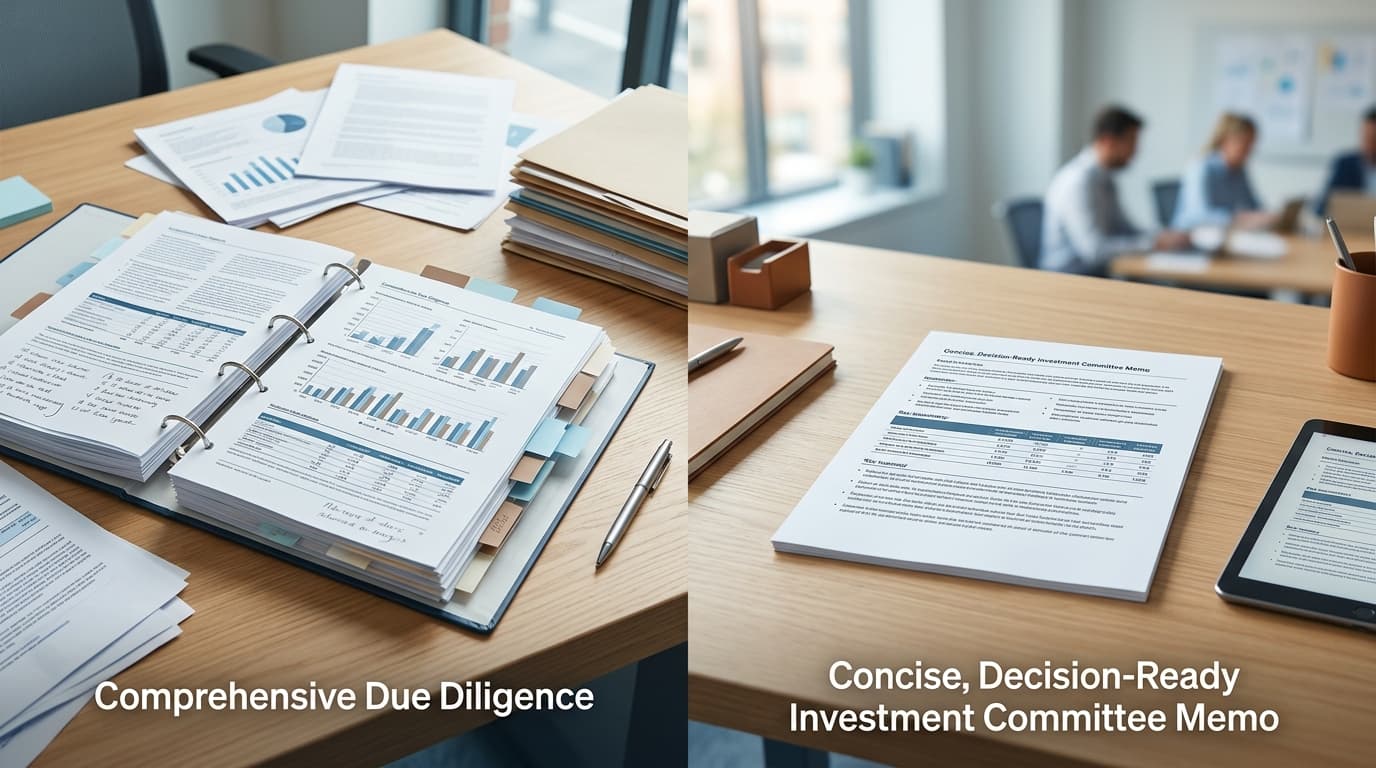
Defining the Multi-Workstream Synthesis Challenge
A modern transaction is rarely examined through a single lens. By the time a letter of intent is signed, buyers typically run parallel investigations across financial performance, taxes, legal matters, operations, customers, employees, technology, and regulatory or environmental exposure, often with separate advisors working each stream at once. Each workstream produces its own findings, its own report, and its own view of the target. The investment committee, however, does not decide on eight reports. It decides on one.
That gap between how diligence is produced and how it is consumed is the synthesis challenge. An investment committee memo that simply stacks workstream summaries together is a filing exercise, not a decision document. Synthesis means applying what practitioners call the decision-relevance filter: every finding is tested against the questions that actually determine value and feasibility, and only what changes the go/no-go decision, the valuation range, the deal structure, or the integration plan earns a place in the memo. The buyer is not trying to know everything; it is trying to know enough about the few issues that matter.
True synthesis also transforms isolated data points into connected deal intelligence. A customer concentration figure means one thing to the commercial advisor, another to the lawyer reviewing change-of-control clauses, and a third to the tax specialist assessing filing exposure. Until those perspectives are reconciled, the committee is underwriting a thesis built on fragments. Structuring the work across explicit 12 workstreams gives teams a shared map of where findings originate, which is the precondition for joining them later. The sections that follow set out how disciplined deal teams close that gap: how findings are handed off, prioritised by materiality, reconciled when they conflict, and traced back to evidence.
Why Connected Due Diligence Matters
The cost of disconnected workstreams is no longer theoretical. Research from the M&A Research Centre at Bayes Business School, analysing more than 900 global transactions announced between 2013 and 2023, found that due diligence now takes 64 per cent longer than a decade ago, with average processing time rising from 124 days to 203 days. Market players interviewed for the study attributed the lengthening to new regulatory requirements and the rise of ESG, both of which add workstreams and add interdependencies between them.
Longer timelines are only the visible symptom. When workstreams run in isolation, three failure modes recur:
- Missed red flags: a risk visible in one stream, such as a change-of-control clause in a key customer contract, never reaches the advisor who could quantify its revenue impact.
- Deal delays: questions that span workstreams, like reconciling contract terms with disclosed obligations, bounce between advisors and reopen closed analysis.
- Integration failures: operational and people findings that never inform the integration plan surface after closing, when they are most expensive to fix.
Integration is what protects the investment thesis and justifies the final valuation. Diligence exists to validate the buyer's thesis, identify risks, confirm opportunities, and determine whether findings warrant adjustments to price or structure. A committee can only make that judgement when the findings arrive connected: the commercial growth story checked against the financial quality of earnings, the operational capacity, and the legal right to transfer the assets the thesis depends on. Connected findings are also what make the memo defensible after the fact, because the reasoning behind every material claim can be shown, not asserted. Teams that treat the workstream map as the backbone of the memo, rather than an appendix, close that gap.
The Role of the Deal Captain and Materiality
Synthesis does not happen by accident; it is owned. The deal captain acts as the central node coordinating all workstream leads, holding the thesis in one hand and the emerging findings in the other. A common and effective structure pairs a small core team, typically corporate development, finance, legal, and an integration or operations lead, with functional workstream leads who carry expertise and accountability for their own domains. The captain's job is to keep those two layers in constant contact, so that synthesis is continuous rather than a scramble in the final week.
Materiality is the deal captain's primary sorting instrument. Not every finding deserves committee attention, and an undifferentiated list of observations buries the issues that should drive the decision. Prioritisation works best against explicit criteria:
- Financial impact: does the finding move the valuation, the earnings quality, or the working capital position?
- Legal exposure: does it create liability that survives closing, such as historical tax exposures or pending litigation?
- Likelihood: is the risk speculative, or is there documentary evidence it has already materialised?
- Deal relevance: does it affect the specific thesis being underwritten, or is it noise in an adjacent area?
Equally important are stop rules tied directly to the investment thesis. If the thesis depends on retention, a stop rule might be accelerating churn in the strategic segment or a contractual ability for customers to terminate on change of control. Stop rules convert the captain's coordination role into a discipline: when a finding trips one, workstream work pauses and the question escalates to the deal team, rather than being resolved quietly inside a single stream. This is also where materiality scoring earns its keep, because high-impact items rise to the top of the register while low-materiality observations are captured but deprioritised, keeping the committee's attention where it belongs.
The Practical Hand-Off Workflow
The hand-off from workstream leads to the core deal team is where most synthesis processes break, because it is usually run through static documents: a report lands, a meeting is held, and the memo writer reconciles versions by hand. A more reliable workflow treats the hand-off as a continuous loop with four stages:
- Findings are logged as they emerge, categorised by workstream, severity, and materiality, rather than batched into a final report.
- The deal captain reviews the finding register on a fixed cadence, flags items that cross workstream boundaries, and assigns follow-ups to specific owners.
- Workstream leads confirm or refute each flagged item against source documents, with disagreements recorded rather than smoothed over.
- Material findings flow into the memo draft with a live reference to their source workstream report, so the committee can trace every claim.
That last element, cross-referencing, is what maintains accountability. The memo should not absorb workstream reports; it should cite them. Each material line in the memo points back to the workstream analysis and, behind that, to the underlying document, so a committee member who challenges a claim can be shown exactly where it comes from. Research on investment memo practice underscores why this matters: memos are time-stamped artefacts that capture the assumptions an investor relied on, and those assumptions should be tracked over time in case they change. The same survey found that 97% of professional investors have a formal memo template and process, and 78% of firms require memo approval before making any investment, which makes the quality of the hand-off a firm-level capability, not a personal habit of the memo writer.
The shift from static document reviews to dynamic, continuous integration is ultimately a tooling question as much as a process one. When findings live in a shared register that every workstream can see and update, the memo draft is never more than one iteration behind the evidence. Teams that keep analysis in a single shared workspace find that the hand-off stops being an event and becomes a by-product of the work itself.
Surfacing and Reconciling Contradictions
Contradictions across workstreams are not a sign of poor diligence; they are one of its most valuable products, provided they are surfaced rather than averaged away. The classic pattern is optimistic commercial projections clashing with stark operational realities: the market analysis shows double-digit growth, while the operations review finds capacity constraints or supplier dependencies that make that growth undeliverable. Left unreconciled, the memo quietly quotes whichever stream the writer saw last.
A disciplined reconciliation framework follows the confirm-refute-refine logic that well-run diligence is built on:
- Detect: compare findings across workstreams systematically, looking for claims that cannot both be true, such as revenue projections that depend on contracts the legal review has flagged as non-transferable.
- Attribute: identify which stream owns each side of the conflict and require each lead to state the evidence behind their position, not just their conclusion.
- Test: return to the source documents. If reported performance is durable, the evidence will show it; if growth is concentrated in one channel or propped up by discounting, the documents will show that too.
- Resolve or escalate: either the contradiction dissolves under better evidence, or it becomes a material open item for the committee, with both positions and the residual uncertainty stated.
Properly contextualised red flags are the output of this process, and they have direct deal consequences. A contradiction that survives reconciliation is rarely a reason to walk; it is an input to renegotiation or protective structuring, such as price adjustments, indemnification protections, or changes to the transaction structure. A committee that sees the conflict, the evidence on both sides, and the proposed mitigation can price the risk. A committee that never saw the conflict is exposed to it.
Building the Evidence Chain and Summary Template
The evidence chain is what turns a memo from an argument into a record. Every material claim should trace through three links: the source document (the contract, financial statement, or data file), the finding it produced in the workstream analysis, and the memo line that cites it. When that chain is unbroken, a committee member can challenge any sentence in the memo and be taken, in one step, to the page and paragraph that supports it. When it is broken, the memo's authority rests entirely on the memo writer's credibility. Research on memo practice makes the case for this rigour: memos condense large amounts of diligence, expertise, and analysis into a single document that leads to an investment decision, and they capture the information, expectations, and logic behind specific investments.
A practical way to enforce the chain is a standard workstream summary block inside the memo. Each workstream contributes one, in the same format, so the committee reads eight summaries as one document rather than eight styles:
| Field | What it contains |
|---|---|
| Workstream | The stream and its lead (e.g. Financial DD, workstream lead name) |
| Thesis relevance | Which element of the investment thesis this stream was testing |
| Key findings | The two to four material findings, each with its materiality score |
| Evidence reference | Source document, page, and paragraph for each finding |
| Open items | Unresolved questions, evidence gaps, and their follow-up owner |
| Deal impact | Recommended price, structure, or integration consequence, if any |
The template does two jobs at once. It forces each workstream lead to state their findings in decision-relevant terms, and it gives the deal captain a consistent unit of synthesis to assemble. Where a summary cannot complete the evidence reference row, that gap is itself a finding: missing or insufficient evidence is surfaced as an open item for follow-up, not papered over. Teams using Findings & Risk Intelligence get this structure as a by-product of the analysis, since every finding already carries its source reference and materiality score.
How to use this in your next diligence workflow
Everything above reduces to one operating principle: synthesis is a workflow, not a writing exercise. The teams that produce strong investment committee memos are the ones whose diligence substrate, the way documents are ingested, findings are registered, and evidence is linked, makes synthesis almost mechanical. That is the problem Plausity's AI-native workspace is built for, and the earlier workstream structure shows where it plugs in.
The workflow maps end to end. Data Room Ingestion connects to the virtual data room and processes PDFs, spreadsheets, contracts, and financial models within minutes, so every workstream starts from the same corpus. The AI Analysis Engine then reads and cross-references those documents across the full workstream set, from commercial and financial to tax, tech, cybersecurity, and ESG, generating findings that are categorised by workstream, severity, and materiality from the moment analysis completes. The Collaboration Hub aligns the workstreams on top of that shared register, with task assignment, expert-in-the-loop review, and threaded discussion attached to the findings themselves.
From there, synthesis becomes decision-ready rather than manual. Findings & Risk Intelligence scores materiality, maps risks across workstreams so interconnections are visible, and detects gaps where expected disclosures or documents are missing, which is precisely the contradiction-surfacing and prioritisation work described above. The Report Builder then helps teams turn diligence analysis into decision-ready synthesis: comprehensive DD reports structured for investment committees, red flag summaries, and executive briefings, each assembled from live analysis with full source traceability rather than copy-paste. The result is IC-ready diligence findings that support evidence-grounded investment committee preparation, with the committee's judgement firmly in the chair. Built for today's investment and deal teams. Trusted by >200 firms.
- Ingest once: connect the data room so all workstreams analyse the same documents, not private copies.
- Register findings continuously: categorise by workstream, severity, and materiality as analysis runs, not after.
- Reconcile on cadence: review cross-workstream conflicts in the shared register, with owners and evidence attached.
- Assemble from live analysis: generate the memo's workstream summaries and risk register from the finding register, every line source-linked.
- Track assumptions: keep the memo's key assumptions versioned, so the committee can see what changed between drafts and why.
For teams running this discipline across a portfolio or a busy advisory practice, the same substrate supports the full deal pace, from target screening through full-scope diligence to IC materials. The workflow above can be adopted incrementally: standardise the workstream summary template first, then move the finding register into a shared workspace, then let the evidence chain do the work of keeping the memo honest.
How Plausity accelerates this workflow
Plausity is an AI-native due diligence and deal intelligence workspace that helps M&A advisory firms, VC and PE funds, corporate development teams and investment-banking teams structure evidence, findings and questions across a data room. Plausity supports evidence extraction, source grounding, findings management and IC preparation — it does not replace human analysts, advisers or investment professionals, does not provide legal, tax, audit, regulatory or investment advice, and does not make autonomous investment decisions. All findings require human review. Built for today's investment and deal teams. Trusted by >200 firms.
To explore the underlying capabilities, see the Plausity AI analysis engine and the findings and risk intelligence product page. For team-level workflows, see how VC and PE funds and M&A advisory firms use Plausity across live deals. See also the IC memo product page.