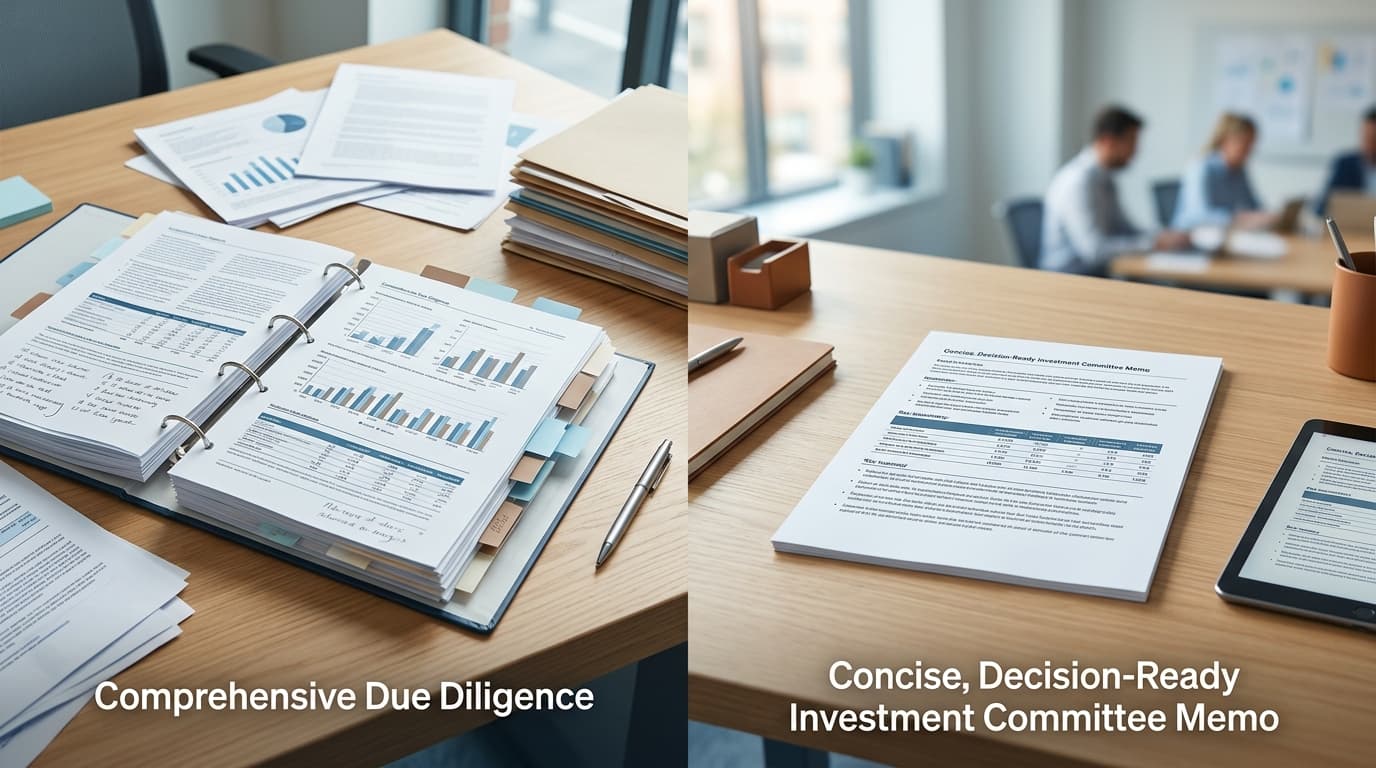
The Human Element: Why Leadership Matters in Modern M&A
Financial and legal due diligence are critical, but human factors often decide M&A success. Assessing leadership risk through modern management due diligence is essential to prevent post-merger integration failure and secure long-term deal value.
In the high-stakes arena of mergers and acquisitions, deal teams routinely spend weeks scrutinizing balance sheets, tax compliance, and legal liabilities. Yet, historical deal data consistently demonstrates that financial engineering alone rarely guarantees long-term integration success. The primary driver of transaction failure is often not a miscalculated synergy projection, but rather the rapid post-deal disruption of leadership and talent. When key executives depart or struggle to collaborate after a transaction, operational momentum stalls, customer relationships weaken, and intellectual property erodes. Consequently, evaluating human capital is no longer an optional HR exercise but a central pillar of comprehensive risk management.
Historically, assessing a target's executive team has been a highly subjective, intuitive exercise. Deal partners relied on chemistry meetings, informal reference checks, and unstructured executive interviews. These qualitative approaches are highly vulnerable to bias, masking deep structural or behavioral mismatches until after the deal closes. This challenge is why investment professionals are demanding a more rigorous methodology. According to comprehensive research by Mercer, 64% of deal professionals now consider talent-related risks a primary focus during the transaction lifecycle. Translating this focus into actionable insights requires integrating human capital assessment directly into the broader due diligence workstreams.
From Subjective Impressions to Quantified Risk
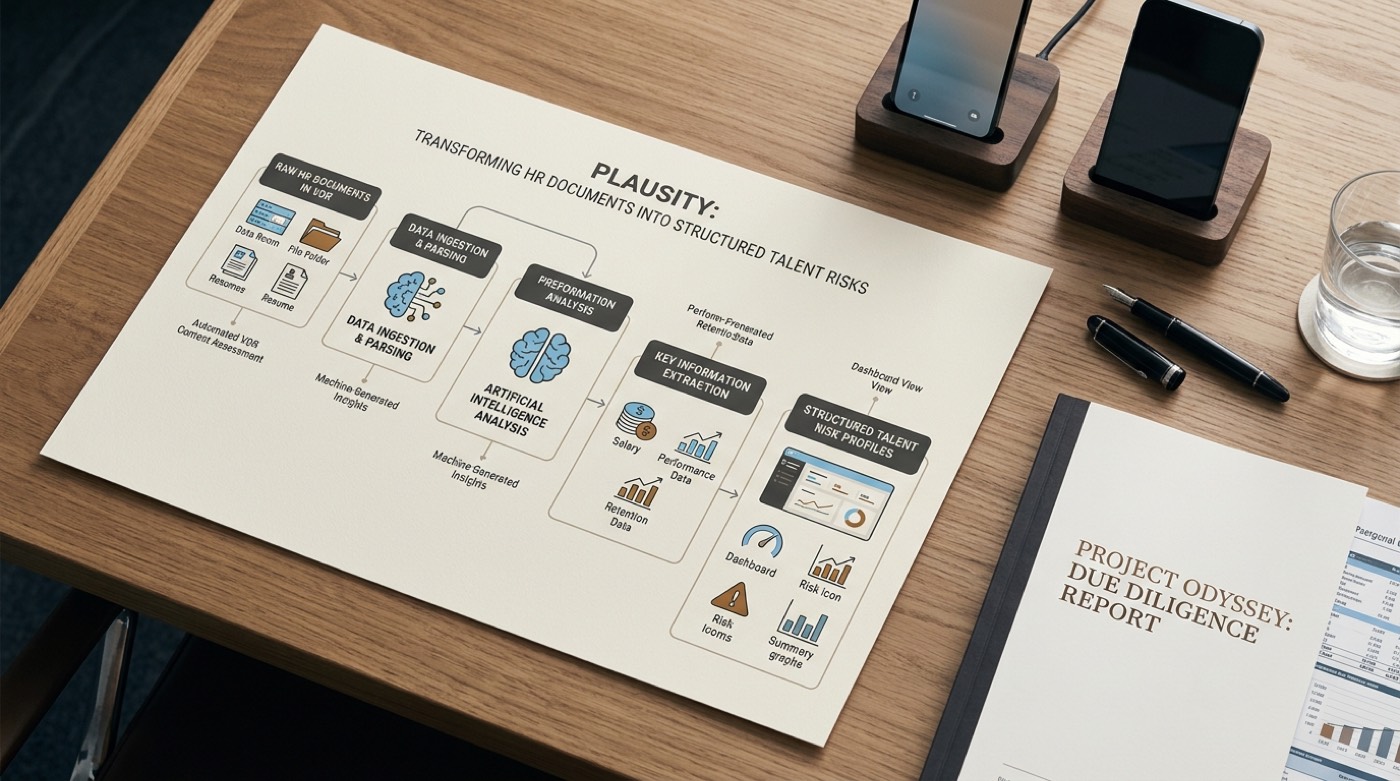
Modern deal teams are moving beyond raw intuition by establishing a data-driven, risk-quantified approach to due diligence frameworks. Rather than waiting for post-merger integration to identify executive vulnerabilities, buyers can leverage advanced technology to analyze leadership alignment, organizational design, and talent risks before signing. Modern AI tools, such as Plausity's core AI-Analysis Engine, can parse through thousands of unstructured data points in the virtual data room to construct objective profiles of target leadership. By evaluating actual organizational footprints, historical performance indicators, and governance structures, acquirers can turn leadership assessment into a repeatable, scientific discipline.
| Dimension | Traditional Approach | Modern AI-Native Approach |
|---|---|---|
| Data Source | Limited to subjective executive interviews and resume reviews | Unstructured virtual data room filings, organizational charts, and communications analyzed via Data Room Ingestion |
| Risk Assessment | Informal gut-feel evaluations and anecdotal reference checks | Systematic mapping of key-person dependencies and cultural misalignment using Risk Radar |
| Analysis Speed | Weeks of scheduling, coordination, and manual reporting | Rapid processing of thousands of documents to generate actionable talent risk insights in real time |
This transition to automated, objective analysis significantly reduces transaction timelines and increases coverage. By leveraging Data Room Ingestion, deal teams can instantly map out corporate hierarchies and identify key-person dependencies that might otherwise remain hidden in fragmented files. Our experience with corporate M&A project leads demonstrates that early discovery of these structural risks prevents costly post-deal integration friction and talent attrition. When leadership risks are systematically identified by Risk Radar, advisors can structure appropriate earn-outs, retention packages, and transition terms that align executive incentives with the buyer's long-term investment thesis.
Defining Management Due Diligence: Beyond Basic Background Checks
When preparing for an acquisition, deal teams often limit their evaluation of target company leadership to basic background screening. While verifying credit scores, professional credentials, and legal histories is a necessary compliance step, it does not address whether the target company's executives can successfully execute the investment thesis under new ownership. Management due diligence is a much broader, more strategic process. It systematically evaluates whether the existing leadership team possesses the specific capabilities, cognitive adaptability, and cultural alignment required to drive the business forward post-transaction. Rather than treating executives as static resources to be cleared, this workstream analyzes how leadership dynamics will perform under pressure during critical transition periods.
Integrating this level of analysis directly into the earliest phases of end-to-end due diligence ensures that acquirers do not overpay for businesses whose growth is entirely dependent on a few non-aligned founders. A recent Forbes analysis of corporate transactions shows that nearly 70% of mergers now succeed when acquirers successfully navigate integration missteps and focus on organizational alignment early in the process. Aligning leadership capabilities and company culture with the strategic goals of the acquirer serves as a powerful predictor of post-close performance. When corporate development leads overlook these behavioral and organizational dynamics, integration struggles often stall synergy capture and result in key executive turnover.
The Three Pillars of Strategic Leadership Evaluation
To move from subjective interviews to an objective, data-driven science, deal teams must break their management due diligence into three foundational pillars. These pillars allow investment committees to map human capital with the same quantitative rigor they apply to financial models and legal disclosures. By evaluating these aspects systematically, acquirers can identify whether the target company's executives possess the specific leadership style required to manage a high-growth environment or if they are better suited for stable, legacy operations.
- Capability Mapping: Documenting existing management strengths against future-state operational requirements to identify skills gaps early.
- Strategic Adaptability: Assessing the executives' historical track record of managing organizational pivots, scaling systems, and navigating macroeconomic shifts.
- Culture Fit and Alignment: Measuring the behavioral norms, decision-making velocity, and communication habits of the target company's leadership team to forecast post-close integration friction.
| Evaluation Dimension | Basic Background Screening | Strategic Management Due Diligence |
|---|---|---|
| Primary Focus | Verify identity, credentials, and legal compliance | Assess leadership capabilities, strategic alignment, and culture fit |
| Key Data Sources | Public records, credit checks, educational registries | Virtual data room disclosures, team structures, past performance data |
| Operational Value | Risk mitigation of fraud or legal non-compliance | Informs post-merger integration, strategic execution, and key talent retention |
Evaluating these pillars across thousands of virtual data room documents has traditionally been slow and highly subjective. However, using Plausity's AI-native due diligence platform transforms this qualitative analysis into an structured science. By employing Plausity's AI-Analysis Engine, investment professionals can rapidly scan human resources directories, corporate governance records, and organizational charts. This automated analysis allows deal teams to identify reporting bottlenecks and key-man dependencies within minutes of entering a data room. Furthermore, tools like Risk Radar help flag misalignments in compensation structures or contract terms that could incentivize sudden leadership departures post-acquisition.
Key Leadership Risk Factors in the Deal Lifecycle
In any transactional context, assessing the management team is traditionally relegated to subjective interviews and personal impressions. However, this qualitative approach often overlooks systemic leadership risks that directly impact post-acquisition value creation. Acquirers frequently face hidden vulnerabilities, such as key-person dependencies, where the target company relies excessively on a single founder or executive, and immediate flight risk among senior leadership. Research from Willis Towers Watson (WTW) underscores the scale of this exposure, showing that 72% of acquiring companies must actively deploy structured retention programs to prevent talent attrition and secure stability during post-merger integration. Recognizing these human-capital risks early is a critical component of comprehensive due diligence workstreams that professional deal teams must run.
Translating Talent Exposure into Quantifiable Deal Terms
To mitigate talent risk, corporate M&A project leads and advisory partners must shift from subjective assessments to data-driven evaluation. Modern transaction teams use specialized systems to scan the virtual data room and identify leadership anomalies before binding offers are made. For example, Plausity's Data Room Ingestion tool allows teams to immediately process organizational charts, employment contracts, non-compete clauses, and historical key performance indicators. The platform's AI-Analysis Engine then evaluates this documentation to construct an objective picture of key-person dependencies and executive alignment. Rather than relying on management's self-reporting, deal professionals can run targeted analytics through a robust due diligence checklist that includes leadership structures, reporting lines, and incentive systems to detect friction points early.
- Key-Person Dependency: Over-reliance on specific individuals for proprietary operational knowledge, customer relationships, or regulatory approvals.
- Retention and Change-of-Control Risks: Inadequate incentive alignment, vesting cliffs, or missing non-compete clauses in executive employment agreements.
- Cultural and Operational Friction: Misalignment in communication styles, reporting systems, or organizational agility during post-merger integration.
- Critical Capability Gaps: Lack of scalability in the middle management layer to support 2026 growth initiatives and expansion plans.
Analyzing these talent dynamics requires evaluating multiple interconnected data points. With Plausity's Risk Radar, deal teams can systematically surface key leadership risks, such as high-impact flight risks or unfavorable change-of-control triggers, directly within the ingested files. By cross-referencing employment agreements with historical retention rates and performance structures, the system flags vulnerabilities that might otherwise remain buried in thousands of data-room PDFs. This level of risk-quantification ensures that VC and PE investment professionals can negotiate realistic retention pools, restructure post-merger vesting schedules, or adapt valuation models to reflect leadership risks before the deal closes.
A Modern Framework for Leadership Risk Assessment
Traditional management due diligence is notoriously subjective, often reduced to brief executive interviews and intuitive gut feelings. However, studies show that between 70% and 90% of mergers and acquisitions fail to deliver their anticipated financial value, with leadership and cultural friction cited as primary root causes. For modern PE and VC teams and corporate development executives, relying on unstructured evaluation is no longer viable. Shifting to an objective, risk-quantified approach turns human capital assessment into a rigorous science. By utilizing Plausity's AI-Analysis Engine, deal teams can systematically analyze organizational footprints, historical reporting lines, and communications within the target business to uncover structural vulnerabilities that standard HR questionnaires miss.
Historical Performance Benchmarking
The first pillar of this modern framework focuses on objective, historical performance benchmarking rather than self-reported resume highlights. Deal teams must audit past executive decisions, historical budget adherence, and employee attrition trends to measure management stability. Through Plausity's Data Room Ingestion, users can instantly scan thousands of pages of historical board minutes, past financial plans, and internal corporate records. This automated scanning builds an objective timeline of leadership milestones, mapping what management promised against what they actually delivered over multiple fiscal cycles. By grounding the assessment in verified operational data, M&A advisory partners can identify track-record anomalies long before drafting final deal terms.
Competency Mapping and Redundancy Audits
The second dimension, competency mapping, evaluates whether the target's existing executive leadership possess the technical and operational capabilities required to execute the buyer's post-acquisition growth plan. Integrating this mapping into broader due diligence workstreams prevents critical post-merger integration delays. For example, if a target software company plans to transition to an enterprise sales model, the sales leadership must have documented experience managing complex enterprise cycles, not just transactional self-serve channels. Utilizing Plausity's Risk Radar allows acquirers to spot key-person dependencies and competency gaps, flagging areas where the target relies too heavily on a single founder or executive to sustain operations.
Strategic Alignment Scoring
The final dimension measures strategic alignment, scoring the operational gap between the seller's current strategic path and the acquirer's post-deal value creation roadmap. Modern transaction teams use configurable templates to score executive alignment objectively across key criteria, such as geographic expansion capabilities or cost-synergy acceptance. Rather than relying on subjective opinions, this process translates qualitative leadership observation into a structured, numerical risk matrix. This strategic alignment score can be directly integrated into the transaction model, giving investment committees a concrete metric to assess whether the target leadership can execute the next phase of corporate growth.
| Evaluation Dimension | Traditional Subjective Approach | Modern Risk-Quantified Framework |
|---|---|---|
| Evaluation Basis | Unstructured interviews and subjective impressions | AI-driven analysis of historical board minutes and track records |
| Risk Assessment | Anecdotal feedback and gut-feel alignment scores | Quantified risk matrices highlighting key-person dependency via Risk Radar |
| Process Integration | Siloed HR workstream separated from financial diligence | Fully integrated workstream mapped against the post-merger value creation plan |
To make these findings actionable, deal teams must seamlessly synthesize their structural analysis into executive-ready outputs. By relying on Plausity's Report Builder, corporate development leaders and private equity analysts can instantly aggregate leadership insights, track-record metrics, and competency maps into a cohesive due diligence report. This report is fully back-linked to its source data within the virtual data room, ensuring that every finding on leadership risk is backed by verifiable analytical evidence rather than simple subjective opinion.
Leveraging AI and Automation in Talent Diligence
Traditional talent assessments in mergers and acquisitions have historically leaned on subjective interviews, high-level leadership reviews, and self-reported performance records. While these traditional methods provide qualitative color, they are frequently vulnerable to cognitive bias and limited sample sizes. According to a global transactions report, 64 percent of respondents identify talent-related issues as the most significant area of focus during mergers and acquisitions. Despite this importance, post-deal integration frequently falters when senior executives and key employees leave unexpectedly, highlighting that talent flight remains a critical, unresolved threat to deal value. To address these challenges, modern deal teams are shifting talent evaluation from an intuitive guessing game into a rigorous, data-driven science by integrating automated analysis early in the process.
By utilizing an AI-native due diligence platform, deal teams can systematically parse organizational data rather than relying on late-stage interviews. Through automated workflows, tools like Data Room Ingestion enable transactional teams to seamlessly scan virtual data rooms and extract unstructured human resources data in minutes. Once the documents are uploaded, the AI-Analysis Engine processes thousands of organizational charts, payroll schedules, historical headcount tables, and employment agreements. This massive data ingestion allows buy-side teams to map the true organizational footprint of a target enterprise, creating an objective baseline of leadership structure and talent distribution before any introductory interview takes place.
Identifying Structural Anomalies and Flight Risks
As talent diligence establishes itself as a core component of comprehensive end-to-end due diligence, AI-powered analytical layers allow acquirers to proactively identify deep organizational risks. Instead of waiting for post-merger integration to reveal systemic bottlenecks, Risk Radar automatically scans the target's corporate structure to surface immediate risks, structural anomalies, and hidden flight vulnerabilities. By cross-referencing compensation details with local market averages and equity vesting schedules, the platform flags which mission-critical personnel have the highest likelihood of leaving soon after the transaction is finalized.
- Key Person Dependency: Highlighting central operational figures who hold disproportionate administrative access, customer relationships, or specialized engineering knowledge.
- Compensation and Equity Cliffs: Spotting key executives whose unvested equity options cliff-vest immediately upon change-of-control, creating substantial financial incentives to leave.
- Span-of-Control Imbalances: Detecting leadership layers with either too many direct reports or highly redundant management structures that cause post-close friction.
- Historical Turnover Vectors: Tracking departmental headcount histories to isolate teams with high attrition rates, indicating potential cultural or leadership dysfunction.
A key advantage of this automated approach is full source traceability, which allows corporate M&A project leads and advisory teams to immediately verify every finding. When Risk Radar flags a flight risk or a structural vulnerability, the deal team is not forced to trust a black-box conclusion. Instead, they can click directly on the flagged risk to see the exact employment contract clauses, organizational chart nodes, or salary line items that triggered the warning. This trace-to-source capability equips transactional partners to negotiate precise retention structures, adjust valuation models, and design highly targeted post-close integration playbooks based on verifiable data.
Structuring Post-Deal Retention and Integration Plans
The true measure of management due diligence is how effectively its findings translate into post-acquisition execution. Traditionally, transaction teams treated leadership evaluation as a compliance exercise separate from post-deal planning. However, modern corporate development leaders and private equity investors realize that integrating qualitative and quantitative leadership insights directly into the 100-day transition roadmap is what preserves long-term deal value. Modern advisory teams and corporate M&A project leads use structured frameworks to bridge the gap between pre-deal discovery and post-deal integration. By shifting from subjective, relationship-based interviews to data-driven, risk-quantified assessments, acquirers can turn leadership risk mitigation into an objective, replicable science. Leveraging tools like Plausity's AI-Analysis Engine to parse management histories, past organizational structures, and performance footprints in the virtual data room helps deal teams spot potential integration hurdles long before the close.
Designing Tailored Post-Acquisition Financial Incentives
Financial alignment must be carefully tailored to the risk profiles identified during pre-deal diligence. Acquirers cannot rely on a one-size-fits-all retention package. According to research on corporate integration, transaction teams typically target less than 2% of the target company's total headcount for formal retention agreements. Deciding who fits into this elite cohort depends on objective data. For instance, analyzing historical communication flows and key-person dependencies using the Data Room Ingestion module allows deal teams to pinpoint unsung technical leaders who hold critical operational knowledge. Once these key players are identified, transaction teams can deploy customized financial incentives to ensure stability through the integration phase.
| Incentive Structure | Diligence Red Flag Addressed | Target Leadership Tier | Strategic Alignment |
|---|---|---|---|
| Retention Bonuses | Short-term flight risk during transition | Middle management and core operational leaders | Secures continuity and knowledge transfer through the critical first 180 days. |
| Earn-Out Structures | Uncertainty in post-acquisition commercial performance | Founding CEOs and revenue-generating executives | Aligns financial payout with post-deal performance targets over a multi-year period. |
| Roll-Over Equity | Misaligned long-term strategic vision | Top-tier C-suite executives and key decision-makers | Ensures leaders remain committed to the overall equity growth and terminal value of the platform. |
The 100-Day Leadership Integration Framework
Securing long-term value requires more than just financial golden handcuffs. A structured 100-day leadership integration plan is necessary to mitigate role confusion, cultural friction, and strategic drift. In the high-stakes environment of post-deal transition, the window between announcement and close is when high-value leadership is most recruitable and vulnerable to attrition. Therefore, integration mapping must begin during the pre-deal phase. By feeding org charts, employment agreements, and operational performance records into Plausity's Risk Radar, deal teams can map out potential reporting conflicts and communication gaps before Day 1.
- Days 1 to 15: Establish immediate governance structures and hold individual alignment workshops with key leaders to clarify new reporting lines and decision-making authority.
- Days 16 to 45: Conduct thorough operational handovers and implement the customized retention bonus structures designed during pre-deal diligence.
- Days 46 to 75: Initiate collaborative strategic planning sessions using Plausity's Collaboration Hub to align the target leadership team with the acquirer's long-term business goals.
- Days 76 to 100: Complete a formal performance and cultural alignment review, addressing any integration friction points surfaced by the transaction team's ongoing risk analysis.
By executing a structured, data-driven integration process, transaction teams can systematically de-risk the human capital element of the transaction. Leadership is often cited as the primary reason why mergers and acquisitions succeed or fail. Transitioning from subjective evaluation to a continuous, documented analysis ensures that post-deal execution is just as analytical and robust as the pre-deal financial modeling.
Plausity brings AI-native analysis to this workstream. Explore how Plausity supports management due diligence.