Where syndicated analyst reports earn their place
The direct answer: syndicated analyst reports are a strong starting layer for large, public, well-covered end markets, but they are context, not evidence. A report can frame a market, size its tiers and summarise how listed peers are performing, yet it cannot tell an investment committee anything specific about the private company, niche vertical or recent inflection sitting inside the deal at hand. Treating the report as the finding, rather than as the framing, is where diligence quietly goes wrong.
What these reports genuinely do well
- Market framing: a structured view of the industry, its value chain and its competitive dynamics, produced by analysts who track the sector continuously.
- Top-down sizing: a defensible starting structure for TAM, SAM and SOM that a deal team can then pressure-test against bottom-up evidence.
- Listed-peer dynamics: consensus growth narratives, margin benchmarks and valuation context drawn from public comparables.
- Speed and coverage economics: one subscription gives an associate a credible first draft of the landscape in hours rather than weeks.
This is why institutional buyers keep subscribing. For a fund screening dozens of targets a year, off-the-shelf industry reports are an efficient way to build shared market vocabulary across the team and to sanity-check whether a thesis is plausible before committing diligence hours. The same logic holds for advisory teams scoping a commercial diligence workstream: the report orients the work, it does not conclude it.
The limits are equally well established. The SEC cautions investors not to rely solely on any analyst recommendation when making an investment decision, and to research the investment themselves before committing capital. The same guidance flags the structural point that matters for deal teams: analysts must disclose potential conflicts of interest, including whether their firm holds a position in the security, makes a market in it, or has an investment banking relationship with the company.
The practical conclusion for PE, VC and corporate development teams is a layering discipline: use the syndicated report to frame the market, then build the evidence base underneath it from primary sources. The next sections cover where that framing systematically breaks down, and how to close the gap with target-specific, source-grounded research.
The four systematic blind spots of syndicated coverage
Syndicated analyst reports earn their place in a diligence stack as a context layer, but the way that coverage is produced creates four recurring gaps. None of them is a flaw in any individual research house. They follow from the economics of syndicated research: analysts allocate scarce coverage capacity to the largest, most liquid and most institutionally interesting names, and publish on a cycle. Deal teams that treat the resulting reports as target-specific evidence inherit those structural choices as their own blind spots.
Niche verticals that never justify a report
Most private targets do not compete in the vertical a report covers. They compete in a subcategory of it: a slice of industrial software, one reimbursement code in medtech, a single niche in specialty chemicals. Syndicated franchises are built around verticals large enough to support a recurring subscription base, so a sub-segment worth a few hundred million euros globally may appear only as a paragraph inside a broader market chapter. The report is not wrong about the vertical; it simply has nothing to say about the specific served market, pricing dynamics and competitive set your target actually faces. That is precisely the layer an investment committee needs, and it has to be built from primary evidence rather than purchased.
Private companies with no disclosure obligation
Coverage follows disclosure. Public companies file, so analysts can model them; private companies do not, so in most cases nobody outside the deal team has ever built a bottom-up view of their revenue quality, customer concentration or margin structure. Even the public universe is unevenly covered: sell-side coverage capacity is finite, analysts carry long lists of names, and the smallest listed companies are often uneconomic for large-bank coverage at all. If listed small caps struggle to attract a single covering analyst, a private company in a niche vertical should be assumed to have zero relevant syndicated coverage until proven otherwise.
Sub-segment mismatch between report and target
Even when a report exists, its market definitions are canned. They are drawn to serve many readers across many transactions, so the segmentation, growth rates and competitive rankings rarely match the target's actual served market or revenue model. A report may size a market at double-digit growth while the target's specific segment is flat, or rank competitors the target never encounters. Reconciling the report's frame with the target's real revenue build is analytical work, and skipping it is how a plausible external number migrates into an IC memo as if it were target-specific.
Recent inflections the last data cut missed
Syndicated research updates on publication cycles: annual refreshes, quarterly data cuts, scheduled forecast revisions. Demand shifts, regulatory changes, customer losses and technology disruptions that occurred after the last cut are invisible in the document, however material they are to the deal. A report published eight months ago cannot reflect a pricing change, a new entrant or a pending regulation that landed last quarter. Diligence has to capture the target as it is now, which means primary sources: statutory filings, management materials, customer references and the target's own data, organised in a structured workspace so every finding stays traceable to its source and any divergence between the syndicated view and the primary evidence is visible.
A three-layer evidence framework for target-specific research
The practical answer is not to abandon syndicated reports but to stack target-specific evidence on top of them, layer by layer. Each layer answers a different class of question, and each finding should map to a specific claim in the deal thesis rather than being collected generically. A useful discipline is to work through three layers, moving from the most verifiable public record to the most proprietary source: the company's own customers.
| Layer | Primary sources | What it verifies |
|---|---|---|
| 1. Public filings and regulator records | Annual reports, prospectuses, sector registries, competition and regulatory filings | Market size, competitor positions, disclosed risks, historical financials. Statutory filings give a detailed picture of a company's business, the risks it faces and its operating and financial results, on the public record rather than in summary form. |
| 2. Management materials and data room documents | Contracts, financial models, board packs, customer lists, management presentations | Unit economics, churn and cohort behaviour, contract terms, pipeline quality, the assumptions behind management's plan |
| 3. Customer references and voice-of-customer work | Structured reference calls, win/loss interviews, churned-customer reviews | Real buying behaviour, switching risk, pricing power, product satisfaction, the claims off-the-shelf reports most often lack |
Layer one grounds the market and competitive facts a syndicated report generalises. Layer two tests whether the target's own numbers support the thesis, which is where an AI analysis engine that cross-references thousands of documents with source traceability earns its place in the workflow. Layer three is the element reports almost never contain: direct evidence from the customers whose renewals and expansions the thesis depends on.
The framework only works when it is claim-driven. Before opening a single document, list the three to five load-bearing assertions in the IC memo, assign each to a layer, and record which source settles it. That structure keeps the team from drowning in undifferentiated reading and makes every finding traceable to evidence, the discipline that findings and risk intelligence tooling is designed to support.
What deal teams should test: checklist and red flags
Before a syndicated report feeds an IC memo, treat it as a set of claims to be tested rather than findings to be accepted. The core tests are quick, and each one either upgrades the report into usable context or demotes it to background reading.
- Stated assumptions behind market sizing: what growth rates, penetration curves and price points drive the top-down number, and are they documented?
- Addressable versus penetrated market: how much of the claimed TAM the target actually serves today, at what share and margin.
- Voice-of-customer evidence: whether demand claims rest on named customer interviews, churn data or anonymous survey aggregates.
- Non-public competitor information: whether competitive claims cite verifiable sources or unattributable 'market participants'.
- Data cut-off date: when fieldwork closed, and whether it predates a recent inflection in pricing, funding or regulation.
Red flags cluster around provenance. A canned report reused across deals, a missing methodology section, stale data presented as current, and undisclosed conflicts of interest each justify discounting the analysis. The conflicts concern is structural, not hypothetical: FINRA's research rules exist precisely because analyst research carries inherent conflicts, requiring firms to separate research from investment banking in supervision, budgeting and compensation, and to disclose material conflicts. For a deal team, the practical implication is that a report's conclusions should be read alongside its disclosures, and neither substitutes for evidence drawn from the target itself.
The practical response is to log every red flag against the finding it touches, with a source link, so the IC sees which conclusions rest on tested evidence and which rest on borrowed context. A structured risk register makes that discipline repeatable, and provenance tracking keeps every claim tied to the document it came from.
Practical transaction implications for the deal team
The coverage gaps described above are not an academic critique of syndicated research; they translate directly into deal risk. The first pressure point is the investment committee. An IC memo that leans on broad market context alone invites challenge, because committee members can ask the one question a syndicated report cannot answer: what does the evidence for this specific target actually say? Findings need source traceability to survive that scrutiny. A claim such as 'the target is gaining share' must resolve to a named document, a customer reference, or a filing, not to a third-party market overview written for a different purpose. Structured findings with materiality scoring and source-linked evidence give committee reviewers a chain they can check rather than an assertion they must take on faith.
The second pressure point is pricing and structure. Evidence gaps move value. Where primary evidence is thin, uncertainty does not simply get priced into the model; it migrates into the transaction documents. Weaker evidence on customer concentration, contract terms, or revenue durability typically surfaces as tighter representations and warranties, broader indemnities, earnout structures, and purchase-price adjustments. Deal teams that close the evidence gap early with management materials, customer references, and statutory filings negotiate from a stronger baseline and often avoid paying for that uncertainty twice, once in price and again in protection.
The third pressure point is internal. Even when teams want to layer primary evidence, their tooling often fights them. Industry reporting on private markets describes persistent data fragmentation, low organisational readiness for AI and the persistence of manual, spreadsheet-based workflows, with only 8% of private equity, credit and venture capital professionals in a Coalition Greenwich survey believing their firms have a high degree of data maturity. The constraint, in other words, is usually workflow and traceability, not access to reports.
- Test every IC finding for source traceability before the memo goes to committee.
- Treat evidence gaps as negotiation inputs: they shape reps and warranties, earnouts, and price adjustments.
- Prioritise primary evidence on the target's own customers, contracts, and filings over additional syndicated context.
- Fix the collaboration and traceability workflow before adding more data sources to the stack.
The practical conclusion is straightforward: syndicated context sets the frame, but the deal is won or lost on target-specific evidence, and the teams who organise that evidence in a shared, source-grounded workspace, for example through Plausity's Collaboration & Workflow, carry stronger positions into both the committee room and the negotiation table.
How Plausity supports source-grounded diligence
The evidence layer described above does not assemble itself. In practice, the bottleneck is rarely a shortage of documents; it is the time it takes to read them, cross-reference them across workstreams, and turn what they contain into findings an investment committee can rely on. That fragmentation problem is well documented: S&P Global Market Intelligence's 2026 private equity survey found many firms constrained by fragmented data and limited visibility into the metrics that matter most, with 37% of GPs dissatisfied with the quality and availability of non-public operational metrics and fragmented or unstructured data cited as a key barrier. GARP reports a similar picture across private markets, where data fragmentation has made it difficult for investors to get a clear picture, and where a Coalition Greenwich survey found only 8% of private capital professionals believe their firms have a high degree of data maturity.
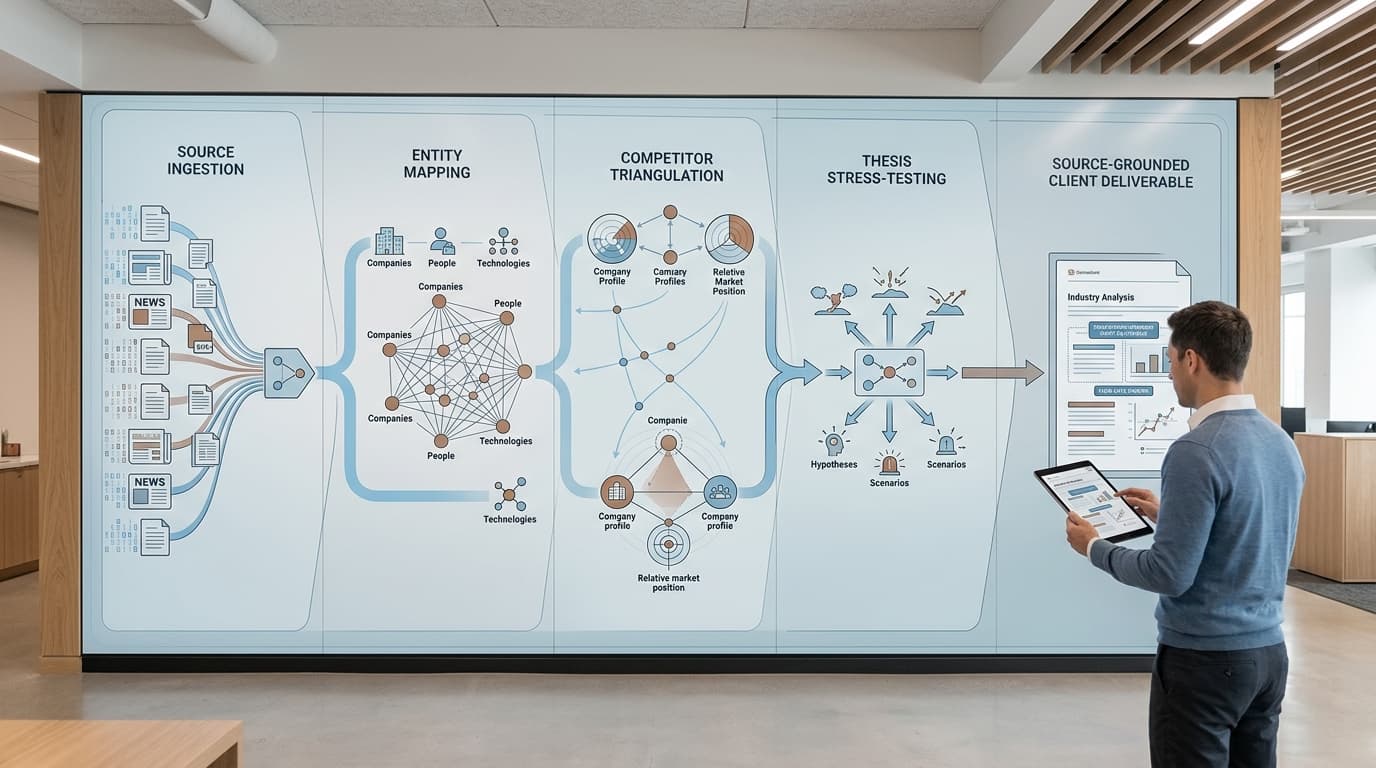
Plausity is built to close that gap between the context layer and the evidence layer. It is a collaborative AI workspace that structures the diligence workflow itself: it ingests the documents, reads and cross-references them, surfaces and scores findings, and drafts the deliverables, with every claim traceable back to its source. It supports and structures diligence; it does not replace research houses, market-data platforms or professional judgment. The syndicated reports and databases discussed earlier remain the context layer. What Plausity adds is the target-specific evidence layer on top of them, and the workflow that keeps the two connected.
From data room to draft report
- Data Room Ingestion connects to virtual data rooms and ingests PDFs, spreadsheets, contracts and financial models within minutes, so the target-specific corpus is assembled in hours rather than weeks. For a view of how this fits into the wider tooling landscape, see the comparison of AI data room analysis software for M&A and private equity.
- The AI-Analysis Engine reads, interprets and cross-references thousands of documents and data points, connecting findings across commercial, financial, legal and technology workstreams, so a disclosure gap in one workstream is visible to the others. The engine produces DD-grade analysis with source traceability and confidence scoring.
- Risk Radar evaluates each finding by materiality, financial impact, legal exposure and deal relevance, so the team's attention goes to the anomalies that could actually move the transaction rather than to an undifferentiated list of observations.
- Report Builder drafts investor-ready deliverables with full source traceability, which means every statement in the report can be traced back to the underlying document, clause or data point that supports it.
- The Collaboration Hub coordinates workstreams in real time, with task assignment, threaded review and role-based access, so analysts, partners and external experts work from the same evidence base rather than parallel versions of it.
The practical effect is that the questions raised in the previous section, what to test, which documents to request, which red flags to escalate, get answered from the target's own record rather than from an extrapolation. A fund diligencing a niche industrial software company, or an adviser running sell-side preparation for a founder-owned business, can point the analysis at the actual contracts, management accounts and customer materials, and let the platform keep the evidence chain intact from ingestion through to the final report. For teams that want to see how this maps to their deal model, Plausity's workspaces are configured for VC & PE funds and for M&A advisory firms respectively, with the same underlying evidence discipline in both cases.
How to use this in your next diligence workflow
The layering discipline described above only creates value if it runs as a repeatable sequence on every deal, not as an ad-hoc reading exercise. The operating rhythm is straightforward: inventory what the syndicated report actually proves, route everything else to a primary-evidence layer, and make the residual gaps visible before the investment committee, not after.
This is the workflow Plausity is built for. The AI-Analysis Engine reads and cross-references filings and data-room documents against the claims in your thesis, Findings & Risk Intelligence surfaces unsupported assertions as scored, source-linked risks, and the Report Builder drafts IC-ready deliverables where every statement carries its evidence. Built for today's investment and deal teams. Trusted by more than 200 firms. The syndicated report remains a useful context layer; the conviction, however, should rest on the primary evidence your own register can point to.
How Plausity accelerates this workflow
Plausity is an AI-native due diligence and deal intelligence workspace that helps M&A advisory firms, VC and PE funds, corporate development teams and investment-banking teams structure evidence, findings and questions across a data room. Plausity supports evidence extraction, source grounding, findings management and IC preparation — it does not replace human analysts, advisers or investment professionals, does not provide legal, tax, audit, regulatory or investment advice, and does not make autonomous investment decisions. All findings require human review. Built for today's investment and deal teams. Trusted by >200 firms.
To explore the underlying capabilities, see the Plausity AI analysis engine and the findings and risk intelligence product page. For team-level workflows, see how VC and PE funds and M&A advisory firms use Plausity across live deals.