What AI-powered industry analysis is, and why it matters now
AI-powered industry analysis is the practice of using LLM-based tools to ingest market sources, structure competitor and market evidence, and draft findings under explicit consultant oversight. The definition carries a boundary condition that matters as much as the capability itself: the technology augments professional judgment, it does not replace it. The consultant still frames the research questions, decides what is material, and signs off on the conclusions that reach the client. What changes is the volume of evidence a single analyst can credibly process, and the speed at which a first structured view of a market can be produced.
The scope of the practice covers the mechanical backbone of industry work: reading data rooms, statutory filings, market reports and management materials; mapping the entities that populate a market, from customers and suppliers to competitors; cross-referencing claims across sources; and assembling first-draft findings that a specialist then tests, corrects and elevates. None of these steps was previously automatable without losing traceability, which is precisely why they consumed so much junior time.
Adoption has moved well past the pilot stage. Deloitte's 2026 Generative AI in M&A Pulse Study finds that 90% of organizations now use GenAI in M&A processes, with 37% applying it across multiple stages of the deal life cycle. On the consulting side, research from LexisNexis reports that 80% of management consultants already use generative AI tools in their daily tasks. These figures describe the baseline operating environment for market analysis in due diligence, not an early-adopter fringe.
Client expectations have shifted accordingly. Buyers now assume that industry analysis arrives faster, covers more ground, and carries an evidence link behind every claim. A loosely sourced narrative deck is harder to defend in front of an investment committee, not because the judgment behind it is weaker, but because the evidence trail is thinner than what the client knows is achievable.
- Definition: LLM-based ingestion, structuring and drafting of market and competitor evidence under consultant oversight, augmenting rather than replacing judgment.
- Adoption: 90% of organizations now use GenAI in M&A (Deloitte 2026 Pulse Study); 80% of management consultants use GenAI in daily tasks (LexisNexis).
- Client expectation: faster, evidence-linked industry work is becoming the assumed standard for advisory deliverables.
The AI-augmented workflow: from ingestion to thesis stress-testing
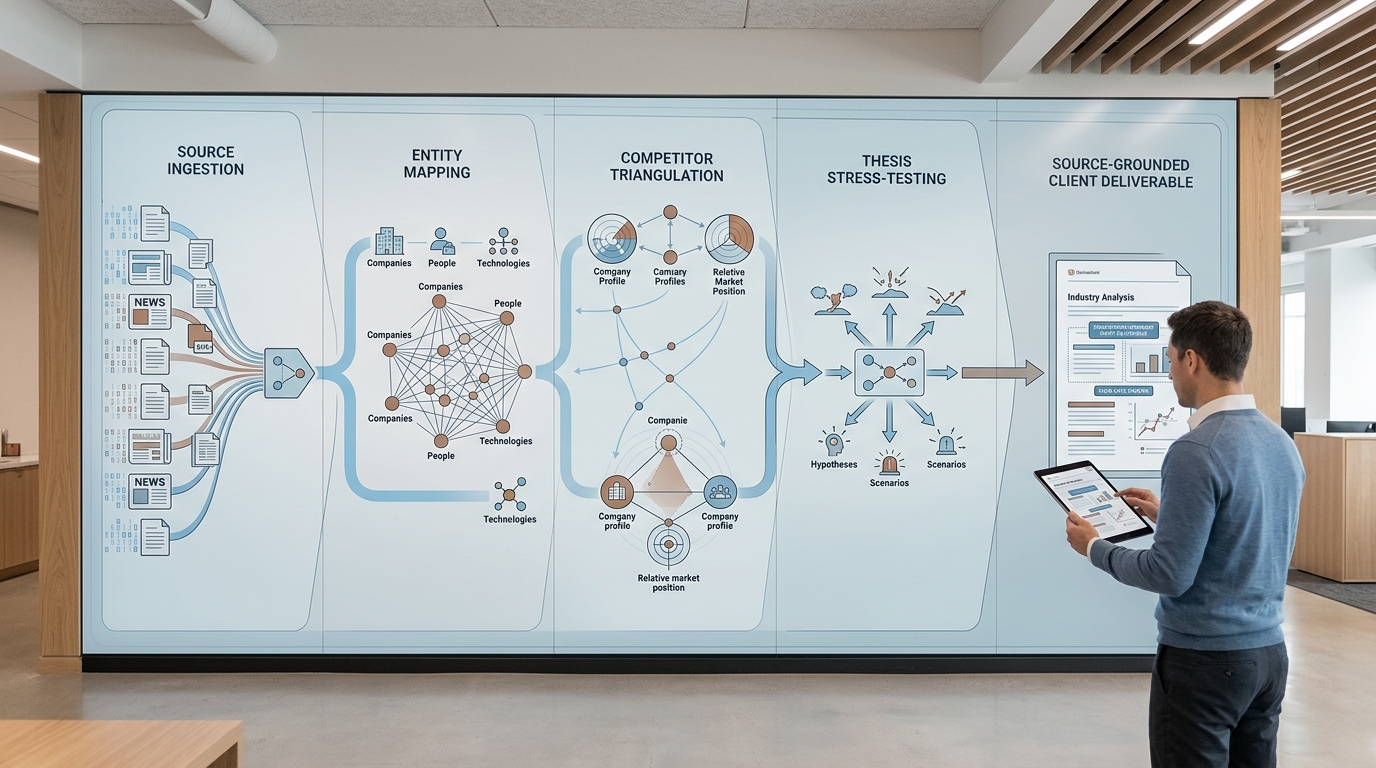
The workflow that has emerged in advisory practice runs in five stages, each of which converts a manual bottleneck into a structured, reviewable step. The stages are sequential, but the discipline that matters most is the traceability carried through all of them: every output at every stage should remain linked to the source document it came from.
Stage 1: Source ingestion
The first stage connects the raw material: virtual data rooms, statutory filings, market reports, management presentations and financial models. Purpose-built ingestion processes thousands of documents in minutes rather than weeks, classifying them by workstream and building the index that every later stage depends on. This is where provenance is established, and data-room analysis software that records the source of every document at ingestion saves substantial rework later, when findings need to be traced back to their origin.
Stage 2: Entity and market mapping
Once sources are ingested, the second stage builds the structure of the market: who the customers are, who supplies them, who competes for the same demand, and how the entities relate to each other. AI accelerates this by extracting entity mentions across thousands of pages and consolidating them into a coherent map, but the consultant decides which relationships are material to the thesis and which are noise. The map is a working hypothesis, not a conclusion.
Stage 3: Competitor triangulation
The third stage cross-references competitor and market claims across independent sources: what management says about market share, what customers say in call transcripts, what filings disclose about revenue concentration, what industry reports estimate about growth. This is where volume processing earns its place in competitive analysis, because every source can be held in view at once and divergences flagged. The consultant then judges which divergence is a data problem and which is a genuine signal.
Stage 4: Thesis stress-testing
The fourth stage deliberately attacks the working thesis. If the thesis assumes pricing power, the analysis searches for evidence of discounting. If it assumes durable growth, it searches for churn and substitution signals. KPMG observes that AI accelerates the review of data rooms and unstructured documents and surfaces anomalies, trends and red flags earlier, allowing specialists to focus on material issues and judgment calls. Stress-testing is where that capability changes the economics of diligence: the second and third hypothesis can now be tested, not just the first.
Stage 5: Synthesis
The final stage assembles tested findings into a structured view: what is known, what is estimated, what remains unverified, and what the evidence supports concluding. AI drafts the synthesis; the consultant decides what it means for the client's decision. The output is a findings register with source links, not a narrative that has to be reverse-engineered to find its evidence.
- Stage 1, Source ingestion: connect data rooms, filings and market reports; thousands of documents processed in minutes.
- Stage 2, Entity and market mapping: build the structure of customers, suppliers and competitors from extracted entities.
- Stage 3, Competitor triangulation: cross-reference claims across independent sources and flag divergences.
- Stage 4, Thesis stress-testing: deliberately search for evidence against each thesis assumption.
- Stage 5, Synthesis: assemble tested findings into a source-linked view for the client deliverable.
What AI does well, and where consultant judgment stays central
The division of labor is not a slogan; it maps to specific tasks on each side. Being explicit about it protects both the quality of the deliverable and the credibility of the firm that signs it.
What AI does well
AI excels at volume processing: reading thousands of pages of data-room material, filings and market reports in a fraction of the time manual review requires. It cross-references claims across sources without fatigue, produces first-draft summaries that give a senior professional a running start, and detects anomalies, unusual revenue patterns, inconsistent disclosures, outlier contract terms, that a tired reviewer scanning page 800 might miss. These are the tasks where the constraint was always human hours, not human judgment.
Where judgment stays central
Judgment remains central where the question is not what does the document say but what does it mean and does it matter. Materiality calls, deciding which findings change the deal thesis and which are footnotes, cannot be delegated. Framing the analysis so it answers the client's actual decision, conducting primary-source interviews with customers and market participants, interpreting client context that never appears in any document, and owning the final conclusions all stay with the consultant. AI structures the evidence; the professional weighs it.
The governance evidence
Deloitte's 2026 Pulse Study provides the governance data point: human review remains the top requirement for high-stakes GenAI use, and only about one-third of organizations apply GenAI to judgment-intensive negotiating steps, a clear signal that practitioners themselves distinguish between mechanical and judgment-critical stages. KPMG's guidance is operational: map where human judgment is essential, including materiality thresholds, exceptions and sign-offs, and embed these checkpoints directly into the workflow, with traceability to source documents so insights can be defended in negotiations.
| Dimension | AI handles | Consultant owns |
|---|---|---|
| Volume | Reading thousands of pages across data rooms and filings | Deciding which of those pages matter for the thesis |
| Cross-referencing | Flagging where claims diverge across sources | Judging whether a divergence is noise or signal |
| First drafts | Producing structured summaries and findings registers | Reframing the analysis around the client's decision |
| Anomaly detection | Surfacing outliers and inconsistencies at scale | Determining whether an anomaly is material |
| Conclusions | Structuring the evidence behind each conclusion | Owning the final judgment and client sign-off |
Keeping findings source-grounded and defensible
Defensibility is the test that separates AI-assisted advisory work from AI-assisted guesswork. A client deliverable must survive the question: where did this come from? Three disciplines make that answer automatic rather than improvised.
Trace every claim to a source document
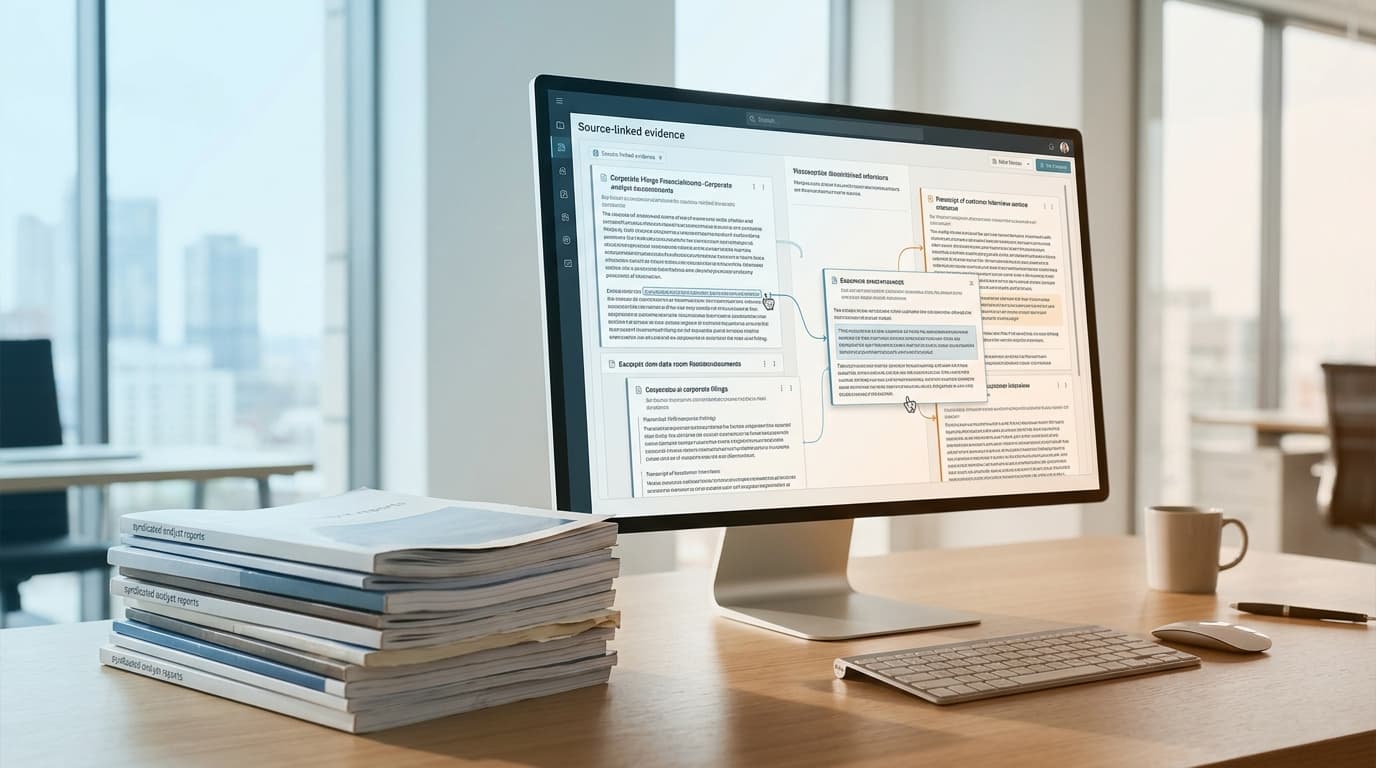
Every claim in a client-facing finding should trace to a specific source document, and that provenance is cheapest to capture at ingestion, when the document first enters the workflow. Retrofitting provenance after analysis is error-prone and expensive, which is why data provenance in AI due diligence is treated as a design requirement rather than a reporting afterthought. Platforms like Plausity's AI Analysis Engine produce findings with source traceability so that each conclusion carries its evidence with it, and the Findings & Risk Intelligence module scores materiality and maps cross-workstream risks against those same source links.
Verify every AI-generated reference
The citation risk is not theoretical. An arXiv study evaluating chatbots against financial literature, analyzing 150 citations, found that ChatGPT-4o fabricated references 20.0% of the time, while Gemini Advanced fabricated 76.7%. The study's own conclusion is the operating instruction: chatbot-provided references must be verified, particularly in rapidly evolving fields. For advisory work the implication is direct: a reference that appears in a draft finding is a lead, not a fact, until someone has opened the source and confirmed it supports the claim.
Treat quality control as a governance requirement
Quality control is not a courtesy step; dealmakers themselves rank it as the leading risk. In the SS&C Intralinks survey of global M&A professionals, a quarter of respondents cite quality control and reliable performance as the top risks associated with AI adoption, ahead of data security and privacy at 19%. The practical translation: a QC gate on AI-assisted findings, with a named reviewer, is becoming as standard as a partner review of a final deck.
- Record provenance at ingestion: capture the source document the moment it enters the workflow, not after analysis.
- Verify every AI-generated reference against the actual source before it appears in a client deliverable.
- Apply a named-reviewer QC gate to AI-assisted findings; a quarter of dealmakers rank quality control as the top AI adoption risk.
- Distinguish drafted claims from verified findings in the working papers, so the client deliverable contains only the latter.
What deal teams should test: red flags and evidence gaps
A concrete test list turns the governance principles above into daily practice. Deal teams running AI-assisted industry analysis should apply three checks before any finding moves from draft to deliverable.
Triangulation checks
Test whether competitor and market claims hold across at least two independent sources. A market-size estimate that appears only in a management presentation is a hypothesis; the same estimate corroborated by an industry report and a customer interview is a finding. AI makes the triangulation check fast by holding all sources in view at once, but the team should confirm the sources are genuinely independent rather than circular, three outlets citing the same press release is one source, not three.
Evidence-gap review
Use AI-flagged missing documents and unanswered questions as a driver for follow-up requests rather than as a reason to proceed on partial evidence. A structured gap list, which documents were requested but never provided, which questions in the management session went unanswered, which market claims lack any third-party corroboration, is itself a deliverable-quality signal. Platforms that surface evidence gaps systematically, scoring findings on materiality and deal relevance, turn the gap review from an afterthought into a managed workstream and reduce the AI blind spots that partial context creates.
Red flags in AI output
Specific patterns in AI output warrant immediate skepticism: unsourced claims with no document behind them, stale data presented as current, single-source conclusions resting on one document, and internally contradictory findings where one section of the analysis contradicts another. Each pattern maps to a failure mode the verification studies document, and each is detectable with a targeted review rather than a full re-read.
The broader context supports the effort: in the SS&C Intralinks survey, 16% of dealmakers identify risk and opportunity identification as the area where AI will matter most, second only to data analysis. And PwC observes that AI lets teams stress-test deal theses in new ways, including simulations that test a thesis before it reaches the investment committee. The teams that benefit most are the ones that pair that capability with a disciplined test list.
- Triangulation: confirm competitor and market claims across at least two genuinely independent sources.
- Evidence gaps: convert AI-flagged missing documents and unanswered questions into structured follow-up requests.
- Red flags: challenge unsourced claims, stale data, single-source conclusions and internally contradictory findings before they reach the client.
Practical transaction implications for advisory deliverables
The changes ripple through advisory practice in three dimensions: the speed and depth of the analysis itself, the quality standard of the deliverable, and the operating model of the team that produces it.
Speed and depth
PwC's benchmark testing shows productivity gains of 35% to 85%, with some diligence tasks, such as competitor analysis and internal financials analysis, going from weeks to days. The gain is not only calendar speed. Because the mechanical review compresses, teams can test more hypotheses, cover more of the data room, and iterate on the thesis rather than defending the first draft produced under time pressure.
Deliverable quality
The quality bar shifts from narrative polish to evidence discipline. Audit-ready findings with source traceability, where every material claim links to the document that supports it, replace loosely sourced narrative decks as the standard for client work. This is a structural change in what clients receive: a findings register with provenance, a red-flag summary with severity scoring, and a synthesis that distinguishes verified conclusions from open questions. Tools that draft these deliverables with traceability built in, such as Plausity's reports and deliverables module, make the standard repeatable rather than heroic.
Operating-model consequences
As routine research hours shrink, staffing models, pricing structures and QC processes need redesign. The analyst leveraged on hourly research is a different economic unit from the analyst supervising AI-assisted review and exercising judgment on materiality. Deloitte's study adds a capability signal: integration with approved deal data sources is cited as the most important capability of an M&A technology solution, which means tool selection is now an operating-model decision, not an IT procurement one.
- Speed and depth: productivity gains of 35% to 85% in benchmark testing, with competitor and financials analysis compressed from weeks to days (PwC).
- Deliverable quality: audit-ready, source-traceable findings replace loosely sourced narrative decks as the client standard.
- Operating model: staffing, pricing and QC processes require redesign as routine research hours shrink; integration with approved deal data sources is the most valued platform capability (Deloitte).
How to use this in your next diligence workflow
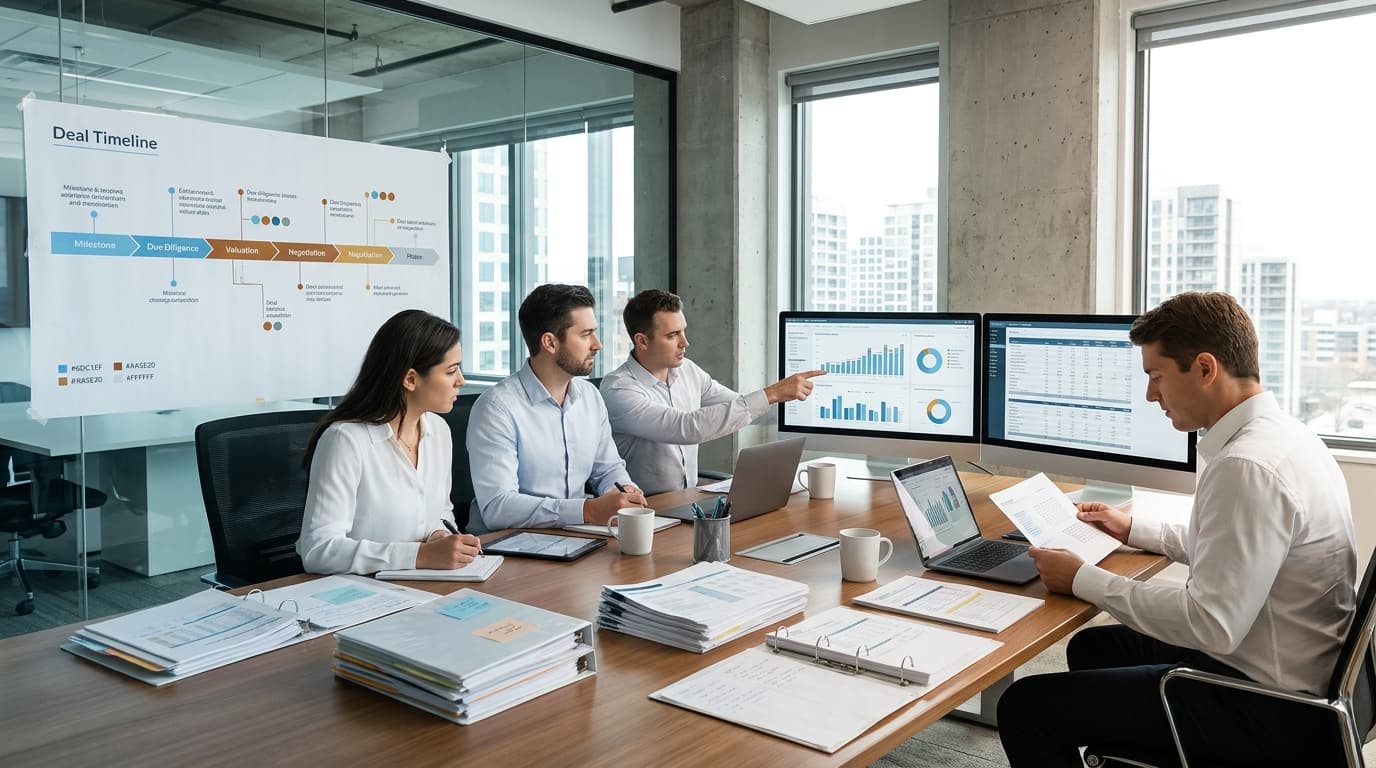
The workflow above compresses into a repeatable sequence that a deal team can run on its next engagement. The steps below pair each stage with the capability that supports it, and with the human checkpoint that keeps the work defensible.
- Connect and scan the data room. Use Data Room Ingestion to connect to the VDR and process PDFs, spreadsheets, contracts and financial models in minutes, recording provenance for every document at the point of entry.
- Run structured reading and cross-referencing. Use the AI-Analysis Engine to read across the corpus, extract entity and market structure, cross-reference claims, and draft findings with source traceability attached to each one.
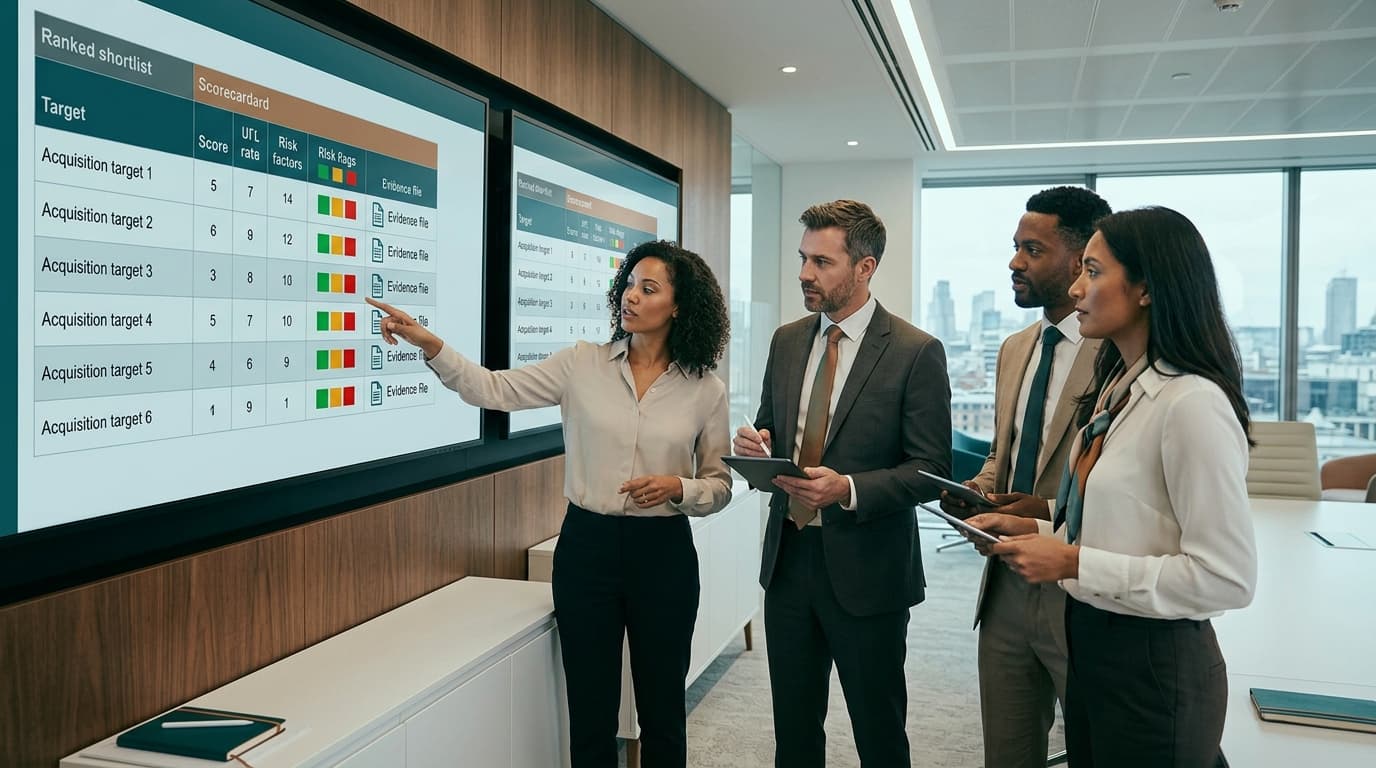
- Surface and rank material risks. Use Risk Radar to score findings on materiality, financial impact, legal exposure and deal relevance, so the team's attention goes to the risks that move the thesis.
- Stress-test the thesis and review evidence gaps. Challenge each thesis assumption against the corpus, convert AI-flagged gaps into follow-up requests, and apply the triangulation and red-flag checks from the section above.
- Draft the client deliverable with full traceability. Use Report Builder to structure the findings register, red-flag summary and executive briefing, with every material claim linked to its source document.
- Coordinate workstreams and human sign-off. Use the collaboration and workflow layer to assign workstreams, thread review comments, and hold sign-off at every materiality threshold, per KPMG's human-in-the-loop design principle of embedding checkpoints for materiality, exceptions and sign-offs directly into the workflow.
The teams that gain most from AI-assisted industry analysis are not the ones that automate the most steps; they are the ones that automate the volume work completely enough to reinvest the saved hours in judgment, triangulation and client context. That reinvestment, not the technology alone, is what makes the deliverable defensible.
How Plausity accelerates this workflow
Plausity is an AI-native due diligence and deal intelligence workspace that helps M&A advisory firms, VC and PE funds, corporate development teams and investment-banking teams structure evidence, findings and questions across a data room. Plausity supports evidence extraction, source grounding, findings management and IC preparation — it does not replace human analysts, advisers or investment professionals, does not provide legal, tax, audit, regulatory or investment advice, and does not make autonomous investment decisions. All findings require human review. Built for today's investment and deal teams. Trusted by >200 firms.
To explore the underlying capabilities, see the Plausity AI analysis engine and the findings and risk intelligence product page. For team-level workflows, see how VC and PE funds and M&A advisory firms use Plausity across live deals.