What AI-powered workflow optimization means for a lean M&A boutique
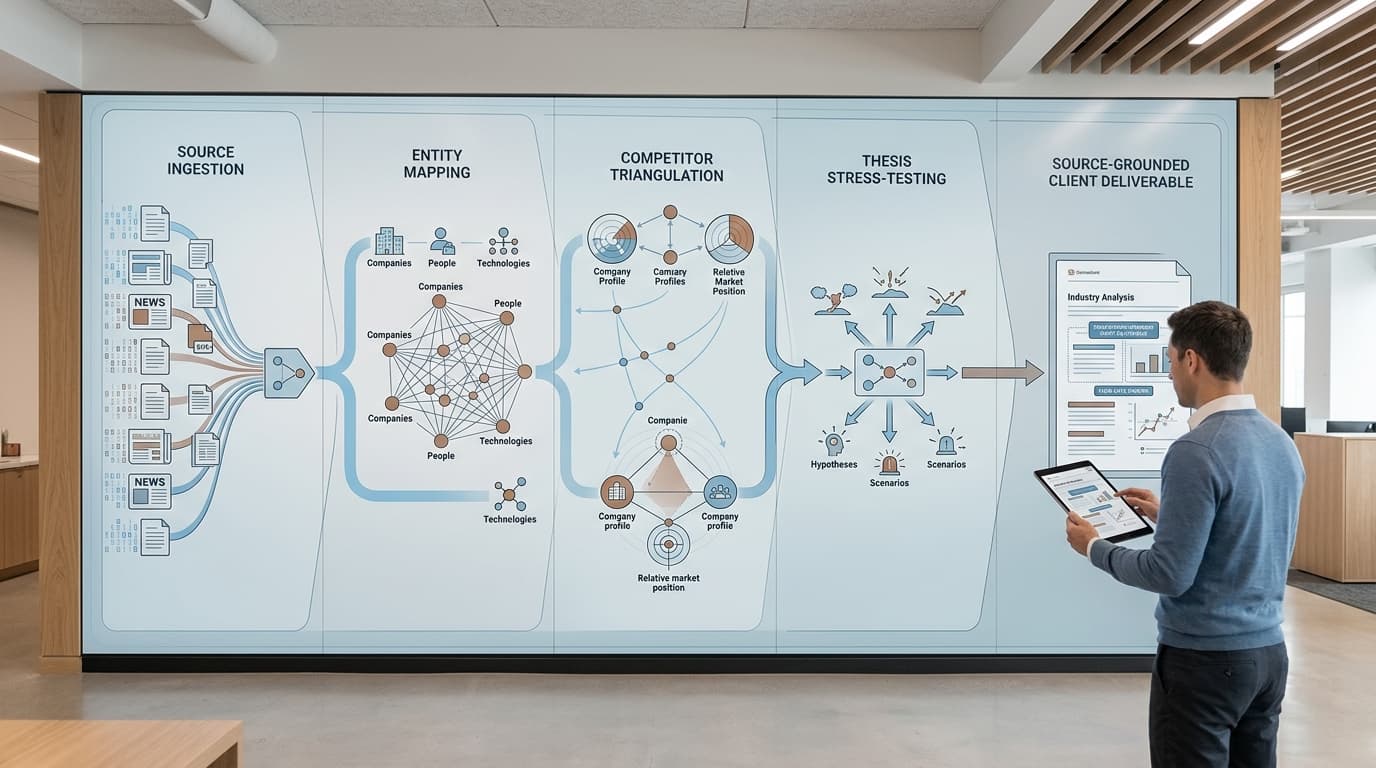
AI-powered workflow optimization is the deliberate restructuring of the deal workflow so that AI handles document-heavy extraction and structuring while partners concentrate scarce analyst hours on judgment, client work and negotiation. In practice, it means the first pass over a data room, the cross-referencing of contract terms against financial disclosures, and the assembly of findings into a structured evidence base are performed by machines, and the partner's team reviews, challenges and extends that work rather than producing it line by line. For a boutique with three analysts where a bulge-bracket peer has thirty, this is not a convenience. It is the only realistic way to cover the same diligence surface without adding headcount.
The shift is no longer marginal. Deloitte's 2026 Generative AI in M&A Pulse Study reports that 90% of organizations now use GenAI in M&A processes and 37% apply it across multiple stages of the deal life cycle. Use is also moving beyond diligence: the same survey finds 49% of respondents applying GenAI in deal closing and 52% in post-close integration. It also finds that human review remains the top requirement for high-stakes GenAI use, and that a system's ability to integrate with approved deal data sources is the most important capability of an M&A technology solution. Adoption, in other words, has become table stakes; the differentiator is how well the workflow around the tooling is designed.
What the term covers, and what it does not
- Document analysis: reading and cross-referencing thousands of diligence documents, as a dedicated AI analysis engine does with source traceability.
- Evidence structuring: organizing extracted facts into findings that link each claim to its underlying document.
- Risk surfacing: flagging anomalies and materiality-weighted issues for partner review.
- Report drafting: producing structured first drafts of deliverables that analysts refine rather than write from scratch.
- What it explicitly does not cover: automated valuation, autonomous investment decisions, or replacing professional judgment. The partner still owns the conclusion, and the study's finding on human oversight confirms the market agrees.
For M&A advisory partners and analysts, the practical framing is an operating model question, not a tooling shopping list. The sections that follow break the boutique workflow into four core patterns and the lightweight governance each requires.
Why boutiques feel the pressure first
AI-supported diligence has stopped being an early-adopter experiment and become the baseline expectation in dealmaking. KPMG's 2025 M&A Deal Market Study found that 77 percent of surveyed dealmakers are already using AI in their M&A processes, with a further 19 percent planning to start soon. The same study puts completing due diligence among the top obstacles to closing deals, cited by 41 percent of respondents, second only to agreeing on valuation. Read together, those two numbers define the competitive problem: the bottleneck has shifted from access to AI tooling to the capacity to run rigorous diligence, and most of the market is already retooling around it.
For a lean boutique, that pressure arrives earlier and lands harder than it does for a bulge-bracket firm. A mid-market sell-side mandate or a buy-side screening process generates much the same document volume, the same data-room sprawl and the same cross-workstream questions as a large-cap process, but a boutique team works through it with a handful of analysts rather than a layered bench. When a partner is also the reviewer, the model validator and the client contact, every hour of manual document triage, evidence chasing and memo formatting is an hour taken directly from client work and judgment.
The widening-gap warning
Deloitte's analysis of generative AI in investment banking makes the asymmetry explicit. It forecasts front-office productivity gains of 27 to 35 percent for the top global banks, with the investment banking division, which includes M&A advisory and due diligence, benefiting the most at an estimated average of 34 percent. The same analysis warns that as the investments required to develop these capabilities grow, the technology may widen the gap among market participants and put smaller, boutique firms at a disadvantage. Deloitte also notes the countervailing force: productivity gains can level the playing field by lowering barriers to entry and intensifying competition. Which effect a boutique experiences depends on whether it restructures its workflows or simply buys tools.
That distinction matters because the constraint at boutique scale is analyst hours, not analyst capability. The counter-move is therefore not hiring to match a large firm's bench; it is compressing the hours each workstream consumes, so the same team covers document review, evidence structuring, IC-memo drafting and sell-side longlist support with institutional rigor. The sections that follow set out how that compression works in practice, and what governance a small team needs to run AI-supported diligence without an operations department behind it.
- 77 percent of dealmakers already use AI in M&A processes, and a further 19 percent plan to soon (KPMG 2025 M&A Deal Market Study, a survey of 300 US M&A professionals).
- Completing due diligence is a top obstacle to closing deals for 41 percent of respondents, behind only agreeing on valuation at 44 percent.
- Deloitte estimates front-office productivity gains of 27 to 35 percent for the top 14 global investment banks, with the investment banking division, which includes M&A and advisory, the biggest beneficiary at an estimated 34 percent.
- Deloitte cautions that as the investment needed for these capabilities grows, the technology may widen the gap among market participants and put smaller, boutique firms at a disadvantage, even as productivity gains can also lower barriers to entry.
The boutique stack: four workflows where AI compresses analyst hours
For a lean advisory team, the operating-model question is not which tools to buy but which workflows to restructure. Four carry most of the analyst-hour load in a typical boutique engagement: data-room review, evidence structuring, IC-memo drafting, and sell-side longlist support. Each has a well-established manual pattern, a workable AI-supported pattern, and a human checkpoint that must survive the transition intact. The scale of the prize is real but should be read as a forecast, not a promise: Deloitte predicts that generative AI can lift front-office productivity at the top global investment banks by 27% to 35%, with investment banking division tasks averaging an estimated 34% because they involve more repetitive document work.
| Workflow | Manual baseline | AI-supported pattern | Human checkpoint |
|---|---|---|---|
| Data-room review | Sequential reading of every document; findings live in individual inboxes | Automated data room ingestion and triage of the full room, with cross-document queries | Partner reviews materiality-weighted findings before anything is circulated |
| Evidence structuring | Copy-pasted excerpts in slides, weak source trail | Every finding anchored to a source document and page with confidence scoring | Analyst verifies each citation against the underlying document |
| IC-memo drafting | Days of formatting and re-keying analysis into a template | AI drafts the structure and evidence sections of reports and deliverables; partners shape the argument | Senior professional owns the recommendation and final wording |
| Sell-side longlist support | Manual research across registries, websites, and databases | AI-assisted screening and synthesis of candidate profiles, then human curation | Deal lead validates fit, timing, and contact strategy |
The economic shift across all four workflows is the same: analyst hours move from extraction to judgment. In the manual pattern, a boutique's scarce senior capacity is spent locating documents, reconciling versions, and reformatting findings. In the AI-supported pattern, the machine handles the high-volume reading and cross-referencing, and the checkpoint becomes the place where the firm's analytical reputation is actually earned. That is why the checkpoint column matters more than the tooling column: a boutique that automates review but skips verification has changed its risk profile, not its productivity.
Two practical notes on sequencing. Start with data-room review and evidence structuring, because they feed everything downstream and their quality is easiest to audit. Treat IC-memo drafting as the second wave, since it inherits the quality of the evidence layer beneath it. And keep the coordination layer visible: shared workstreams and expert-in-the-loop review, of the kind a structured workspace such as Collaboration Hub supports, are what stop four restructured workflows from becoming four new silos.
Governance and red flags without an operations team
Large firms institutionalise oversight through dedicated operations and risk functions. A boutique has neither, which means governance has to be built into the workflow itself rather than bolted on as a department. The good news is that the controls that matter most in AI-supported diligence are lightweight by design: every finding traceable to a source document, every AI-generated claim reviewable by a named human before it reaches a client or an IC. Deloitte's 2026 Generative AI in M&A Pulse Study confirms the direction of travel: human review remains the top requirement for high-stakes GenAI use, and practices that verify AI outputs are essential precisely because GenAI processes are not highly visible.
Why source-grounded findings are non-negotiable
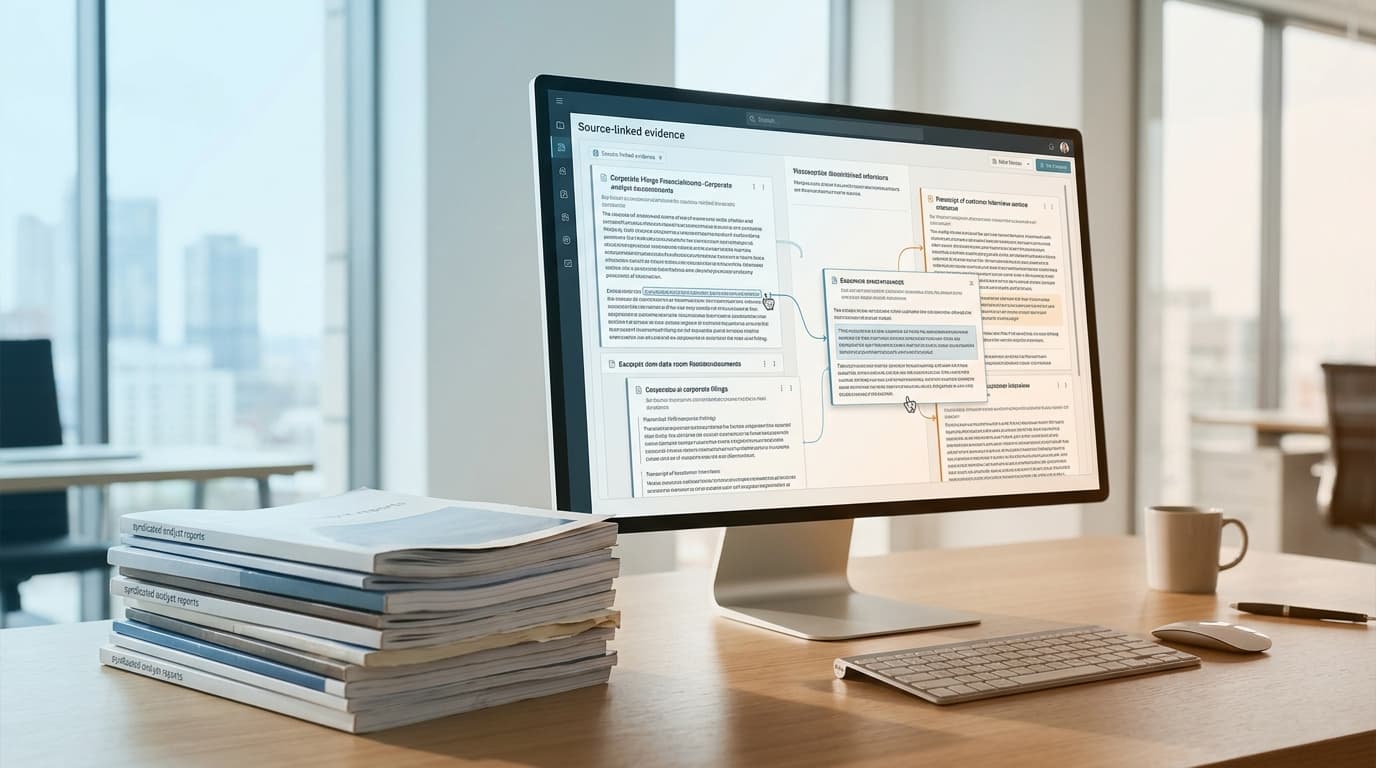
The evidence on hallucination risk is sobering enough to treat ungrounded AI output as a category error, not an inconvenience. Deloitte Switzerland's analysis of AI risk in M&A diligence cites Stanford research from 2024 showing that general-purpose chatbots produced hallucination rates of 58 to 88 percent on legal questions, and a 2024 medical study in which GPT-4 hallucinated 28.6 percent of citations when asked to generate references for systematic reviews. For a boutique whose entire product is analytical credibility, a single fabricated citation in a diligence report is an existential event. This is why source-grounded findings, with an auditable data provenance trail back to the underlying document, are the baseline requirement rather than a nice-to-have. Platforms built for this produce findings and risk intelligence with source traceability and confidence scoring, so that every claim can be checked against the document it came from.
Red flags to watch for
- Unsourced conclusions: any AI-generated finding that cannot be traced to a specific document, page, or data point should be treated as a hypothesis at best, and excluded from client deliverables at worst.
- Fluency mistaken for accuracy: large language models produce confident, well-structured prose regardless of whether the underlying claim is correct, so polish is not evidence of correctness.
- Uncontrolled document handling: diligence materials pasted into general-purpose chatbots leave the firm's control perimeter, creating confidentiality and data-protection exposure that no amount of analytical speed offsets.
- Compounded errors across steps: when one AI output feeds the next analysis stage without verification, small inaccuracies accumulate into large distortions, a propagation risk Deloitte highlights for agentic AI models.
Lightweight controls that substitute for a governance department
Three practices give a lean team most of the protection a large operations function would provide. First, expert-in-the-loop review: AI findings are triaged and validated by a senior professional before they enter the risk register or the report, which is the control Deloitte's pulse study identifies as the top requirement for high-stakes use. Second, a single shared workspace rather than scattered personal chats: when findings, comments, and evidence live in one auditable place, review becomes a workflow step instead of a forensic exercise. Third, role-based access and document-level permissions, so that sensitive materials are only visible to the people who need them. Tools designed for this operating model, such as Plausity's collaboration and workflow workspace, coordinate workstreams and expert review in one place, which is how a five-person team runs controls that at a bulge-bracket firm would sit with a whole operations team.
None of this requires headcount. It requires that the firm decide, once, that no unsourced claim leaves the building, and then choose tooling that makes that rule the path of least resistance. For boutiques, governance done this way is not overhead. It is the mechanism that lets a small team credibly claim the analytical rigour of a much larger one.
What to test before relying on an AI-supported workflow
For a boutique, the pilot is the governance. A lean team cannot absorb a tool that quietly misreads contracts or invents a covenant term, so the evaluation has to happen against your own documents, not a vendor's demo set. Four tests separate tools that can carry deal work from tools that create review debt.
- Extraction accuracy against a known sample. Take ten to twenty documents you have already analysed manually (a SPA, a customer contract set, a management account pack) and compare the tool's output line by line. You are measuring whether it confuses defined terms, misses amendments, or misreads tables in scanned PDFs.
- Source traceability for every finding. Ask the tool to justify a finding and check whether each claim links back to a specific document and page. If a finding cannot be traced, it cannot be defended in an IC discussion or a negotiation, and it should not enter your workstream. The same discipline applies to the questions you put to a data room.
- Data handling and confidentiality controls. Confirm where documents are processed and stored, who can access them, and what administrative controls exist for sensitive deal materials. The market is moving this way: OpenAI's ChatGPT for Financial Services, built with design partners Morgan Stanley and Evercore, ships with citations that trace outputs back to their underlying sources and admin controls for enterprise data. Treat that as the baseline, not the differentiator.
- Fit with your existing workstream structure. Run a live workstream through the tool and see whether outputs land where your team already works, or whether they create a parallel set of unreviewed documents that someone must reconcile later.
Each result carries a transaction implication. Weak extraction accuracy means the tool belongs in triage, not in findings. Missing traceability means every output needs human verification before it reaches a client or an IC, which erodes the analyst-hour savings that justified the purchase. Thin confidentiality controls disqualify a tool from live deal data regardless of capability. Poor workflow fit is the most common failure: the tool works, but the firm ends up managing two document systems, and the review burden lands exactly where the boutique has least capacity.
The practical standard is simple: a tool earns reliance only when its findings are traceable, its controls are documented, and its outputs slot into the structured workstreams your team already runs, whether that is document review in a platform like the AI Analysis Engine or coordinated review in a shared workspace. Anything less is a pilot that never ends.
Mapped against the four workflows described above, Plausity's platform breaks into five capabilities, each anchored to a specific stage of a boutique engagement. The point of this section is descriptive: what each component does, and where a small team should keep its own review in the loop. Data Room Ingestion connects to virtual data rooms and scans PDFs, spreadsheets, contracts and financial models within minutes, which replaces the manual download-and-index pass that consumes the first days of most boutique deals, the pattern set out in our guide to AI data room analysis software. From there, the AI-Analysis Engine reads and cross-references thousands of documents to generate structured diligence analysis with source traceability, so every finding can be checked against the document it came from.
| Workflow stage | Capability | What it does | Where human review sits |
|---|---|---|---|
| Data room opening | Data Room Ingestion | Connects to VDRs and ingests PDFs, spreadsheets, contracts and financial models within minutes | Confirming index completeness and setting review priorities |
| Document analysis | AI-Analysis Engine | Reads and cross-references thousands of documents to produce structured, source-grounded findings | Verifying each finding against its cited source before it enters the workstream |
| Risk assessment | Risk Radar | Evaluates findings by materiality, financial impact, legal exposure and deal relevance | Partner judgement on which flagged risks are deal-relevant |
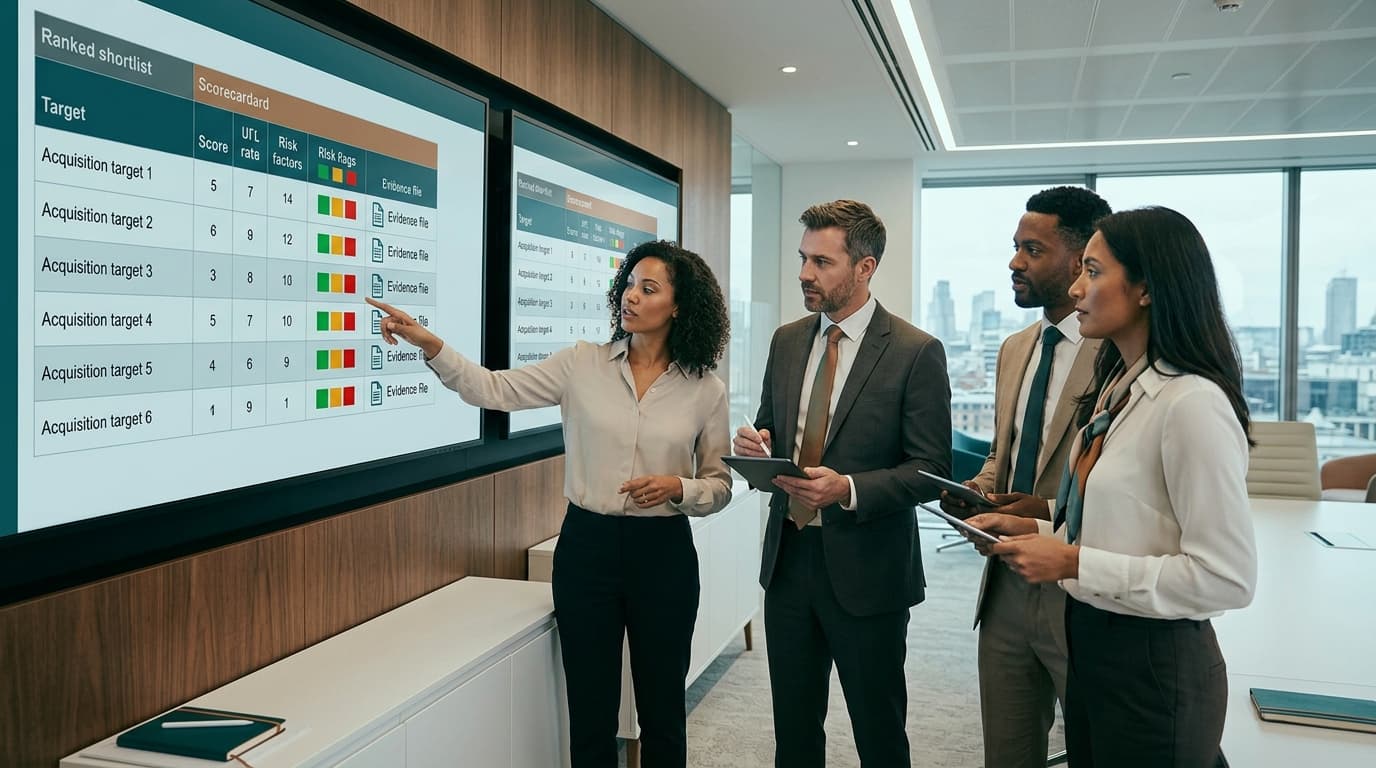
| Deliverable drafting | Report Builder | Drafts and structures investor-ready reports and deliverables with full source traceability | Editing for deal context, client voice and fiduciary framing |
| Team coordination | Collaboration Hub | Coordinates workstreams, task assignment and expert-in-the-loop review in a shared workspace | Workstream lead sign-off at each stage gate |
The pieces connect end-to-end: ingestion feeds the analysis layer, analysis output populates the risk register and draft deliverables, and the Collaboration Hub keeps a three- or four-person team aligned across workstreams that a larger firm would staff separately. Human review sits at every stage, not at the end: analysts confirm findings against sources, workstream leads arbitrate materiality, and partners own the final judgement. That division is what lets a boutique run an institutional process without an operations team, and it is the operating model behind the platform's work with M&A advisory firms and funds. Built for today's investment and deal teams. Trusted by >200 firms.
How to use this in your next diligence workflow
The playbook only pays off if it is sequenced, and the sequence starts before the first document is read. With diligence often spanning thousands of documents, multiple stakeholders and hard deadlines, the teams that get the most from AI-supported workflows set up structure first and let the tooling run inside it. On your next live mandate, run the following sequence:
- Connect the data room on day one. Use Data Room Ingestion to scan the VDR as materials land, so gaps and missing uploads surface while the seller can still fix them, not in week three.
- Define workstreams and evidence standards before analysis starts. Agree what counts as a finding, what source it must cite, and what materiality threshold triggers escalation, so every workstream produces comparable output.
- Route AI-surfaced findings through partner review. Set explicit thresholds so that only findings above a defined materiality, financial impact or legal exposure level reach partner attention, using risk register automation to keep the record consistent.
- Draft the IC memo or sell-side materials from the structured findings. Build the narrative from the evidence base rather than from memory, following the discipline of IC memo reframing.
- Close the loop. Log every open question, evidence gap and assumption so the next mandate inherits the standards rather than reinventing them.
Keep a short evidence checklist per workstream: financial (reconciled statements, quality-of-earnings inputs, working-capital bridge), commercial (customer data, churn and pricing evidence, market-size sources), legal (material contracts, change-of-control clauses, litigation), and operational (org charts, key-person dependencies, systems documentation). Each item should name its owner and its source document before analysis begins.
The governance habits matter more than the tooling: one evidence standard per firm, materiality thresholds agreed up front, and a named reviewer for every AI-surfaced finding. Repeated on every deal, these habits make rigor systematic rather than heroic, and they are what let a boutique team stand behind its output in front of an IC or a buyer.
How Plausity accelerates this workflow
Plausity is an AI-native due diligence and deal intelligence workspace that helps M&A advisory firms, VC and PE funds, corporate development teams and investment-banking teams structure evidence, findings and questions across a data room. Plausity supports evidence extraction, source grounding, findings management and IC preparation — it does not replace human analysts, advisers or investment professionals, does not provide legal, tax, audit, regulatory or investment advice, and does not make autonomous investment decisions. All findings require human review. Built for today's investment and deal teams. Trusted by >200 firms.
To explore the underlying capabilities, see the Plausity AI analysis engine and the findings and risk intelligence product page. For team-level workflows, see how VC and PE funds and M&A advisory firms use Plausity across live deals.