Why this matters now
Biotech asset differentiation due diligence is the rigorous, multi-domain evaluation of an investigational drug or therapeutic platform to confirm whether its biological mechanism, clinical efficacy, safety profile, and intellectual property offer a defensible advantage over current and emerging standards of care. In an environment defined by higher capital costs and selective public markets, venture capital funds and pharmaceutical business development teams can no longer underwrite incremental "me-too" candidates. When macroeconomic liquidity contracts, copycat assets suffer severe valuation haircuts, failed partnering rounds, and abandoned clinical programs because they lack the clinical or commercial leverage required to secure premium market share.
The structural reality of biopharma R&D leaves minimal margin for uninspired science. Overall likelihood of approval from Phase I across all developmental candidates stands at just 7.9%, falling to 5.9% in chronic, high-prevalence disease indications. When clinical assets enter late-stage development without clear differentiation, they face compounding headwinds: slower patient recruitment, unfavorable regulatory scrutiny, and severe reimbursement resistance. Evaluating differentiation early in the biotech IPO readiness and deal assessment timeline is essential to prevent capital allocation toward programs that cannot survive head-to-head clinical or commercial competition.
- Capital efficiency mandates ruthless triage: Crowded therapeutic classes with marginal efficacy gains face steep discount rates and limited exit optionality.
- The Phase I to approval hurdle remains low: With an overall likelihood of approval from Phase I of 7.9%, undifferentiated assets compound regulatory and attrition risk.
- Standard of care is a moving target: Diligence must benchmark an asset against treatments expected at commercial launch, not just the treatments approved today.
- Reimbursement is the ultimate arbiter: Payers increasingly demand demonstrable superiority on hard clinical outcomes rather than surrogate biomarkers alone.
- Primary data verification protects downside: Management presentations frequently gloss over subtle safety signals or restrictive patent landscapes that undermine asset viability.
The main practical framework
Evaluating a therapeutic asset requires moving past high-level pitch decks to conduct a systematic audit of target biology, mechanism of action (MoA), and preclinical assay validity. Deal teams must practice radical transparency when assessing technical realities, explicitly documenting biological limitations rather than accepting optimistic extrapolations. The core framework begins by establishing whether the target has been validated through robust human genetics, clinical pharmacology, or replicated animal disease models, and whether the proposed MoA exhibits functional advantages such as improved binding affinity, allosteric selectivity, or tissue-specific biodistribution.
A central failure mode in preclinical evaluation is testing candidates only against negative controls or untreated baselines. True differentiation requires proving mechanistic superiority against the current and evolving standard of care (SoC). Diligence teams must compare the asset's Target Product Profile (TPP) directly against active competitors across four core technical pillars:
- Target biology validation: Cross-referencing human genetic evidence, functional genomics, and independent academic literature to verify that target modulation directly alters disease pathology.
- Assay reproducibility and robustness: Auditing whether preclinical pharmacology, pharmacokinetic/pharmacodynamic (PK/PD) relationships, and in vivo efficacy have been replicated across multiple independent laboratories.
- Selectivity and off-target liability: Reviewing broad receptor, ion channel, and kinase profiling screens to ensure high target selectivity and minimal off-target toxicity.
- TPP benchmarking against future SoC: Evaluating the candidate's dose frequency, route of administration, and predicted efficacy ceiling against late-stage competitor compounds rather than legacy standard therapies.
By establishing these technical baselines before committing capital, investors determine whether an asset holds potential as a first-in-class breakthrough or best-in-class entrant, or whether it is simply replicating well-trodden biological mechanisms with minimal upside.
What investors, lenders, buyers, or operators are really testing
When assessing clinical-stage assets, institutional investors and acquirers focus their scrutiny on the clinical study design, patient stratification methods, and the clinical meaningfulness of observed endpoints. Clinical development experiences its most severe attrition during the transition from Phase II to Phase III, where only 28.9% of programs successfully advance. In highly competitive fields like oncology, the Phase II success rate drops further to 24.6%. Diligence must test whether early Phase I/II signals represent genuine clinical proof of concept or artifacts of small sample sizes and selected cohort baselines.
Diligence teams must evaluate whether clinical endpoints address the requirements of downstream regulatory agencies and commercial payers. A trial that achieves statistical significance on a surrogate biomarker may satisfy an early regulatory milestone but fail completely in healthcare reimbursement reviews if it fails to show improvements in overall survival, organ function preservation, or patient-reported quality of life.
| Clinical Diligence Dimension | Key Evaluation Criteria | Underlying Risk Tested |
|---|---|---|
| Patient Selection & Stratification | Preselection biomarkers, genetic enrichment, baseline disease severity | Heterogeneous response dilution; trials using preselection biomarkers achieve 15.9% likelihood of approval compared to industry baselines |
| Primary & Secondary Endpoints | Hard clinical outcomes vs. surrogate measures, validation of clinical outcome assessments | Regulatory rejection or payer refusal to grant premium pricing if endpoints fail to show clinically meaningful benefit |
| Safety & Tolerability Profile | Dose-limiting toxicities, adverse event discontinuation rates, off-target organ liabilities | High commercial discontinuation, restrictive black-box warnings, or uncompetitive therapeutic index relative to alternatives |
| Comparator Arm Selection | Active standard-of-care control vs. placebo, dosage alignment with modern clinical practice | Inability to prove superiority or non-inferiority against established treatment regimens in registrational Phase III trials |
Thorough diligence requires testing whether the clinical protocol adequately isolates the drug effect from background supportive care, and whether safety signals in early dose-escalation cohorts point to unmanageable class effects that could derail broad commercial adoption.
What companies, funds, or platforms are expected to show
Beyond early scientific validation and Phase II proof-of-concept data, target companies must present an integrated non-clinical foundation covering regulatory strategy, chemistry, manufacturing, and controls (CMC), and robust intellectual property. Gaps in any of these functional disciplines can delay development timelines, inflate required capital, or compromise market exclusivity, turning an otherwise promising molecule into an uninvestable project during commercial due diligence.
Intellectual property is a primary driver of transaction value, and diligence must extend far beyond verifying issued composition-of-matter patents. High-stakes pharmaceutical patent litigation routinely costs a median of $5.5 million through trial per dispute. Consequently, investors must examine Freedom-to-Operate (FTO) opinions across compound, formulation, process, and method-of-use claims, since a company can hold clear FTO in one of those categories while facing a blocking patent in another. Target assets must demonstrate that their patent estate provides an uninterrupted exclusivity runway through commercial launch and peak sales.
- Formal regulatory minutes and feedback: Verifiable Type B/C meeting minutes, Scientific Advice from EMA, or minutes from national competent authorities confirming agreed clinical endpoints and pivotal study requirements.
- Scalable and validated CMC processes: Documented drug substance (DS) and drug product (DP) synthesis routes, analytical assay validation, stability testing data, and contracted capacity at compliant cGMP manufacturing facilities.
- Comprehensive Freedom-to-Operate (FTO) opinions: Formal legal analyses confirming that the lead compound, formulations, salt forms, and synthesis routes do not infringe active third-party patent claims.
- Clean chain-of-title documentation: Executed assignments, institutional consents from university tech-transfer offices, and license agreements confirming unrestricted commercial development rights.
- Commercial supply chain architecture: Established master service agreements (MSAs) and quality agreements with qualified contract development and manufacturing organizations (CDMOs) capable of commercial-scale production.
A red-flag table
During technical diligence, identifying risks early prevents deal teams from wasting weeks evaluating flawed opportunities. Target companies carry an inbuilt bias toward promoting value, and without deliberately obscuring risks they may deemphasize them in presentations or bury them in a mass of detail. Implementing automated red flag reporting allows investment committees to track and weigh critical deal-breakers systematically.
| Observed Red Flag | Diligence Domain | Underlying Structural Risk | Verification & Remediation Method |
|---|---|---|---|
| Presentation deck diverges from primary study reports | Clinical & Scientific | Management slides do not match the clinical study reports, agency correspondence, or raw data behind them | Reconcile summary slides directly against raw CSR tables, statistical analysis plans, and patient tracking logs |
| Unresolved third-party IP or unconsented university licenses | Intellectual Property | Academic institutions or co-inventors retain underlying rights, exposing the asset to chain-of-title gaps and cumulative royalty stacking | Audit executed tech-transfer agreements, institutional consents, and patent assignment chains across all jurisdictions |
| Unified Patent Court (UPC) exposure without opt-out strategy | Intellectual Property | A single revocation action before the UPC can invalidate a European patent across all UPC member states at once | Review the explicit European patent register opt-out filings and legal risk assessments for all key patents |
| Payer and KOL misalignment on target product profile | Commercial Viability | Asset meets regulatory minimums but the target product profile has little practical value, with no payer willing to reimburse and no KOL willing to prescribe | Conduct independent blinded interviews with health economics and outcomes research (HEOR) specialists and prescribing KOLs |
| Commercial supply chain work deferred past Phase II | CMC & Manufacturing | Clinical material is assumed to serve the launch market, so scale-up and comparability issues only surface when launch timelines are stress-tested | Evaluate batch records, scale-up protocols, and CDMO tech-transfer timelines to ensure launch readiness |
A data-room / evidence / checklist section
A thorough biotech diligence exercise requires reconciling primary source records across clinical, regulatory, manufacturing, and legal workstreams. Reviewers must treat pitch decks as subjective claims and verify every quantitative assertion against contemporaneous laboratory notebooks, regulatory correspondence, and audited clinical databases.
- Clinical Study Reports (CSRs) and Protocols: Complete, unredacted CSRs for all completed Phase I, II, and observational studies, including full statistical analysis plans (SAPs), protocol amendments, and complete safety appendixes listing all serious adverse events (SAEs).
- Agency Correspondence and Meeting Minutes: Unedited correspondence logs with the FDA, EMA, PMDA, and other health authorities, focusing on End-of-Phase 1/2 meeting minutes, official briefing books, and agency feedback on trial design.
- Preclinical Pharmacology and Safety Pharmacology: Raw assay data for in vitro binding affinity, in vivo animal efficacy studies, pharmacokinetic/pharmacodynamic (PK/PD) modeling files, and Good Laboratory Practice (GLP) toxicology reports with histopathology findings.
- CMC Dossier and Stability Data: Certificates of Analysis (CoAs) for clinical batches, active pharmaceutical ingredient (API) route synthesis descriptions, formulation development reports, real-time and accelerated ICH stability data, and vendor audit reports for CDMOs.
- Intellectual Property Portfolio and FTO: Complete schedules of issued patents, pending applications, office action responses, terminal disclaimer records, executed assignment documents from all named inventors, and third-party FTO opinion letters.
- Freedom-to-Operate and Landscape Searches: Element-by-element patent claim charts analyzing compound, polymorph, formulation, process, and method-of-use coverage against competitor patent estates.
- Commercial and Reimbursement Models: Bottom-up epidemiological market models, payer research transcripts, pricing analogue analyses, and health economic cost-effectiveness assessments.
Specialized attention must be dedicated to cross-referencing patent expiration schedules against projected clinical development timelines. If clinical delays or manufacturing scale-up bottlenecks push projected commercial launch within 5 to 7 years of primary patent expiration, the asset's net present value deteriorates rapidly unless secondary formulation, dosing, or combination patents offer enforceable lifecycle protection.
Practical implications
For deal teams, the practical consequence of this framework is that differentiation findings should drive deal structure, not just the go/no-go vote. Where target biology is well validated but the comparator arm is weak, the risk is priced through milestone-weighted tranches tied to a head-to-head or active-controlled readout rather than through a lower headline valuation. Where the patent estate is thin beyond composition-of-matter, exclusivity risk belongs in the earn-out and in the reps and warranties, with specific indemnities for chain-of-title and third-party licence gaps. Where CMC work has been deferred, the capital plan needs an explicit bridging line for process scale-up and comparability studies before launch.
Three practices separate teams that act on differentiation evidence from teams that merely document it. First, write a single differentiation thesis of no more than one page, stating the specific clinical or commercial claim the asset must eventually support, and test every data-room finding against it. Second, keep a live register of unresolved items with an owner, a materiality score, and a decision deadline, so committee discussion focuses on the handful of findings that can actually change the answer. Third, reuse the same evaluation structure across therapeutic areas so that portfolio comparisons hold, much as investors apply consistent criteria in medtech VC due diligence across device categories.
How to use this in your next diligence workflow
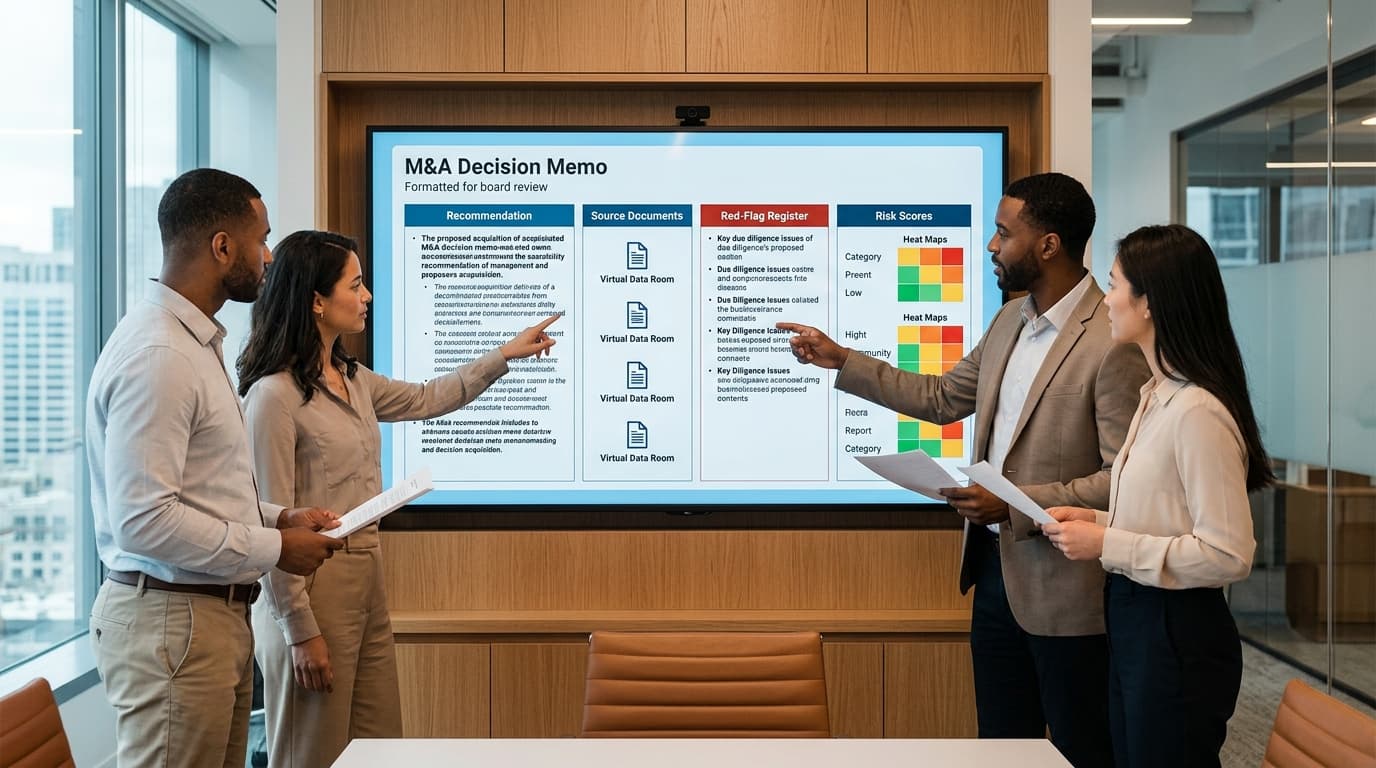
Executing differentiation due diligence across thousands of clinical, regulatory, and patent documents under tight deal deadlines creates substantial operational strain for deal teams. When analysts review complex data rooms manually, subtle discrepancies between summary decks and underlying regulatory minutes often remain undetected until after terms are signed. Implementing an automated, AI-driven diligence workflow enables investment professionals to systematically ingest data rooms, verify scientific claims against primary records, and surface hidden deal risks.
How Plausity supports the workflow
Plausity accelerates this workflow by connecting directly to virtual data rooms via Data Room Ingestion to parse, index, and analyze thousands of technical documents within minutes. The core AI-Analysis Engine extracts and cross-references quantitative trial endpoints, patient cohorts, and CMC specifications against published literature and competitor benchmarks. Through Risk Radar and Findings & Risk Intelligence, deal teams can automatically identify missing regulatory correspondence, highlight chain-of-title gaps, and score clinical inconsistencies based on deal materiality.
By replacing fragmented manual spreadsheets with an integrated, auditable analysis pipeline, biopharma venture funds and M&A advisory teams can compress diligence timelines, validate asset differentiation with institutional precision, and make high-conviction go/no-go decisions before committing capital.