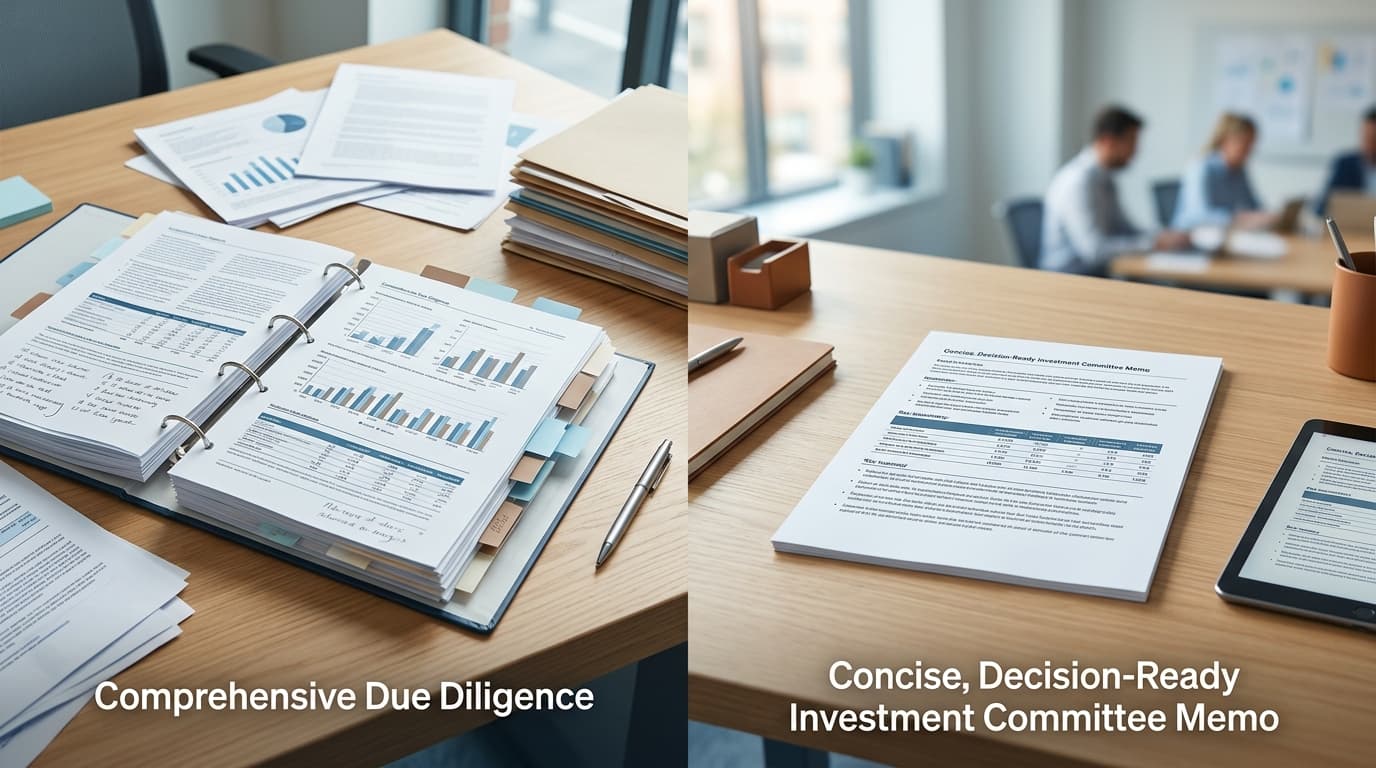
What is a modern due diligence provider?
A modern due diligence provider is a specialized partner or technology platform that equips private equity investors, corporate development teams, and M&A advisors to evaluate target assets across financial, legal, commercial, and operational dimensions. In contemporary dealmaking, a mid-market buyout data room can hold thousands of mixed-format files spread across dozens of folders. Rather than relying solely on static document repositories, modern providers combine deep domain expertise with automated data extraction and structured analysis to help deal teams rapidly assess risks, validate investment theses, and make defensible underwriting decisions.
The due diligence ecosystem has transformed from siloed spreadsheets into an interconnected workflow. Traditional providers focus on specialized advisory services, delivering manual findings and advisory opinions. In contrast, modern diligence providers offer software platforms and hybrid delivery models that ingest messy data rooms, cross-reference contract clauses against financial schedules, and surface material red flags without replacing human oversight.
| Diligence Dimension | Core Objective | Primary Document Inputs |
|---|---|---|
| Financial Diligence | Validate earnings quality, normalize EBITDA, and audit cash flow | Audited financials, trial balances, general ledgers, tax filings |
| Legal Diligence | Uncover undisclosed liabilities, litigation exposure, and contract risks | Material contracts, cap tables, corporate charters, IP assignments |
| Commercial Diligence | Evaluate addressable market size, customer concentration, and pricing power | Customer lists, churn data, pipeline reports, market studies |
| Operational & Technical | Assess scalability, infrastructure resilience, and cybersecurity posture | Architecture diagrams, SOC 2 reports, org charts, IT policies |
Selecting the appropriate provider requires identifying whether a deal team needs pure advisory counsel, specialized software tools, or an integrated platform to structure the evidence base. As document volumes continue to expand, modern due diligence platforms enable teams to manage complex data rooms while maintaining absolute source traceability.
Why selecting the right diligence partner matters now
Transaction dynamics have placed dealmakers under unprecedented timeline pressure. Post-LOI confirmatory diligence runs four to six weeks at smaller funds and six to ten weeks at mid-market funds, stretching to as much as sixteen weeks at the largest funds depending on deal complexity. During this narrow window, deal teams must coordinate multiple third-party workstreams, verify thousands of data points, and prepare comprehensive investment committee deliverables.
Choosing the wrong diligence provider introduces severe structural risks. Traditional manual approaches often suffer from selective sampling, where junior analysts review only 10 to 20 percent of contracts due to time constraints. This leaves critical change-of-control clauses, non-standard customer liabilities, or unassigned intellectual property undetected until after closing. Conversely, deploying unvetted automated tools without rigorous validation protocols risks introducing hallucinations or unverified figures into the investment memo.
- Timeline compression: Tight exclusivity windows demand faster initial triage and accelerated document processing.
- Volume expansion: Data privacy, ESG exposure, cybersecurity posture, and AI governance increasingly sit alongside the traditional financial and legal categories, widening the corpus reviewers must cover.
- Auditability requirements: Investment committees and limited partners expect full provenance for every financial adjustment and risk assessment.
- Cost control: High third-party advisor hourly fees require teams to streamline evidence gathering and preserve budget for high-leverage strategic analysis.
Modern deal teams cannot afford to choose between speed and thoroughness. By implementing sophisticated workflow automation alongside trusted advisory partners, firms protect deal value and ensure that every flagged risk is backed by verifiable primary evidence.
Advisory, software, or hybrid workflows
When evaluating diligence capabilities, deal teams generally choose among three primary operating models: traditional advisory firms, standalone software tools, or hybrid workflows that combine specialized technology with expert human review. Each model possesses distinct strengths and trade-offs depending on transaction complexity, budget, and internal deal team capacity.
Traditional advisory providers, such as Big Four accounting firms, boutique strategy consultancies, and specialized law practices, offer extensive subject-matter expertise and formal liability coverage. However, they rely heavily on manual labor, leading to substantial hourly fees and rigid delivery timelines. Standalone software platforms provide self-service document ingestion and search capabilities, but they place the entire burden of synthesis, validation, and strategic interpretation on internal analysts.
| Operating Model | Core Strengths | Primary Limitations | Best Fit For |
|---|---|---|---|
| Traditional Advisory | Deep specialized expertise, formal opinions, outsourced labor capacity | Adviser-led confirmatory workstreams run four to six weeks even at smaller funds, and longer as deal size grows, typically billed hourly | Complex carve-outs, formal regulatory filings, cross-border tax structuring |
| Standalone Software | Fast document indexing, low software subscription costs, self-service | Internal analysts must synthesize findings across every document a mid-market data room holds | Simple data rooms, routine compliance checks, exploratory screening |
| Hybrid Workflow | Full document coverage, automated risk synthesis, expert-led human validation | Requires internal process alignment and workflow adoption | Mid-market PE buyouts, recurring corporate M&A, high-volume deal pipelines |
The hybrid model has emerged as the preferred structure for sophisticated private equity and venture capital teams. Because a mid-market fund typically reviews 80 to 100 opportunities for every single closed transaction, relying exclusively on manual advisory retainers for early-stage evaluation is economically unsustainable. A hybrid approach leverages automated document triage and structured risk intelligence to screen pipeline targets, reserving expensive advisory deep dives for live transactions under exclusivity.
12 questions to ask a due diligence provider
To rigorously evaluate potential diligence partners, deal teams and investment committees should ask these twelve practical questions across technical, operational, and security dimensions before signing an engagement or licensing contract.
- How quickly can the solution ingest, OCR, and index complex virtual data rooms containing tens of thousands of mixed-format files?
- What specific artificial intelligence architectures or analytical methodologies are used to extract, cross-reference, and synthesize unstructured documents?
- Does the platform provide direct, verifiable source citations and page-level deep links for every extracted metric and finding?
- How does the provider ensure strict data privacy, enterprise-grade encryption in transit and at rest, and total isolation between client workspaces?
- What independent security attestations does the provider maintain, such as SOC 2 Type 2 certification or ISO 27001 compliance?
- Are client data and uploaded data room files ever utilized to train public or multi-tenant machine learning models?
- How does the provider support human-in-the-loop workflows, enabling deal team members and external experts to validate, edit, and annotate automated outputs?
- Can the platform automatically generate structured risk logs that categorize issues by materiality, financial impact, and deal relevance?
- Does the solution integrate with standard virtual data rooms, document repositories, and internal investment memo drafting workflows?
- What is the provider's track record in supporting complex M&A, private equity buyouts, and technical transactions across multiple sectors?
- How are conflicting data points, missing exhibits, or discrepancies across historical financial statements handled and surfaced?
- What dedicated customer support, onboarding assistance, and deal-specific configuration services are included with the offering?
Using this structured framework enables investment leads to separate basic search utilities from robust diligence engines. Ensuring that a provider delivers verifiable audit trails and strict confidentiality safeguards prevents costly oversights during high-stakes negotiations.
Red flags to watch for during provider selection
Selecting a diligence provider without thorough technical and procedural validation introduces substantial risk. Deal teams must scrutinize prospective vendors and advisors for operational shortcomings that compromise diligence integrity or slow down transaction execution.
The most critical red flag in modern diligence software is the black-box AI model. If an automated system provides risk summaries or financial calculations without linking directly back to the underlying contract clause or spreadsheet cell, the findings cannot be verified for the investment committee. Unanchored generative outputs create hallucination risks that can lead to miscalculated normalized EBITDA or overlooked restrictive covenants.
- Unverifiable claims: Tools that generate summaries without direct page-level citations force analysts to manually re-read documents, eliminating efficiency gains.
- Inadequate security posture: Providers lacking SOC 2 Type 2 compliance, robust role-based permissions, or clear data processing guarantees represent major confidentiality hazards.
- Model training on confidential data: Vendors that reserve rights to train foundational AI models on uploaded data room contents violate standard non-disclosure agreements.
- Fragmented workstreams: Solutions that fail to centralize findings into an auditable risk register perpetuate operational silos between legal, tax, and commercial teams.
- Rigid black-box scoring: Automated platforms that output qualitative risk scores without allowing human analysts to adjust materiality thresholds or inspect underlying assumptions.
Avoiding these pitfalls ensures that diligence deliverables remain reliable, fully transparent, and defensible before external lenders, co-investors, and investment committee members.
How Plausity supports the workflow
Plausity functions as an advanced platform layer designed to structure, accelerate, and organize complex due diligence workflows while keeping human expert judgment at the center of every decision. Rather than replacing professional advisors or legal counsel, it equips deal teams, corporate acquirers, and advisory firms with purpose-built AI tools to handle vast document corpuses with precision.
The platform is built around dedicated modules that streamline the transaction lifecycle from initial data room upload to final committee deliverable. Data Room Ingestion connects securely to virtual data rooms, rapidly processing thousands of multi-format documents, including scanned PDFs, complex spreadsheets, and contracts. The core AI-Analysis Engine reads, cross-references, and reasons over the entire document corpus, surfacing hidden dependencies and financial anomalies with precise source citations.
- Data Room Ingestion: Securely scans and processes multi-format files in minutes, organizing unstructured data into structured workstreams.
- AI-Analysis Engine: Conducts multi-document reasoning to uncover discrepancies between financial schedules and contract terms.
- Risk Radar: Evaluates findings based on materiality, financial impact, and legal exposure to generate an actionable, real-time risk register.
- Report Builder: Automatically structures diligence findings into customizable, memo-ready deliverables with complete audit trails.
- Collaboration Hub: Coordinates multi-disciplinary deal teams, aligning internal analysts and external specialists within a shared workspace.
By utilizing Risk Radar to prioritize red flags and Report Builder to synthesize findings into clear narratives, investment professionals significantly compress the time required to draft comprehensive memos. To see how structured automation accelerates transaction preparation, explore this guide to IC memo automation.
How to use this in your next diligence workflow
Implementing an effective due diligence provider strategy requires aligning your internal deal team capacity with the right blend of advisory expertise and software capabilities before entering active negotiations. Applying the 12-question framework early in your deal cycle establishes clear standards for speed, security, and analytical depth.
- Define your operational model: Assess whether upcoming transactions require full-scope advisory retainers, standalone software tools, or a scalable hybrid workflow.
- Audit data security standards: Verify that any candidate platform provides enterprise-grade encryption, SOC 2 certification, and strict zero-training data policies.
- Benchmark document ingestion: Test prospective providers on complex, messy data room folders to evaluate processing speed and OCR accuracy.
- Standardize risk registers: Implement structured risk classification protocols to ensure legal, financial, and commercial findings are integrated into a single source of truth.
- Evaluate deliverables against the 12 questions: Score short-listed vendors using the 12 diligence questions to confirm source traceability and collaborative human oversight.
By establishing a rigorous evaluation protocol, private equity funds and corporate development teams protect deal value, eliminate blind spots, and execute transactions with complete confidence.