The M&A Integration Challenge: The Cost of Fragmented Deal Data
- The Model Context Protocol (MCP) was open-sourced in November 2024 to standardize how AI models securely access diverse data repositories.
- Unintegrated data silos slow down transactions, given that poor due diligence contributes to nearly 60% of all M&A deal failures.
- An interoperable due diligence platform allows investment teams to plug automated analysis directly into active deal workflows.
- Adopting AI-assisted tools can reduce billable hours for transaction advisory and financial due diligence by an average of 28%.
In the fast-paced world of modern dealmaking, private equity firms, venture capital funds, and advisory partners must make critical investment decisions under intense time pressure. Despite the high stakes, due diligence teams routinely struggle with highly fragmented datasets. Vital transactional information resides in isolated environments, including legacy file shares, disparate virtual data rooms, buried email threads, and specialized database systems. For venture capital and private equity firms, this lack of unified access hampers both the speed and accuracy of target evaluations, forcing analysts to manually piece together disparate facts.
The consequences of fragmented transaction data extend far beyond simple operational friction. According to research from Bain & Company, more than 60% of executives cite poor due diligence as the primary driver of M&A transaction failures, highlighting the absolute necessity of establishing complete, connected context before signing. When deal teams cannot easily connect due diligence to data stack environments, analysis is frequently delayed, and critical risks remain hidden. To overcome this, M&A Advisory Firm Partners & Analysts require a more secure, streamlined approach to data ingestion and analysis.
- Virtual Data Room (VDR) Silos: Critical corporate files remain locked in external third-party data rooms, isolated from the buyer's internal analytical software.
- Communication Fragmentation: Historical legal and financial context sits unmonitored in scattered emails, messaging logs, and advisory notes.
- Secure Internal Archives: Historic portfolio deal terms, market benchmarks, and proprietary internal research are stored in private internal servers, unreachable by typical cloud-based AI tools.
Connecting the Stack with the Model Context Protocol
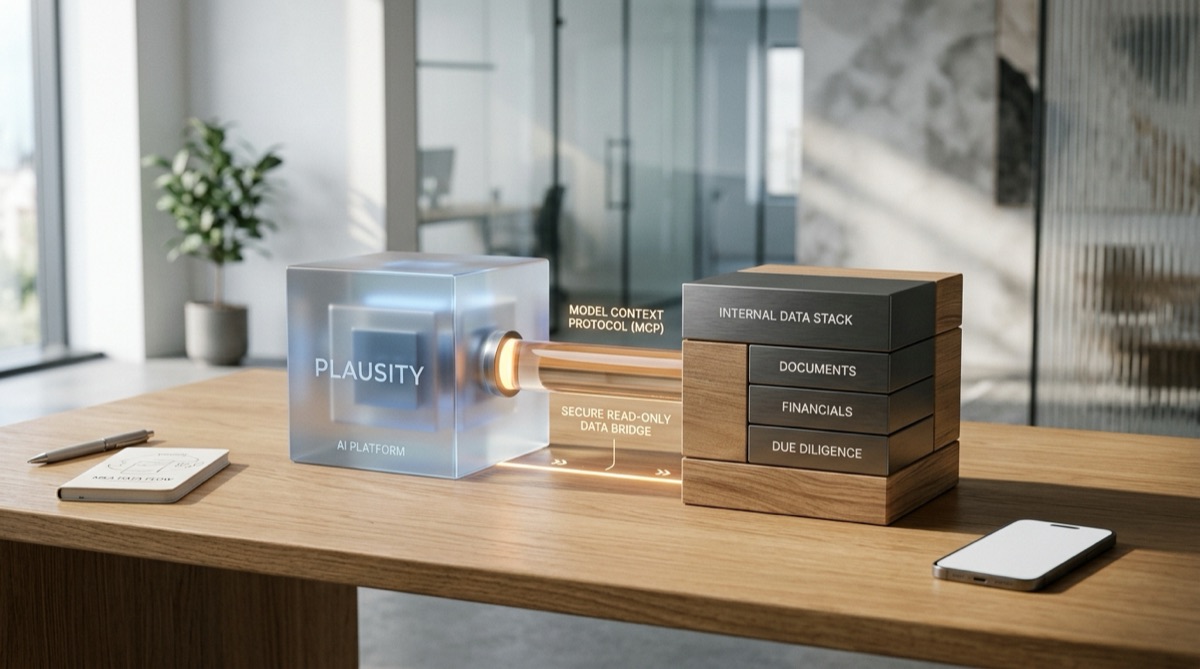
This is where the Model Context Protocol (MCP) enters the picture as a game-changing technical standard. Originally developed to provide LLMs with structured, standardized access to external data sources, MCP acts as an open, secure bridge. Rather than building custom, high-maintenance API integrations for every single file system or database, a firm can implement a unified model context protocol integration. By serving as an interoperable due diligence platform, Plausity can seamlessly connect with secure internal systems and external data rooms alike, enabling deep, secure, context-aware analysis without data leaving its secure origin.
Through this architectural model, Plausity's core enterprise-grade security standards are preserved while its core systems, such as the AI-Analysis Engine, gain direct, read-only access to custom internal and external files. For corporate M&A project leads, this MCP connectivity due diligence eliminates the need to manually download thousands of target files and upload them into separate processing tools. Instead, capabilities like Data Room Ingestion operate natively through the protocol, querying and processing the data directly at the source to ensure full traceability and high-fidelity risk screening in real time.
What is the Model Context Protocol? A Non-Technical Primer
In November 2024, Anthropic open-sourced the Model Context Protocol (MCP) as an open standard designed to enable seamless, secure communication between AI models and external data sources. For private equity and venture capital investment professionals, this standard represents a critical architectural shift. Traditionally, connecting an AI application to custom internal databases, local document servers, or external transaction platforms required building and maintaining complex, proprietary API integrations. MCP replaces this fragmented, ad-hoc development model with a universal, standardized interface, effectively acting as a secure USB port for artificial intelligence.
In the high-stakes environment of M&A due diligence, deal teams struggle with fragmented data across virtual data rooms (VDRs), local files, and secure clouds. When using an interoperable due diligence platform, having a standardized connection is crucial. Rather than moving sensitive target company data out of secure environments or writing custom code to link separate tools, MCP connectivity due diligence allows a firm's AI platform to securely query data directly where it lives. This open standard eliminates data silos and custom API integrations, enabling an AI platform to deliver highly secure, context-aware analysis without compromising data boundaries.
How the MCP Architecture Operates in M&A Workflows
To understand how a model context protocol integration operates, it helps to look at its core architecture. In an MCP-enabled stack, the AI due diligence platform does not directly search every file system. Instead, it communicates via a unified protocol with lightweight, secure local connectors (servers) that expose only the authorized data. For instance, when analyzing complex transaction records, Plausity's AI-Analysis Engine acts as the client, requesting targeted context via MCP to evaluate specific risks, while maintaining a strict, verifiable log of exactly where every retrieved data point originated.
- MCP Clients: AI-native applications (such as Plausity's core analysis tools) that initiate requests, request context, and require external data to answer user queries with high accuracy.
- MCP Servers: Lightweight, secure programs that expose data sources (such as a secure database, a file repository, or an internal research database) through a standardized API.
- MCP Hosts: The runtime environments or applications that orchestrate the connection between clients and servers, enforcing precise access controls and security parameters.
For M&A project leads and advisory partners, this architecture minimizes the IT overhead of onboarding new AI solutions. Instead of spending months on customized engineering to connect due diligence to data stack environments, firms can configure secure MCP servers in a fraction of the time. This plug-and-play capability ensures that deal teams can immediately run rigorous, deep-dive analyses across multiple workstreams while maintaining robust control over their proprietary transactional data and enforcing strict integrations and security protocols.
Why an Interoperable Due Diligence Platform Matters for Investment Teams
Traditional due diligence systems act as isolated repositories, forcing deal teams to manually move documents, risk assessments, and historical data between siloed folders during intense transaction periods. According to corporate transaction studies, poorly coordinated data management and system integration remain major barriers to capturing deal value, highlighting the need for connected workflows from the very beginning of a transaction. An interoperable due diligence platform changes this dynamic by establishing structural bridges between separate software systems.
Rather than building complex, proprietary integrations for every tool in an enterprise data stack, investment firms are adopting open standards. The Model Context Protocol (MCP), an open standard introduced by Anthropic, enables developers to establish secure, two-way connections between AI-powered applications and external data sources. Leveraging MCP connectivity due diligence allows firms to securely plug their AI-native due diligence platform, such as Plausity, directly into existing data stacks to perform secure, context-aware analysis.
Breaking Down the Model Context Protocol for Deal Teams
For a non-technical deal professional, model context protocol integration can be understood as a universal translator for AI tools. Previously, connecting a modern AI-Analysis Engine to a secure corporate folder, an internal database, or a custom workspace required engineering teams to build custom API wrappers. Under the MCP framework, data sources are wrapped in lightweight MCP servers, and AI tools act as MCP clients. This client-server architecture allows the AI to securely query and read relevant files on demand without copying sensitive target data permanently onto a third-party server.
| Feature | Traditional Siloed Architecture | MCP-Enabled Interoperable Architecture |
|---|---|---|
| Data Transfer | Manual folder exports, bulk downloads, and redundant document uploads across multiple tools. | Real-time, secure queries executed directly to host repositories via open-standard clients. |
| Historical Context | Isolated by transaction; historical diligence files remain locked in archived folders. | Cross-deal databases and firm-wide knowledge bases are queried dynamically during active reviews. |
| Information Security | Proprietary files must be duplicated and stored across multiple point solutions. | Sensitive files remain in their original secure environments, queried on demand under strict client protocols. |
Dynamic Knowledge Retrieval and Context-Aware Analysis
For private equity and venture capital funds, the value of an interoperable platform lies in its ability to connect due diligence to data stack environments containing years of historical deal context. When starting a transaction review, the AI-Analysis Engine can query past investment memoranda, sector benchmark reports, and proprietary risk frameworks stored in the firm cloud. This background integration allows M&A project leads to instantly compare new target findings against past transaction standards, shifting analysis from basic reading to high-level strategic intelligence.
- Elimination of manual transcription and double-data entry by bridging the gap between Data Room Ingestion systems and draft investment templates.
- Dynamic risk cross-referencing by comparing active files with historical Risk Radar databases compiled from previous transactions.
- Efficient compilation of final reports via the Report Builder, which can draw verified figures directly from internal data warehouses.
- Stronger data compliance, as target company files are processed within secure, federated boundaries without exposing intellectual property.
Plugging Plausity into Your Existing Data Stack
Traditional due diligence workflows frequently suffer from fragmented data silos. Deal teams must manually migrate files between secure file shares, local network drives, and isolated analysis tools. This fragmentation introduces security vulnerabilities and delays critical decision-making. By implementing a standardized model context protocol integration, modern investment firms and M&A advisory partners can securely connect due diligence to data stack systems via standardized Integrations & Security frameworks without relying on costly, custom-built API pipelines. The Model Context Protocol (MCP) acts as an open, universal standard developed to establish secure, bi-directional connections between advanced AI systems and diverse, enterprise-grade data sources.
In practice, this interoperable due diligence platform allows corporate M&A project leads to link Plausity directly to existing infrastructure, including secure SQL databases, cloud-based file repositories, and internal communication channels such as Slack. Rather than moving sensitive target documents out of secure networks, the AI-Analysis Engine queries the target systems in real time through an MCP server. This local, context-aware routing ensures that proprietary transaction data stays within the firm's strict boundaries while enabling the AI to extract and synthesize complex financial and legal points.
Streamlining the Ingestion to Analysis Pipeline
To execute rapid, comprehensive diligence, the platform's Data Room Ingestion pipeline interfaces directly with virtual data rooms (VDRs) to scan and import documents within minutes. When combined with MCP connectivity due diligence, these imported datasets feed seamlessly into the AI-Analysis Engine. This architecture guarantees that every extracted risk, regulatory discrepancy, or financial variance remains fully grounded in the target's original files, as explained in the platform's How It Works guide. The platform maintains a persistent chain of custody, linking every generated finding directly back to its source document for complete auditability. This direct integration eliminates manual file-handling errors and accelerates the transition from raw data collection to actionable risk intelligence.
| Integration Vector | Traditional API Approach | MCP-Enabled Architecture |
|---|---|---|
| Deployment Overhead | Requires custom middleware, long-term maintenance, and distinct API tokens for each software tool. | Uses a single open standard to connect multiple data sources, dramatically lowering development and maintenance overhead. |
| Data Security & Isolation | Requires data to be duplicated or transferred into third-party servers, increasing the attack surface. | Enables context-aware, localized queries where sensitive transaction files stay within secure enterprise boundaries. |
| Data Sources Covered | Often restricted to pre-built native connectors or limited file storage platforms. | Extends to SQL databases, local file shares, Slack, and cloud storage through standardized server protocols. |
For private equity and venture capital deal teams, this unified architecture translates directly into faster underwriting cycles and more robust risk mitigation. By connecting the data stack directly to analysis tools, the Risk Radar can continuously scan incoming files for legal exposures or material liabilities, while the Report Builder compiles investor-ready reports with complete source traceability. The result is a highly secure, interoperable due diligence platform that fits into the existing enterprise workflow without demanding disruptive changes to a firm's established technology stack.
Streamlining the Deal Workflow from Risk Analysis to Final Reports
Establishing an interoperable due diligence platform is key to breaking down the traditional silos that plague modern M&A transactions. By implementing robust model context protocol integration, deal teams can seamlessly connect due diligence to data stack environments without having to build or maintain custom API wrappers. This allows the core AI-Analysis Engine to ingest, read, and analyze target company documents directly from secure data rooms and enterprise storage systems. Linking deep analytical capabilities to a firm's existing IT architecture ensures that diligence findings are consistently grounded, fully auditable, and traceably linked to their source documents Plausity Facts.
With a continuous, secure flow of transactional data, the integrated workspace accelerates risk assessment and cross-team review. For VC and PE fund investment professionals, M&A advisory partners, and corporate M&A project leads, a unified platform coordinates the entire workflow. The Risk Radar automatically scans the ingested data to identify and flag potential legal exposures, regulatory risks, and financial discrepancies. Once flagged, the Collaboration Hub enables deal team members to review, discuss, and verify these findings in real time. This unified process replaces fragmented email threads and disconnected spreadsheets with a single, highly coordinated workspace for transactional risk intelligence.
Once risks are flagged and analyzed, compiling the final deliverables is highly automated. The Report Builder extracts the verified observations and automatically drafts comprehensive, investor-ready due diligence reports with full source traceability. This automated transition from data ingestion to report compilation drives major efficiency gains. Advisory insights from firms like PwC suggest that integrating advanced artificial intelligence solutions into transaction advisory can drive up to a 28% average reduction in financial diligence billable hours. By moving away from manual data retrieval and spreadsheet validation, analysts can focus their efforts on strategic negotiations and deep-dive financial due diligence.
| Diligence Phase | Traditional Siloed Workflow | Connected MCP Workflow |
|---|---|---|
| Document Ingestion | Manual file downloads and offline storage transfers | Secure automated streams using Data Room Ingestion |
| Risk Assessment | Siloed excel lists and manually compiled legal checklists | Automated flagging and severity scoring via Risk Radar |
| Deal Collaboration | Fragmented feedback loops over email and slide decks | Real-time, context-aware analysis inside Collaboration Hub |
| Advisory Reporting | Days spent manually copying text and drafting reports | Automated draft compilation via Report Builder with trace links |
The technical standard underpinning this end-to-end workflow is the Model Context Protocol (MCP). For non-technical deal teams, MCP serves as an open-source standard that enables secure, bi-directional communication between LLMs and local or cloud-based data sources. Deploying MCP connectivity due diligence allows investment firms to connect their proprietary tools, compliance databases, and pipeline systems directly to their analytical engines without exposing sensitive IP to public networks. By combining high-speed automated ingestion with enterprise-grade security, deal teams maintain complete control over their information architecture while extracting deep, context-aware insights from target datasets.
Maintaining Data Security and Compliance in AI-Driven Diligence
Due diligence in mergers and acquisitions involves handling highly sensitive corporate assets, including proprietary code bases, intellectual property portfolios, and detailed financial forecasting models. Because deal transactions expose deep operational information, security frameworks such as SOC 2 and ISO 27001 define mandatory guidelines for robust data encryption, secure identity management, and continuous risk mitigation. For M&A advisory firm partners and analysts, maintaining a verifiable audit trail throughout this process is not merely a technical preference but a legal and fiduciary necessity.
The Shift to In-Place Querying with Model Context Protocol
Traditionally, leveraging artificial intelligence in transaction reviews required extracting raw documents from internal directories and uploading them to external cloud instances, which introduced secondary data storage risks and fragmented the compliance perimeter. The introduction of the Model Context Protocol (MCP) as an open standard fundamentally changes this workflow. Rather than replicating sensitive information across third-party environments, MCP connectivity due diligence allows systems to query data safely in place. This protocol functions as an open-source abstraction layer, establishing isolated local sessions that connect the analytical capability of AI directly with secure corporate networks without transferring underlying data assets permanently.
Implementing a model context protocol integration ensures that critical deal facts remain inside the enterprise firewall. This structure allows compliance leads to connect due diligence to data stack nodes without exposing original text to model training loops or external indexing. By adopting an interoperable due diligence platform, firms avoid the operational risk of unauthorized data duplication, aligning directly with security baselines like ISO 27001 that require strict access governance and the continuous evaluation of third-party platform integrations.
| Integration Parameter | Traditional API Ingestion | MCP-Enabled Connectivity |
|---|---|---|
| Data Storage Location | Requires copying and uploading raw files to external vendor cloud storage. | Maintains files in secure local storage while allowing in-place analysis. |
| Compliance Boundary | Expands the compliance attack surface through multiple data transfers. | Preserves the existing corporate security and database compliance perimeter. |
| Custom Engineering Overhead | Demands proprietary, high-maintenance connectors for individual data sources. | Uses an open-source standard to unify tool and data connectivity seamlessly. |
Enabling Seamless Interoperability Across Your Tech Stack
For private equity and venture capital funds, speed is a competitive edge, but speed must never bypass regulatory vetting. Internal compliance officers must verify that automated tools respect the organization's existing access controls and user privilege levels. To understand how this interactive standard functions in practice, deal teams can consult the general How It Works overview. Investment professionals can review how these security protocols function in detail by examining the platform's Integrations & Security architecture. This approach allows enterprise tools like the AI-Analysis Engine to parse documents on demand, protecting highly restricted files while facilitating accelerated transaction execution.