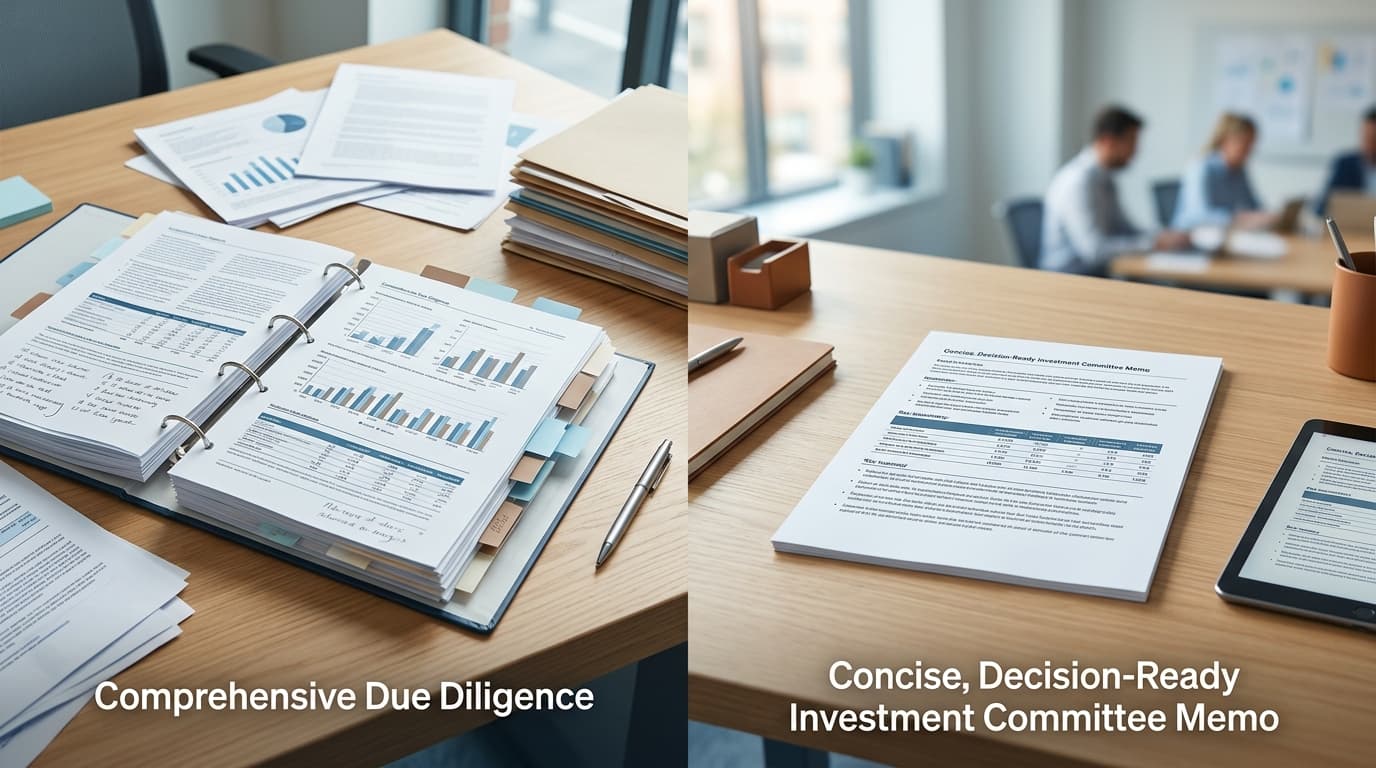
What is AI due diligence?
- Deloitte reports that 86% of M&A leaders have integrated generative AI into deal workflows to accelerate transactions.
- Modern AI due diligence systems reduce manual document review times by up to 70%, boosting efficiency across deal teams.
- Reliable AI diligence requires complete traceability, where every analytical finding links directly back to its source document.
- Keep a human-in-the-loop to manage hallucination risks and verify complex risk analyses in high-stakes transactions.
At its core, AI due diligence is the strategic application of machine learning, natural language processing, and generative AI to automate the ingestion, structured analysis, and auditing of transaction documents during mergers and acquisitions. Rather than relying solely on manual associate reviews of thousands of files in virtual data rooms, deal teams deploy AI-native platforms to accelerate risk discovery, verify historical financials, and validate compliance postures. This technology has rapidly shifted from an experimental tool to an operational standard. According to the 2025 GenAI in M&A Survey by Deloitte, 86% of corporate and private equity leaders have already integrated generative AI into their dealmaking workflows. Within this cohort, 35% of adopters use the technology specifically for due diligence tasks, while another 35% employ it for target identification and screening.
How does AI help with due diligence?
When looking closely at how does AI help with due diligence, the primary advantage lies in the structural transition from manual checklists to deep-dive automated analysis. Traditional transaction auditing is notoriously linear and labor-intensive. Deal teams work under severe time pressure, manually scanning employment agreements, intellectual property filings, and customer contracts to build risk profiles. This manual approach is highly prone to human oversight. Modern platforms transform this workflow by analyzing thousands of complex agreements simultaneously. For example, Plausity, an AI-powered platform developed by CITO GmbH, acts as an end-to-end workspace that processes multiple diligence streams in parallel. By leveraging its core AI-Analysis Engine, the platform ingests files, flags irregularities, and provides structured findings that link back to the exact source documents for full verification.
This automation directly serves the distinct needs of diverse deal professionals. For VC & PE Fund Investment Professionals, it enables rapid commercial and legal screening to match aggressive bidding timelines private equity. For M&A Advisory Firm Partners & Analysts, it reduces the administrative burden of preparing investor-ready reports, allowing advisors to focus on negotiation strategy. Meanwhile, Corporate M&A Project Leads rely on these tools to organize disjointed data streams, maintaining a single, consistent version of truth across cross-functional integration teams.
Is AI reliable for M&A due diligence?
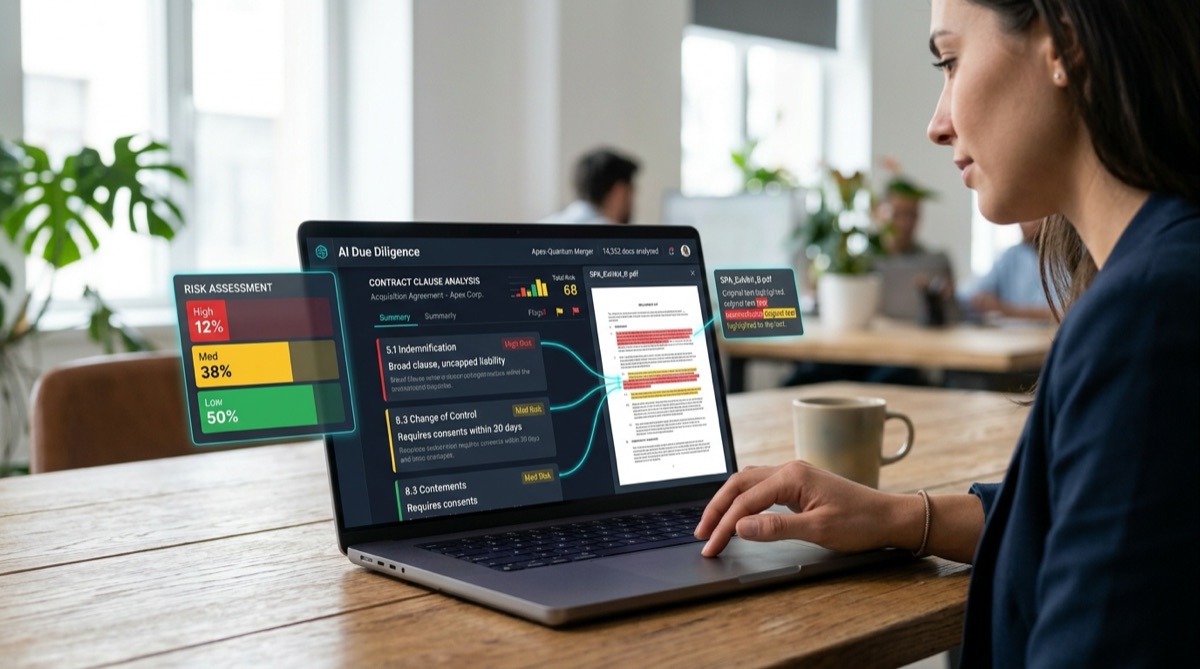
A critical question for risk officers and investment committees is: is AI reliable for M&A due diligence? The short answer is yes, provided there is strict source traceability and a human-in-the-loop review process. Because generative models can occasionally hallucinate or misinterpret legal nuances, enterprise-grade tools do not operate as black boxes. Instead, they use deterministic anchoring systems. For instance, when Plausity detects a liability, the Risk Radar flags it and links the finding directly to the corresponding clause in the virtual data room. This ensures that advisory partners can instantly verify every observation, neutralizing the risks of automated oversight and maintaining absolute compliance with transaction standards.
What to look for in the best AI due diligence software
When executing a technology procurement plan, decision-makers must define exactly what to look for in the best AI due diligence software. Critical capabilities include native Virtual Data Room (VDR) integration, automated risk scoring based on materiality, and robust data isolation. Deal-grade software must also provide an end-to-end reporting workflow, such as the Plausity Report Builder, to export investor-ready documentation with inline citations. The following comparison highlights how these automated capabilities compare directly with traditional, manual methods.
| Diligence Workstream | Traditional Manual Approach | AI-Native Platform Capabilities |
|---|---|---|
| Data Ingestion | Manual sorting, indexing, and folder structuring in virtual data rooms. | Automated ingestion via tools like Data Room Ingestion to instantly organize thousands of PDFs and spreadsheets. |
| Risk Identification | Sample-based contract reviews and manual checklist validation. | Comprehensive scanning of all files via Risk Radar to flag material liabilities, regulatory exposure, and financial discrepancies. |
| Traceability & Auditing | Time-consuming cross-referencing of findings to original PDF pages. | Direct traceability where every drafted observation is linked back to its precise source sentence for rapid partner review. |
How does AI help with due diligence?
In modern transactions, deal teams are routinely inundated with thousands of pages of corporate history, financial models, and customer agreements. This is where the application of artificial intelligence becomes critical. So, how does AI help with due diligence? Rather than replacing human judgement, specialized software streamlines the process by automating the ingestion, classification, and deep-dive review of massive document collections. By integrating an AI-native platform into the transaction lifecycle, VC & PE fund investment professionals and advisory teams can shift their focus from mechanical searching to strategic risk analysis and deal structuring.
At its core, modern due diligence software handles three major technical tasks: automated ingestion, semantic querying, and contract categorization. This begins with tools like Data Room Ingestion, which connect directly to electronic virtual data rooms to parse multi-format documents, from unstructured PDFs to intricate spreadsheets. Once ingested, the AI-Analysis Engine runs deep semantic indexing to locate specific legal or financial provisions across the entire corpus. Instead of relying on rigid keyword lookups that miss key synonyms, deal teams can query the system using natural language. The system then automatically groups contracts by type, counterparty, governing law, and expiration date, organizing the target company's operational footprint in minutes.
The Quantitative Impact on Deal Timelines
The acceleration provided by these technologies has a direct impact on the speed and efficiency of transaction analysis. Industry research shows that specialized AI due diligence tools can reduce manual document review times by up to 70%. This massive compression of the review window directly benefits M&A project leads and analysts, who can bypass weeks of manual reading and instead focus on quantifying liabilities or negotiating deal terms. By automating the extraction of clauses like change-of-control, indemnification, and restrictive covenants, investment teams can identify deal-breakers early in the process rather than during the closing stages.
- Document ingestion: Tools like Data Room Ingestion link directly to virtual data rooms, extracting and parsing documents without requiring manual setup or directory structure mapping.
- Semantic search: The underlying AI-Analysis Engine interprets context, synonyms, and intent, locating critical liability clauses that standard keyword searches frequently overlook.
- Risk scoring: Automated workflows run by Risk Radar flag issues such as missing change-of-control clauses or restrictive covenants based on deal-specific thresholds.
- Report assembly: Features like Report Builder compile findings into structured, investor-ready summaries, ensuring every flagged risk is linked directly back to its source document.
To capitalize on these efficiencies, cross-functional teams must be able to coordinate in real time. Features like Collaboration Hub allow M&A Advisory Firm Partners & Analysts to assign specific document reviews, share findings, and track progress across multiple workstreams. When an analyst identifies a material legal exposure, they can instantly flag the item and alert the team within the platform. Rather than dealing with fragmented email threads, the entire deal team works inside a single environment where every observation is traced back to the exact paragraph in the source document. This ensures that even under compressed timelines, accuracy and collaboration are never compromised.
Is AI reliable for M&A due diligence?
As deal velocity accelerates, corporate and private equity leaders are adopting generative artificial intelligence at a rapid pace. According to the Deloitte 2025 M&A Generative AI Study, 86% of organizations have already incorporated generative AI into aspects of their M&A workflows, including target screening and due diligence. However, for VC & PE Fund Investment Professionals who manage complex transaction pipelines and Corporate M&A Project Leads driving cross-functional integrations, a fundamental question remains: is AI reliable for M&A due diligence? The short answer is yes, but only when the technology is deployed as a highly traceable, analytical partner rather than an autonomous decision maker. Reliability in high-stakes deals is not achieved through blind trust, but through strict architectural guardrails, verifiable document references, and human-guided AI-native due diligence workflows.
The Necessity of Source-Level Traceability
The primary operational risk of using generative AI is hallucination, where algorithms generate plausible-sounding but entirely fabricated facts or numbers. In transaction diligence, a single unverified financial figure or an overlooked liability can disrupt a transaction or lead to post-closing disputes. To solve this, enterprise-grade platforms implement strict source-document traceability. When the AI-Analysis Engine processes target documentation, every single finding, risk assessment, or financial summary is structurally anchored back to its exact page or spreadsheet cell in the data room. Through features like Risk Radar, deal teams can immediately audit any flagged issue. This absolute connection between analysis and source document transforms AI from a black box into a completely auditable research assistant.
Maintaining a Human-in-the-Loop Workflow
Even the most sophisticated language models cannot substitute for the seasoned commercial judgment of experienced dealmakers. Strategic alignment, corporate culture fit, and complex regulatory mapping require human oversight. A human-in-the-loop workflow ensures that the AI-Analysis Engine functions as an accelerator for the deal team, not a replacement. Instead of losing weeks to manual document review, M&A Advisory Firm Partners & Analysts use AI to isolate high-priority clauses and potential deal-breakers in minutes. This shift allows advisors to reallocate their time to qualitative analysis, structural negotiation, and expert-led validation. In addition, collaboration tools like the Collaboration Hub enable teams to review and verify AI-generated findings side-by-side, maintaining a transparent audit trail of every decision.
| Diligence Dimension | Pure AI Autopilot (High Risk) | Traceable Human-in-the-Loop Standard |
|---|---|---|
| Data Ingestion & Extraction | AI extracts data into summaries without verifiable references, requiring manual searching to confirm facts. | The Data Room Ingestion tool imports documents and maps every extracted data point directly to its source for instant validation. |
| Risk Detection & Analysis | AI flags generic liabilities based on general training data, missing deal-specific or industry-specific nuances. | The Risk Radar isolates and ranks material exposures based on specific deal parameters, which human analysts then audit and verify. |
| Reporting & Deliverables | AI outputs an unvetted, static narrative report that may propagate hidden errors or hallucinations. | The Report Builder drafts structured, investor-ready M&A reports with embedded source citations, prepared for final human approval. |
What to look for in the best AI due diligence software?
When evaluating technology platforms to accelerate transaction timelines, deal teams often ask: what to look for in the best AI due diligence software? For serious investment and advisory professionals, the decision goes far beyond simple document search or optical character recognition. The ideal platform must act as an automated, multi-workstream partner that securely ingests massive quantities of corporate data, isolates transaction risks, and translates raw findings into structured, investor-ready deliverables. To achieve this, deal teams should focus on security-first architecture, deep document traceability, and the ability to process complex financial, legal, and operational materials simultaneously.
Enterprise-Grade Security and Native VDR Integrations
Security is the absolute baseline for any M&A technology. The best platforms offer seamless integrations and security protocols with leading virtual data rooms, allowing teams to securely ingest target company documentation without exposing sensitive corporate data to external risks. For instance, Plausity utilizes its native Data Room Ingestion tool to connect directly to secure environments, processing PDFs, complex spreadsheets, and legal agreements within minutes. Furthermore, a complete audit trail is non-negotiable. Every automated finding must link directly back to its source document and specific page number, ensuring complete traceability that protects the deal team from artificial intelligence errors and hallucinations.
- Direct connections to enterprise virtual data rooms to avoid manual downloads and uploads
- High-integrity data processing pathways with strict access controls and session-specific document processing
- Granular citation mapping where every extracted fact or risk links back to its exact clause in the source PDF
- Full historical logs of all document uploads, team queries, and report versions for absolute compliance tracking
Materiality-Based Risk Categorization and Team Collaboration
An effective due diligence platform must do more than extract text; it must organize findings based on corporate impact. Advanced platforms utilize specialized modules like Risk Radar to categorize legal, financial, and compliance findings by severity and transaction relevance using automated risk intelligence systems. This allows VC & PE Fund Investment Professionals, M&A Advisory Firm Partners & Analysts, and Corporate M&A Project Leads to instantly focus on red-flag liabilities rather than sorting through low-risk administrative records. Additionally, cross-functional collaboration is vital. Using a centralized workspace, such as Plausity's Collaboration Hub, multiple workstreams can run concurrent analyses, assign findings, and track progress in real time through secure collaboration workflows.
| Feature Area | Traditional Due Diligence | Modern AI Due Diligence Platforms |
|---|---|---|
| Data Ingestion | Manual downloads, folder-by-folder analysis, and slow offline organization. | Automated ingestion via direct data room connections with parallel document processing. |
| Risk Analysis | Sample-based contract reviews and manual tracking of potential legal or financial liabilities. | Comprehensive screening of all files, using tools like Risk Radar to rank liabilities by materiality. |
| Traceability | Isolated notes and manually compiled spreadsheets referencing folder names without exact links. | Complete audit trails with every highlighted risk mapped to its exact source clause for verification. |
| Report Drafting | Days spent manually copying tables and findings into presentation decks and report templates. | Automated drafting of investor-ready executive summaries via specialized report builders. |
Ultimately, the value of automated diligence is realized when findings are converted into actionable intelligence. The best software includes automated features to draft clean, investor-ready reports and deliverables based on the analyzed findings. By combining the automated analytical power of an AI-Analysis Engine with human oversight, deal teams can compress analytical cycles from weeks to days while significantly reducing the risk of overlooked material liabilities.
Streamlining transactions with Plausity
Transaction timelines in modern dealmaking are tighter than ever. Corporate M&A Project Leads and VC & PE Fund Investment Professionals face a constant trade-off between the depth of legal and financial audits and the speed of transaction execution. Traditional manual processes can take weeks, during which deal momentum can fade. Industry research shows that artificial intelligence has become a critical lever for overcoming these challenges. For instance, reports indicate that AI can reduce document review times in due diligence by up to 70% on average, while automated financial diligence can reduce required engagement hours by approximately 28%. Plausity addresses these operational pressures with an integrated platform built for analytical deal teams.
From raw data rooms to traceable findings
The foundation of AI-native due diligence begins with secure data ingestion and semantic analysis. Rather than manually indexing folders and files, M&A Advisory Firm Partners & Analysts can leverage Data Room Ingestion to instantly sync and parse massive quantities of unstructured documentation, from standard corporate registries to complex contracts. Once the files are loaded, the AI-Analysis Engine serves as the analytical core. The engine cross-references information across multiple workstreams to map operational structures and verify facts. This continuous review feeds directly into the Risk Radar, which surfaces legal liabilities, structural anomalies, and financial discrepancies, linking each flag directly back to its source file for absolute traceability.
In parallel, deal teams must organize their workflow and package findings for investment committees or executive stakeholders. The Report Builder automates the drafting of due diligence reports and briefing memos, converting raw data into professional, structured deliverables. Crucially, the system ensures that every metric and finding is traceable back to its origin inside the target's virtual data room, removing the risk of untraceable conclusions. The entire review process is managed inside the Collaboration Hub, which allows cross-functional deal teams, legal experts, and financial auditors to coordinate tasks, assign responsibilities, and monitor the progress of different diligence workstreams in real time.
| Due Diligence Challenge | Traditional Approach | Automated Approach |
|---|---|---|
| VDR Processing | Manual scanning, naming, and spot-checking | Automated Data Room Ingestion and semantic indexing |
| Anomaly Detection | Sample-based audits and checklists | Full-scope document scanning with Risk Radar |
| Report Assembly | Manual writing, styling, and version-control issues | Automated drafting via Report Builder with trace links |
| Team Coordination | Disjointed email chains and spreadsheet trackers | Unified workspace tracking within the Collaboration Hub |
When evaluating due diligence software, institutional deal teams should prioritize security and data privacy. Robust transactions demand platforms that protect sensitive material from unauthorized access. Buyers should verify that vendor infrastructure conforms to industry-accepted security benchmarks, such as SOC 2 and ISO 27001 standards, which establish stringent criteria for data processing, system availability, and confidentiality. Ensuring these security and operational compliance controls are built into the platform architecture helps maintain the integrity of the data room throughout the entire transaction lifecycle.