Why Secondary Market Concentration Matters for Diligence
Artificial intelligence has captured an unprecedented share of private technology investment over recent years. In 2025, AI firms accounted for 61% of global venture capital investment, USD 258.7 billion out of USD 427.1 billion, roughly double AI's share in 2022. While this primary funding boom fueled unprecedented expansion, it simultaneously created an acute liquidity bottleneck for early investors, employees, and fund managers seeking liquidity. In response, secondary transaction volume has expanded rapidly as institutional buyers step in to provide alternative paths to liquidity.
Institutional asset managers now estimate that the total addressable market for venture secondaries exceeds $100 billion, with current transaction volume penetrating less than 20% of this overall market potential. However, this expanding market presents a distinct structural challenge for institutional buyers: capital activity in AI startup secondaries has concentrated heavily around a small subset of high-profile private companies. Conducted properly, VC secondary market due diligence requires recognizing that current liquidity patterns are not static.
When liquidity concentrated in headline late-stage companies eventually shifts, whether through initial public offerings, strategic acquisitions, or broad market repricing, secondary buyers and venture funds will face a recalibrated deal environment. Navigating this shift requires moving beyond momentum-driven pricing to establish disciplined, institutional diligence frameworks that evaluate fund concentration risks and underlying business quality.
- Primary capital concentration: High-growth AI assets absorb the majority of primary growth rounds, restricting access for late-stage co-investors.
- Pent-up demand for private company liquidity: Fund lifecycles and extended time-to-exit mandate structured liquidity solutions for early shareholders.
- Secondary market expansion: Venture secondaries represent an increasingly vital liquidity mechanism as direct IPO timelines extend.
- Diligence practice evolution: Buyers must transition from high-level growth narratives to rigorous line-item legal and financial audits.
As the venture secondary market scales toward its potential, investment committees cannot assume that historical primary round valuations provide a reliable baseline. Effective diligence demands a comprehensive audit of cap table mechanics, legal transfer rights, and true underlying operating metrics.
Navigating Cap Table Structure and Transfer Restrictions
Unlike primary funding rounds where lead investors negotiate directly with company management to establish standardized share classes, secondary transactions require navigating existing shareholder agreements, historical side letters, and complex corporate governance restrictions. Direct secondary sales carry no standard disclosures (sometimes companies provide no information at all to buyers and sellers), prices are negotiated bilaterally rather than set by the company, which can produce different implied valuations across transactions, and companies and existing investors commonly hold a right of first refusal plus transfer restrictions that let them block a sale outright. Performing thorough startup cap table diligence is essential to ensure that a proposed transfer is legally enforceable and politically viable within the target company's governance structure.
A central operational friction in secondary purchases is the enforcement of transfer restrictions. Most late-stage tech startups enforce strict Right of First Refusal (ROFR) provisions, granting the issuer or designated major shareholders the option to purchase proposed secondary shares on matching terms before an external buyer can close. Furthermore, secondary buyers must evaluate tag-along (co-sale) rights, drag-along provisions, and mandatory company consent requirements that can delay, alter, or block transactions entirely. Conducting detailed venture liquidity due diligence before executing purchase agreements prevents wasted deal resources on non-transferable equity.
| Restriction Type | Core Legal Mechanism | Strategic Impact on Secondary Buyer |
|---|---|---|
| Right of First Refusal (ROFR) | Company or major investors match third-party price within 30-60 days | Transaction can be pre-empted after diligence costs are incurred |
| Co-Sale / Tag-Along Rights | Existing shareholders sell proportionally alongside seller | Allocated share volume to buyer may be substantially reduced |
| Board Consent Requirement | Board holds discretionary veto over direct equity transfers | Transaction requires explicit strategic alignment with management |
| SPV Layering Constraints | Secondary stake held via multi-tiered intermediary vehicle | Introduces additional management fees and information opacity |
The rapid expansion of direct secondary transactions has also accelerated the deployment of multi-layered Special Purpose Vehicles (SPVs). While SPVs offer pooled access to high-value targets, they add structural complexity, including multi-tier management fee stacks, carried interest hurdles, and diluted information rights. Secondary investors must diligence the exact chain of title from the SPV entity to the underlying issuer cap table.
Valuation Marks: Bridging the Pricing Disconnect
Evaluating private company liquidity requires addressing the persistent gap between historical primary round valuations and current secondary clearing prices. During bull market cycles, primary funding rounds often established optimistic paper marks based on elevated revenue multiples. In the current secondary landscape, discounts diverge sharply by vintage: companies that have repriced under post-correction assumptions trade at modest secondary discounts of around 19%, while companies still carrying 2021 marks trade at an average discount of about 68%. Headline discount averages therefore say more about what is being sold than about asset quality.
For secondary buyers, acquiring equity at a steep discount to the last primary round does not automatically guarantee a margin of safety. Stale primary marks often mask structural changes in underlying ARR growth, expanding customer churn, or margin compression. To establish true baseline value, secondary investors must perform rigorous SaaS revenue quality analysis that decouples headline ARR from unsustainable pilot contracts or temporary usage spikes.
- Deconstruct headline valuation marks: Isolate the core financial assumptions established during the prior primary equity round.
- Audit capital structure seniority: Determine liquidation preference ordering and dividend accruals that impact common versus preferred equity payouts.
- Apply secondary market pricing benchmarks: Compare transaction clearing prices across peer companies within the same market segment.
- Stress-test exit scenarios: Model expected returns across multiple exit valuations, accounting for potential dilution in future primary financing rounds.
Bridging the valuation disconnect requires secondary diligence teams to construct independent DCF models and peer multiple comparisons rather than relying on historical funding announcements. Establishing a defensible baseline valuation protects buyers against downside risks when market sentiment shifts.
What Investors Must Test Before Buying Secondary Stakes
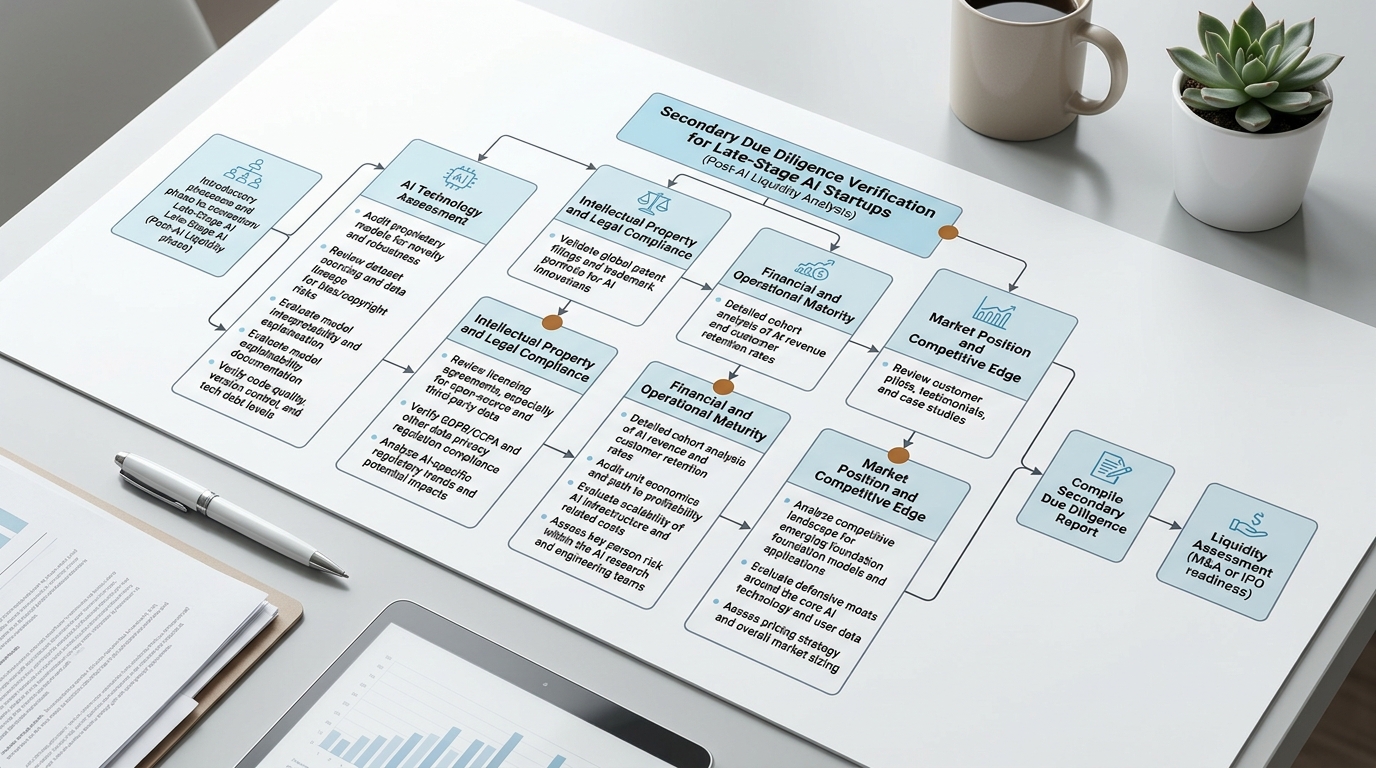
Conducting effective VC secondary market due diligence requires a systematic verification process across financial, technical, and operational dimensions. In late-stage AI companies, distinguishing between sustainable enterprise value and short-term market momentum requires analyzing cost of goods sold (COGS), inference compute infrastructure commitments, and long-term customer retention metrics.
Investors evaluating AI unicorn secondary market opportunities must scrutinize whether revenue growth is driven by proprietary technology or easily replicable API wrappers. That distinction increasingly shapes how buyers underwrite valuations in this market. Buyers must also audit vendor commitments and cloud infrastructure expenditures to ensure that gross margins remain viable as product utilization scales.
Beyond technology architecture, operational diligence must examine customer acquisition cost payback periods, enterprise net retention rates, and regulatory compliance frameworks. Validating these core operational levers ensures that secondary capital is deployed into durable assets capable of navigating broader market cycles.
Diligencing the Post-AI Liquidity Shift
As secondary trading volume expands, the ultimate test of secondary investment performance remains exit execution. While direct secondary trading provides essential intermediary liquidity, institutional returns are realized when companies achieve liquidity through IPOs or strategic acquisitions. That matters because the traditional exit route has narrowed: US venture-backed listings fell from 198 in 2021 to 42 in 2022 and recovered only modestly to 48 in 2025, leaving secondaries as a critical interim liquidity channel for mature unicorns funded in prior market cycles.
Evaluating venture exit readiness requires assessing corporate governance standards, regulatory filing readiness, and financial audit history. When evaluating secondary stakes in late-stage entities, investors must determine whether the company possesses the internal financial reporting infrastructure required for public market scrutiny or strategic M&A integration.
- Audit public market readiness: Evaluate GAAP accounting compliance, SEC filing preparation, and internal controls infrastructure.
- Assess exit timeline assumptions: Verify whether management incentives and board consensus align with projected IPO or M&A timelines.
- Evaluate secondary lock-up obligations: Review post-IPO lock-up terms and registration rights that govern share sale restrictions.
- Monitor acquirer landscape dynamics: Analyze balance sheet capacity and strategic interest among corporate buyers in the target sector.
Preparing for the post-AI liquidity shift requires secondary investors to model exit returns under varying market conditions, ensuring that secondary stakes remain attractive even if public market trading multiples normalize.
Overcoming Information Asymmetry in Data Rooms
A primary challenge in secondary deal execution is information asymmetry. Unlike lead investors in primary financing rounds, secondary buyers rarely receive seat rights on the board of directors or direct access to executive management. Access to direct secondaries typically runs through SPVs that come together very quickly, in 2025 with a median raise of about $930,000 from nine LPs over just 16 days, which places buyers closest to the asset but with the least time and transparency to validate what they are buying. Information rights in secondary transactions are frequently limited or non-existent, leaving investors dependent on fragmented seller disclosures and incomplete historical financial summaries.
To overcome these limitations, institutional secondary buyers must maximize the analysis of available virtual data room records. Utilizing automated Data Room Ingestion tools enables investment teams to rapidly process cap tables, audit reports, articles of incorporation, and cap table side letters to surface hidden risks.
- Ingest raw data room assets: Extract structured data from unstructured PDFs, board decks, and financial spreadsheets.
- Reconstruct capitalization history: Verify share class mechanics, option pool allocations, and warrant overhangs.
- Cross-reference transfer documentation: Identify explicit ROFR notification periods, transfer fee obligations, and board approval prerequisites.
- Generate automated risk highlights: Flag anomalous covenants, liquidation preferences, or restrictive side letters.
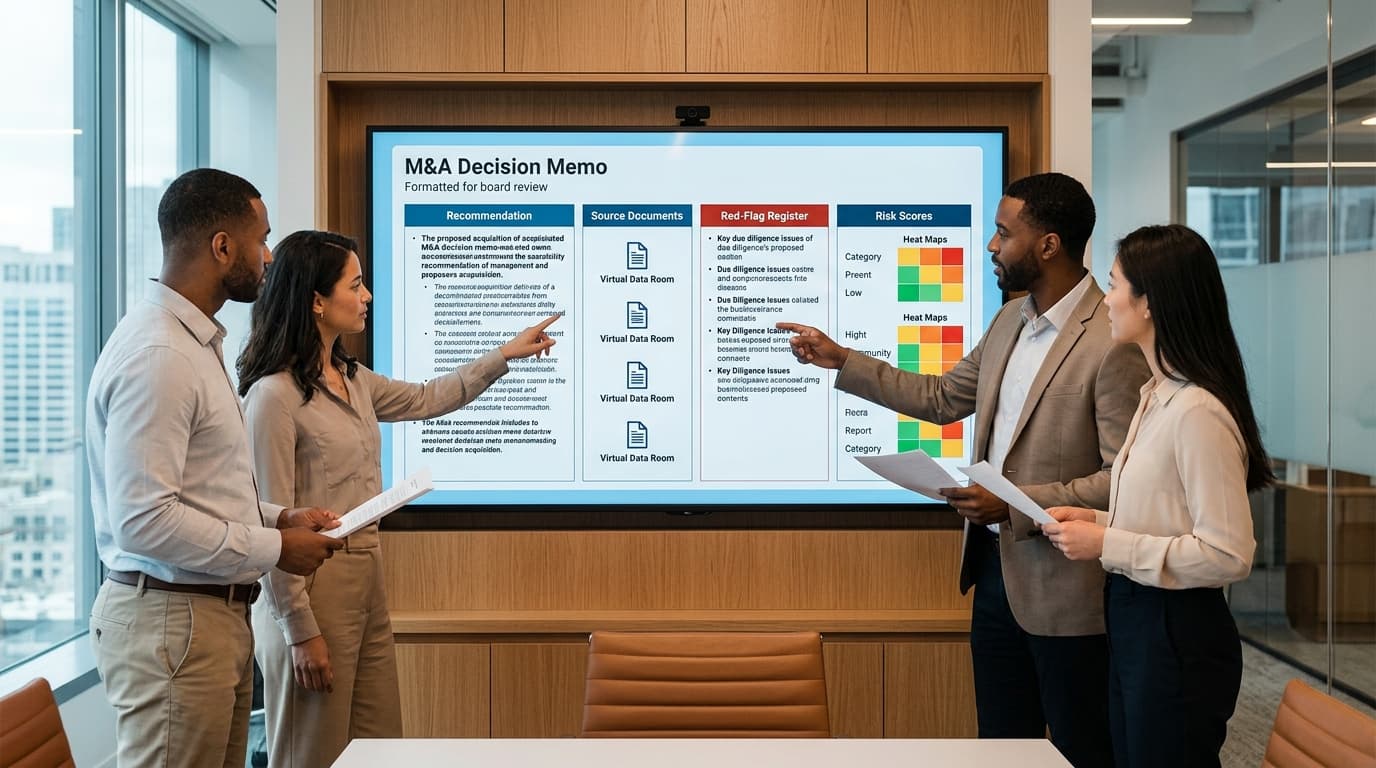
By converting unstructured virtual data room contents into queryable knowledge structures, investment teams can eliminate blind spots, bridge information gaps, and accelerate investment committee decisions.
Automating Secondary Due Diligence Workflows
Executing secondary transactions efficiently requires specialized technology designed to process complex, fragmented deal data at speed. Modern investment teams evaluating secondary opportunities leverage Plausity to streamline deal screening, legal document review, and report generation.
By integrating an AI-Analysis Engine, deal teams can cross-reference hundreds of legal and financial documents in minutes, ensuring complete source traceability across every diligence finding. The platform's Risk Radar automatically identifies critical transfer hazards, non-standard liquidation terms, and ROFR constraints, allowing analysts to prioritize material risks immediately. Furthermore, using an automated Report Builder transforms unstructured findings into structured, investor-ready IC memos and advisory deliverables, dramatically reducing turnaround times on competitive secondary opportunities AI-native due diligence platform.
- Rapid VDR scanning: Automated Data Room Ingestion extracts cap table terms, financial statements, and corporate filings instantly.
- Risk identification: Risk Radar flags restrictive transfer clauses, liquidation preferences, and ROFR triggers.
- Traceable intelligence: AI-Analysis Engine connects analytical findings directly to underlying source documents.
- Automated reporting: Report Builder compiles comprehensive, investor-ready memo outputs for investment committees.
As the venture secondary market continues to evolve beyond concentrated AI liquidity waves, adopting automated diligence workflows enables investment teams to maintain rigorous analytical standards, scale deal throughput, and capture compelling secondary opportunities with confidence.
Red Flags in Secondary Transactions
| Red Flag | Why It Matters | Recommended Action |
|---|---|---|
| No ROFR waiver or transfer consent on file | The transaction can be blocked or pre-empted after diligence costs are already sunk | Obtain written waiver or consent confirmation before committing capital |
| Secondary price anchored to a stale primary mark | Headline discounts can overstate value if the underlying business has deteriorated since the last round | Rebuild an independent valuation using current revenue quality and peer benchmarks |
| Multi-tier SPV structure with undisclosed fee stacking | Layered vehicles erode net returns and obscure the true chain of title to the underlying shares | Request full SPV documentation and trace the cap table down to the issuer |
| Limited or no information rights granted to the buyer | Buyers without board access depend entirely on fragmented seller disclosures | Negotiate periodic reporting access or discount pricing to reflect the information gap |
| Revenue growth concentrated in a small customer base or reliant on third-party model APIs | Growth that is not defensible or diversified is vulnerable to repricing when competitive dynamics shift | Verify customer concentration and technology differentiation directly with source documents |
| No clear evidence of IPO or M&A readiness, including audited financials and governance structure | Illiquidity risk increases materially if the company cannot execute a near-term exit | Assess public-company readiness and realistic exit timelines before pricing the stake |
Data Room Checklist and Practical Implications
Before committing capital to a secondary stake, buyers should assemble the same evidence base they would expect in a primary round, adapted for the realities of a secondary transaction. A practical AI startup data room checklist and a structured set of VC due diligence questions for AI startups both provide a useful starting framework, adapted here for secondary-specific risks.
- Signed transfer agreement, ROFR waiver, and board consent documentation
- Complete capitalization table with option pool, warrant, and SPV layering disclosure
- Most recent audited financials and interim management accounts
- Customer concentration and retention data supporting revenue quality claims
- Evidence supporting underlying AI moat due diligence, including model dependency and data rights
- Documentation supporting the company's AI pricing model due diligence and gross margin trajectory
- Prior information rights letters and side letter terms governing the specific block of shares
- Exit timeline assumptions, including IPO or M&A readiness indicators
In practice, investors and corporate development teams active in the venture secondary market benefit from tooling built for diligence for PE and VC funds, combining findings and risk intelligence with AI-powered diligence analysis to cross-reference cap table documents, valuation support, and legal terms at speed. Surfacing these risks systematically, including through risk register automation, helps buyers avoid pricing secondary stakes on stale assumptions.